Russian Odyssey Part 4 ~ The Everlasting Snows ~ October 1995.
Haiku on a sad Cydonia
Solitary Quince
Bitter lemon legacy
Summer Survivor
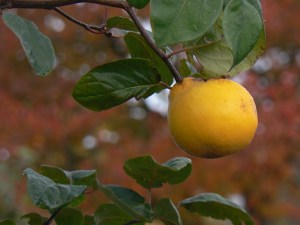
Last quince on the tree with cherry behind
October 18th ~ Feast of St Luke
Today is the feast day of St Luke the patron saint of doctors. It is said that he was born in Antioch in Syria. I have been so worried today by the news from Syria that I thought I would post this article about St Luke from http://www.catholic.org
Would that there was someone so wise in Syria today who could change the course of history in that troubled country.
Luke, the writer of the Gospel and the Acts of the Apostles, has been identified with St. Paul’s “Luke, the beloved physician” (Colossians 4:14). We know few other facts about Luke’s life from Scripture and from early Church historians.
It is believed that Luke was born a Greek and a Gentile. In Colossians 10-14 speaks of those friends who are with him. He first mentions all those “of the circumcision” — in other words, Jews — and he does not include Luke in this group. Luke’s gospel shows special sensitivity to evangelizing Gentiles. It is only in his gospel that we hear the parable of the Good Samaritan, that we hear Jesus praising the faith of Gentiles such as the widow of Zarephath and Naaman the Syrian (Lk.4:25-27), and that we hear the story of the one grateful leper who is a Samaritan (Lk.17:11-19). According to the early Church historian Eusebius Luke was born at Antioch in Syria.
In our day, it would be easy to assume that someone who was a doctor was rich, but scholars have argued that Luke might have been born a slave. It was not uncommon for families to educate slaves in medicine so that they would have a resident family physician. Not only do we have Paul’s word, but Eusebius, Saint Jerome, Saint Irenaeus and Caius, a second-century writer, all refer to Luke as a physician.
We have to go to Acts to follow the trail of Luke’s Christian ministry. We know nothing about his conversion but looking at the language of Acts we can see where he joined Saint Paul. The story of the Acts is written in the third person, as an historian recording facts, up until the sixteenth chapter. In Acts 16:8-9 we hear of Paul’s company “So, passing by Mysia, they went down to Troas. During the night Paul had a vision: there stood a man of Macedonia pleading with him and saying, ‘Come over to Macedonia and help us.’ ” Then suddenly in 16:10 “they” becomes “we”: “When he had seen the vision, we immediately tried to cross over to Macedonia, being convinced that God had called us to proclaim the good news to them.”
So Luke first joined Paul’s company at Troas at about the year 51 and accompanied him into Macedonia where they traveled first to Samothrace, Neapolis, and finally Philippi. Luke then switches back to the third person which seems to indicate he was not thrown into prison with Paul and that when Paul left Philippi Luke stayed behind to encourage the Church there. Seven years passed before Paul returned to the area on his third missionary journey. In Acts 20:5, the switch to “we” tells us that Luke has left Philippi to rejoin Paul in Troas in 58 where they first met up. They traveled together through Miletus, Tyre, Caesarea, to Jerusalem.
Luke is the loyal comrade who stays with Paul when he is imprisoned in Rome about the year 61: “Epaphras, my fellow prisoner in Christ Jesus, sends greetings to you, and so do Mark, Aristarchus, Demas, and Luke, my fellow workers” (Philemon 24). And after everyone else deserts Paul in his final imprisonment and sufferings, it is Luke who remains with Paul to the end: “Only Luke is with me” (2 Timothy 4:11).
Luke’s inspiration and information for his Gospel and Acts came from his close association with Paul and his companions as he explains in his introduction to the Gospel: “Since many have undertaken to set down an orderly account of the events that have been fulfilled among us, just as they were handed on to us by those who from the beginning were eyewitnesses and servants of the word, I too decided, after investigating everything carefully from the very first, to write an orderly account for you, most excellent Theophilus” (Luke 1:1-3).
Luke’s unique perspective on Jesus can be seen in the six miracles and eighteen parables not found in the other gospels. Luke’s is the gospel of the poor and of social justice. He is the one who tells the story of Lazarus and the Rich Man who ignored him. Luke is the one who uses “Blessed are the poor” instead of “Blessed are the poor in spirit” in the beatitudes. Only in Luke’s gospel do we hear Mary ‘s Magnificat where she proclaims that God “has brought down the powerful from their thrones, and lifted up the lowly; he has filled the hungry with good things, and sent the rich away empty” (Luke 1:52-53).
Luke also has a special connection with the women in Jesus’ life, especially Mary. It is only in Luke’s gospel that we hear the story of the Annunciation, Mary’s visit to Elizabeth including the Magnificat, the Presentation, and the story of Jesus’ disappearance in Jerusalem. It is Luke that we have to thank for the Scriptural parts of the Hail Mary: “Hail Mary full of grace” spoken at the Annunciation and “Blessed are you and blessed is the fruit of your womb Jesus” spoken by her cousin Elizabeth.
Forgiveness and God’s mercy to sinners is also of first importance to Luke. Only in Luke do we hear the story of the Prodigal Son welcomed back by the overjoyed father. Only in Luke do we hear the story of the forgiven woman disrupting the feast by washing Jesus’ feet with her tears. Throughout Luke’s gospel, Jesus takes the side of the sinner who wants to return to God’s mercy.
Reading Luke’s gospel gives a good idea of his character as one who loved the poor, who wanted the door to God’s kingdom opened to all, who respected women, and who saw hope in God’s mercy for everyone.
The reports of Luke’s life after Paul’s death are conflicting. Some early writers claim he was martyred, others say he lived a long life. Some say he preached in Greece, others in Gaul. The earliest tradition we have says that he died at 84 Boeotia after settling in Greece to write his Gospel.
A tradition that Luke was a painter seems to have no basis in fact. Several images of Mary appeared in later centuries claiming him as a painter but these claims were proved false. Because of this tradition, however, he is considered a patron of painters of pictures and is often portrayed as painting pictures of Mary.
He is often shown with an ox or a calf because these are the symbols of sacrifice — the sacrifice Jesus made for all the world.
Luke is the patron of physicians and surgeons.

English: Saint Luke the Evangelist. Russian Eastern Orthodox icon from Russia. 18th century. Wood, tempera. Luke is the author of the Gospel of Luke and the Acts of the Apostles. He is considered one of the Four Evangelists. (Photo credit: Wikipedia)
Russian Odyssey Part 3 ~ October 1995
This is the day we had been waiting for; the chance to go into our partner schools. Natalya’s husband arrived to pick me up. He is a sculptor and artist. He was obviously very successful ‘pre-perestroika’ as he has a car. All the vehicles we saw in Sochi seem incredibly old, and made a dreadful noise. They gave off clouds of smelly blue smoke. However, the Lada got us to our destination. The school was in the middle of a dense urban development of high-rise flats. The area was quite run down with pot-holed roads and rusted metal lying around.
In Russia at that time, the schools were not named but numbered according to how close to the centre of the town or city they were situated. So school number 1 would be very close to the centre. Our school was School Number 15 as it was some way out. Some of my colleagues had much further to travel with schools numbered in 30s and 40s.
School No. 15 was an experimental school. The Director (Headteacher) and staff were ‘Methodists’ educationally speaking. They followed the Leonid Zankov (1901-1977) model and were influenced by sociologist, Tarasov. These were progressive approaches involving the integration of subjects and the development of the whole child. My interest was stimulated by the fact that Zankov was a colleague of Lev Vygotsky who studied the relationship between teaching, learning and child development. Vygotsky’s theory on the ‘zone of proximal development’ was to be the basis of the 4 year study I would work on with Natalya in our two schools. As Zankov was the first to test Vygotsky’s theories in the Russian classrooms in the 1970’s and 80’s, this was very exciting for me.
The method was based on the development of the 3 aspects of a child’s psyche, Intellect, Will and Emotions.
Intellect ~ development involves not only the acquisition of knowledge, but also various kinds of cognitive activities, such as logical thinking, observation, memory, and imagination.
Will ~ is described as the ability to set goals and motivate oneself to achieve them. Will grows out of wishes and desires, and develops as the child achieves his or her goals.
Emotions ~ enable learning where children feel safe and cared for. In the classroom situation, good teacher/pupil relationships were essential.
In the classroom Zankov’s theories required teachers to focus on:~
- Teaching at an optimal level of difficulty
- Emphasizing theoretical knowledge
- Proceeding at a rapid pace
- Developing students’ awareness of the learning process
- The purposeful, systematic development of each student
On the surface the classes reminded me of the “Montessori” classrooms of the sixties in Britain. However, I was soon to learn that it was far more radical than this.
Inside the school I was welcomed by a student of the ‘method’ from the university, and a lecturer who trained the student teachers in the ‘method’. We were joined by Valentina, an incredibly dignified lady who had adapted Zankov’s theories and devised the ‘method’ for the schools in this area.
I was taken to the Director’s office to be faced with a table, beautifully set and groaning under the weight of a feast. I ate pancakes with yoghurt and drank very strong coffee. After this I was taken on a tour of the school.
The first stop was the medical room which reminded me of a Chinese Chemist’s! I wasn’t far off the mark as I was greeted by a meditating acupuncturist in what looked like transparent pyjamas and bare feet. This charming man stopped meditating as soon as I walked in and offered to fix my ‘aura’. I accepted gratefully and was led to a bed where everyone watched as he manipulated the bones in my arms, hands, legs, and spine. He was horrified by the tension in my neck and treated this very efficiently, just like my chiropractor at home. He then taught me how to relax by pressing on various pressure points. As he pressed on one in my thigh, he looked worried and said I had a problem with my liver. This could have been due to all the vodka I had consumed to get me through our welcome meal, or it could be long term damage from my gallstone operation. Either way I was impressed.
By this time the doctor had a queue of children waiting outside his room. He allowed me to watch as he treated children for all manner of problems with aromatherapy, massage and chiropractic. This was definitely alternative medicine with a capital A and would lead to court cases for assault in Britain. But the most alarming thing was that the doctor mixed up his own medicines and even injections, which he gave to children, “to help them leave their parents and settle into school without any problem”. I could not help but worry that these children are being sedated from the age of 2.
There were 273 children at the school aged between 2 and 10. The school is open from 7am and most children stay until 7pm. However, they can stay until 9pm if their parents work unusual shifts; or they can leave early if parents are at home. The young children slept for 2 or 3 hours in the afternoon. All of the children were given 4 meals a day of very nutritious food from a detailed menu plan. All of this was free as the government was very concerned about the poor health of the population generally at this time, and the children particularly.
The children had a wide variety of opportunities in the school. There was a qualified gymnast to develop the children physically. I watched two of his lessons which reminded me of drill at the Victorian school in Blists Hill. There was a trained musician who taught the children to listen and speak through song, dance and drama. And there were students from the University on teaching practice working with classes. During the day I saw an integrated curriculum that was intended to develop art, language, music, and nature study.
Some lessons were heavily teacher led. For example The Butterfly lesson:
The teacher started by demonstrating how to “splatter paint” on a folded piece of paper. She then allowed the children to choose their own colours and do the same. She then demonstrated how to cut out a butterfly shape. The children had a stencil in front of them which they drew round. They then cut out the shape. Finally they drew around the butterfly shape and cut it out of their painted paper. The finished object was very professional. All the children finished at the same time and placed their butterfly on a perfect paper flower they had made earlier. They then sat on the carpet and the teacher talked about the life cycle of butterflies. She showed them photographs of butterflies and told them their names. The children then sang a song about a butterfly and acted out a little play.
During all this time the ‘nurse’ sat and watched every move the children made. She clearly had a different role to our nursery nurses as she did not help the children with their work, or take any active part in the lesson. I assumed that she did the setting up of materials and she may have done the clearing away.
The children all produced an attractive finished butterfly but I was alarmed to be told that these pictures would now be given to a psychologist to analyse for any mental health problems. One butterfly was shown to me and the Head said, “you can see this child has psychological problems because of the colours she has used.” It looked perfectly ok to me and I did wonder if they were being over-analytical.
The children did not take their artwork home until the end of the year, which runs from January to December. Much of their work is stuck into an individual record book. I looked through many of these books and they were all exactly the same, lots of Origami, scraps of material made into pictures, and cut out ducks, trees and animals. There was no evidence of children expressing their own imagination or creativity
Newspaper photograph of me joining in a dance class at School number 15

Typical classroom in the kindergarten
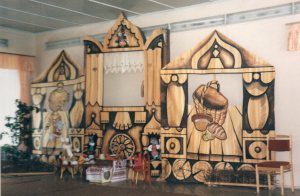
Exquisite scenery painted by Head’s husband for a play in school hall

Wonderfully painted little wooden chairs every child had one.
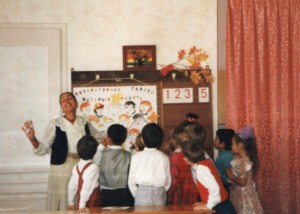
A wonderful interactive maths lesson
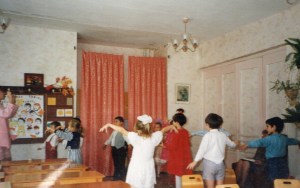
Children stop lessons to do physical exercises every so often.
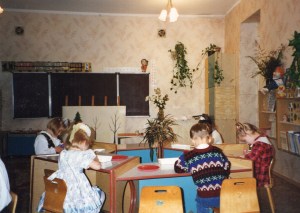
Small group hard at work

Relaxed children working on a collaborative project
Russian Odyssey Part 2 ~ October 1995
 Sochi sign in Russian
The departure lounge at Sheremetova 1 set the tone for our trip to Sochi. It was packed. There were babushkas who had been on major shopping trips and had huge parcels wrapped in brown paper and tied with string. There were business men returning from wheeling and dealing, looking very smart and slightly sinister, carrying impenetrable briefcases. There were older men who looked like farmers carrying crates of chickens. All were dressed in dark colours except our group. We stood out like sore thumbs as foreigners because of our brightly coloured clothes.
We walked to the Aeroflot (Аэрофлот—Российские авиалинии) plane blissfully unaware that this would be a flight like no other we had been on. The plane was a very old Boeing 737, and unusual. Getting into the plane was fine but it seemed to be 2 storeys high. Most of the baggage was left loose below and the seating was accessed by climbing up a wooden ladder. At the back of the plane was what can only be described as a huge wooden wardrobe. Here people hung their coats and left their hand luggage, including the chickens. There was free seating so we were scattered around but settled down quickly, fastening our seat belts. A rather severe looking air stewardess came round immediately and gave everyone a plastic cup ~ empty. The engine roared and the plane started taxiing. Another severe and very blonde stewardess came round and filled all our plastic cups with Coca Cola. Just then the plane lifted off steeply, the cups tipped over, and we were all soaked in said Coca Cola! Not the ideal way to start a 4 hour journey.
When we reached the correct altitude the plane levelled out sharply causing the ‘wardrobe’ and its contents to topple forwards. Fortunately the rear seats stopped it from falling on the passengers and the chickens survived too.
The rest of the journey was uneventful and we arrived safely at our destination, the Riviera of the Black Sea, Sochi. It was cold and raining but the warmth of our welcome party made up for everything. A couple of minibuses soon whisked us along the coast road to the town of Sochi. We were all booked into single rooms on the fourth floor at the Hotel Moskva.
The rooms looked like those in Moscow, very basic, but the bathroom was much worse. There was a sink, a toilet, a shower, and a cockroach running across the floor. The drain for the shower was just a hole in the floor. This hole served to allow everything emptied from the sink, which had no plug, to overflow onto the bathroom floor. But at least the toilet flushed, but constantly!
Managing to get washed after a fashion, I dressed in my best clothes for our formal welcome dinner. The meal consisted of two courses, firstly, raw fish from Georgia which is a local delicacy. Unfortunately I don’t eat fish, as it brings me out in a rash, so I waited for the main course of Chicken Kiev. There were lots of toasts and speeches in Russian which were translated for us. After dinner we met our hosts, the Headteachers from the schools we had been partnered with. My host was Natalya who spoke no English. As Head of a kindergarten, she is responsible for 270 pupils aged 2 to 10. We got on very well from the start and soon found out a lot about each other and our families. The evening was a great success and we went back to the hotel feeling very positive.
 Our welcome meal in Sochi
I decided to skip the shower and went to bed fully covered and with a light on to keep the cockroaches at bay.
I slept quite well and woke to find that Sochi’s famous ‘Mediterranean’ climate had turned quite cold and it looked like rain. Unfortunately, at our briefing back in Gloucestershire, we had been told it would be quite sub-tropical, so we only brought light summer clothes! Feeling a bit despondent I went down to breakfast to find everyone else shivering too. The raw fish was having another outing so I skipped breakfast altogether as did my friend Liz, a vegetarian.
Things looked up when we were picked up by minibuses and taken to the Education offices. Here we met the Chief Education Officer and his Assistant CEO, Irina. There were also some Education advisors and all of the Headteachers from our partner schools. There were interesting and informative talks for 4 hours and we learned a great deal at this meeting about the education philosophy and practice in Sochi. We returned to our hotel for lunch which was very lavish, and very familiar, consisting of fish soup, raw fish, and Chicken Kiev, after which we went for a guided tour of Sochi.
This was wonderful as we got to see the sea (complete with lighthouse and huge model dinosaurs), the parks, the gardens, the street market, and the Outdoor Education Centre. This facility was most impressive. We were shown slide shows and video of field study trips undertaken by children as young as 10. They travel enormous distances to go hiking, mountain climbing, orienteering, and white-water rafting. It all looked very exciting but hair-raisingly dangerous.
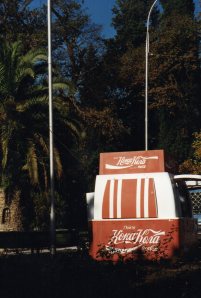 Coca Cola stalls in the park
 Bus at the bus stop
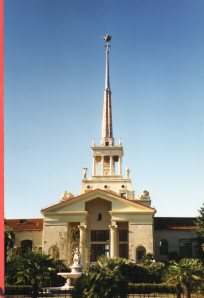 Customs building in Sochi on the Black sea
 memorial in the park reflecting the fact that Sochi is a Sanatorium town or Health Spa
 Museums, theatres and art gallery in Sochi ~ 1995
 Our hotel Moskva, the shopping mall, statue of Lenin and a writer and the theatre in Sochi ~ 1995
 Sochi’s Catholic Church
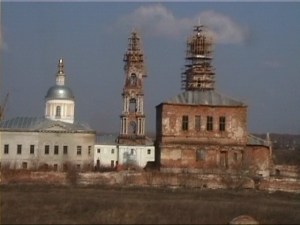 Sochi’s old buildings
 Sunset over the Black sea
Liebster Award

I’m delighted to say I’ve been nominated for the Liebster Award. Thank you so much to metaphoricalmarathons . Do go and visit her blog, she writes with such sensitivity and wisdom and is just an all-round beautiful person.
The process goes as follows: I tell you 11 facts about myself. Answer the 11 questions dipitblack asked. Then nominate 11 blogs, with under 200 followers Then I ask the 11 I’ve nominated, 11 questions of my choice… I think that’s how it goes anyhow!
11 random facts about myself.
If you could go one place right now, where would you go?
I would pack a rucksack and walk the Cotswold Way with a camera and a tape recorder~showing my age there!
What is your favourite thing to do to relax?
Lie in a deep, hot bath with mountains of frothy, heavenly-smelling bubbles and perfumed candles gently flickering on the windowsill.
What is your favourite flower?
The humble wild poppy, vivid red and delicate is my favourite flower. I love the way the flower head droops before it opens then reaches up to the sun. I love the seed heads after the petals fall. I love the way they grow where they will, along the weediest hedgerows or the smartest garden borders. The poppy shouts summer to me.
What do you most like to do whilst with friends?
Catch a bus to London and wander the streets or ride on an open top bus, getting off at our favourite galleries and restaurants where we would eat beautiful food, drink lovely wine and talk about our latest creative venture.
When listening to music, which track do you have on repeat right now?
Anywhere on this Road from the album The Living Road by Lhasa.
What does writing do for you?
It releases me to truly express myself ~ the real me and say whatever I want. “Those who matter don’t mind and those who mind don’t matter”.
How does blogging help you?
Blogging gives me a readership of like-minded or open-minded people who can dip in and out as they wish. It also keeps my posts available to look back at without having to hunt through journals. And I get to meet remotely some fascinating people and read all about them.
If you could be an animal, what would you be?
I rather fancy being a robin living in an old teapot behind a shed in someone’s garden. I would pop out to sit on a fencepost and sing my heart out daily then fly wherever the mood takes me.
What was the first thing you did when you woke up this morning?
It was very misty when I woke up this morning so I grabbed my camera and walked down the garden path in my pj’s to take photos of the trees in the park opposite my house.
George Clooney, Gerard Butler or Johnny Depp?
It’s got to be George Clooney for me. Apart from being an amazing actor, film director, producer and screen writer he is noted for his political activism, and has served as one of the United Nations Messengers of Peace since 2008. George’s humanitarian work includes his advocacy of finding a resolution for the Darfur conflict, raising funds for the 2010 Haiti earthquake, 2004 Tsunami, and 9/11 victims, and creating documentaries such as “Sand and Sorrow” to raise awareness about international crises. He is also a member of the “Council on Foreign Relations”. I copied all this information from Wikipedia but my admiration for George comes straight from the heart.
Now some questions for the people I have nominated:~
1. If you could be anywhere right now, where would you choose?
2. If you could travel back in time, which era would you go to?
3. What is your fancy dress costume of choice?
4.What would you put top of your gifts list if money were no object?
5. If you could choose a Master chef to cook for you, who would you choose and what meal would you request?
6. City, beach, mountain, wilderness or forest?
7. What is the city that fascinates you the most?
8. If you could study any subject now, what would you choose?
9. What is your favourite colour?
There are so many blogs I follow and admire deeply it is difficult to choose. I would encourage you to check out all those on my community widget ~ but for starters try:~
Michael Lewis Glover | Fine Art Photography
Haiku ~ Shroud and Home
I am following Haiku Heights’ weekly prompts in October. Last week’s word was Home and this week’s word is Shroud. As I was in London last week I thought I would combine the two and put my musings here with a few photographs.
The first photos are from Hampstead Heath in London. In the distance is the ancient St Paul’s Cathedral, once the most illustrious feature of the skyline, but now overshadowed by the Shard.
Next are some very misty views from my bedroom window at home. When I woke up this morning the field opposite my home was shrouded in mist. The beauty of the trees is enhanced by the Autumn colours and the mist just makes them more beautiful in my opinion.
I also squeezed in a photo of Dayna, my little Dachsund lying at my feet in the front bedroom. She is never far away and I am happy to say she has settled into her new home beautifully.
So here are my Shroud Haiku:~
High on Hampstead Heath
Misty miles mellow the view
of a city spoiled.
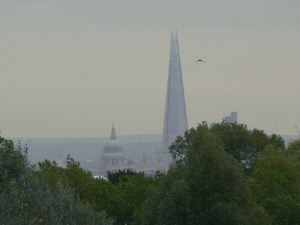
The Shard overwhelming St paul’s Cathedral
St Paul’s stands subsumed
Skyline shattered by the Shard
Crystal Colossus.

The Gherkin shrouded in mist seen from Hampstead Heath
And here are my rather sombre Home Haiku:~
Hopeless the homeless
their troubles unrelenting
as winter approaches.
~
Despairing. In debt.
Brow-beaten by bankers.
Deprived of their home.
And a much more cheerful one:~

Dayna at rest in the sun
She wallows in warmth
with the sun on her body.
It’s heaven at home
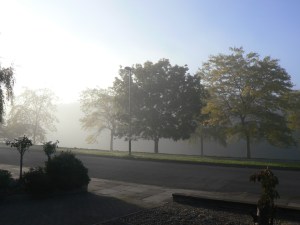
Misty view from my bedroom window today
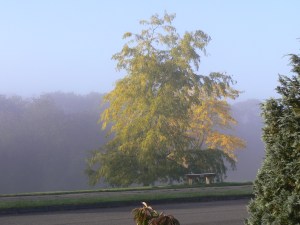
Heaven is outside my home
My friend Chris in Monze
Thought you might be uplifted by reading my friend’s blog posts. he is currently doing voluntary work in Monze, Zambia, where life is much harder than here!
A Sunday Walk on Cleeve Hill in the Cotswolds
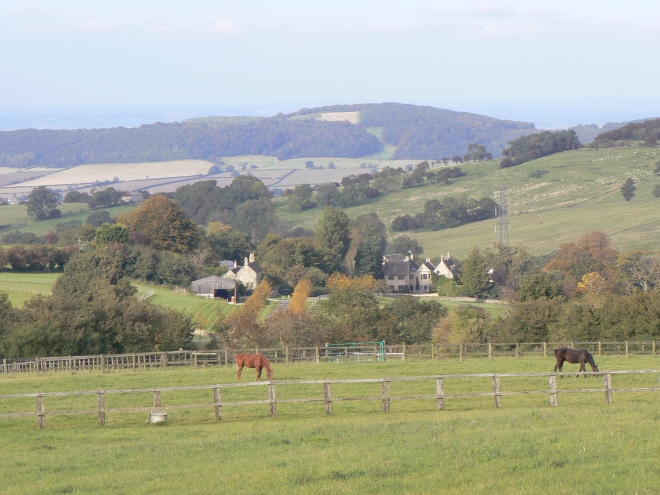
A perfect Autumn day in the Cotswolds
My mum and I in days gone by

My mum and I in days gone by. It is 6 years since my mum died, it has gone by so quickly in some ways, yet so slowly in others. I reckon I think about her more now than ever before. Today I visited her grave and put her favourite pink flowers there. It is in a perfect setting near the hills above Cheltenham, ina lawned garden. The trees are all golden, orange and red now that Autumn is here and they look so beautiful. She would have enjoyed that.
As We Look Back ~ unknown
As we look back over time
We find ourselves wondering …..
Did we remember to thank you enough
For all you have done for us?
For all the times you were by our sides
To help and support us …..
To celebrate our successes
To understand our problems
And accept our defeats?
Or for teaching us by your example,
The value of hard work, good judgement,
Courage and integrity?
We wonder if we ever thanked you
For the sacrifices you made.
To let us have the very best?
And for the simple things
Like laughter, smiles and times we shared?
If we have forgotten to show our
Gratitude enough for all the things you did,
We’re thanking you now.
And we are hoping you knew all along,
How much you meant to us.
Russian Odyssey ~ Part 1 ~ October 1995
My first Russian Trip ~ October 1995
Gloucestershire has always had strong links with Russia thanks to a very active Twinning Committee on the County and Borough Councils. So after Perestroika, when Russia’s Education Departments wanted to link with those in other countries, it was natural for them to contact the GCC. At this time I was a Headteacher in a Gloucestershire Primary school and I was very keen to travel. I was also fascinated by different schools and their pedagogy. I had already linked with a school in Kenya and found that experience life enhancing. So, when the opportunity was offered to go to Moscow and link with schools in Sochi, I signed up straight away.
We had a crash course in Russian with a wonderful lady called Sheila who had previously worked at GCHQ. She assured us that this would help us to ‘get by’ once we went into schools. Fortunately she was coming with us and would be our guide for the first part of the visit, and she made all the travel arrangements.
So it was that I finished school on the Friday afternoon and headed straight for Heathrow for a very early flight to Moscow on the Saturday morning of half term. After a delay the plane took off, flying over Denmark and the Baltic Sea. I sat next to a Mongolian man who was very quiet for the whole 41/2 hour journey!
When we finally arrived in Moscow’s rather dismal airport, it was desperately cold. Fortunately we were met by a guide with a nice warm car and we were whisked into the city. The route between the airport and the city in 1995 was very drab with grey trees (silver birch), grey blocks of flats (hardly any private houses then), trolley buses grey with grime, and a few old Ladas. Very few Russian people could afford cars at that time so the roads were very quiet. Trolley buses were the main form of transport along with the fabulous Metro system. We did see some quaint old dachas along the airport road. Like wooden summer houses, or grand garden sheds, these all had a piece of land around them. A left over from Soviet times, the dacha was where the Russian people could grow their own fruit and vegetables, and keep chickens to supplement their diet.
We were staying at the infamous Hotel Russia (Россия ) which was situated in what must be one of the world’s most exclusive building plots – overlooking Red Square. The hotel was huge, built in the 60’s, indeed at the time it was the largest hotel in the world according to the Guiness Book of Records! The hotel had 21-storeys, 3,200 rooms, 245 half suites, a post office, a health club, a nightclub, a movie theater and a barber shop as well as the 2500-seat State Central Concert Hall. It held a maximum 6000 people! It was almost the only hotel that foreigners were allowed to stay in then. The hotel was still run on Soviet principals in that there was a corridor attendant (дежурная) on every floor. These were terrifying, large ladies with no sense of humour and no social skills. They made us feel very uncomfortable as they demanded our passports and travel papers every time we left our room. They kept them under lock and key until we returned and always wanted to know where we were going and when we would be back. Inside, the hotel was a strange mixture of austere, tatty corridors and very basic rooms, complete with bed bugs and whole families of cockroaches; but the dining room was totally over the top with flashing lights and lots of gold paint, like a 1950’s ballroom. The dining room was huge but almost deserted except for a small group of very inebriated ‘businessmen’ with a ‘lady’. The hotel was demolished in 2007 to be replaced by an entertainment complex. Overseen by British architect, Sir Norman Foster, the new plans include a new, two thousand room hotel with apartments and secure parking.[
Our evening meal reminded me of a convent I used to go to. There was no choice or menu, just a salad starter then rissoles with cabbage. This was followed by tea without milk. Afterwards we congregated in the room with the most spectacular view over Moscow’s old onion domed churches, and drank lovely Russian Champagne, which at £2 a bottle was half the price of a bottle of water! I shared a room with a colleague and being very tired we slept really well hardly noticing the cockroaches.
We woke early to see snow falling lightly on Red Square. I will never forget that sight. It was truly magical. On one side there was the Kremlin, opposite that there was the Main Universal Store (Государственный универсальный магазин), abbreviated to Gum (ГУМ), at one end there was the world famous , St Basil’s Cathedral, and at the opposite end the state historical museum. So after a breakfast of Salami, cucumber and rye bread we set off to see as much of the city as we could in one day.
The best way to get around Moscow was, and still is, by Metro. It is very fast and very efficient. The stations are very deep under the city and the old escalators are incredibly long and steep, and move very quickly. They seemed to be made of walnut and formica and were lit by gas light which emitted a dim glow and a distinctive smell, reminding me of the lighting in my childhood home. Each station is different and they are all very beautiful. We got on at the Kremlin station which is decorated with sculptures and frescoes depicting characters from the Bolshoi Ballets. The ceiling was white porcelain with gold decorations; the walls, white and grey marble. The station was absolutely spotless with no adverts, no graffiti, not a speck of litter ~ just beautiful. A token to go anywhere on the Metro at that time cost 1000 roubles which was about 15p at that time.
We travelled around the city stopping at various stations just to see them. One was a 1920’s art deco style. The walls were made of Onyx and there were alcoves with fabulous standard lamps made of bronze. Chandeliers hung from beautiful ceilings. The Metro stations were used as air raid shelters during the war as were our own in London. One of the Moscow stations has scenes from the war painted in huge cameos on the ceiling like modern day icons, in deep rich colours and sparkling gold. Eventually we returned via the Bolshoi station and walked to the Kremlin.
The word Kremlin means fortress and it is actually a walled city. There are 20 watchtowers on the walls, one with a famous clock. The Kremlin dates back to the 14th century, and the walls to the 16th; it was home to the Czars. On the way we passed the monument to the Unknown Soldier. This is a very beautiful and moving tribute sculpted in bronze. There is a cloak, sword and helmet, and an everlasting flame.
Once inside the Kremlin we were in awe. At that time we were not allowed to take photos so those that I have of the spectacular buildings are from a later visit. There are so many churches all topped with gold domes and icon painted walls inside and out. We went into the Church of the Assumption, which, like most of the churches had been turned into a museum, but services were held 5 or 6 times a year. Every inch of the walls, ceiling and pillars was covered in exquisite icons. The old icons were painted on prepared wood using paints made from natural materials including crushed gemstones. The finished icons were covered in olive oil to preserve it. Unfortunately, over the centuries, the olive oil darkens and the icons get very dull. Many have been restored. Centuries ago, icons were the only Russian art and they all had a religious theme.
Leaving the Kremlin we walked back into Red Square and visited Lenin’s tomb. Lenin died in 1954 and for a long time he was revered. However the cost of keeping his body in good enough condition to be on display to the public is enormous and, while we were there, people in Moscow were questioning whether it should continue. The body was almost luminous and we were rushed through by the guards.
After a fleeting visit to the fabulously luxurious department store that is GUM, we were rushed to Sheremetova 1 airport for our domestic flights to Sochi by the infamous Aeroflot airline!
I will write about that tomorrow.
 Travel was free on buses in Moscow for Russians in 1995
 Church of the Assumption in the Kremlin
 Churches in the Kremlin
 Statues of workers in the underground in Moscow
 Metro station in Moscow 1995
 Steep and fast moving gas lit escalator in Moscow underground 1995
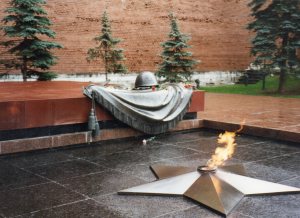 Memorial to the Unknown Soldier behind the Kremlin. Moscow’s Brides leave their wedding bouquets there as a mark of respect
 A typical dacha
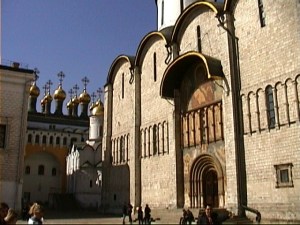 Cathedral inside Kremlin
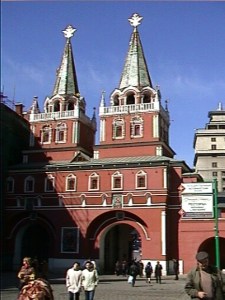 Gate at the end of Red Square
 St Basil’s Cathedral
 Red Square by Kremlin Walls. Lenin’s mausoleum in the background
 Inside the Kremlin
Russian Odyssey Part 4 ~ The Everlasting Snows ~ October 1995

When I wrote my Haiku, entitled ‘Sleep’, about a 36 hour trip on a sleeper train from Moscow to Sochi, I said that I would write more about my Russian adventures. This is the first instalment!
It was October 1995 when my colleague, Liz and I got up very early at the Hotel Moscow in Sochi. We were being taken on a trip to the Caucasian Mountains for the day. We skipped breakfast and went out to meet Igor, his young daughter Anna, the 2 Natalya’s, both Headteachers, Irena, our interpreter, and another couple. We were driven out of Sochi along the airport road in two Ladas. We followed the Black Sea coastline until we reached the ‘new’ airport which was being built by construction workers from Yugoslavia, as it was then. Apparently they never have enough money for materials so the job is taking years to complete. However, what they have built looked very modern, even futuristic, and very impressive.
At this point we turned inland towards the mountains. We could not go straight on as this was the road to Georgia and there were still Russian tanks along the border to stop refugees from the Abkhazia/Georgia conflict from coming into Russia.
From here on, the journey took two or three hours, passing some of the most spectacular scenery I have ever seen. It reminded me of the best of the Pyrenees with shades of Canada. The colours of the ancient forests of broadleaf trees were indescribably beautiful: Reds, yellows, oranges and all shades of green glinted in the glorious early morning sunshine. Above these trees were the alpine forests of evergreen trees, and beyond those, the everlasting snows. This is the home of the Russian bear, the mountain cat, the black Ousel, the wolf and much more.
All the time we were driving along the course of the ‘wild river’, as its name translates. This river is icy cold, deep and treacherous, coming straight from the snow-capped mountains. I was told that there are 1 metre long red fish (presumably salmon) in this river. The road got steeper, and narrower, and more winding as it climbed higher into the mountains. There were many interesting stops; the Men’s Tears Waterfall, the Ladies’ Tears Waterfall, the ancient cave where Neolithic tools have been found, the memorial to the Red Army soldiers from Krasnapolyana who were butchered and thrown into the ravine in 1927 during the civil war, to name just a few. The road was so dangerous that we could not get out and take many photographs unfortunately.
Eventually we arrived at the village of Krasnapolyana where Igor was born. It was like going back to medieval times in England. There were very few cars, and ours had to drive dead slow to avoid the pigs, hens, cows and dogs wandering at will through the main (and only) street of the village. There were very few people around but one or two slowly plodded by. The pace of life in this village is so slow that it seems as if at some point time stopped, stood still, and then started to go slowly backwards. All around there were little Hansel and Gretel cottages with tiny barns packed to the rafters with the harvest produce. Not a shop or a pub to be seen ~ just little old people living on whatever they could grow or rear, in little houses with little gardens.
We were told that the air and water is so pure here that people have been known to live to 130 or even 140 years old. Some years ago the world’s top biologists got together to stop a bid to hold the winter Olympics in the area. They considered Krasnapolyana to have the purest and cleanest environment in the whole world. I can believe it and I am so thrilled that I got to see it in this unspoilt state. It looked and smelled like Paradise to me.
At last we drove the last few bumpy metres through the forest to a clearing by the river. Here we stooped and got out of the cars. The sun was very hot by now and the air was soft, warm, and full of sweet perfume. It was explained to me that much of the greenery growing in the forest could be used for herbal remedies. Every bit of ‘grass’ I picked seemed to have an exotic smell and curative properties according to Natalya. As Liz and I wandered round in raptures at the scenery, the women in our group set about laying out a picnic area.
They emptied the two Ladas and laid out blankets, mattresses, sheets of cardboard, dishes, bowls, cups and saucepans. Then, out came flasks of tea and coffee, bottles of Russian Vodka and an amazing array of green salad, huge tomatoes, freshly made Georgian Lava bread and homemade cheese. Meanwhile the men returned from the forest with twigs, sticks and small branches. They set about building a fire with great precision. Apparently building a fire for cooking food is an exact science, and Russian men take great pride in it. Once the fire was lit, it was fussed over like a new baby until it was ready to put the meat over. Igor skewered three whole chickens which had travelled with us in a huge pan marinating in a batter flavoured with herbs and spices. The men collected water from the river and splashed the fire and the chickens regularly. They told me that this helps stop the chicken’s skin from burning and keeps it moist as it cooks right through. The smell coming from this outdoor barbecue was mouth-watering and I couldn’t wait to eat the food. Liz, being vegetarian, had been horrified by the whole process, but was glad to see a vegetarian selection cooking on a skewer at the edge of the fire.
As the men cooked, animals wandered by to take a look: a family of wild pigs complete with babies, cows of all sizes and shades, dogs and butterflies. It really was quite primitive and biblical and I was totally relaxed just watching and anticipating. When we did sit down on the ground to eat, the meal was superb. Every sense was alive with the sight, the feel, the smell and the taste of the food was complemented by the sounds of the fire spitting and the river rushing by. It was an amazing experience. At the end of the meal we wandered round with 10 year old Anna, writing our names on stones with stones, and drawing the animals we could see, rather as Neolithic man must have done in those caves we had seen. Finishing up, we cleared everything away and set off again to go further along the mountain track.
Liz and I were told that we were going to touch the everlasting snows. I had a dreadful feeling that we were going up the mountain on horseback. But then to our amazement we saw an old ski lift! Before we had time to panic we were sitting on this thing which climbed as far as the eye could see up into the snow-capped mountains.
I was not in the slightest bit bothered by it. I thought this totally untypical relaxed state might have been due to the environment, but Liz reckoned it was due to all the vodkas I had consumed at lunchtime! Either way I loved the splendid views from the top of the ski lift.
After this we set off on the homeward journey. We took detours to give messages to grandmothers, to buy curative honey from the bee farm, to drink coffee, and to see the hydro-electric station and reservoir that supplies these remote and fortunate people with their power. They seem to have everything they need in abundance and all naturally produced. It was a most unusual, thought provoking, pleasurable, and satisfying day. I was very sad to leave Krasnapolyana.
The views on the way down the mountain were even more spectacular than on the way up. The setting sun gave the already beautifully coloured autumn leaves a shimmering golden glow. The only hiccup occurred when I dropped my jar of medicinal honey from this wonderful place. The beekeeper had gone to so much trouble to find me a small jar and filled it for me to take home. But, it smashed to bits right outside our hotel. It seemed almost as if I was not supposed to take anything away from Krasnapolyana.
I have been back to Krasnapolyana several times since then and it has changed out of all recognition. There are new roads, helicopter pads, tourist hotels, new ski lifts and lots of palatial new houses. Mr Putin has a beautiful summer home there and skis regularly on the mountain. And, I am sad to say that the 2014 Winter Olympics will be held in Krasnapolyana, which will bring masses of people and vehicles to this fragile but still beautiful area. I fear that the environment will be ruined. But I feel privileged to have seen it when it was still in pristine condition.

Igor, Natalya, Liz and friends picnic Russian style

Igor in charge of the campfire

Wonderful fresh food cooked over the fire beside the river

Unspoilt forest and wild pigs at the foot of Krasnapolyana

melted snow feeds the river rushing down towards Sochi

Krasnapolyana in 1995
Related articles
Free
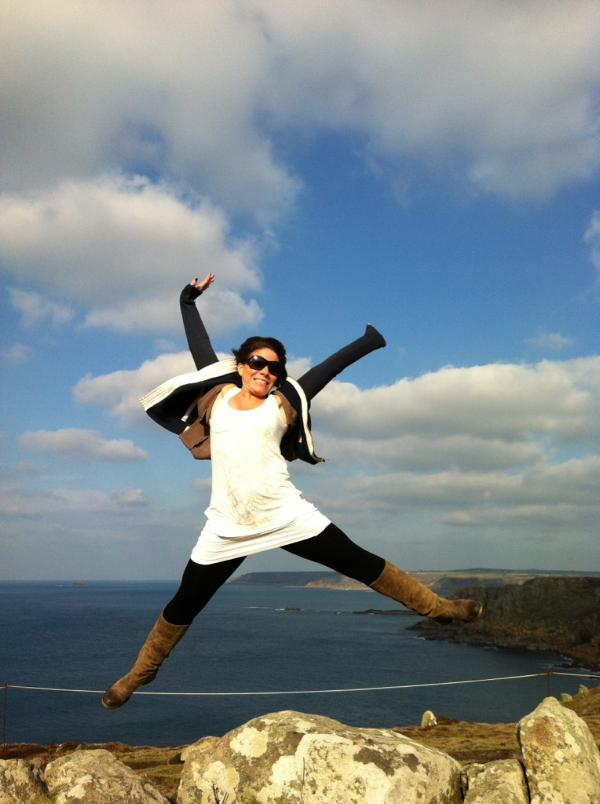
Free Spirit ~ my beautiful daughter
I know the real me.
At the core of my being,
My spirit is free!
Nothing is free!
Mankind is a mess.
Motivated by money,
Morality’s mired.
Free Trade ~ there has to be a way found to share the earth’s resources more equitably. It is unsustainable for the majority to live in dire poverty while the minority consume without conscience.
Free trade or fair trade
Ethical extremities,
Conscience compromised.
Free people ~ I find it ridiculous that different ethnic peoples can not respect each other’s differences and reach compromise. Will conflict never end?
Trapped in tradition,
Hostages to history,
Future’s foreboding.
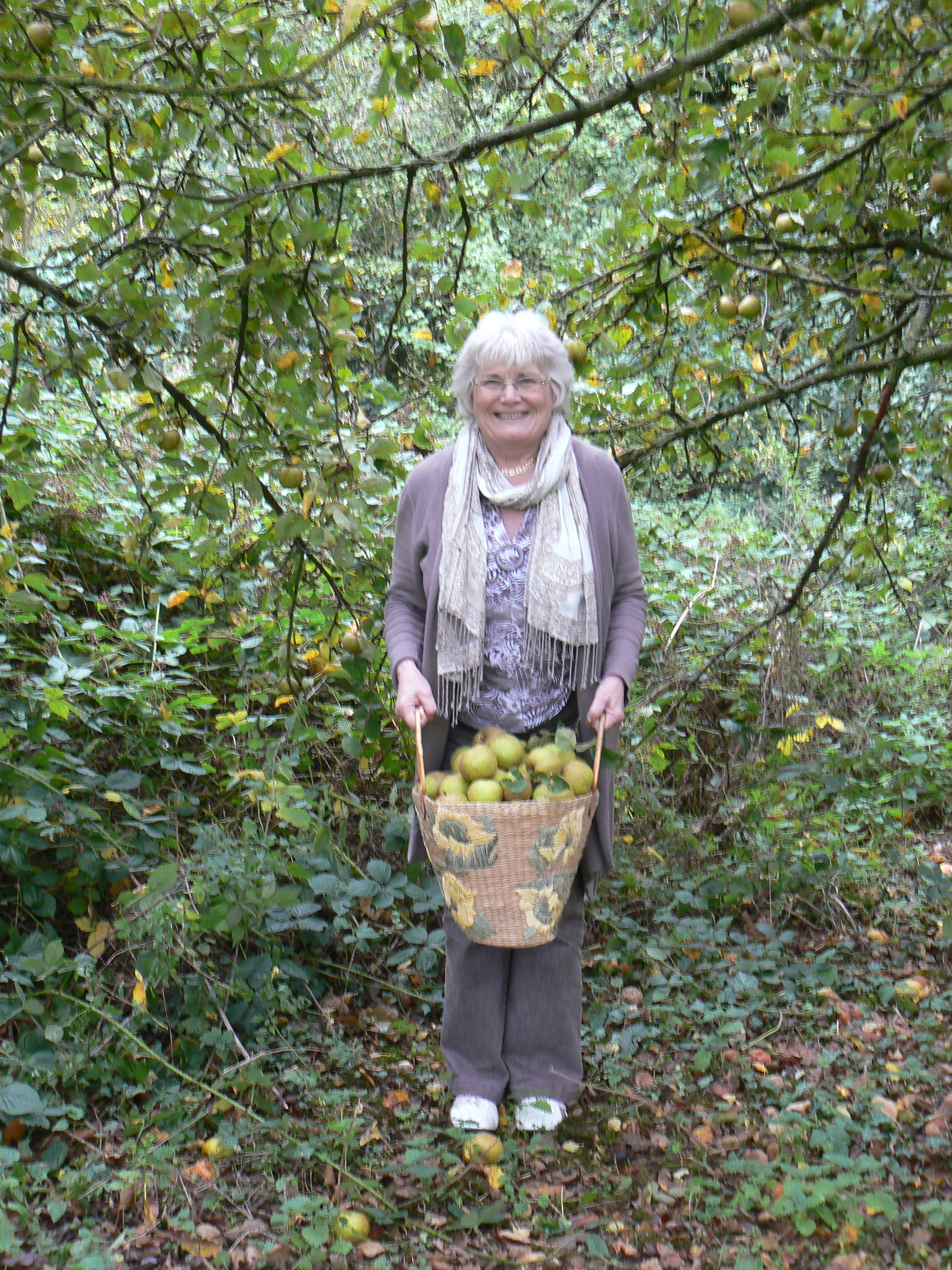
Free food ~ I find it amazing when I walk in the countryside, that there is an abundance of fruit on the trees and in the hedgerows, and people don’t seem to pick it. They prefer to go to a supermarket and buy inferior stuff at inflated prices in polythene bags. Why?
Free for the hungry
Nature’s abundant harvest
Hanging on the trees
Addictive Blog Award
The Addictive Blog Award 
Addictive Blog Award was given to me by Renee at : http://positiveboomer.net
Renee is a life affirming baby boomer with a heart of gold and loads of common sense. Do visit her blog ~ it will lift your spirits and enrich your life.
The rules for this Award are as follows:
1. Thank the person who nominated you and link them back.
Thank you dear friend!
2. Share a little bit about why you started blogging.
I started blogging as an extension of the daily journal I was keeping for The Artist’s Way. I enjoy thinking, researching and writing. The wonderful thing about blogging is that over time you become part of a community of people whom you would never normally meet, who are interested in your posts and interesting in their own right. It is inspirational.
3. Copy and Paste the award onto your own blog.
4. Nominate up to 10 other bloggers you think are addictive enough to deserve the award.
That is a hard one as there are so many fascinating and addictive blogs out there.
Please know that I totally understand if you are not interested in Awards. I only want you to know your blog is addictive!
http://mariodavalos.com ~ fantastic photography
http://leafandtwig.wordpress.com/~ more great photography plus inspired words
http://selfblossoming.wordpress.com
http://mypenandme.wordpress.com
http://purplepeninportland.wordpress.com
http://inspiremylife.wordpress.com/
Thank you again Renee x
Battlefield ~ Haiku
Todays Haiku Heights word is Battlefield. This stirred up lots of poems in my head ~
My father in law was in the Arctic Convoys. He served on the destroyer HMS Liverpool guarding merchant navy vessels taking supplies to the beleaguered Russians via Murmansk. His ship was torpedoed twice in the Mediterranean but he survived the war.
Foes in the fjords
Death lurks in depth for Allied
Atlantic convoys.
My uncle Robert fought and died in Burma as part of the “forgotten army”. Because they had no supplies and no radios they didn’t even know that the war was over so kept on fighting. Uncle Robert was killed after the official end of the war so his widow did not get a war pension!
Forgotten fighters
in the jungles of Burma
fought and died in vain.
Of course people at home in the UK fought their own battles and lived through countless air raids. The things they feared most were the doodle bugs which made a dreadful whining noise overhead. But the most worrying time was when the whining stopped, as that meant the bombs were falling!
Air raid warning as
Doodle Bugs whine overhead.
Silence brings despair.
Many young children were evacuated from cities to relative safety in the countryside which brought its own terrors.
Evacuated!
Human fish out of water
blitzed from city homes.
Waltz – The Permitted Embrace – Haiku
Today’s post is inspired by Haiku Heights and the word prompt is Waltz but I am using the Argentinian Vals for my inspiration.
Look into her eyes
Aroused by primal passions
Feel her body move
~
Look into your soul
Stirred by sensual music
Let your spirits soar
~
Look into his heart
Alert to every movement
Lose yourself in dance
~
Duo dance as one
Exploring their desires
Stylish seduction
~
Now I used to think the Waltz was a boring dance, until I discovered Argentinian Waltz (Vals). I saw it performed at a very exciting WI meeting. There was passionate, fiery and exotic music, rare footage of filmed Argentinian dances, a fascinating talk and beautiful dancing demonstrations. Janet Earl and Adrian Barsby, who teach together but are not regular partners, did a double act chatting in a relaxed fashion and inviting members to ask questions or interrupt whenever they wished, rather than wait until the end. The talk was really informative, explaining the background and history of Argentinian dances such as Tango, Milonga and Canyengue as well as Vals (Waltz), I have written about Argentinian Tango in a previous post.
Now the Waltz as we europeans know it – is much older than Tango Vals. It was thought to be one of the very first dances in which the couple face and touch each other when dancing. However, I have been listening to a wonderful programme on BBC Radio 4 about the history of dance and it seems there were dances, namely La Volta, way back in Elizabethan times which shocked society because the men held the women around the waist and used their knees to swing them round!! Indeed it is said that Queen Elizabeth the First shocked courtiers by dancing La Volta with the Earl of Leicester! The programme is called Dance Nation and is by Deborah Bull. The episode is called The Permitted Embrace.
By the end of the 18th century the European Bourgeoisie had made the Waltz their own and it became a symbol of their attitudes – self-assured, emotional, free, erotic. If you read Jane Austen’s novels you will know that dancing was the most acceptable way for a young girl to flirt and court a possible suitor! Yet when it became fashionable in Vienna around 1773, it was shocking to the masses and the aristocrats, and was considered ‘riotous and indecent’ as late as 1825!
I don’t know why it was considered ‘riotous and indecent’ but I certainly find Argentinian Waltz sensual, erotic and very moving. It appears as if the goucho, or man, is leading but in fact he is just inviting her with his leg movements. A confident lady will let him know by her responses with her legs whether she is willing or not. It all appears very structured and rehearsed, but actually the dance evolves according to the signals each give with their legs. It truly is wonderful to watch once you know this. I recommend that you watch video clips of Anton and Flavia who dance on a BBC TV show in UK called Strictly Come Dancing and it is wonderful. They do a sensational Argentinian Waltz.
Footprints ~ Haiku
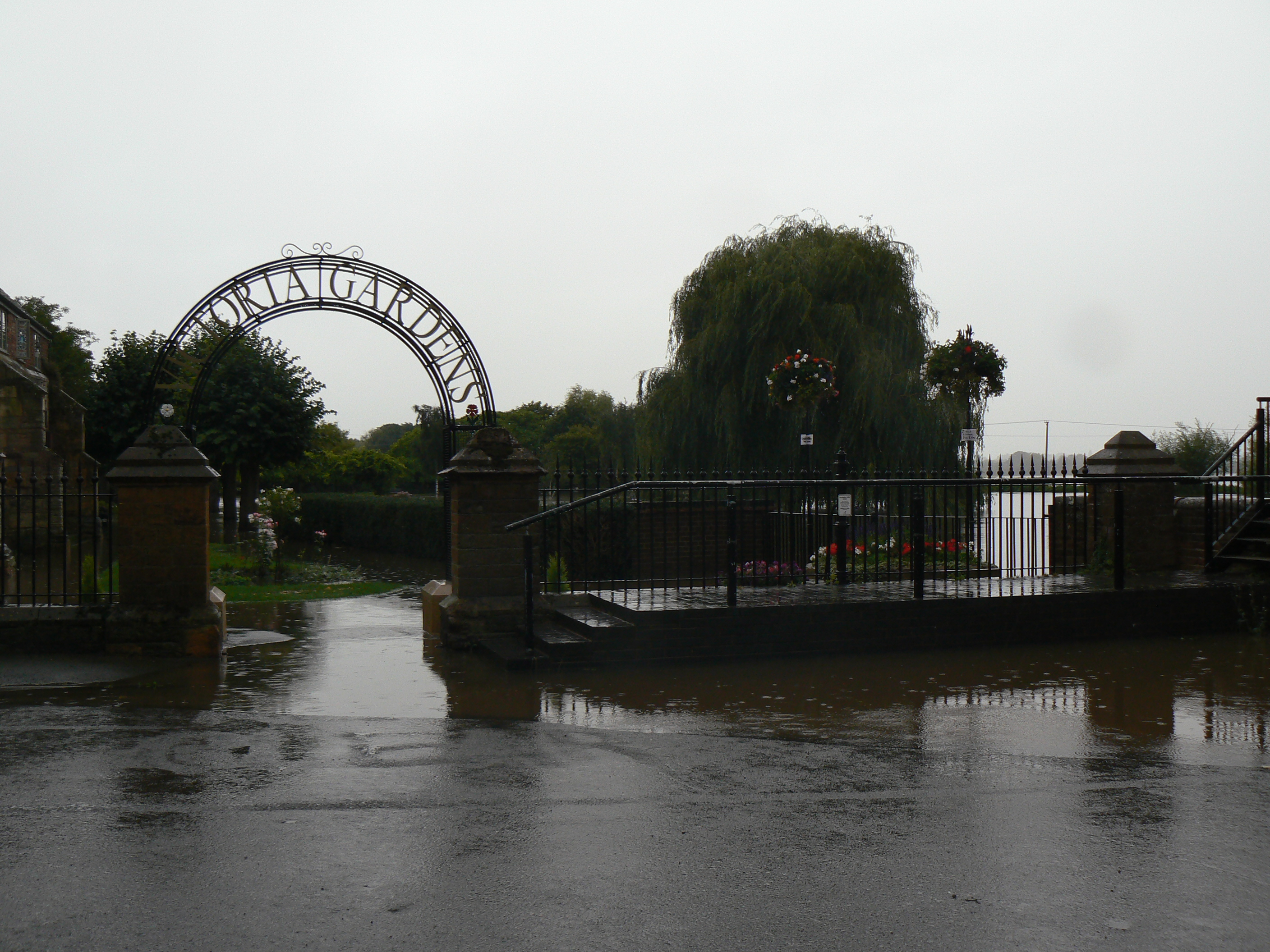
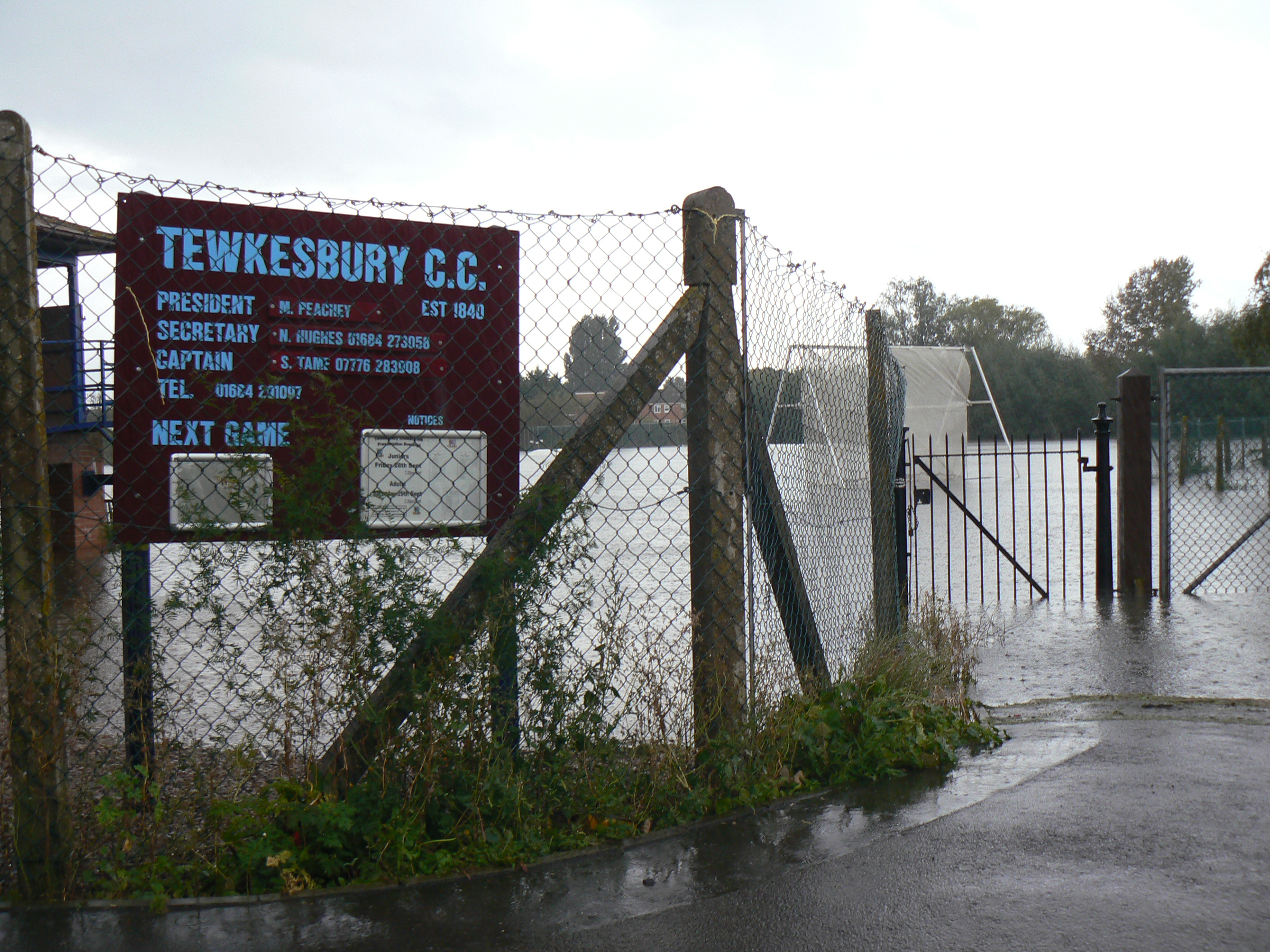
A Tewkesbury Garden 26th September 2012
No footprints today
over park, pitch, or pavement.
Rampant rivers rule.
I took my little dog for a walk yesterday in Pershore and Tewkesbury. The Rivers Avon and Severn were both flooding. Although both Abbeys were still safe, the surroundiing areas were flooding ominously as my photographs show.


How To Have A Great Day
Oh I just love this ~ as one who never gets enough sleep I am going to print it out and pin it to my bedroom door!

How To Have A Great Day…..
Get enough sleep…

Don’t forget those morning exercises…

Wash properly and everywhere…

Have a good stretch…

Don’t get out on the wrong side of the bed…

And if you are still tired …

Then best go back to sleep till catnip!
(Breakfast)

But Remember to take time out to Pray that’sthe Secret for a great day!
Paperboat
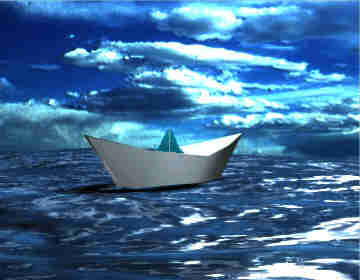
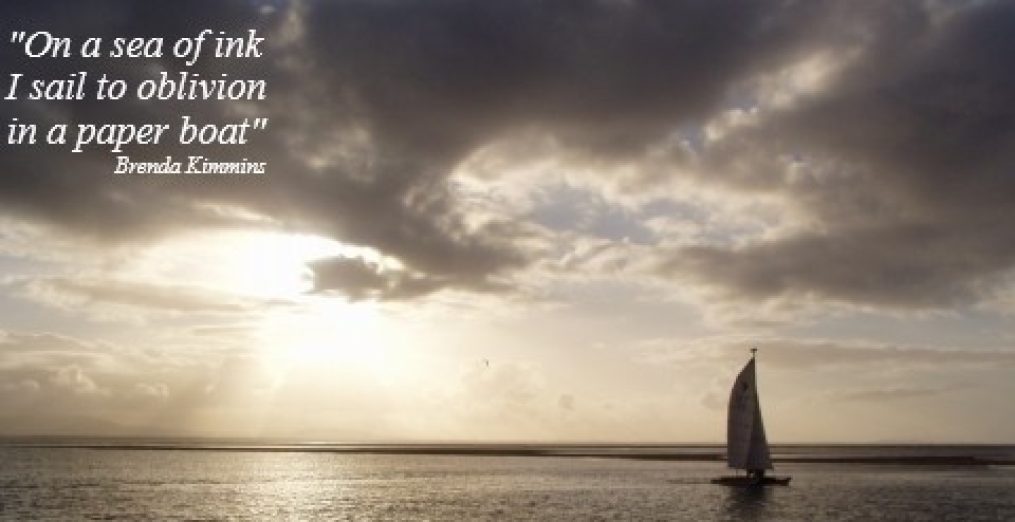
In a sea of ink
I sail to Oblivion
on a paper boat
Inspired by the haiku heights September challenge. Today’s word is Paperboat.
Sleep ~ Haiku
Today’s post is inspired by September challenge on haiku heights. The word today is SLEEP and it reminded me of a wonderful journey I took by train from Moscow to Sochi on the Black Sea coast. I will write a series of blogs about my many visits to Russia and the amazing experiences I had there. But for now I can say that 36 hours on a Russian sleeper train is an experience I will never forget for many reasons!
Night train to Sochi
A cultural odyssey
Vast Russia unfolds

The entrance to Sochi, town name in Russian
 Heavenhappens