Pilgrimage

This post is inspired by the February theme of ‘Pilgrimage’ on  Carpe Diem

Seeking solitude
I journey into my soul
A Prayerful Pilgrim

I have written about my idea of pilgrimage before and have posted links to these posts so you can read them again if you wish. I am aware that a number of my readers have no faith or a different faith from myself. I respect that and hope you will read with an open heart and mind, and enjoy the photographs

Inner Journey http://wp.me/p2gGsd-Lv
Pilgrimage to Lourdes ~ http://wp.me/p2gGsd-i

PICKING HIBISCUS FLOWERS AT DAWN

What an amazing blog I discovered this morning. The post is so beautiful that I just had to pass it on to you x Enjoy~

“And so our mothers and grandmothers have, more often than not anonymously, handed on the creative spark, the seed of the flower they themselves never hoped to see – or like a sealed letter they could not plainly read.”

Alice Walker

via PICKING HIBISCUS FLOWERS AT DAWN.

Snowdrops

Thanks to reading one of my favourite blogs I remembered that the flower of the day is the snowdrop. I already have snowdrops and hellebores appearing in my garden as the weather is so mild here so I thought I would repost some of the photos I have taken of these flowers in the past. I live near the Rococo gardens at Painswick, a place I have blogged about several times. According to The Independent Newspaper in 2008,

The Rococo Garden has one of the largest naturalistic plantings of snowdrops in the country and is in many ways the spiritual home of Galanthus Atkinsii.

Although many believe the Romans introduced snowdrops they are more likely to have been brought to England in the early 16th Century. Galanthus nivalis is native to a large tract of mainland Europe from the Pyrenees in the west, through France and Germany to Poland in the north, Italy, Northern Greece and European Turkey.

Most of the other species Galanthus come from the eastern Mediterranean, though several are found in South Russia, Georgia and Azerbaijan. Galanthus fosteri comes from Jordan, Lebanon, Syria, Turkey and Israel.
More photos are at the following links:
Springtime http://wp.me/p2gGsd-MW
Snowdrops and Hellebores http://wp.me/p2gGsd-ET

Mary

This is a poem written on Poet’s Corner. It is deals with a sad condition which affects so many families now. Ageing relatives can grow confused and their lives shrink. But we must always remember to spend time with them, listen to them, and remember they have stories to tell of their lives. A photo, a song, a perfume, anything can turn the key on these locked stories. You will be richly rewarded for any efforts you make to find that key for your loved one.

Mary.

Meditating on a window


Thanks to Sherri’s blog I was led to ‘A Lingering Look at Windows’. If, like me you find windows fascinating you should take a look at the current challenge to post a photo of a window each week.
I am awed by stained glass windows especially, and have an enormous collection of photos from around the world. But very close to home there is a window that fascinates me. It is in Gloucester Cathedral. It is quite a modern window and from a distance with a cursory glance, it can appear to be simply random shapes of blue glass. On closer inspection though, this window draws the viewer in rather as an icon does. It is a meditative experience to sit and really look at this window. Soon the shape of a man appears then you are drawn to the face. It has a haunting expression of deep understanding and empathy. It represents the face of Jesus.

The window was created and installed in 1992 by Thomas Denny.  It is mainly blue and white with splashes of red and yellow.  It is greatly affected obviously by the light coming from outside but it does appear to be in shadow when the viewer is at a distance, then as you get closer it gets brighter and quite mesmerises me!   Doubting Thomas and Jesus are the central characters of the middle window and the two side windows are a song of praise for creation based on psalm 148.

Thomas Denny, was born in London.  He trained in drawing and painting at Edinburgh College of Art. One day a friend asked him to consider creating a stained glass window for a church in Scotland (Killearn 1983).  So began a remarkable career that has produced over 30 stained glass windows in Cathedrals and Churches of this country. (Visit http://www.thomasdenny.co.uk for the full listing.) Tom’s love for painting and drawing, especially the things of nature, is evident in his windows.   All of Tom’s windows depict biblical themes and encourage the viewer to sit in silent meditation.  Look closely, feel the colours, take the time to let the details emerge, then reflect.  It is a spiritual experience.

Even closer to home there is a simple parish church in Warden Hill called St Christopher’s, which has a set of 10 stained glass windows by Thomas Denny.   Each of them is based on a parable from the Gospels.  The windows are linked by colour too with the colours from one window flowing into the next.  They are simply stunning and anyone can visit the church to see them.  If you are too far away you can click on this link to enjoy photos of the windows http://www.tciwh.org.uk/index.php?page=windows

south ambulatory chapel window

Weekly Photo Challenge ~ Windows

Spring and Summer Doors Spring and Summer Doors

A Window on my world
The word ‘sanctuary’ comes from the Latin root word, sanctus, which means holy. So the primary meaning of the word is, ‘a sacred space’. Following on from this is the idea of a ‘place of refuge’, where someone can escape to and find safety.

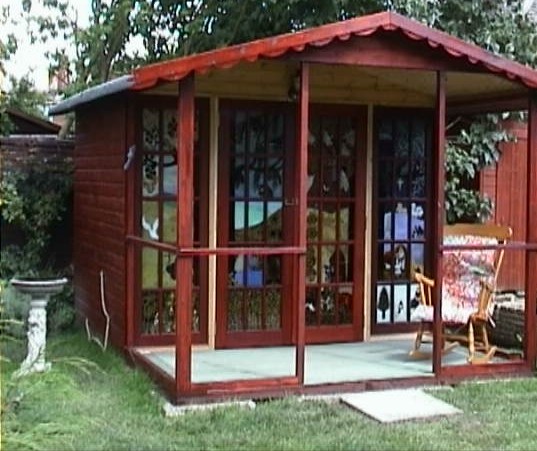
In the year 2000 I retired from full time working, and spent a year seeking ‘sanctuary’ from a life so busy that it had overwhelmed me. Being too exhausted to go anywhere, my sanctuary had to come to me, so my wonderful husband built me a summerhouse at the end of the garden where I could find some healing peace.

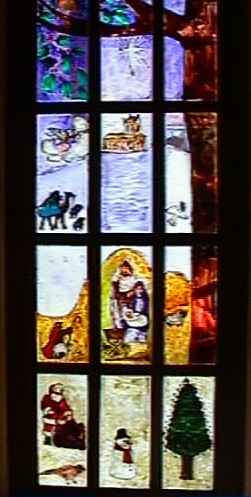
It was 3metres by 4metres made of solid wood lined with tongue and groove pine panels with a waterproof, pitched roof and 4 doors. Each door had 12 glass panes and I was inspired to paint them with glass paints.

Knowing that the Domain in Lourdes had been one of the most inspirational places in my life, and thinking (wrongly) that I might never get an opportunity to go there again, I decided to reflect its importance in my summerhouse. Each door would have a depiction of the grotto and of water included, as well as images that I love.

I chose the 4 seasons as my theme and decided to paint the doors Spring, Summer, Autumn and Winter. Before the doors were hung I measured out 4 pieces of wall lining paper and sketched my designs

For each door. I used trees, laburnum, wisteria, maple, holly, bending towards each other to form arched shapes. I then drew images from nature related to each season, mice, hedgehogs, robins and anything else that came into my mind. Once the paper design was complete I stuck the paper onto the back of each door and drew over it straight onto the glass with ‘tube lining’. This dries quite quickly so then I started to paint!

I am not an artist so the result was very primitive, but because the glaze comes in such beautiful colours, the overall effect was stunning.

Once the doors were hung we laid electricity cables to the summerhouse so that we could light it from inside or out. This meant that at night we could see the stained glass effect shining down the garden from the house. If I was in the summerhouse on a sunny day with the doors shut, the stained glass effect cast coloured light all over the inside of the summerhouse. If I was in there at night I sometimes turned off the lights and lit candles to gain a different effect.

This was my sacred space, my sanctuary, my still point, my little bit of heaven and I loved it. In my summerhouse I looked deep inside my self; I wrote (and then shredded) my life story; I restored my spirit; I emerged a different person.

Sadly, I had to move home some years ago, and I could not take my summerhouse with me. But I have the photographs and I just have to think of it to find a beautiful stillness.

Winter door Winter door
My Sanctuary My Sanctuary

Grimace ~ Haiku

I was in hospital at the weekend having an operation on my foot.  The pain is indescribable but at least it helped me to write a haiku inspired by this week’s Haiku Heights’ prompt word “Grimace”.

Humour held hostage
In agony arrested
Face frozen in pain

~~~

Features contorted
Awakened in agony
Pain surges through me


Writing and reading tips

Gosh what a useful and entertainng post I just read. It kept me fascinated so I have pasted it below for you. Honestly there is so much in it.
I’m in hospital at the moment and likely to be stuck in bed for a couple of weeks so thank goodness for the blogging community! I will have time to read every word! I am also enjoying books by Sally Vickers – I have meant to read them for a long time but now I can. Just finished The Cleaner of Chartres and am enjoying Miss Garnet’s Angels x will hunt out more online !
They are gently mysteries set in beautiful places such a Venice and Chartres, with a spiritual angle, lots of psychological insight and history as well – all written in glorious prose x magnificent!

Saturday Edition – What We’re Writing and Reading

The Winter Olympics in Sochi and Krasnayapolyana

The Winter Olympics in Sochi and Krasnayapolyana

As the Winter Olympics in our twin town of Sochi gets underway, I am totally glued to the TV to see how much this beautiful area has changed. I remember the many exciting journeys I made to Sochi, and Krasnayapolyana in particular almost 20 years ago. Russia was a totally different place the first time I visited. It was not long after Perestroika and there was still a gloomy rather austere atmosphere reminiscent of Stalinist times. I have written many blogs about my visits to Russia and if you would like to read them you can click on the links below. But I really feel driven to write about one particularly magical place again. This is Krasnayapolyana which is where many of the Olympic events will be held. If you went there today you could never imagine that only 20 years ago it was officially recognised as a totally unspoilt area of outstanding natural beauty. I was lucky enough to spend some time there with my Russian friends and a work colleague, Liz.
Liz and I got up very early one morning at the Hotel Moscow in Sochi. We were being taken on a trip to the Caucasus Mountains for the day. We skipped breakfast and went out to meet Igor, his young daughter Anna, the 2 Natalya’s, both Headteachers, Irena, our interpreter, and another couple. We were driven out of Sochi along the airport road in two Ladas. We followed the Black Sea coastline until we reached the ‘new’ airport which was being built by construction workers from Yugoslavia, as it was then. Apparently they never have enough money for materials so the job is taking years to complete. However, what they have built looked very modern, even futuristic, and very impressive.
At this point we turned inland towards the mountains. We could not go straight on as this was the road to Georgia and there were still Russian tanks along the border to stop refugees from the Abkhazia/Georgia conflict from coming into Russia.
From here on, the journey took two or three hours, passing some of the most spectacular scenery I have ever seen. It reminded me of the best of the Pyrenees with shades of Canada. The colours of the ancient forests of broadleaf trees were indescribably beautiful: Reds, yellows, oranges and all shades of green glinted in the glorious early morning sunshine. Above these trees were the alpine forests of evergreen trees, and beyond those, the everlasting snows. This was the home of the Russian bear, the mountain cat, the black Ousel, the wolf and much more.
All the time we were driving along the course of the Mzymta or ‘wild river’, as its name translates. This river is icy cold, deep and treacherous, coming straight from the snow-capped mountains. I was told that there are 1 metre long red fish (presumably salmon) in this river. The road got steeper, and narrower, and more winding as it climbed higher into the mountains. There were many interesting stops; the Men’s Tears Waterfall, the Ladies’ Tears Waterfall, the ancient cave where Neolithic tools have been found, the memorial to the Red Army soldiers from Krasnapolyana who were butchered and thrown into the ravine in 1927 during the civil war, to name just a few. The road was so dangerous that we could not get out and take many photographs unfortunately.
Eventually we arrived at the village of Krasnapolyana where Igor was born. It was like going back to medieval times in England. There were very few cars, and ours had to drive dead slow to avoid the pigs, hens, cows and dogs wandering at will through the main (and only) street of the village. There were very few people around but one or two slowly plodded by. The pace of life in this village is so slow that it seems as if at some point time stopped, stood still, and then started to go slowly backwards. All around there were little Hansel and Gretel cottages with tiny barns packed to the rafters with the harvest produce. Not a shop or a pub to be seen ~ just little old people living on whatever they could grow or rear, in little houses with little gardens.
We were told that the air and water is so pure here that people have been known to live to 130 or even 140 years old. Some years ago the world’s top biologists got together to stop a bid to hold the winter Olympics in the area.

They considered Krasnapolyana to have the purest and cleanest environment in the whole world.

I can believe it and I am so thrilled that I got to see it in this unspoilt state. It looked and smelled like Paradise to me.
At last we drove the last few bumpy metres through the forest to a clearing by the river. Here we stooped and got out of the cars. The sun was very hot by now and the air was soft, warm, and full of sweet perfume. It was explained to me that much of the greenery growing in the forest could be used for herbal remedies. Every bit of ‘grass’ I picked seemed to have an exotic smell and curative properties according to Natalya. As Liz and I wandered round in raptures at the scenery, the women in our group set about laying out a picnic area.
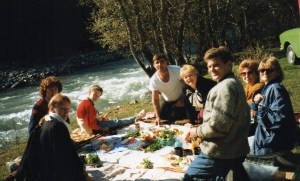
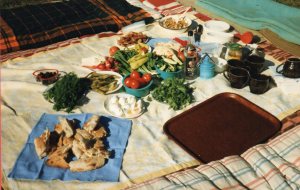
They emptied the two Ladas and laid out blankets, mattresses, sheets of cardboard, dishes, bowls, cups and saucepans. Then, out came flasks of tea and coffee, bottles of Russian Vodka and an amazing array of green salad, huge tomatoes, freshly made Georgian Lava bread and homemade cheese. Meanwhile the men returned from the forest with twigs, sticks and small branches. They set about building a fire with great precision. Apparently building a fire for cooking food is an exact science, and Russian men take great pride in it. Once the fire was lit, it was fussed over like a new baby until it was ready to put the meat over. Igor skewered three whole chickens which had travelled with us in a huge pan marinating in a batter flavoured with herbs and spices. The men collected water from the river and splashed the fire and the chickens regularly. They told me that this helps stop the chicken’s skin from burning and keeps it moist as it cooks right through. The smell coming from this outdoor barbecue was mouth-watering and I couldn’t wait to eat the food. Liz, being vegetarian, had been horrified by the whole process, but was glad to see a vegetarian selection cooking on a skewer at the edge of the fire.
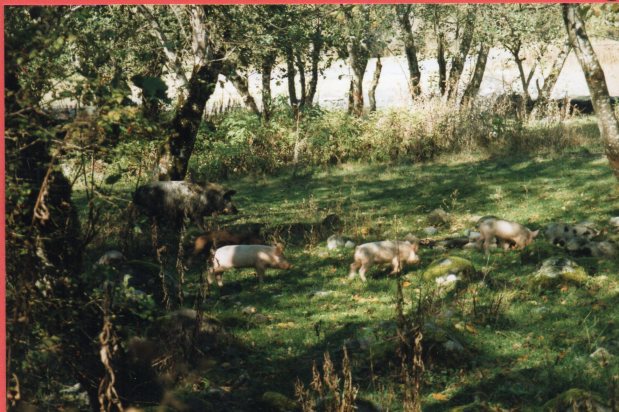
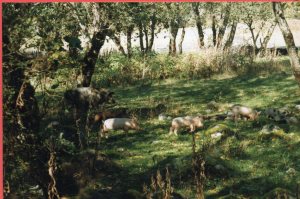
As the men cooked, animals wandered by to take a look: a family of wild pigs complete with babies, cows of all sizes and shades, dogs and butterflies. It really was quite primitive and biblical and I was totally relaxed just watching and anticipating. When we did sit down on the ground to eat, the meal was superb. Every sense was alive with the sight, the feel, the smell and the taste of the food was complemented by the sounds of the fire spitting and the river rushing by. It was an amazing experience. At the end of the meal we wandered round with 10 year old Anna, writing our names on stones with stones, and drawing the animals we could see, rather as Neolithic man must have done in those caves we had seen. Finishing up, we cleared everything away and set off again to go further along the mountain track.
Liz and I were told that we were going to touch the everlasting snows. I had a dreadful feeling that we were going up the mountain on horseback. But then to our amazement we saw an old ski lift! Before we had time to panic we were sitting on this thing which climbed as far as the eye could see up into the snow-capped mountains.
I was not in the slightest bit bothered by it. I thought this totally untypical relaxed state might have been due to the environment, but Liz reckoned it was due to all the vodkas I had consumed at lunchtime! Either way I loved the splendid views from the top of the ski lift.
After this we set off on the homeward journey. We took detours to give messages to grandmothers, to buy curative honey from the bee farm, to drink coffee, and to see the hydro-electric station and reservoir that supplies these remote and fortunate people with their power. They seem to have everything they need in abundance and all naturally produced. It was a most unusual, thought provoking, pleasurable, and satisfying day. I was very sad to leave Krasnapolyana.
The views on the way down the mountain were even more spectacular than on the way up. The setting sun gave the already beautifully coloured autumn leaves a shimmering golden glow. The only hiccup occurred when I dropped my jar of medicinal honey from this wonderful place. The beekeeper had gone to so much trouble to find me a small jar and filled it for me to take home. But, it smashed to bits right outside our hotel. It seemed almost as if I was not supposed to take anything away from Krasnapolyana.
I have been back to Krasnapolyana several times since then and it has changed out of all recognition. There are new roads, helicopter pads, tourist hotels, new ski lifts and lots of palatial new houses. Mr Putin has a beautiful summer home there and skis regularly on the mountain. And, I am afraid that the 2014 Winter Olympics will bring masses of people and vehicles to this fragile but still beautiful area. I have mixed feelings about the mountain events in Krasnayapolyana, as my daughter is joint owner of USElite Ski camps which has helped train some outstanding skiers. However, I fear that the environment will be ruined. But I feel privileged to have seen it when it was still in pristine condition.

Russian Odyssey part 1
Russian Odyssey Part 2
Russian Odyssey Part 3
The Tree of Friendship
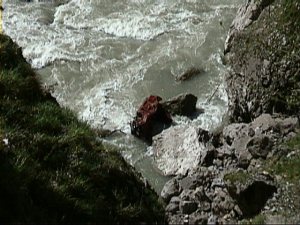
Ravine at the side of the road from Sochi to Krasnayapolyana
Ravine at the side of the road from Sochi to Krasnayapolyana

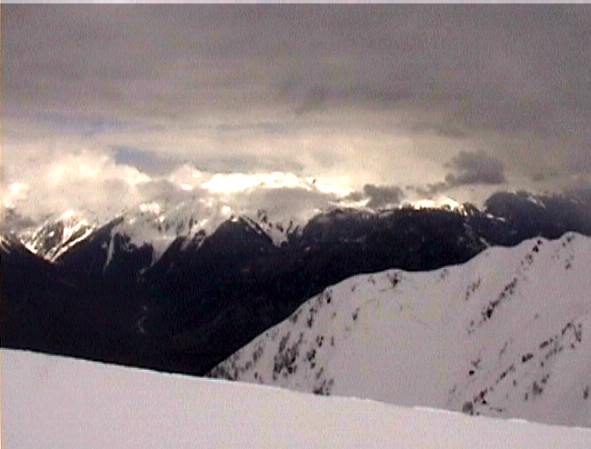
Everlasting snows at Krasnayapolyana
Everlasting snows at Krasnayapolyana

Colleagues and friends in Krasnayapolyana in 1995
Colleagues and friends in Krasnayapolyana in 1995

Wild pigs wandered by as we prepared our picnic
Wild pigs wandered by as we prepared our picnic

A fresh picnic in the beautiful and still unspoilt Krasnayapolyana 1995
A fresh picnic in the beautiful and still unspoilt Krasnayapolyana 1995
Happy New Year

Happy New Year to all the lovely, talented, thoughtful and spiritual people who read and comment on my humble blog.  I have had so much pleasure from your posts and feel that I have got to know most of you personally.  2013 was such a busy year that I have not always managed to write as much as I would wish to, but in 2014  I will aim to be more focused!

The greatest joy of 2013 was watching little Stanley, my grandson, grow.  He was 1 year old on 1st December and he now walks and is a delight in every way.

If you want to see just how much he has changed and what he means to me you could re-read some of my posts about him.


I am a grandma!

Wishes and a quilt for Stanley

Pain

Small Stones 5 ~ Stanley’s first smile

Stanley’s growing up healthy ~ Haiku

New baby

Small Stones ~ Starry Night Haiku

Modern Madonna ~ Haiku Heights Day 7

Ripples


See how he has grown
Stanley with his first toolset 1

The Remembering Tree, 2013. Bancroft Gardens, Stratford upon Avon

Well it has been a strange and wonderful weekend with its usual ups and downs.

The weather was so lovely today that I set off for Stratford on Avon, where I spent my teenage years, to see the spectacular Christmas lights and decorations.

I always enjoy the walk from Holy Trinity Church, Shakespeare’s final resting place, past the Dirty Duck pub where I spent many a happy evening in the 60’s hobnobbing with the likes of Eric Porter, John Hurt and David Warner, through the park, across the Royal Shakespeare Theatre balcony, along the riverside towards the Bancroft Gardens.  I love to pop into the theatre just to see what is coming up ~ Peter Pan and Wendy starts this week (tickets still available), as does the stupendous Wolf Hall and Bring up the Bodies (totally sold out before opening night)!

I usually drift over to the canal basin to see the houseboats before heading into town.  Today however, I was stopped in my tracks by a spectacular tree which seemed to be covered in one of those blankets made out of colourful knitted squares, which is exactly what it was!

I discovered that it was called the Remembering Tree and people had worked from 4am to 11am to fix all those squares in place in memory of someone they loved.  Money raised by this venture was going to a charity which you can read about here.

As it got dark I headed up Bridge Street to see the colourful lights before reaching my destination ~ Shakespeare’s Birthplace.  This year the house is transformed by a laser light show accompanied by some excerpts from Shakespeare’s plays being enacted from inside the house.  It is truly worth seeing.  I apologise in advance for the poor quality of my photos which is partly due to the crowds, partly to my excitement and partly to my battery failing!

Leaving the light show I was stopped in my tracks by a busker singing the most beautiful songs in a tenor voice which flowed like warm chocolate on a cold and frosty night.  After singing his own songs, he sang requests from the small crowd that gathered.  he then sang Christmas Carols.  His name is Karl Loxley and the crowd were deeply disappointed to find that he had no CDs to sell!  Hopefully he will soon and I will certainly be listening out for him.  Listen to Karl sing Bring Him Home.

So those are all the ups in my day ~ only one down to report ~

I was so excited to arrive in Stratford that I forgot to pay for parking!  Of course Stratford wardens are like Rottweilers and they don’t miss a thing ~ so I got a parking ticket.  Do you know it was worth it because I felt as if I had been to a free concert and I had a lovely day!

Garden of Remembrance

Prompted by Haiku Heights theme of ‘grass’, I decided to write about the beautiful garden of remembrance I visited in London this week.

Wreathed in fallen leaves

A sea of wooden crosses

And scarlet poppies

~~~~~~~

Lawned garden of grief

A moving memorial

Heroes remembered

This week I have been in London, and I was fortunate to be passing Westminster Abbey at just the right time to see an amazing spectacle.  Wreaths were being laid to mark all those brave men and women who fought and died in the service of our country.  Several members of the Royal Family were there to honour their sacrifice.  Movingly the Duke of Edinburgh and Prince Harry laid crosses of remembrance in front of two wooden crosses from the Graves of Unknown British Soldiers from the First and Second World Wars.  Every conceivable branch of service was represented by wreaths and crosses of all shapes and sizes.  This year there are 388 plots and 100,000 crosses. 

There were poignant photos on some of the displays.  Particularly moving were the crosses to mark those who have died in recent conflicts in Afghanistan and Iraq.

I was very impressed by the huge wreaths made up of hundreds of poppies representing our Army, Navy and Air force.  My father and my husband’s father were both in the Navy during WW2.  But, I spent a long time searching for the display to commemorate the Durham Light Infantry which my grandfather, Frederick Charles McCluskey, belonged to for almost 40 years.   He was born in 1899 and he joined up at the age of 14 years 8 months to fight in the first world war.  He was sent to France at the age of 17 as a bugler!  He survived that war and went on to fight in the Second World War.   He was one of the Desert Rats  and fought with the Durham Light Infantry at El Alamein. He wrote an account of that battle, a copy of which I still have.

Grandad never talked about the war but he kept wonderful photo albums of the places he visited during the second world war.  It wasn’t until after he died that we read in the newspapers of some of his exploits when they called him a hero:~

“Tyneside war hero, Major Frederick Charles McCluskey who played a leading role in a legendary desert trek to freedom, has died at the age of 88.
In June 1942, he and 200 men from The Durham Light Infantry‘s 9th Battalion evaded fierce enemy fire to escape after being surrounded by a division of Rommel’s desert army at gazzala, North Africa.
They travelled 350 gruelling miles to safety.  Major McCluskey, who lived in Milvain Avenue, Benwell fought in both world wars.”

I am very proud of him.

Ballet

Inspired by Haiku-heights September Challenge ~ Day 5 ~ Ballet

In the 1960s I was still living in Stratford on Avon studying A Levels at Shottery Manor, which was the Girl’s Grammar School.  I have written a post before about the unforgettable year that was 1964 ~ Shakespeare’s quartercentenary.  I was totally immersed in the Shakespeare memorial Theatre at that time and met many very interesting and exciting people.  One of those who stands out for me was Rudolph Nureyev.  He had only recently begun his life-changing dance partnership with Margot Fonteyn.  Who could ever forget their performance of Romeo and Juliet ?  It could be that he is responsible for my deep connection with the Russian culture, language, and people.

Devoted to dance

A picture of perfection

Two souls become one

Rudolf Nureyev and Margot Fonteyn in La Bayadère.

September started off very busy for me so posting my haiku has been a challenge too far!  However I think I have caught up now so if you have time you can read my earlier posts here:

http://wp.me/p2gGsd-Ou Shepherd

http://wp.me/s2gGsd-silver Silver

http://wp.me/s2gGsd-guardian Guardian

http://wp.me/p2gGsd-11m Frog

Silver

Inspired by Haiku-heights’ September Challenge Day 3 ~ Silver

Each night I take my little dachshund Dayna out to wander in the garden before she goes to bed.  I love to sit at the end of the garden under the gazebo, where it is very dark and totally quiet, to watch the sky and enjoy the last few minutes of the day.  Recently I have been enjoying the tail end of the Perseid shower of shooting stars.  Last night I saw a beauty which seemed much higher than the others I have seen.

Silver arrows pierce

The depths of distant darkness,

And faraway fall

~

Meteorites make

Momentary magic, leave

Lasting memories

~

Shooting stars shatter

The celestial stillness

With their final show

~

I can’t resist reposting a haiku I wrote when my grandson was just a few weeks old!

On a soft white cloud

As silver stars surround him

He silently sleeps

photo (7)

Look at him now just 9 months old!

299


Guardian

Inspired by haiku heights September Challenge day 2 ~ Guardian

When I am troubled
Take me to a quiet place
To rest with angels

Frogs in Torun

Through towering trees

Strange sounds are carried from a

Bog seething with frogs

Sunday’s prompt for Haiku Heights’ September challenge is the word ‘Frog’.  My mind works in mysterious ways and the prompt instantly took me back to 2004 when I travelled with a group of friends from Global Footsteps, to take part in a conference in Torun, which is in Poland.  I’ve written about it before but I think it is worth revisiting.

Frog in Torun

There is a wonderful fountain in the centre of Torun with several statues of frogs in it.  It is called the Flisakiem fountain.  Flisak was a raftsman in Torun who played the violin very well.  According to an old legend, the city of Torun was overrun by a plague of frogs and no-one knew how to get rid of them.  The Mayor promised the hand of his daughter in marriage  to any person who could clear the city of the frogs.  Of course, rather like the Pied Piper of Hamelin, Flisak played so well that all the frogs followed him and left the city of Torun.    He claimed his reward and married his beloved and they lived happily ever after.

It was on a chilly June morning in London that we caught the ‘Orbis’ coach for the 36 hour journey to Torun.  The bus was not full so there was plenty of room and it was very comfortable.  The friendly hostess, Isabella, served tea and coffee and we had a pleasant journey to Dover where we caught the Ferry to Calais.  The weather was very pleasant and we had an enjoyable crossing.  The channel was unusually busy because it was the 60th Anniversary of the D Day Landings.  Old soldiers were gathering for a memorial service.

We got back onto the coach and set off northwards through France, Belgium, Netherlands and Germany, crossing the River Oder at the Polish border town of Slubice.  We were expecting long delays at the border but were astonished to be met by smiling customs officers who briefly checked our passports and waved us through with no problems.  This is a very encouraging development since Poland joined the European Union this year.  Already the scenery was fascinating to me and the weather was beautiful.   I noticed the narrow cobbled roads in the towns, the many shrines by the roadside in the country and lots of churches.  There was an abundance of pine tree forests and masses of poppies on the verges.  I was thrilled to spot a stag and a hare and then amazed to see storks in the fields and a flock of herons.  We were travelling on Route 22 towards the city of Gdansk.  We saw flats along the way that reminded me of Russia, and a huge river with men fishing.  Petrol stations were Statoil and fuel was 4.0 zl, about 60p, I guessed for a litre.  We saw agriculture everywhere – endless fields of crops with no fences; allotments with dachas like grand sheds; orchards; lakes and picnic spots; and miles of greenhouses and garden centres.  We saw timber-framed houses and lots of new buildings, but we saw very little livestock.  In Belgium and Germany we had seen herds of very healthy looking cattle but none at all yet in Poland.  We saw big churches with round towers, Rapunzel-style, and the remains of old city walls were evident in many towns.

At Bydgostcz we stopped for coffee and met a Polish-Canadian-Scot who reminisced about D-Day, when he was 15 years old.  He told us how he had been taken away from his village in Poland by the German occupying forces.  They had forced him to fight for them.  He was saved by the US troops who eventually offered to take him to the USA to start a new life. He had opted for Canada and eventually married a Scottish lady and went back with her to Scotland.  He has now retired to Vancouver Island in Canada but visits Poland as often as he can.

On entering Torun we saw storks on huge nests on top of telegraph poles.  When the coach stopped a friend was there to meet us.  He took us to the TTCA building to rest and unpack before we met our group leader who treated us to a meal at Damroki restaurant.  The food was delicious and we were entertained by an impromptu folk concert performed by groups from all over Eastern Europe, who had attended the Folk Festival in Torun earlier in the day.

stork

On Monday, Ula (or Ursula), who is a professional guide, met us at the TTCA.  Thankfully she speaks English very well, self-taught we later found out.  She is going to give us a 5-hour tour of Torun.  She was a mine of information and she showed us everything of interest in the old and new town.  We walked miles until we were ready to mutiny so she took us to her favourite coffee shop.  This was wonderful so all was forgiven.  We drank a special coffee like Cappuccino with Pierniki sprinkled on top.  Pierniki is gingerbread, which is the local speciality.  Later Ula took us to a restaurant, which served pancakes and dumplings with exquisite fillings and lashings of strawberries and cream on top.  We were a little puzzled, as they seemed to put savoury and sweet fillings all together and the portions were way too big, however it was very enjoyable.  After our marathon walking tour we went back for a well-earned rest and shower before dinner.

We were amazed at the low prices of meals in Torun.  It varies of course but it was possible to get a very good meal and a drink for less than £2.  Coffee and delicious pastries with fruit and cream cost less than £1.40.  Kodak films for my camera (pre-digital cameras!), which cost £4 in the UK cost £1 here and a loaf of freshly baked bread from the bakers cost about 23p.  We just cannot imagine how the shopkeepers manage to sell their goods at these prices and still make a profit.  We are worried that the cost of living may rise dramatically now that Poland has joined the EU.

Public transport is very reasonable here and accommodation is good.  Rents seem very cheap at £75 a month for a 1 bed roomed, central flat.  Big US hotel chains are moving in with high priced rooms but there are still bargains to be had for the traveller or tourist.  We stayed at the Twin Town Association building, which is in the restored Burgher House and Tower of the ruined Teutonic Castle.  The large rooms have been refurbished to a very high standard and we shared bathrooms and a kitchen as in a Youth Hostel in UK.  It was comfortable and cheap and, with fabulous views of the River Vistula from our windows it suited us very well.

On Tuesday our guide met us at 8 am and rushed us off to catch the bus to the railway station where we caught a train for the 90-minute journey to Gniezno.  The city is known as the cradle of the Polish state as it was in the Cathedral here that the first King of Poland, Boleslaw Chrobry, was crowned in 1025.  We rushed to the Cathedral of the Assumption of the Blessed Virgin Mary and St Adalbert, founded 1000 years ago by King Boleslaw the Brave.  Here we saw the famous bronze doors from 1175, which show 18 scenes from the life of St Adalbert.  We also saw the statue of Our Lady of Gniezno and the sarcophagus of St Adalbert.  St Adalbert was a Bohemian Bishop from Prague who passed through Gniezno in 997 on a missionary trip to convert the Prussians, a heathen Baltic tribe who lived in N E Poland.  Sadly they didn’t want to be converted so they chopped his head off.  King Boleslaw paid a ransom of his weight in gold for the body then brought it back to Gniezno and buried it in the Cathedral in 999.  Pope Sylvester then canonised the martyr.

After this very short visit we rushed off to catch a narrow gauge train to Biskupin.  This trip was organised as a treat and was a major highlight of the trip for me.  Gorgeous weather and fabulous countryside edged with poppies, and white and purple wildflowers.  Biskupin was besieged by children on school trips but was very interesting.  It was a sort of Baltic Blists Hill, with characters in costume minting coins, chopping wood, firing crossbows and riding horses etc.  The ‘iron age’ fortified town was built entirely of wood some 2730 years ago on the shore of a beautiful lake.  It was subsequently disappeared under a peat bog where it was perfectly preserved until 1933 when it was discovered by accident.  It is now a fascinating archaeological reserve and one time film set.

Wednesday was another gorgeous day arranged for us by a local friend, Anya.  We started with a bus ride to the bike shop where we hired bikes.  It took an age to organise this because the shop appeared to only have huge mountain bikes, which were fine for the men but not for we 3 delicate and very fussy ladies!  We ended up a very motley selection with one on an ancient ‘sit up and beg’ shopper complete with basket, dodgy gears and a mudguard, another on a man’s bike with sticky red handles, and me on a junior BMX!  After lots of giggles and false starts we set off for a 23 km round trip to Anya’s home for a barbecue.  We cycled through the forest and past vast poppy fields and a bog seething with very vocal frogs.  When we reached Anya’s home village of Lysomice we saw stork families on top of telegraph poles.  Then we were treated to a super barbecue and lots of homemade blackcurrant drinks, some alcoholic and some not!  We also met Killer the guard dog, who eats cucumbers, and had a guided tour of garden and greenhouses where Anya’s family grow tomatoes, cucumbers, fir trees and flowers to sell at the local Farmers’ Markets.  The whole day was absolutely wonderful and we really enjoyed the cycle ride home to Torun.  I was very proud of myself since I hadn’t been on a bicycle for 25 years!

Thursday saw the Feast of Corpus Christe and being a Catholic country, the celebrations were massive so we had a free day in Torun.  After the 9am Mass in the churches and 2 Cathedrals, the entire congregation left to process through the streets to the square where decorated altars had been set up.  There were columns of nuns, altar servers, guides, scouts, priests, and rows of young girls in long white dresses and veils.  They carried baskets of flower petals, which they scattered on the ground in front of the canopy covering the Priest and the Monstrance containing the sacred host.  There was a military band leading the procession and a vehicle at the rear with loudspeakers amplifying traditional hymns.  The processions came from all quarters to meet near Copernicus’ statue.  There was a huge poster showing Pope John Paul 11 who visited Torun in 1999.  A service was held here before the whole procession moved on to another square for another service.  The crowd was huge and everyone was dressed in their ‘Sunday Best’.  The windows and balconies of many houses and businesses were hung with posters, tapestries, candles, statues and mini shrines to celebrate the Feast Day.  The Priests and altar servers wore white cassocks with embroidered or lacework chalice and host decorations.  It was a grand occasion and a privilege to watch.  It reminded me of May processions in the North of England when I was a child.

In the evening we visited the Fort and saw a huge fire on the horizon.  We never did find out what building was on fire.

On Friday we had a very early start again for the 7.45am bus to the railway station to catch the train to Malbork.  The journey took just 2 hours so we arrived in time for a lovely cup of coffee in the shopping centre.  Sadly when we came out the heavens had opened so we had to buy umbrellas.  The rain was torrential but nevertheless we set off for Mary’s castle.  This is reputed to be Europe’s largest Gothic castle and Poland’s oldest castle.  It is so important that in 1997 it was included in UNESCO’s World Heritage List.  It is situated on the Nogat River, an eastern arm of the Vistula River, which flows through Torun.  It is a truly impressive and huge reconstruction.  The castle was built in three parts (higher, middle and lower castle) by the Teutonic Knights, who called it Marienburg (Mary’s Fortress).  The Teutonic Knights, a German order, were also called Knights of the Cross.  Their commander in chief was called a Grand Master.  They were crusaders who wore white robes with a black cross.  The castle was started in 1276 and finished within 30 years.  The Knights ruled from here for 150 years.  It was the largest fortress in the middle ages, but the castle, like Poland, had a very stormy history being in the hands of various conquering armies then largely destroyed in World War Two.  It is now in danger from subsidence.  Inside the castle there are several notable exhibitions.  There is a room full of tapestries and a room full of exquisite jewellery boxes, altars, crucifixes, artwork and jewellery all made purely from amber.  There is also a bombed out church which has not been renovated due to lack of funds.  This is breathtakingly poignant with its battered walls and statues, and the miraculously undamaged boss of the Mother and Child.  The memory of the broken crucifix will stay with me always.  This empty shell of a church was the most moving thing I saw in Poland and for me it illustrates the total pointlessness of war.

Saturday was a very special day and we had to get up very early for a bus and train journey to Gdansk.  The area was referred to a Gyddanyzc (Gdaniesk) or wetness in 999 in “The Life of St Adalbert”.  There was a settlement here as early as 2500BC and by the 13th century when the Teutonic Knights seized the city it was a major port and municipal centre.  In 1454 the city broke free from the Knights and became a part of Poland.  Over the next century there was incredible economic development in the city, which had a monopoly of trade in Polish grain.  The city also became the largest town in Poland and a great centre for shipbuilding.  1580 to 1650 was a ‘Golden Age’ when artists and craftsmen settled here and the city became a centre of artistic and cultural style.  In 1793 during the second partition of Poland the city was annexed to the Prussian state and underwent a long period of Germanisation, briefly interrupted by a period of French rule in 1807 to 1814.  After 1850 there was another economic boom due mainly to the railways, the port and shipbuilding.  In 1920 after WW1 due to the influence of the Britain the free city of Gdansk was created under the patronage of the League of Nations.  However it then fell to the Germans in WW2 during which the Polish citizens of Gdansk were exterminated in concentration camps.  Allied forces carried out air raids then the Soviet Russian troops almost destroyed the city and ruined its industrial base.  After WW2 the Germans were expelled and thousands of new inhabitants set about rebuilding the city.  I think they did a wonderful job as the city is incredibly beautiful.  Peace did not last long though, because between 1970 and 1980 workers’ protests turned violent and prompted great social and political changes in Poland.  In 1997 the city ceremoniously celebrated the millennium of the visit of St Adalbert Slawnikowic, the Bishop of Prague who left Gdansk in 997 on a Christian mission to then still pagan Prussia.  In 1992 and 1999 Pope John Paul 2 visited Gdansk.

We explored as much as it was possible to see in a day.  We saw the shops, the churches and cathedrals, the memorial to the fallen shipyard workers and then caught a tram to the beach and paddled in the Baltic.  It was a wonderful day and Gdansk is a place that everyone should visit.  It is a city with everything in my opinion.  It has history, culture, spirituality, beautiful buildings, wonderful people and a golden sandy beach.  What more could anyone want.