The Joys of Cornwall

Derelict mine building at Wheal Coates3

Old tin mines stand tall

Telling stories of the past

On Cornish coastline

I recently spent another lovely week in Cornwall. I wanted to be near the sea while still being near Truro for my hubby’s regular dialysis sessions, so I opted for a cottage in St Agnes. St Agnes is a beautiful, unspoilt little town on the North Cornwall coast. It is full of fascinating relics from the days when tin and copper mining was the main industry. It seemed strange to me to see derelict tin mines visible from behind houses and forming the boundary walls of gardens. In fact tin is still produced in St Agnes at the Blue Hills Mine, the only place in the UK that still produces it. St Agnes is an area of outstanding natural beauty and it has been designated a World Heritage Site. I can certainly see why. I just loved the rugged land and seascapes. Even in our state of unfitness we were able to walk some of the coastal path. This leads to sights that can never be appreciated from the road. One of these is Wheal Coates Mine. It is truly amazing when seen from a distance with its three shafts and its spectacular position on the side of the cliffs. In fact the mine goes all the way down to the sea and at high tide you can hear the waves crashing against rocks through a grid in the ruins. It was possible to get into this mine via a large cave at a nearby beach. There is a local legend that says Wheal Coates is haunted by the spirits of the miners who died there. I expect the eerie sounds of the sea account for the legends.
I’ve always been interested in industrial buildings. I guess this is mainly due to my father’s influence as he was a steel man from the age of 13 and he developed in me a passion for ships, bridges and buildings. The other reason could be because of where I grew up. I lived in the Felling, a shipbuilding and mining area in the North of England. I skipped past the railway station and shipyard every day on my way to school and there was a derelict engine house complete with winding gear at the end of our street of 2 up and 2 down back to back miners’ cottages. These were our adventure playgrounds. Children were never allowed to play on the grass or ride bikes in the municipal parks in those days! Parks were for floral displays and grown-ups to walk in and the park warden was fierce.
Being a traditional and romantic sort of person I regret that industrialisation almost destroyed the crafts of blacksmiths, weavers, spinners, millers and grinders. But I find there is great beauty to be found in the derelict buildings, in the machinery that drove the mines and the mills, and in the engines that turned their wheels and moved their goods

Around St Agnes there are beaches, bays and coves with caves where wreckers and smugglers, no doubt, once hid their treasures. We visited a pub reminiscent of Jamaica Inn. The pub is called the Driftwood and it has a fascinating history. It is a 17th century building which in its time has been a warehouse for the tin mines, a ships’ chandlery, and a sail maker’s loft, before becoming a characterful old pub. It is built of Cornish stone and slate and ship’s timbers and spares. Behind one of the fireplaces in the pub there is a tunnel which was uncovered during restoration. It is said that this was the secret escape route for the wreckers and smugglers of the area as it leads all the way to the beach.

The cottage we stayed in was perfect and my joy was complete when my daughter came to stay for a couple of days with my adorable grandson. He just loved the sea and sand, the horses in the paddock and the trampoline in the garden. We took him to Lappa Valley Railway, which is kiddie heaven in my book. Built on the site of yet another ruined mine, there are castles and treehouses and adventure equipment to satisfy any age. There are also 12 steam engines giving rides on trains which Stanley really loved. There is also a boating lake, café, shop and everything you could want for a fun day out. I loved it.

Home


Sadly it will be another year before I can go away again due to the shortage of holiday dialysis spaces around the country. But until then I have my photos to remind me of the fun we had and the beauty of Cornwall. Enjoy!

All of a Flutter with Real Confetti

confetti fields 17

We took a drive out on Friday to a lovely part of the Cotswolds, the village of Wick near Pershore. I was keen to see the fields of Delphiniums at Wick while the weather was good.
Acres of delphiniums are grown by Charles Hudson on the Wyke manor Estate, which are dried and sold as natural confetti for the Real Confetti Company. Apparently delphiniums, apart from growing in a range of vibrant colours, keep their colour indefinitely once they are dried, while rose petals go brown, carnations go black and marigolds shrivel up. This makes delphiniums perfect for confetti. Being totally natural, they biodegrade and don’t litter up churchyards and wedding venues, many of which have banned paper confetti for this reason.  I was told that when Prince Charles and Camilla came out from their wedding the young royals, William, Harry, Zara and others threw real confetti from Wick over the happy couple.
The village of Wick is a delight to behold. It is really ancient and retains every bit of its character. It must be the quintessential English village with its old church, thatched cottages and beautiful manor house.
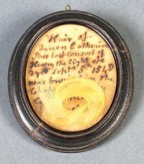
The original manor was called Wyke Manor, using the ancient spelling, and it had a very long and illustrious history. It was owned by John Nevill, 3rd Lord Latimer, involved in the Pilgrimage of Grace in 1538. Upon his death in 1543, he willed the manor to his widow Catherine Parr. Catherine later married King Henry VIII (28 June 1491 – 28 January 1547) as his sixth and last wife in July of 1543. She was 31 years old and he was 52. The marriage didn’t last long as Henry died in 1547 so Catherine outlived him. A small piece of Catherine has returned to the Manor recently as a lock of her hair came up for auction. The hair is mounted in an oval frame on ink-inscribed paper which states “Hair of Queen Catherine Parr, Last Consort of Henry, the night she died September 5th 1548 was in the Chapel of Sudeley Castle”. The current owner of the manor, Charles Hudson, paid £2,160 for the hair, in order to return it to the manor.
Catherine Parr's Hair
After Catherine died, the estate passed to Anthony Babington, who was later executed for treason after plotting to kill Queen Elizabeth I! It then passed to Sir Walter Raleigh, who was also executed.
The Hudson family have owned the Wyke manor Estate since the 1760s and the current owner is Charles Hudson and his wife, the writer Cressida Connolly. I was fascinated to learn that Cressida is an authority on Ladybird Books, which I have always rated highly.

I have recently been told that the house which is now on the Wyke Manor Estate was partially rebuilt in the 1920s in the Elizabethan style.  I am grateful to Paul, a resident of Wick, for this update.

The people of Wick that I met were absolutely lovely and pointed me in the direction of the shop at the back of the manor house. This is not like any shop I have ever seen before. It is literally a part of the stable block and there are children’s bikes scattered all over the yard. Inside the ‘shop’ a lovely young lady, who must have the best job and workplace in the world, was boxing up exquisite dried petals into pretty boxes. Along one wall is a vast array of open boxes each containing different coloured dried petals. The smell and colour and atmosphere is hypnotic. I felt as if I had walked into a fairytale. Honestly, if you get the chance you just have to go along and experience it.
Well I spent so long soaking up the atmosphere that it was getting decidedly overcast by the time I headed off to the actual confetti fields. But I rushed to get as many photos as I could before the light failed, the heavens opened and I got soaked! It was definitely worth it though. Enjoy my photos.

Fireworks for Shakespeare’s 450th Birthday

shakespeare1

Tonight there will be the start of the celebrations in honour of William Shakespeare’s 450th Birthday. The celebrations will be spectacular in Stratford on Avon, his birthplace and the home of the Royal Shakespeare Theatre. Resurrecting an old tradition, there will be a massive firework display over the River Avon behind the theatre. The display starts at 10.40 so it will be a late night for me but I am hoping to get a good view from the bridge in the Bancroft Gardens. I used to walk this way to school every day when I was a teenager so it will bring back lots of memories.

In addition to traditional pyrotechnics, the special birthday display will feature an 8 metre high frame (note this is smaller than the 1830 one!) depicting Shakespeare’s face, which will light up in ‘stars’ made of fireworks. It will be based on the Droeshout engraving of Shakespeare from the First Folio, and reminiscent of Juliet’s lines about Romeo~

Take him and cut him out in little stars,
And he will make the face of heaven so fine
That all the world will be in love with night
And pay no worship to the garish sun.

If you haven’t read my blog about the 400th Birthday celebrations you can find it at this link~ http://wp.me/p2gGsd-5c

There is also a wonderful Shakespeare blog here ~ http://theshakespeareblog.com/2014/04/fireworks-for-shakespeare/

Palm Sunday 2014

I have celebrated Palm Sunday in many different countries, Kenya, Spain, France, Poland, Italy and UK and it is a church tradition that I love. When I was at work (teaching primary children) one of our jobs was to make the palm crosses for the local church each year. It was an eagerly awaited treat for the 10/11 year olds in their final year of primary school, to learn how to weave and fold the crosses from simple palm leaves.
I have written about other Palm Sundays before and the links are below if you would like to read them. I hope you do.
This year I am laid up in bed with a very nasty case of tonsillitis on antibiotics so I have not even seen a palm!
But I did look at the Vatican website to see the celebrations in St Peter’s Square. My overriding impression is that this Pope, like Jesus, is adored by the people because of his common touch and understanding of what it means to be poor in this world. But my fear is that like Jesus, he is rattling too many cages and there will be those who plot against him. I also see in his face that after only a few months in the job he is looking exhausted and strained.
Two Haiku I wrote last year sum up my fears.

Pope Francis Pope Francis

Cheering throngs gather

In Messianic fervour

Fronds fall at His feet
~
Calling for His death

Crowds that cheered Him now decry

Innocent, He’ll die

You can see the Palm Sunday in Rome here http://www.news.va/en/news/pope-to-celebrate-palm-sunday-mass-in-saint-peters
And my previous Palm Sunday posts are here:~

Palm Sunday 2012

Krakow today

Lenten memories of Lourdes

Cornwall here I Come

I am so thrilled to be going back to Cornwall for a holiday this year. A holiday and travel in general is a rare treat since my hubby started dialysis some years ago. We can only go to an area with a hospital that offers holiday dialysis ~ and has a vacant week. Twice we have been fortunate enough to get holidays in Dorset and I have written about those before.
Last year we travelled to Truro where the general hospital also offers holiday dialysis. Having never explored Cornwall I had great plans of all the places I wanted to see. But my hopes were firmly dashed when the car broke down before we even got to our hotel!
There’s only one thing to do in those circumstances I find ~ write a poem ~ so here it is…

I came for cool, clean, salty air
For cloudless skies and seagulls
I came for peace, tranquillity,
For time to think of only me

I came to stop, to rest, to think
To wander country lanes
I came to taste delicious meals
And sparkling wines to drink

I came this county to explore
Its hillsides, gardens and seashore
‘Til my car broke down it was going so well ~
Now I’m confined to my hotel!

I did manage to visit some tin mines,  the Lost Gardens of Heligan and the Minack Theatre once my car was fixed, and you can see photos of them by clicking their links.

Here are some photos I didn’t manage to post…

The Winter Olympics in Sochi and Krasnayapolyana

The Winter Olympics in Sochi and Krasnayapolyana

As the Winter Olympics in our twin town of Sochi gets underway, I am totally glued to the TV to see how much this beautiful area has changed. I remember the many exciting journeys I made to Sochi, and Krasnayapolyana in particular almost 20 years ago. Russia was a totally different place the first time I visited. It was not long after Perestroika and there was still a gloomy rather austere atmosphere reminiscent of Stalinist times. I have written many blogs about my visits to Russia and if you would like to read them you can click on the links below. But I really feel driven to write about one particularly magical place again. This is Krasnayapolyana which is where many of the Olympic events will be held. If you went there today you could never imagine that only 20 years ago it was officially recognised as a totally unspoilt area of outstanding natural beauty. I was lucky enough to spend some time there with my Russian friends and a work colleague, Liz.
Liz and I got up very early one morning at the Hotel Moscow in Sochi. We were being taken on a trip to the Caucasus Mountains for the day. We skipped breakfast and went out to meet Igor, his young daughter Anna, the 2 Natalya’s, both Headteachers, Irena, our interpreter, and another couple. We were driven out of Sochi along the airport road in two Ladas. We followed the Black Sea coastline until we reached the ‘new’ airport which was being built by construction workers from Yugoslavia, as it was then. Apparently they never have enough money for materials so the job is taking years to complete. However, what they have built looked very modern, even futuristic, and very impressive.
At this point we turned inland towards the mountains. We could not go straight on as this was the road to Georgia and there were still Russian tanks along the border to stop refugees from the Abkhazia/Georgia conflict from coming into Russia.
From here on, the journey took two or three hours, passing some of the most spectacular scenery I have ever seen. It reminded me of the best of the Pyrenees with shades of Canada. The colours of the ancient forests of broadleaf trees were indescribably beautiful: Reds, yellows, oranges and all shades of green glinted in the glorious early morning sunshine. Above these trees were the alpine forests of evergreen trees, and beyond those, the everlasting snows. This was the home of the Russian bear, the mountain cat, the black Ousel, the wolf and much more.
All the time we were driving along the course of the Mzymta or ‘wild river’, as its name translates. This river is icy cold, deep and treacherous, coming straight from the snow-capped mountains. I was told that there are 1 metre long red fish (presumably salmon) in this river. The road got steeper, and narrower, and more winding as it climbed higher into the mountains. There were many interesting stops; the Men’s Tears Waterfall, the Ladies’ Tears Waterfall, the ancient cave where Neolithic tools have been found, the memorial to the Red Army soldiers from Krasnapolyana who were butchered and thrown into the ravine in 1927 during the civil war, to name just a few. The road was so dangerous that we could not get out and take many photographs unfortunately.
Eventually we arrived at the village of Krasnapolyana where Igor was born. It was like going back to medieval times in England. There were very few cars, and ours had to drive dead slow to avoid the pigs, hens, cows and dogs wandering at will through the main (and only) street of the village. There were very few people around but one or two slowly plodded by. The pace of life in this village is so slow that it seems as if at some point time stopped, stood still, and then started to go slowly backwards. All around there were little Hansel and Gretel cottages with tiny barns packed to the rafters with the harvest produce. Not a shop or a pub to be seen ~ just little old people living on whatever they could grow or rear, in little houses with little gardens.
We were told that the air and water is so pure here that people have been known to live to 130 or even 140 years old. Some years ago the world’s top biologists got together to stop a bid to hold the winter Olympics in the area.

They considered Krasnapolyana to have the purest and cleanest environment in the whole world.

I can believe it and I am so thrilled that I got to see it in this unspoilt state. It looked and smelled like Paradise to me.
At last we drove the last few bumpy metres through the forest to a clearing by the river. Here we stooped and got out of the cars. The sun was very hot by now and the air was soft, warm, and full of sweet perfume. It was explained to me that much of the greenery growing in the forest could be used for herbal remedies. Every bit of ‘grass’ I picked seemed to have an exotic smell and curative properties according to Natalya. As Liz and I wandered round in raptures at the scenery, the women in our group set about laying out a picnic area.
They emptied the two Ladas and laid out blankets, mattresses, sheets of cardboard, dishes, bowls, cups and saucepans. Then, out came flasks of tea and coffee, bottles of Russian Vodka and an amazing array of green salad, huge tomatoes, freshly made Georgian Lava bread and homemade cheese. Meanwhile the men returned from the forest with twigs, sticks and small branches. They set about building a fire with great precision. Apparently building a fire for cooking food is an exact science, and Russian men take great pride in it. Once the fire was lit, it was fussed over like a new baby until it was ready to put the meat over. Igor skewered three whole chickens which had travelled with us in a huge pan marinating in a batter flavoured with herbs and spices. The men collected water from the river and splashed the fire and the chickens regularly. They told me that this helps stop the chicken’s skin from burning and keeps it moist as it cooks right through. The smell coming from this outdoor barbecue was mouth-watering and I couldn’t wait to eat the food. Liz, being vegetarian, had been horrified by the whole process, but was glad to see a vegetarian selection cooking on a skewer at the edge of the fire.
As the men cooked, animals wandered by to take a look: a family of wild pigs complete with babies, cows of all sizes and shades, dogs and butterflies. It really was quite primitive and biblical and I was totally relaxed just watching and anticipating. When we did sit down on the ground to eat, the meal was superb. Every sense was alive with the sight, the feel, the smell and the taste of the food was complemented by the sounds of the fire spitting and the river rushing by. It was an amazing experience. At the end of the meal we wandered round with 10 year old Anna, writing our names on stones with stones, and drawing the animals we could see, rather as Neolithic man must have done in those caves we had seen. Finishing up, we cleared everything away and set off again to go further along the mountain track.
Liz and I were told that we were going to touch the everlasting snows. I had a dreadful feeling that we were going up the mountain on horseback. But then to our amazement we saw an old ski lift! Before we had time to panic we were sitting on this thing which climbed as far as the eye could see up into the snow-capped mountains.
I was not in the slightest bit bothered by it. I thought this totally untypical relaxed state might have been due to the environment, but Liz reckoned it was due to all the vodkas I had consumed at lunchtime! Either way I loved the splendid views from the top of the ski lift.
After this we set off on the homeward journey. We took detours to give messages to grandmothers, to buy curative honey from the bee farm, to drink coffee, and to see the hydro-electric station and reservoir that supplies these remote and fortunate people with their power. They seem to have everything they need in abundance and all naturally produced. It was a most unusual, thought provoking, pleasurable, and satisfying day. I was very sad to leave Krasnapolyana.
The views on the way down the mountain were even more spectacular than on the way up. The setting sun gave the already beautifully coloured autumn leaves a shimmering golden glow. The only hiccup occurred when I dropped my jar of medicinal honey from this wonderful place. The beekeeper had gone to so much trouble to find me a small jar and filled it for me to take home. But, it smashed to bits right outside our hotel. It seemed almost as if I was not supposed to take anything away from Krasnapolyana.
I have been back to Krasnapolyana several times since then and it has changed out of all recognition. There are new roads, helicopter pads, tourist hotels, new ski lifts and lots of palatial new houses. Mr Putin has a beautiful summer home there and skis regularly on the mountain. And, I am afraid that the 2014 Winter Olympics will bring masses of people and vehicles to this fragile but still beautiful area. I have mixed feelings about the mountain events in Krasnayapolyana, as my daughter is joint owner of USElite Ski camps which has helped train some outstanding skiers. However, I fear that the environment will be ruined. But I feel privileged to have seen it when it was still in pristine condition.

Russian Odyssey part 1
Russian Odyssey Part 2
Russian Odyssey Part 3
The Tree of Friendship

Ravine at the side of the road from Sochi to Krasnayapolyana

Ravine at the side of the road from Sochi to Krasnayapolyana

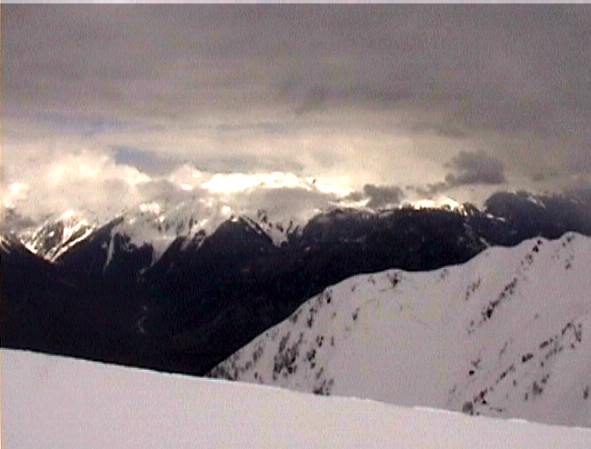
Everlasting snows at Krasnayapolyana

Everlasting snows at Krasnayapolyana

Colleagues and friends in Krasnayapolyana in 1995

Colleagues and friends in Krasnayapolyana in 1995

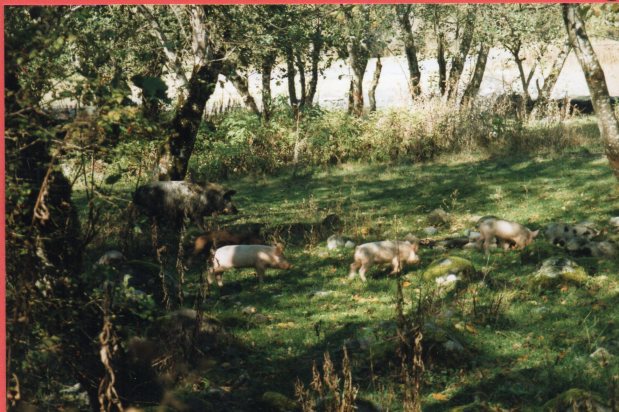
Wild pigs wandered by as we prepared our picnic

Wild pigs wandered by as we prepared our picnic

A fresh picnic in the beautiful and still unspoilt Krasnayapolyana 1995

A fresh picnic in the beautiful and still unspoilt Krasnayapolyana 1995

The Remembering Tree, 2013. Bancroft Gardens, Stratford upon Avon

Well it has been a strange and wonderful weekend with its usual ups and downs.

The weather was so lovely today that I set off for Stratford on Avon, where I spent my teenage years, to see the spectacular Christmas lights and decorations.

I always enjoy the walk from Holy Trinity Church, Shakespeare’s final resting place, past the Dirty Duck pub where I spent many a happy evening in the 60’s hobnobbing with the likes of Eric Porter, John Hurt and David Warner, through the park, across the Royal Shakespeare Theatre balcony, along the riverside towards the Bancroft Gardens.  I love to pop into the theatre just to see what is coming up ~ Peter Pan and Wendy starts this week (tickets still available), as does the stupendous Wolf Hall and Bring up the Bodies (totally sold out before opening night)!

I usually drift over to the canal basin to see the houseboats before heading into town.  Today however, I was stopped in my tracks by a spectacular tree which seemed to be covered in one of those blankets made out of colourful knitted squares, which is exactly what it was!

I discovered that it was called the Remembering Tree and people had worked from 4am to 11am to fix all those squares in place in memory of someone they loved.  Money raised by this venture was going to a charity which you can read about here.

As it got dark I headed up Bridge Street to see the colourful lights before reaching my destination ~ Shakespeare’s Birthplace.  This year the house is transformed by a laser light show accompanied by some excerpts from Shakespeare’s plays being enacted from inside the house.  It is truly worth seeing.  I apologise in advance for the poor quality of my photos which is partly due to the crowds, partly to my excitement and partly to my battery failing!

Leaving the light show I was stopped in my tracks by a busker singing the most beautiful songs in a tenor voice which flowed like warm chocolate on a cold and frosty night.  After singing his own songs, he sang requests from the small crowd that gathered.  he then sang Christmas Carols.  His name is Karl Loxley and the crowd were deeply disappointed to find that he had no CDs to sell!  Hopefully he will soon and I will certainly be listening out for him.  Listen to Karl sing Bring Him Home.

So those are all the ups in my day ~ only one down to report ~

I was so excited to arrive in Stratford that I forgot to pay for parking!  Of course Stratford wardens are like Rottweilers and they don’t miss a thing ~ so I got a parking ticket.  Do you know it was worth it because I felt as if I had been to a free concert and I had a lovely day!

Garden of Remembrance

Prompted by Haiku Heights theme of ‘grass’, I decided to write about the beautiful garden of remembrance I visited in London this week.

Wreathed in fallen leaves

A sea of wooden crosses

And scarlet poppies

~~~~~~~

Lawned garden of grief

A moving memorial

Heroes remembered

This week I have been in London, and I was fortunate to be passing Westminster Abbey at just the right time to see an amazing spectacle.  Wreaths were being laid to mark all those brave men and women who fought and died in the service of our country.  Several members of the Royal Family were there to honour their sacrifice.  Movingly the Duke of Edinburgh and Prince Harry laid crosses of remembrance in front of two wooden crosses from the Graves of Unknown British Soldiers from the First and Second World Wars.  Every conceivable branch of service was represented by wreaths and crosses of all shapes and sizes.  This year there are 388 plots and 100,000 crosses. 

There were poignant photos on some of the displays.  Particularly moving were the crosses to mark those who have died in recent conflicts in Afghanistan and Iraq.

I was very impressed by the huge wreaths made up of hundreds of poppies representing our Army, Navy and Air force.  My father and my husband’s father were both in the Navy during WW2.  But, I spent a long time searching for the display to commemorate the Durham Light Infantry which my grandfather, Frederick Charles McCluskey, belonged to for almost 40 years.   He was born in 1899 and he joined up at the age of 14 years 8 months to fight in the first world war.  He was sent to France at the age of 17 as a bugler!  He survived that war and went on to fight in the Second World War.   He was one of the Desert Rats  and fought with the Durham Light Infantry at El Alamein. He wrote an account of that battle, a copy of which I still have.

Grandad never talked about the war but he kept wonderful photo albums of the places he visited during the second world war.  It wasn’t until after he died that we read in the newspapers of some of his exploits when they called him a hero:~

“Tyneside war hero, Major Frederick Charles McCluskey who played a leading role in a legendary desert trek to freedom, has died at the age of 88.
In June 1942, he and 200 men from The Durham Light Infantry‘s 9th Battalion evaded fierce enemy fire to escape after being surrounded by a division of Rommel’s desert army at gazzala, North Africa.
They travelled 350 gruelling miles to safety.  Major McCluskey, who lived in Milvain Avenue, Benwell fought in both world wars.”

I am very proud of him.

Frogs in Torun

Through towering trees

Strange sounds are carried from a

Bog seething with frogs

Sunday’s prompt for Haiku Heights’ September challenge is the word ‘Frog’.  My mind works in mysterious ways and the prompt instantly took me back to 2004 when I travelled with a group of friends from Global Footsteps, to take part in a conference in Torun, which is in Poland.  I’ve written about it before but I think it is worth revisiting.
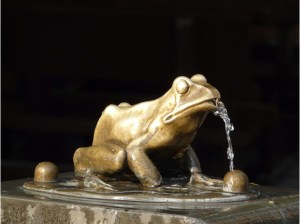
Frog in Torun

There is a wonderful fountain in the centre of Torun with several statues of frogs in it.  It is called the Flisakiem fountain.  Flisak was a raftsman in Torun who played the violin very well.  According to an old legend, the city of Torun was overrun by a plague of frogs and no-one knew how to get rid of them.  The Mayor promised the hand of his daughter in marriage  to any person who could clear the city of the frogs.  Of course, rather like the Pied Piper of Hamelin, Flisak played so well that all the frogs followed him and left the city of Torun.    He claimed his reward and married his beloved and they lived happily ever after.

It was on a chilly June morning in London that we caught the ‘Orbis’ coach for the 36 hour journey to Torun.  The bus was not full so there was plenty of room and it was very comfortable.  The friendly hostess, Isabella, served tea and coffee and we had a pleasant journey to Dover where we caught the Ferry to Calais.  The weather was very pleasant and we had an enjoyable crossing.  The channel was unusually busy because it was the 60th Anniversary of the D Day Landings.  Old soldiers were gathering for a memorial service.

We got back onto the coach and set off northwards through France, Belgium, Netherlands and Germany, crossing the River Oder at the Polish border town of Slubice.  We were expecting long delays at the border but were astonished to be met by smiling customs officers who briefly checked our passports and waved us through with no problems.  This is a very encouraging development since Poland joined the European Union this year.  Already the scenery was fascinating to me and the weather was beautiful.   I noticed the narrow cobbled roads in the towns, the many shrines by the roadside in the country and lots of churches.  There was an abundance of pine tree forests and masses of poppies on the verges.  I was thrilled to spot a stag and a hare and then amazed to see storks in the fields and a flock of herons.  We were travelling on Route 22 towards the city of Gdansk.  We saw flats along the way that reminded me of Russia, and a huge river with men fishing.  Petrol stations were Statoil and fuel was 4.0 zl, about 60p, I guessed for a litre.  We saw agriculture everywhere – endless fields of crops with no fences; allotments with dachas like grand sheds; orchards; lakes and picnic spots; and miles of greenhouses and garden centres.  We saw timber-framed houses and lots of new buildings, but we saw very little livestock.  In Belgium and Germany we had seen herds of very healthy looking cattle but none at all yet in Poland.  We saw big churches with round towers, Rapunzel-style, and the remains of old city walls were evident in many towns.

At Bydgostcz we stopped for coffee and met a Polish-Canadian-Scot who reminisced about D-Day, when he was 15 years old.  He told us how he had been taken away from his village in Poland by the German occupying forces.  They had forced him to fight for them.  He was saved by the US troops who eventually offered to take him to the USA to start a new life. He had opted for Canada and eventually married a Scottish lady and went back with her to Scotland.  He has now retired to Vancouver Island in Canada but visits Poland as often as he can.

On entering Torun we saw storks on huge nests on top of telegraph poles.  When the coach stopped a friend was there to meet us.  He took us to the TTCA building to rest and unpack before we met our group leader who treated us to a meal at Damroki restaurant.  The food was delicious and we were entertained by an impromptu folk concert performed by groups from all over Eastern Europe, who had attended the Folk Festival in Torun earlier in the day.
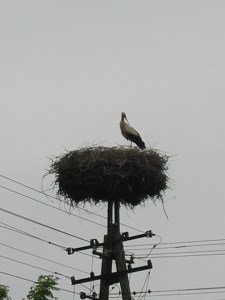
stork

On Monday, Ula (or Ursula), who is a professional guide, met us at the TTCA.  Thankfully she speaks English very well, self-taught we later found out.  She is going to give us a 5-hour tour of Torun.  She was a mine of information and she showed us everything of interest in the old and new town.  We walked miles until we were ready to mutiny so she took us to her favourite coffee shop.  This was wonderful so all was forgiven.  We drank a special coffee like Cappuccino with Pierniki sprinkled on top.  Pierniki is gingerbread, which is the local speciality.  Later Ula took us to a restaurant, which served pancakes and dumplings with exquisite fillings and lashings of strawberries and cream on top.  We were a little puzzled, as they seemed to put savoury and sweet fillings all together and the portions were way too big, however it was very enjoyable.  After our marathon walking tour we went back for a well-earned rest and shower before dinner.

We were amazed at the low prices of meals in Torun.  It varies of course but it was possible to get a very good meal and a drink for less than £2.  Coffee and delicious pastries with fruit and cream cost less than £1.40.  Kodak films for my camera (pre-digital cameras!), which cost £4 in the UK cost £1 here and a loaf of freshly baked bread from the bakers cost about 23p.  We just cannot imagine how the shopkeepers manage to sell their goods at these prices and still make a profit.  We are worried that the cost of living may rise dramatically now that Poland has joined the EU.

Public transport is very reasonable here and accommodation is good.  Rents seem very cheap at £75 a month for a 1 bed roomed, central flat.  Big US hotel chains are moving in with high priced rooms but there are still bargains to be had for the traveller or tourist.  We stayed at the Twin Town Association building, which is in the restored Burgher House and Tower of the ruined Teutonic Castle.  The large rooms have been refurbished to a very high standard and we shared bathrooms and a kitchen as in a Youth Hostel in UK.  It was comfortable and cheap and, with fabulous views of the River Vistula from our windows it suited us very well.

On Tuesday our guide met us at 8 am and rushed us off to catch the bus to the railway station where we caught a train for the 90-minute journey to Gniezno.  The city is known as the cradle of the Polish state as it was in the Cathedral here that the first King of Poland, Boleslaw Chrobry, was crowned in 1025.  We rushed to the Cathedral of the Assumption of the Blessed Virgin Mary and St Adalbert, founded 1000 years ago by King Boleslaw the Brave.  Here we saw the famous bronze doors from 1175, which show 18 scenes from the life of St Adalbert.  We also saw the statue of Our Lady of Gniezno and the sarcophagus of St Adalbert.  St Adalbert was a Bohemian Bishop from Prague who passed through Gniezno in 997 on a missionary trip to convert the Prussians, a heathen Baltic tribe who lived in N E Poland.  Sadly they didn’t want to be converted so they chopped his head off.  King Boleslaw paid a ransom of his weight in gold for the body then brought it back to Gniezno and buried it in the Cathedral in 999.  Pope Sylvester then canonised the martyr.

After this very short visit we rushed off to catch a narrow gauge train to Biskupin.  This trip was organised as a treat and was a major highlight of the trip for me.  Gorgeous weather and fabulous countryside edged with poppies, and white and purple wildflowers.  Biskupin was besieged by children on school trips but was very interesting.  It was a sort of Baltic Blists Hill, with characters in costume minting coins, chopping wood, firing crossbows and riding horses etc.  The ‘iron age’ fortified town was built entirely of wood some 2730 years ago on the shore of a beautiful lake.  It was subsequently disappeared under a peat bog where it was perfectly preserved until 1933 when it was discovered by accident.  It is now a fascinating archaeological reserve and one time film set.

Wednesday was another gorgeous day arranged for us by a local friend, Anya.  We started with a bus ride to the bike shop where we hired bikes.  It took an age to organise this because the shop appeared to only have huge mountain bikes, which were fine for the men but not for we 3 delicate and very fussy ladies!  We ended up a very motley selection with one on an ancient ‘sit up and beg’ shopper complete with basket, dodgy gears and a mudguard, another on a man’s bike with sticky red handles, and me on a junior BMX!  After lots of giggles and false starts we set off for a 23 km round trip to Anya’s home for a barbecue.  We cycled through the forest and past vast poppy fields and a bog seething with very vocal frogs.  When we reached Anya’s home village of Lysomice we saw stork families on top of telegraph poles.  Then we were treated to a super barbecue and lots of homemade blackcurrant drinks, some alcoholic and some not!  We also met Killer the guard dog, who eats cucumbers, and had a guided tour of garden and greenhouses where Anya’s family grow tomatoes, cucumbers, fir trees and flowers to sell at the local Farmers’ Markets.  The whole day was absolutely wonderful and we really enjoyed the cycle ride home to Torun.  I was very proud of myself since I hadn’t been on a bicycle for 25 years!

Thursday saw the Feast of Corpus Christe and being a Catholic country, the celebrations were massive so we had a free day in Torun.  After the 9am Mass in the churches and 2 Cathedrals, the entire congregation left to process through the streets to the square where decorated altars had been set up.  There were columns of nuns, altar servers, guides, scouts, priests, and rows of young girls in long white dresses and veils.  They carried baskets of flower petals, which they scattered on the ground in front of the canopy covering the Priest and the Monstrance containing the sacred host.  There was a military band leading the procession and a vehicle at the rear with loudspeakers amplifying traditional hymns.  The processions came from all quarters to meet near Copernicus’ statue.  There was a huge poster showing Pope John Paul 11 who visited Torun in 1999.  A service was held here before the whole procession moved on to another square for another service.  The crowd was huge and everyone was dressed in their ‘Sunday Best’.  The windows and balconies of many houses and businesses were hung with posters, tapestries, candles, statues and mini shrines to celebrate the Feast Day.  The Priests and altar servers wore white cassocks with embroidered or lacework chalice and host decorations.  It was a grand occasion and a privilege to watch.  It reminded me of May processions in the North of England when I was a child.

In the evening we visited the Fort and saw a huge fire on the horizon.  We never did find out what building was on fire.

On Friday we had a very early start again for the 7.45am bus to the railway station to catch the train to Malbork.  The journey took just 2 hours so we arrived in time for a lovely cup of coffee in the shopping centre.  Sadly when we came out the heavens had opened so we had to buy umbrellas.  The rain was torrential but nevertheless we set off for Mary’s castle.  This is reputed to be Europe’s largest Gothic castle and Poland’s oldest castle.  It is so important that in 1997 it was included in UNESCO’s World Heritage List.  It is situated on the Nogat River, an eastern arm of the Vistula River, which flows through Torun.  It is a truly impressive and huge reconstruction.  The castle was built in three parts (higher, middle and lower castle) by the Teutonic Knights, who called it Marienburg (Mary’s Fortress).  The Teutonic Knights, a German order, were also called Knights of the Cross.  Their commander in chief was called a Grand Master.  They were crusaders who wore white robes with a black cross.  The castle was started in 1276 and finished within 30 years.  The Knights ruled from here for 150 years.  It was the largest fortress in the middle ages, but the castle, like Poland, had a very stormy history being in the hands of various conquering armies then largely destroyed in World War Two.  It is now in danger from subsidence.  Inside the castle there are several notable exhibitions.  There is a room full of tapestries and a room full of exquisite jewellery boxes, altars, crucifixes, artwork and jewellery all made purely from amber.  There is also a bombed out church which has not been renovated due to lack of funds.  This is breathtakingly poignant with its battered walls and statues, and the miraculously undamaged boss of the Mother and Child.  The memory of the broken crucifix will stay with me always.  This empty shell of a church was the most moving thing I saw in Poland and for me it illustrates the total pointlessness of war.

Saturday was a very special day and we had to get up very early for a bus and train journey to Gdansk.  The area was referred to a Gyddanyzc (Gdaniesk) or wetness in 999 in “The Life of St Adalbert”.  There was a settlement here as early as 2500BC and by the 13th century when the Teutonic Knights seized the city it was a major port and municipal centre.  In 1454 the city broke free from the Knights and became a part of Poland.  Over the next century there was incredible economic development in the city, which had a monopoly of trade in Polish grain.  The city also became the largest town in Poland and a great centre for shipbuilding.  1580 to 1650 was a ‘Golden Age’ when artists and craftsmen settled here and the city became a centre of artistic and cultural style.  In 1793 during the second partition of Poland the city was annexed to the Prussian state and underwent a long period of Germanisation, briefly interrupted by a period of French rule in 1807 to 1814.  After 1850 there was another economic boom due mainly to the railways, the port and shipbuilding.  In 1920 after WW1 due to the influence of the Britain the free city of Gdansk was created under the patronage of the League of Nations.  However it then fell to the Germans in WW2 during which the Polish citizens of Gdansk were exterminated in concentration camps.  Allied forces carried out air raids then the Soviet Russian troops almost destroyed the city and ruined its industrial base.  After WW2 the Germans were expelled and thousands of new inhabitants set about rebuilding the city.  I think they did a wonderful job as the city is incredibly beautiful.  Peace did not last long though, because between 1970 and 1980 workers’ protests turned violent and prompted great social and political changes in Poland.  In 1997 the city ceremoniously celebrated the millennium of the visit of St Adalbert Slawnikowic, the Bishop of Prague who left Gdansk in 997 on a Christian mission to then still pagan Prussia.  In 1992 and 1999 Pope John Paul 2 visited Gdansk.

We explored as much as it was possible to see in a day.  We saw the shops, the churches and cathedrals, the memorial to the fallen shipyard workers and then caught a tram to the beach and paddled in the Baltic.  It was a wonderful day and Gdansk is a place that everyone should visit.  It is a city with everything in my opinion.  It has history, culture, spirituality, beautiful buildings, wonderful people and a golden sandy beach.  What more could anyone want.
 

Tin and China Clay Mines in Cornwall

This post is for Alice who wanted to see my photos of mines in Cornwall.

I was very excited to see the remains of mines scattering the skyline during our recent holiday in Cornwall.

I’ve always been interested in industrial buildings.  I guess this is mainly due to my father’s influence as he was a steel man from the age of 13 and he developed in me a passion for ships, bridges and buildings.  The other reason could be because of where I grew up.  I lived in the Felling, a shipbuilding and mining area in the North of England.  I skipped past the railway station and shipyard every day on my way to school and there was a derelict engine house complete with winding gear at the end of our street of 2 up and 2 down back to back miners’ cottages.  These were our adventure playgrounds.  Children were never allowed to play on the grass or ride bikes in the municipal parks in those days!  Parks were for floral displays and grown ups to walk in and the park warden was fierce.

Being a traditional and romantic sort of person I accept that industrialisation almost wiped out the jobs for blacksmiths, weavers, spinners, millers and grinders. But I find there is great beauty in the  machinery that drove the mines and  the mills, and in the engines that turned their wheels and moved their goods.

The Redruth and Camborne area was the central tin and copper mining district of Cornwall.   The area is now part of the Cornish Mining World Heritage Site and has made the most of it’s heritage by opening up the old tramways and railways as trails for walking, biking or horse-riding.  Along the trails there are the remains of the historic mines.  And along the way there are spectacular views of the coast or  gorgeous countryside.  I was amazed to learn that Gwennap and the mines around it was once the richest copper producing area in the world.

One or two of the mines are now restored.  For example Geevor Tin Mine, Gwennap Pit and King Edward Mine are open as visitor attractions but we avoided those preferring to walk around and discover the remains of derelict mines.

We did however visit Wheal Martyn.  This place is amazing being almost a complete Victorian China Clay works.  Thousands of people made their living here in its day.  It is brilliantly preserved with its huge waterwheel, tools, machinery, vintage vehicles, pits and tunnels all in working order.  Walking round, it feels as if the workers have just left their labours for the day.

There is still a great china clay industry in Cornwall but it is not just used for ceramics now.  Mostly it is used in the production of paper, cosmetics and toothpaste, as well as in the farming, building, medical and chemical industries.

Lost Gardens of Heligan

Original George V postbox at Lost Gardens of Heligan. Original George V postbox at Lost Gardens of Heligan.

Seeing this old post box at Heligan reminded me that the prompt word for haiku-heights this week is  “time”.  The postbox is from the first world war period and is marked with the plain G R indicating it was from the time of King George V, who reigned for 26 years from 6 May 1910 to 20 January 1936.   It seemed fitting to link it with the sad fate of the gardeners who worked on the gardens

Garden abandoned

Young men posted like letters

To fight at the front

I recently wrote about the mysterious Church of Ampney St Mary which had been covered in ivy and lost for years until it was rediscovered in 1913.

Today I visited an equally mysterious garden in Cornwall which had been lost in undergrowth and weed for over 75 years until it was rediscovered quite by accident in  1990.  Heligan had been the seat of the Tremayne family since the 16th Century and was surrounded by fabulous gardens which had been designed and added to by successive members of the family.  At the beginning of the 20th century there were 22 full time gardeners looking after the estate.  But in 1914 when war broke out they all had to go away to fight.  Before leaving one of the gardeners scratched a puzzling message into a wall saying, “Don’t come here to sleep or slumber…”.  Under the message were the names of the workers and the date August 1914.

W Durnsford
W Guy
William Robins
R Barron
Chaeles Dyer
Charles Ball
Albert Rowe
W Rose
3 Paynters – initials illegible
Vercoe
Vickery
Leonard Warne
D Hocking
Percy Carhart
Others were illegible

16 of the 22 gardeners were killed in the war and the fortunes of the Tremayne family home were altered for ever.  During the First World War Britain suffered a terrible decline in its social and economic structures.  Many large estates were broken up including Heligan.  The house itself was rented out and the gardens became overgrown through neglect until they all but disappeared.

That could have been the end of the story but John Willis, who is a descendent of the Tremayne family who lived in the area visited Heligan with some friends.  While exploring he found a tiny room buried under fallen masonry and there on a wall he found the gardener’s sad message.  It captured his imagination and along with his friends he decided to restore the gardens to their former glory in memory, not of the great people who had owned the estate, but of the great gardeners who had worked on it.

And so the amazing restoration of the Lost Gardens of Heligan began.  It is an ongoing project but the gardens today were magnificent.  My favourite bits are the Crystal Grotto, the flower garden and the jungle.  My favourite plant was the tree fern.  But the whole place is enchanting, atmospheric, mysterious and inspirational.  I  saw lots of wildlife and half expected to see fairies dancing in the woods!

Do enjoy the photos I took today in the flower garden and take a look at the website for the Lost Gardens of Heligan.

All the world’s a stage

As I drove around the park area of Cheltenham today I noticed a road called Rowena Cade Avenue. I wondered how many residents of our lovely town know who she was, so I thought I would blog about her connection with the town and her amazing legacy. As this year is the centenary of the start of WW1 I thought this was appropriate.  Rowena spent her formative years living in Cheltenham where her uncle was Head of the Junior school at Cheltenham College.  Rowena herself went to Cheltenham Ladies College for a while. Rowena lived with her father James, and her mother, in a house called Ellerslie, which backed onto Pittville Pump Rooms. When the First World War started she was given the heartbreaking job of selecting and breaking in horses to be sent to the front.  Readers may have seen the play or film of Michael Morpurgo’s book,  War Horse.  This perfectly illustrates the horrors those poor horses were sent to.

After the war Rowena’s father had died and the rest of her family had dispersed, so she moved to Cornwall.  It was here she developed her talent for designing and making costume, putting on shows, and ultimately developing the unique and iconic Minack Theatre.  The theatre was entirely planned and financed in the 1920s and 30s by this inspirational woman, Rowena Cade.  The Minack was her passion and she literally worked on it until she died at almost 90 years of age.

We visited the Minack Theatre while we were on holiday in Cornwall. The weather was spectacularly good which made the setting all the more wondrous.  The stage is made of stone set against a backdrop of the cliffs and sea.  There is a stone balcony, stone pillars, stone boxes and all the terraced seating is tiered into the cliff face and made of stone.  Many of the seats have the year carved into them as well as the title of plays performed in that year.  The first play to be performed there was The Tempest in 1932.   There is a seat with 1939 carved into it and the next one says “Break for the war”!  Some of the stone seats have huge cockle shells carved into them.

Around the theatre is a spectacular garden with plants from all around the globe.  The plants were chosen by Rowena to withstand the salty winds coming off the sea, as well as the very wet winters and often hot, dry summers.

Minack theatre is open all year round to visitors.  If you are lucky and you visit between in spring or summer months you may see a play, concert or opera.  You would be advised to take a cushion and have something warm to wear as the seats are solid stone and it can get very cold.

While we were there, the performance was the Marriage of Figaro.  This year there is surely something for everyone, including:

Pygmalion, Tosca, Far From the Madding Crowd, The Producers, Oh What A Lovely War, A Midsummer Night’s Dream.  The full programme can be found on the website http://www.minack.com/

I took lots of photos as the weather was so good.  I hope they give you an insight into the wonderful achievements of Rowena Cade.

Tin Mines ~ Haiku

I am loving the totally different landscape in Cornwall.  It is hilly with occasional surprise glimpses of tin mines, relics of an industrial past.  There are bays and coves with caves where smugglers hid their bounty.  Unfortunately our car broke down as soon as we arrived, probably due to the long journey in searing temperatures.  Still it gave me a chance to explore Truro city itself and the beautiful cathedral.  I was very surprised to see abandoned churches, almost derelict up for sale.  Even our hotel is a former convent with a magnificent deconsecrated chapel which is now used as a great hall for weddings and conferences.  Ah well, it is a sign of the times I suppose.  Christianity, like old industries are being squeezed.

Old tin mines stand tall

Telling stories of the past

On Cornish coastline

Image

Relics of the past

Old convents and churches stand

Boarded up ruins

Cotswold Colours Today

Gracious today has been a visual feast in the Cotswolds.  I had to drive from Cheltenham to the market town of Moreton in Marsh along the A429.  There can be no more beautiful stretch of road in the world than this.   It is part of the ancient Roman Fosse Way.  Unfortunately, it is a single carriageway, rural road and there are very few opportunities to stop and just stare at the views.  But I managed to find a farm track where I could park to take some photos on my phone.  As I drove along, I saw fields of blue Linseed, green crops, yellow rapeseed, red poppies and golden earth.  At one point I looked over the wildflower strewn hedgerow to see 3 fields of soft blue Linseed; in the near distance there were fields of vivid yellow rapeseed; and in the far distance a startlingly red field of poppies.  The colours took my breath away.

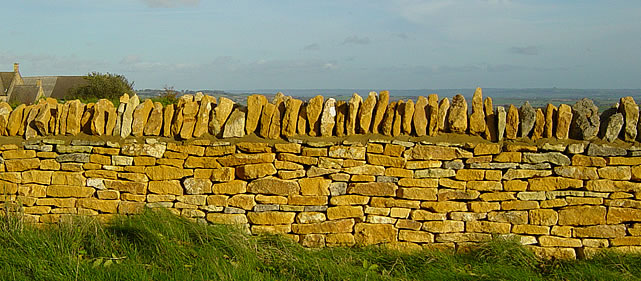
I saw a dry stone waller at work and a thatcher and  arrived in Moreton to find the market in full flow.

Open gardens for the NGS


Although the weather was cool and cloudy today, we visited Sandywell barn House in Whittington, which was open as part of the National garden Scheme (NGS). There are over 3700 gardens in the UK which open for one or more days a year to raise money for charity. Most of them are privately owned and a labour of love ~ and it shows. Sandywell was a lovely garden, the work of a lovely ‘plantaholic’ designer lady and her husband. The garden was set in 2.5 acres and totally walled in with some brick wall and some old Cotswold stone. Their lovely house was converted from an old cow shed but is now really settled in the landscape near to the beautiful Sandywell Manor House, which itself is now apartments.

Originally the money raised all went to Nursing charities. Today there are many medical charities supported including; Macmillan Cancer Relief, Marie Curie Cancer Care, Help the Hospices and Crossroads Caring for Carers.

NGS gives away more than £2.5 million each year to nursing, caring and gardening charities and over the last 15 years they have given more than £25 million in total. Most of the work is done by volunteers so the charity’s overheads are small. Consequently more than 80p in every pound raised goes directly to the charities. A wonderful result I think.

As I said the weather was not brilliant and I am not a great nature photographer but I will let me photos show you some of the highlights of this gorgeous garden.

Lunch


Inspired by Haiku Heights prompt word “Lunch”

I have simple tastes when it comes to food, especially lunch.  In winter there is nothing better than home-made soup and crusty bread with lots of butter.

With fresh home-made soup

Crusty bread from the oven

A nourishing meal

P1080686

I think the best lunches I ever had were on holidays travelling in France.  It was such a treat to buy wines, cheeses, French breads, and wonderful cakes from the patisserie.  My favourite cakes were called “Religieuse” as they look like a nun in her habit.  They are usually made of choux pastry filled with the most delicious cream and covered with ganache.  A bit like an éclair, they are usually coffee or chocolate flavour they are simply the best cake ever.  A picnic by a river in France is my idea of heaven, especially if it is near the Pyrenees!

Soft cheese on French bread

Religieux to follow

And café au lait

200px-Religieuses

A picnic is best

Sitting by a river on

A warm sunny day

~

Today I got a photo of my son enjoying a pint.  His term is over and holidays are just beginning. Tomorrow he sets off for Bali in Indonesia for a friend’s wedding.  Happy days.

End of the school year

Liquid lunch to celebrate

Happy holidays

~

The Ivy Church at Ampney St Mary in the Cotswolds

This ancient little church is a little gem which I normally drive right past on my way to pick up the grandchildren from school.  It sits off the busy A417 which goes from Cirencester to Fairford.  Today I decided to stop and have a look around.  It was a bit drizzly but I still managed to get some photographs which I will put in a gallery for you to enjoy.

It is very ancient with the remains of a stone cross in the grounds where travelling monks would have given sermons originally.  The church itself was built of local limestone rubble around 1250 and it has a very simple interior.  Unusually it has a stone screen separating the nave from the chancel, or the people from the altar.  It probably had a wooden screen over this with a crucifix on it in the early days.  Originally there would have been no furniture or pews, just rushes on the stone floor where the people stood to hear Mass.  Most of the windows looked leaded to me and one is particularly unusual as it is set in a single piece of carved stone.  There is a very pretty bell tower which has a Sanctus Bell in it made about 1747 in Gloucester by Abel Rudhall.  It carries the motto, “Peace and Good Neighbourhood”.

Above there is a very rugged looking wagon vault roof of oak beams.

The oldest things in the church are probably the original stone entrance archway which is now sealed up.  On the outside, above this arch there is an ancient carving of a lion stamping on a two-headed serpent, representing good conquering evil. There is a griffon looking on.  Apparently it is the only one of its kind in England.  Inside the church there is a Norman stone font which is complete.  Then there is the beautiful arched door which is ancient and solid made from elm or oak.  It has the original metal hinges and handles.

Best of all inside are the remnants of wall paintings which were defaced then plastered over after the reformation.  There are intriguing bits of these paintings gradually being revealed but you have to look very hard to make them out.  I saw a face which I am sure is the Virgin Mary.  I saw a number of saints including St Christopher with the infant Jesus.  But try as I might I could not find St George and the dragon who is supposed to be depicted somewhere on the walls.

The history of this simple rural church is like a Disney story.  The parish in common with much of England was hit by the Black Death in medieval times.  So after 1350 the entire village with its remaining inhabitants was moved to higher ground in a nearby village.  Any cottages left fell into ruins.  The church was used less and less until eventually it was abandoned.  Ivy grew over it until it was entirely covered, disappeared, and was forgotten.  Doesn’t it have shades of Sleeping Beauty?   A century ago in 1913 it was discovered again and all the ivy removed to reveal this lovely little gem of history.  Since then it has been restored but with all its original features preserved.

The churchyard has a little stream running around it and a stone bridge which leads to a little wooded area.  Beyond this there is Ampney Brook which was in full flow today.  The ancient dry stone walls leading to the church from the brook are still there and I felt strange thinking of all those villagers of long ago who had trodden this same path to get to their little church.  Some had maybe lived through the Black Death and floods which were the ruin of their way of life.  Today there is a deep peace about the place and I am so glad I stopped to visit the Ivy Church.

Eccentric ~ Haiku

This post is for Haiku heights prompt word ‘Eccentric’

Everything about Warwick Castle was eccentric when we visited at the weekend.  The theme was ‘Horrible Histories’ so there were knights in armour and princesses, dragons and wizards in the towers as well as scarily lifelike waxwork models of kings, queens and nobility.

But the most eccentric things were the peacocks which seemed intent on stealing the show with their courtship and flying displays.  I have never seen a peacock perch so high in a tree before!

He shows no restraint

With his flamboyant display

Attracting a mate

I missed the deadline for the Stone Haiku in which I posted lots of pictures of Warwick castle so please do click on the link and read it! http://wp.me/p2gGsd-U4

Meanwhile here are some more photos for you to enjoy