This weekend there is a Medieval Festival taking place in the nearby market town of Tewkesbury. It is an annual event which commemorates the Battle of Tewkesbury which took place here on 4th May 1471. The main event is a very realistic re-enactment of the battle on the actual site.
The Battle of Tewkesbury brought to an end the Wars of the Roses between the house of York whose symbol was the white rose, and the house of Lancaster, whose symbol was the red rose. The Yorkist King Edward 1V, was victorious while Edward, Prince of Wales, son of Henry V1 and last Lancastrian heir to the throne, was killed. His burial place lies in Tewkesbury Abbey with an inscription which reads,
“Here lies Edward, Prince of Wales, cruelly slain whilst but a youth, Anno Domine 1471, May fourth. Alas the savagery of men. Thou art the soul light of thy Mother, and the last hope of thy race.”
Also in Tewkesbury Abbey high up on the ceiling there is a magnificent Red Rose carved, which shows the badge of Edward 1V, the ‘sun in splendour’.
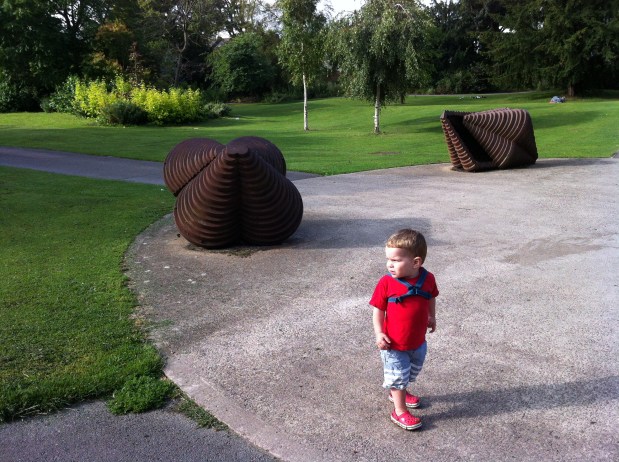
Fittingly, both the victor and the vanquished are remembered in the Abbey. They are also remembered by an impressive sculpture, which was installed on the Stonehills Roundabout at the Tewkesbury end of the A38 road to Gloucester last year. The sculpture is called ‘Arrivall’ and consists of two timber framed horses 5m (16ft) tall. One is a mounted knight, known as Victor, which is a symbol of the victorious Yorkist forces of King Edward IV. On the opposite side of the roundabout stands the other sculpture, the riderless horse Vanquished, which is a symbol of the beaten Lancastrian forces. His head is bowed in defeat and exhaustion from the battle. The sculptures, made by Phil Bews from the Forest of Dean are of green oak, and the work took 2 years to complete. Local schoolchildren and members of the community were invited to carve poppies on the horses’ legs in remembrance of the centenary of WW1 in 2014.
Both of the horses have lances with pennants which swing in the breeze. These were made by a local company and donated free. In fact the local people and business community raised almost all the £65,000 needed for this magnificent sculpture, which rather eerily faces the original battle site.
I took my life in my hands on this busy roundabout to get some photos. I am looking forward to going back and getting more photos at different times of the year and in different weather conditions, at sunset and in moonlight. But even in daylight I found the sculptures very impressive and strangely moving.
Slype Door at Gloucester Cathedral Watercolour by Fr Stephen Horton
Entrance Door to Chapter House from Cloisters at Gloucester Cathedral Watercolour by Fr Stephen Horton
Door in Gloucester Cathedral Cloister Watercolour by Fr Stephen Horton
Door at Withington Church Watercolour by Fr Stephen Horton
Today I took my grandson to Prinknash Abbey for a snack in the wonderful café, and to play in the beautiful grounds of the Monastery of Our Lady and St Peter. I have written about the abbey several times before as it is a very special place for me. I was thrilled to meet Fr Stephen Horton again, who painted all the beautiful doors above.
The Abbey is set high in the Cotswold Hills near Cranham and Painswick so the views are spectacular. There is ancient woodland behind, and to the front, a clear view towards Gloucester with its magnificent Cathedral. On a clear day you can see May Hill with its crown-shaped clump of trees on the summit. They were planted in celebration of Queen Victoria’s Diamond Jubilee in 1897, and are visible for miles around. Beyond that there are the Brecon Beacons and the Black Mountains. Having observed that view on a daily basis, the monks are very good at forecasting the weather merely by looking at May Hill. If the hill looks a misty blue they know there will be rain at Prinknash later. If the crown of trees is lost in cloud, there will be a storm.
I discovered while working in the old ‘St Peter’s Grange’, which is now home to the monks again, that it was built in this position, sheltered by the hills and trees, as protection from the plague! There is documentary evidence, as well as evidence inside, that some parts of the Grange were built in the 14th century. In 1339 the Bishop of Worcester granted a licence “For the Abbot of Gloucester and his fellow monks to celebrate Mass or to have it celebrated by a suitable chaplain in an oratory within their manor of Princkenasch.” So we know that there was a chapel on the site then. By the time the Grange was built the Black Death had already swept through England and people thought it was carried on the wind. Wealthy people therefore built their homes on the side of a hill sheltered from the wind in the hope that this would protect them.
One of my jobs at the Abbey was to polish the Parker room. This room was named after William Parker who was Master of the Works in the Abbey before he was elected Abbot in 1515. He was responsible for many improvements to the building. In July 1535 Abbot Parker entertained King Henry V111 and Anne Boleyn for a week. They used St Peter’s Grange as a hunting Lodge because there were many deer around – as there are today nearby. One fascinating snippet that appeals to me is that Abbot Parker had windows put into positions from which he could watch the monks about their work. He used to spy on them. I believe, contrary to what Wikipedia states, that this is where the phrase “Nosey Parker” comes from.
At Prinknash the monks have long been known for their art and craft work. Vestments and stained glass were early specialities. They also made beautiful pottery for many years from the local clay. The monks still make Incense that is exported all over the world. One of the monks. who sadly passed away. created a huge wonderful painting for the millennium which was displayed in the Abbey Church. He also painted and created stained glass. Many of his pictures were made into lovely cards which were sold in the Abbey Shop. The abbey’s walled garden is still growing a variety of fruits. Today there were ripe raspberries to pick.
As I said, we met Fr Stephen Horton OSB who is the Prior and Novice Master. He is a prolific and very talented painter. I was fortunate enough to buy some of his original water colour paintings while I worked at the Grange. They are my pride and joy. The one I love especially is a watercolour of the Vale of Gloucester as seen from the roof of the Abbey. When inspiration struck him for this painting he had no suitably sized paper on which to paint the panorama. Being a monk and used to making use of whatever is available, he used two pieces of A4 paper side by side. This painting speaks to me of so much more than the view. It is creativity at its most basic, I feel. The painting had to be painted there and then using whatever was to hand. The muse could not wait for a trip to the art suppliers! It also speaks to me of the way of life of the monks. They waste nothing and ask for nothing. They live such a simple life yet produce beauty all around them from whatever is there to be used.
Apart from being a brilliant painter, Fr Stephen is also a great thinker who gives wonderful sermons. He says that “the one journey that really matters is the journey inwards”. On occasion I have asked him for copies of his notes as I want to study his words deeply. He says monastic silence is, “an inner stillness like at the bottom of the ocean, where the force eight gale might be going on, but deep down you do come to a stability, an inner anchoring”.
One of the saddest things that happened at Prinknash was the theft of a statue of Our Lady of Prinknash in 2002. There are many statues at Prinknash but this one was extremely beautiful and so special. It was about 20 inches tall, carved of Flemish Oak, and had belonged to St Thomas More. After the Reformation, it was taken abroad but returned in 1925 when the Benedictine monks founded their new abbey at Prinknash. Of course this means it was hundreds of years old and priceless in the truest sense. The Abbey Church was always open for visitors and those who wished to pray, and the statue used to stand on a shelf to the left side of the church. One day it just disappeared while the monks were at tea, stolen to order presumably as nothing else was taken. It devastated the community in the abbey and the wider community, including myself, who attended Mass there. I almost believe it took the heart out of some of the monks and the community itself. I have a picture of that statue and I often think that one day it will return to its rightful home. Maybe when the current ‘owner’ dies he will leave it in his will to be returned to Prinknash ~ after all he can’t take it with him!
This coming Saturday, 11th July is the Feast Day of St Benedict who lived in the 6th Century. I have no doubt that the monks at Prinknash, who follow the rule of St Benedict, will be celebrating with a special meal and maybe a glass of wine.
This Weekly Photo Challenge. is the word Muse and it has given me a lot to think about. On reflection I believe my muse is the natural world. It provides memorable, magnificent moments when my spirit soars with the spectacle before me. This is usually when I am on my own, in silence, in the countryside. Wide open pastures, woodland filled with wildflowers and birdsong, snow-capped mountains, cool crashing waterfalls, tumbling streams and majestic rivers. These are what excite me. Acres of colourful, cultivated flowers, or a single poppy bursting into life uplifts me and carries me away from the mundane. These are the moments that matter. this is when heaven happensand I just have to capture it with my camera or with a blogpost.
These days I don’t do much travelling, but I am blessed to live in a beautiful part of the world. Whatever the season there is always something sublime to see within a short journey. And, if I can’t get out, I can always enjoy nature’s efforts in my garden.
In January there are snowdrops, crocuses and hellebores, and often snow on the Cotswold Hills. Then I take myself off to Painswick or Sherborne to enjoy them.
In February the first primroses and wild daffodils appear. There is frost on the ground and skeletal trees when the first lambs and goat kids are born. That’s when I go to the Golden Triangle.
In March the magnolias burst into flower and blackthorn gleams white in the hedgerow. Hyacinths smells fragrant and frogspawn appears in the pond.
In April there are cowslips on the Common and blossom on the fruit trees and in hedgerows. This is the prefect time to go on the Blossom Trail around Evesham. By the time Easter arrives the new lambs and baby rabbits are out in the fields and the lilac trees are in full flower.
In May fields of yellow rapeseed sweep far into the distance, and yellow and orange poppies brighten up the roadside. Self-seeded Lily of the Valley fill the border under my fruit trees.
In June it’s off to the woods to see the Bluebells and wild garlic which grows by the roadside. Bright red poppies appear in the fields and roses fill the gardens
In July I go to Wick near Pershore to see acres of delphiniums, which are grown to be dried and sold as natural confetti. On the way back I stop to admire the blue Linseed fields outside Elmley Castle. Now is the time to pick cherries from the trees and strawberries from the fields.
By August I am picking apples, pears and blackberries daily and storing or freezing them for winter. In Pershore the plum festival is held and there are sunflowers to see and lavender fields to visit!
But September is my favourite time. There are conkers and cob nuts to collect. The Cotswold countryside is a giant nature table with a cloth of autumnal colours.
October means pumpkins, root vegetables, toffee apples and fudge. It’s time to go to Westonbirt Arboretum for the best display of Maples turning red outside of Japan.
November means baked potatoes, nourishing soups and bonfires, foggy mornings and falling leaves. Time to head to the park to watch them dance in the wind!
Things quieten down in December but there are fir trees and holly bushes to admire. Christmas lights glisten in the houses, shops and streets. I head off to Stratford on Avon to see them at their best.
naturalised snowdrops
snowdrops and hellebores
Bluebells in Bradbury Clump
Yellow Rapeseed in Cotswolds
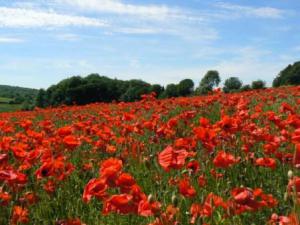
Red Poppy field in Cotswolds
Spring lambs enjoying the fresh green grass at hailes Abbey
Violet coloured Delphiniums growing near Pershore
Yellow rapeseed Kimbolton, Herefordshire
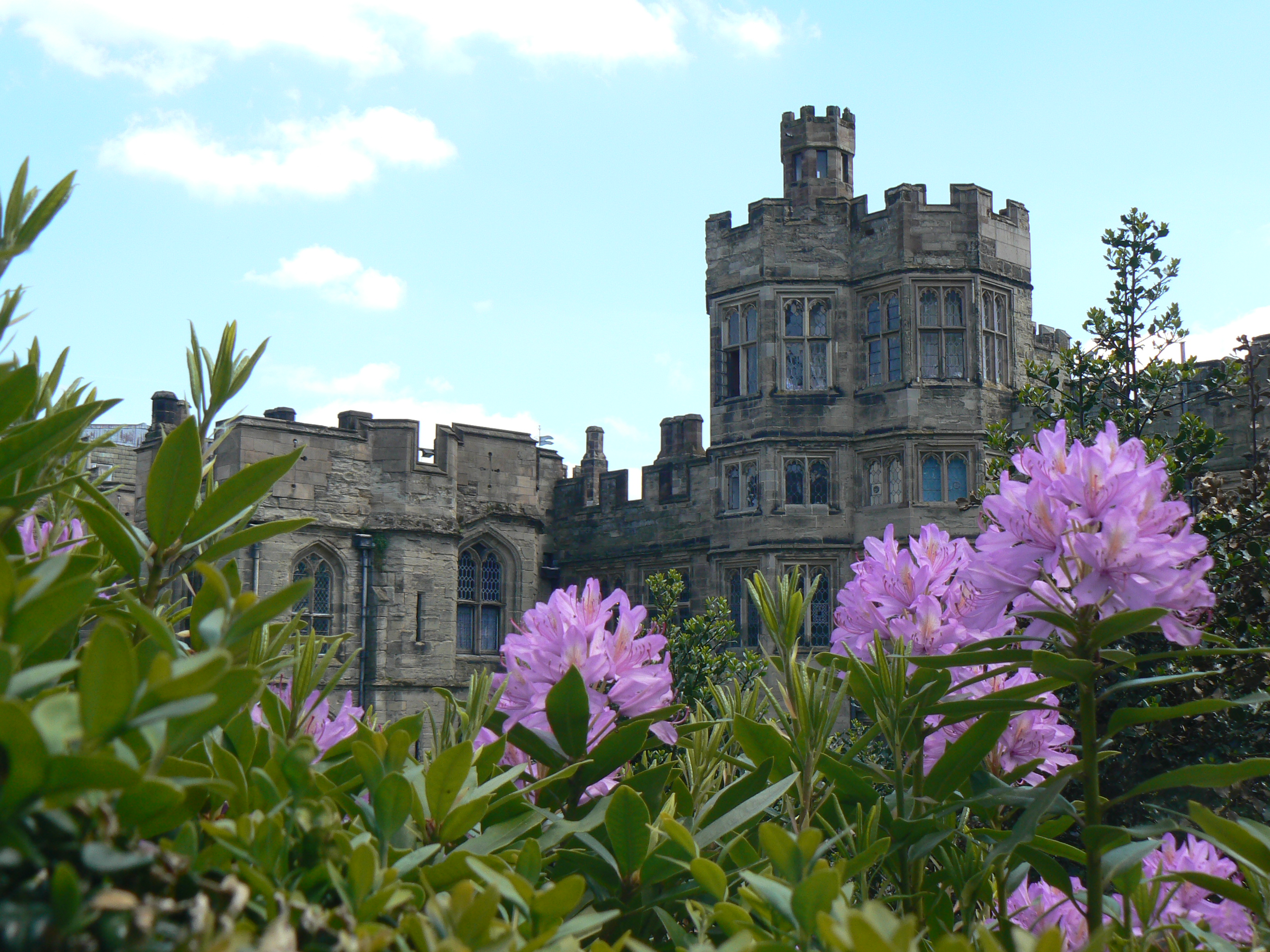
Rapeseed viewed from Warwick castle
Glass-Painted Summerhouse Doors My sacred space in winter
River Avon at Stratford on Avon
Apple blossom in my garden
Robin redbreast gathering food for his young in my garden
Me gathering apples at Willen
Daffodils
Light show projected onto the wall of William Shakespeare’s Birthplace in Stratford on Avon
Fields of Linseed growing between Elmley castle and Hinton
stone wall in a garden in Cornwall with plants
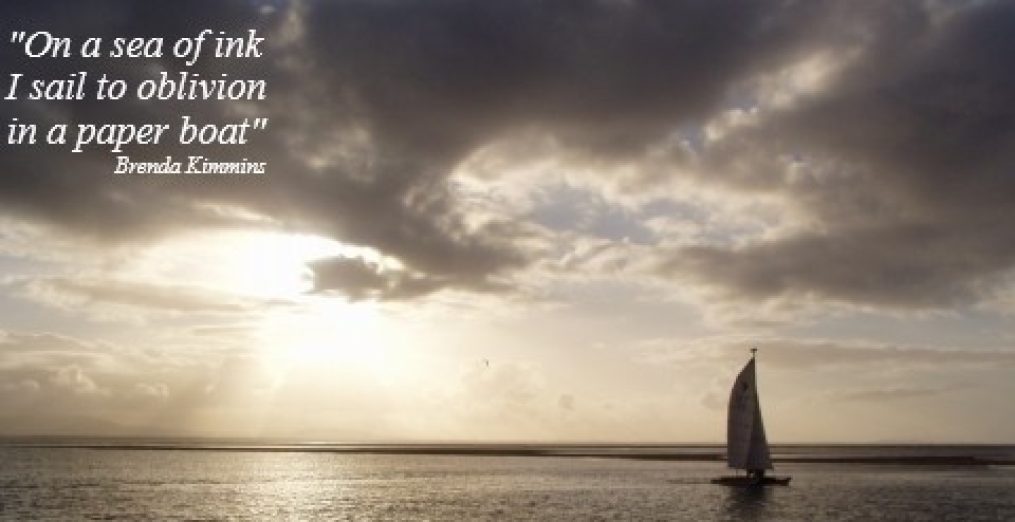
Peaceful sunset over Somerset with sailing boat and Hinckley point Nuclear power Station fading into the misty distance
The differences between being a child in postwar Britain, a parent in the 1970’s, and a grandparent today are amazing to me. When I was a child there were still shortages of food which meant essential supplies were rationed while luxuries were just none existent for the ordinary family. This made for a simpler diet with few choices and little chance of overindulging. However, undernourishment was such a big issue for children at the time that the government provided orange juice, cod liver oil, malt extract and often a tonic like Minadex for every school age child. Babies and schoolchildren were given free milk.
Food was basic, grown, fished or farmed, and home cooked. There was very little processed food and no such thing as ready meals! Packaging was practical and simple too. Butter and cheese was cut off a large block and wrapped in greaseproof paper then put in a brown paper bag. Sugar, flour and dry goods were scooped out from large sacks, weighed and poured into paper bags. Fresh fish was bought straight from the quayside or from a man who brought it round the houses in a horse and cart. Bread and pastries were usually baked at home or bought from the local baker, while meat was from the local butcher and chickens were often still alive! Every town had a High Street which had a selection of specialist shops and there were ‘corner shops’ in most residential areas. In fact when my grandfather left the army in 1952, he bought a corner shop right next to the hospital off the West Road in Newcastle. Some shops, like Woolworth’s, were quite large, but nothing like the huge supermarkets of today.
Women, and it was almost always women, had large sensible shopping bags, which were used over and over again. Plastic bags had not been invented. Often the shopping was delivered to the housewife in a cardboard box by a lad on a bicycle or a man in a van. This was essential as working class women, or indeed men, would not have had a car. We have gone full circle here as so many supermarkets deliver shopping now, but not for the same reason!
But to get back to childhood, babies as far as I remember were dressed and treated as babies until they were about 3 years old. They would be put in a big pram and stuck outside in the garden or yard, or often, on the street outside the front door. Here the child would sleep or watch the world go by for hours between feeds with a few toys. My soft toys would have been knitted by my mum while my dad would occasionally make wooden toys. Toys, being few, were treasured. I still have the doll I had when I was 1 and the golly (sorry) my mum knitted when I was 4. Boys would often have tin cars or lead soldiers, both of which would be considered dangerous now.
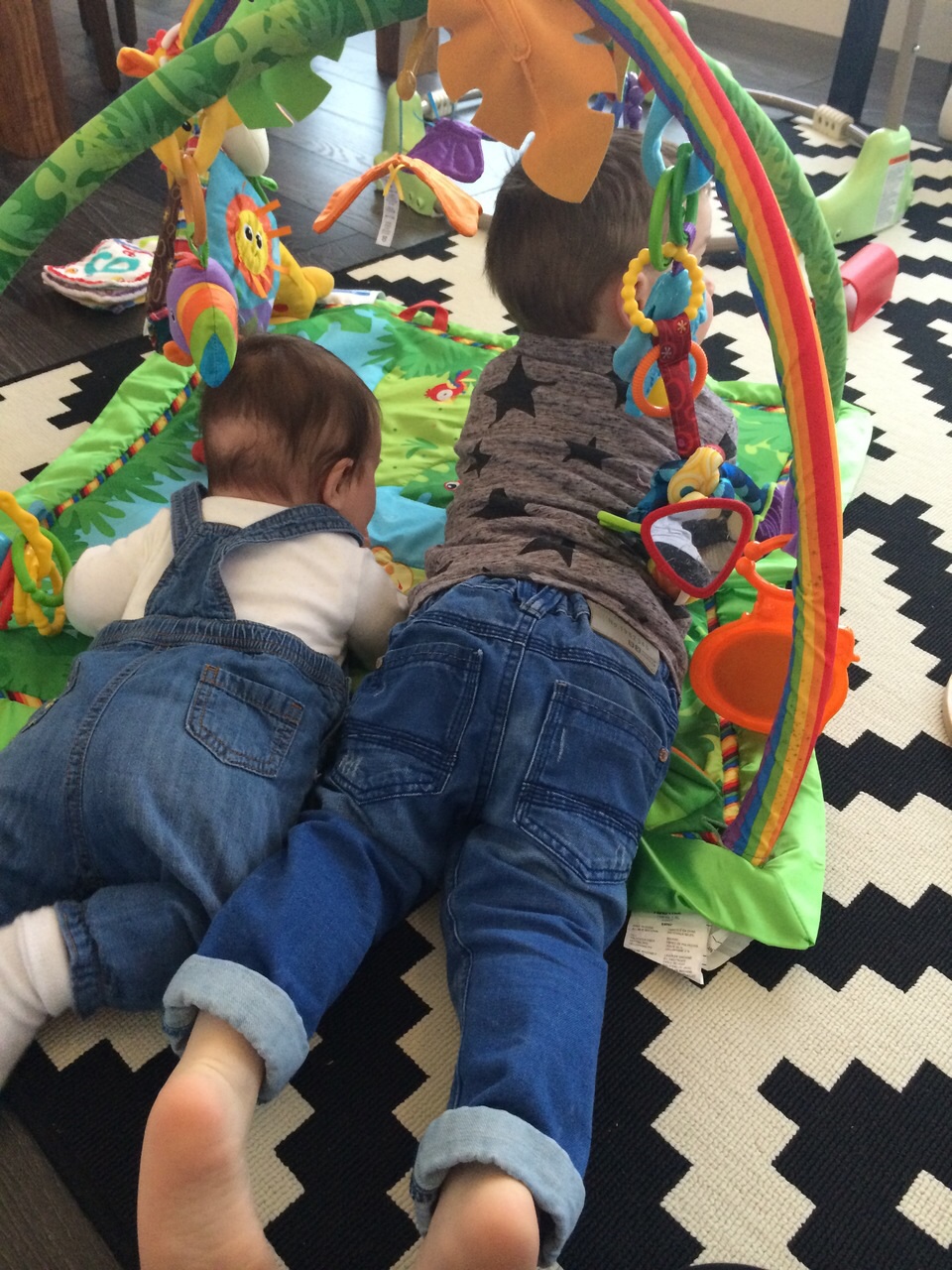
Today things are so different. Babies are socialised and stimulated from the earliest age. My grandchildren are taken to ‘bounce and rhyme’, baby gym, play barns, swimming classes, baby massage etc. etc. It amazes me to see the speed of their development. And at home the range of toys is breathtaking. Everything seems to have movement, music, colour and lights built in. Even books have appropriate sounds alongside the story. And, before babies can even crawl they have play mats like the one in my photo. This 3D mat has all the colours of the rainbow in it. It is based on a jungle theme so there are animals adorning it. It is soft, safe, supportive and stimulating. It plays a variety of music, animal noises, and even waterfall sounds. It has given my grandchildren hours of pleasure. I chose this photo for a couple of reasons. It shows my two and a half year old grandson teaching his 8 month old sister how to roll over. It is so cute and the clothes just tickle me. Denim jeans on a baby I find hilarious and absolutely adorable.
So this week’s photo challenge was to illustrate the colours of the rainbow and I think this photo does that. The denim jeans qualify as Indigo while all the other colours of the rainbow are in the playmat. but just in case you want more I have added a little group of colourful shots below.
Red Poppy field in Cotswolds
Orange Lifeboat on Porthtowan Beach
Yellow rapeseed Kimbolton, Herefordshire
Deep Green Leaves of Lily of the valley in my garden
Gorgeous green grass of Cotswolds
lavendar fields at Snowshill
Blue Stained Glass Window at Gloucester cathedral detail
Driving past Cheltenham Racecourse the other day I noticed that the next Race Meeting is not until 23/24th October. And, the National Hunt Season proper gets under way on 13/14/15th November. This seems such a long way off I got to wondering what happens there during the ‘Off-season’, so I decided to pop up there this Sunday and find out. It was a revelation!
In the UK most horse racing is on turf although there are a few all weather tracks. I guess the ‘going gets tough’ during the summer months when the ground is hard and dry, making it dangerous for thoroughbred racehorses to jump the fences. Every racecourse is different whether it is for flat racing, National Hunt racing, or point to point. Few are a regular oval shape and different horses run better on different tracks ~‘horses for courses’, as the saying goes.
Flat racing is run over distances between 5 furlongs (5/8 miles) and 2 miles with no fences to be jumped, while National Hunt racing, as at Cheltenham, is between 2 miles and 4 1/2 miles with challenging obstacles to be jumped. At Cheltenham these include hurdles, fences and water jumps. These races are strictly governed and the jumps, although terrifying, are built with safety in mind. Point to Point races on the other hand are much more ‘informal’ and for amateur riders. I have only watched a couple of point to points and I found them terrifying. The jumps are horrendous and riders often fall and end up covered in blood!
Cheltenham Racecourse is very special and world famous. The Cheltenham Festival is unmissable for any serious racing fan. It is held annually in the third week of March around St Patrick’s Day. The atmosphere is electric and the whole town comes alive. Race fans come from all over the UK, Southern Ireland and beyond to enjoy the four day meeting. There is a Championship Race each day, the highlight being the Gold Cup race. This year the weather was perfect for spectators with early spring sunshine, although the horses may have found the ground a bit hard.
The Gold Cup is a Grade 1 race, run over a distance of 3 miles 2 1/2 furlongs. All the horses carry the same weight in the Gold Cup and the hill to the finish is a test of their stamina and courage. Famous winners of the Gold Cup include Dawn Run (a mare, ridden by Jonjo O’Neill), Arkle (considered the greatest horse of all time), Golden Miller, Best Mate, Desert Orchid & Kauto Star. Racegoers, and non-racegoers alike, grow attached to individual horses as they each have their own personality and style. In National Hunt racing the horses do not have to be thoroughbred, which adds an extra twist to the races. Of course there are lots of breeders, trainers and stables in the Cotswolds so it is possible to see these beautiful creatures out galloping occasionally which is wonderful.
So what is going on at the racecourse before then? Well lots of things as I discovered.
There is an amazing building at the racecourse, appropriately called the Centaur (half man/half horse)! This building seats over 2000 people (4000 standing) and has some beautiful spaces inside including the gorgeous Steeplechasing hall of Fame. During the ‘off-season’ it hosts music festivals, craft shows, business meetings, seminars, conferences, graduation ceremonies for the local university as well as being a fabulous wedding venue.
Outside the Centaur in the grounds around the racetrack there is lots of activity too as you will see from my photos. There is a permanent facility for Riding for the Disabled and the racecourse has its own railway station which still has steam trains running. This is operated by the Gloucestershire Warwickshire Railway GWR and is run mainly by volunteers. The station, signal box and platform take me right back to my childhood and day trips to the seaside. But now visitors can steam through the Cotswolds enjoying the scenery. It is marvellous.
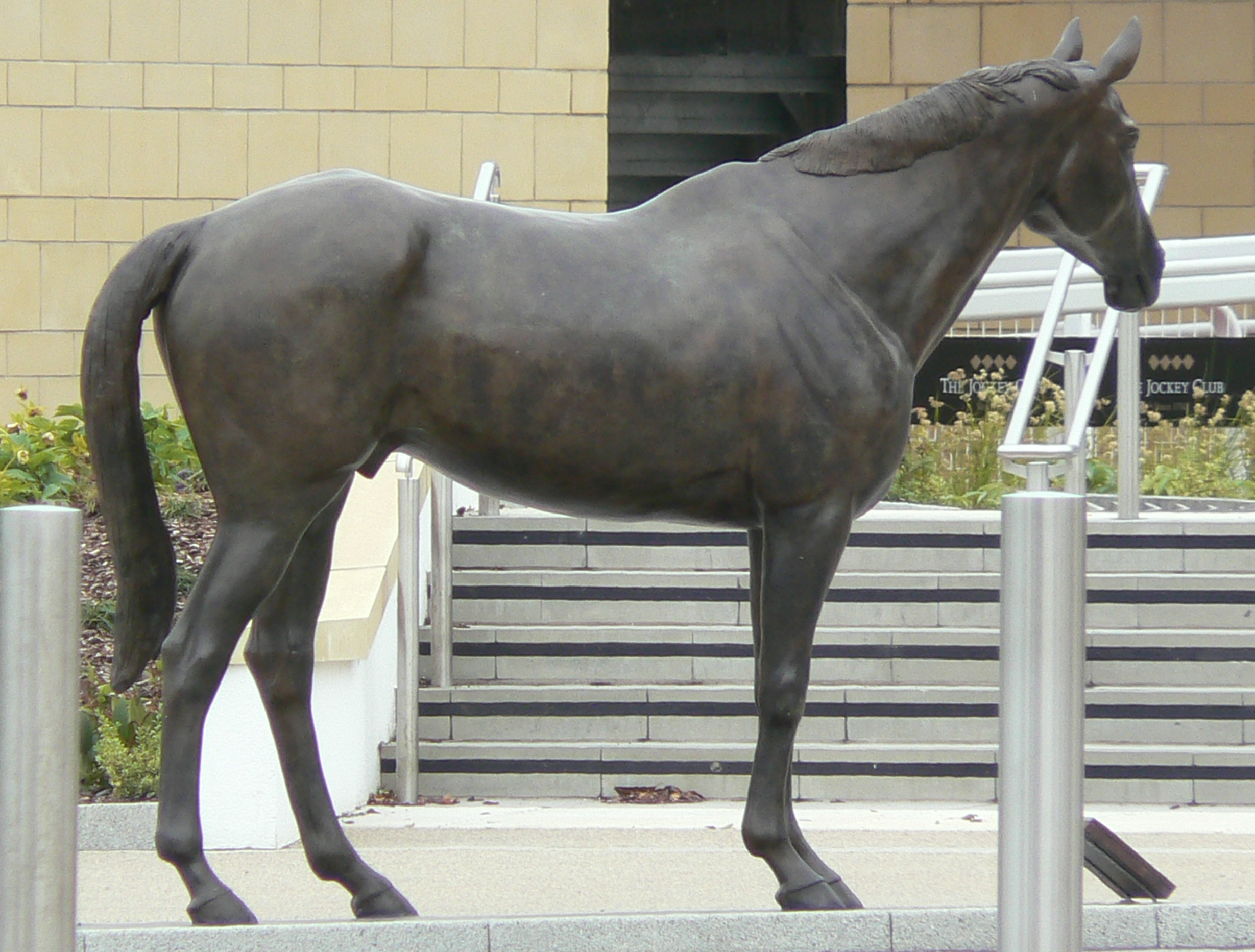
There are some great statues around the racecourse of Gold Cup winners Golden Miller and Arkle, as well as dawn Run, and Best Mate and of course the Centaur. Some of these were removed while the £45million building work is going on but I did find one or two. The fabulous new stand and walkway is due to be ready for the 2016 Festival and I must say it was looking great today.
Another permanent feature near the entrance to the racecourse is a veterinary block complete with tackle shop, offices etc. And, in the car park of this building is a waiting area for emergency vehicles and responders.
Also in the grounds was a temporary ‘big top’. This beautiful blue and white tent was the circus with a purpose, Circus Starr, a wonderful charity bringing fun and excitement into the lives of disabled and disadvantaged children and their families. I was so jealous that I didn’t have a ticket as I stood outside and enjoyed the music from Frozen waft out from the big top. I could hear gasps of pleasure at what I assumed were trapeze artists doing aerial dances to ‘Let it Go’.
Apart from this there were dog walkers, joggers, cyclists, and a young lad riding a motorbike as well as builders creating the new walkway.
Cheltenham Spa Express
Circus Starr
Emergency vehicle Waiting Station at racecourse
Entrance to Centaur Building
GWR Train
On the footplate
Jockey Club Entrance
One of the statues
New building almost finished
Cheltenham Racecourse Station
Steam Engine coming into Cheltenham Racecourse Station
Steam Engine coupling to train
team Train waiting at Cheltenham Racecourse Station
waiting for the signalman
Advertised events coming up before the season takes off included;
As soon as we arrived at Church Farm for Open Farm Sunday I was captivated. At the entrance there were Shetland ponies and goats to pet, as well as a great display of crops and posters giving information about oats, barley and oilseed rape. It was like the best nature table you could possibly arrange! As a primary school teacher many years ago, I would have loved to put on a display like this for my pupils. But even as an adult I found it fascinating. What appealed to me most was the opportunity to learn about the oilseed rape.
I love to see the fields of gold that stretch across the Cotswold in late Spring each year. I go out and take photographs and take the grandchildren to admire them. I usually say something simple like, “It’s used for cooking oil”, but I honestly hadn’t a clue what really happened to those gorgeous yellow plants.
Well, having chatted to the farmer and a seed merchant, I now know a great deal more. Rapeseed belongs to the Brassica family of plants like turnips, cabbages, Brussel sprouts and cauliflower among others. In fact the word Rape comes from the Latin, Rapum which means turnip! Who knew? Natural rapeseed has been grown, and used to produce fuel, for centuries. In fact Brassica are some of the oldest plants around. There are records of Brassica oilseed varieties being grown in India 4000 years ago, and China and Japan 2000 years ago. It is likely that the Romans introduced it to Britain. It was found to be a useful ‘break crop’, which means that it keeps down weeds and helps enrich the soil in between growing other crops. By the middle-ages rapeseed oil was being used as fuel for lamps. But it was not until the Industrial Revolution, when steam power came to the fore, that machinists discovered its suitability as a lubricant.
During the Second World War huge quantities of oil were needed to keep the engines of naval and merchant vessels seaworthy, but because of blockades it was difficult to source from Europe and the East. So Canada greatly increased its rapeseed cultivation.
The original, natural strains of rapeseed had been used for centuries to feed animals, but not people. It had a bitter taste and was high in erucic acid, which is toxic to young children. However, following research and development in Canada, a strain was developed that had low levels of erucic acid and a pleasant nutty taste, making it suitable for human consumption. The Canadian climate was good for growing it, so in 1978 a company was set up to produce Canadian Oil, Low in Acid, hence the name Canola! Although this was a brand name it is now accepted as a generic term for oilseed rape.
I have used Rapeseed Oil for years at home for frying and roasting food, as well as baking carrot cakes and biscuits. It is also suitable for bread and pastries, and of course, it makes delicious dressings, marinades and mayonnaises. A knowledgeable doctor told me years ago that Rapeseed oil is high in Vitamin E and contains less than half the saturated fat of olive oil, which helps to keeps cholesterol down. Rapeseed oil is also rich in omega 3, 6 and 9 and contains no preservatives or additives, making it a healthy alternative to butter or other vegetable oils.. I buy the locally produced ‘Cotswold Gold’ rapeseed oil as it is made in small batches by methods which preserve the goodness of the oil and it is not genetically modified as some mass produced or foreign oils are.
In recent years, celebrity chefs have made rapeseed oil very popular, which is one reason why there is so much grown in this country now. Another reason is its use in the biodiesel industry. In fact over 60% of the rapeseed grown in Europe now is used for fuel. This would be a worry if it was taking up land which could be used for food production. But apparently it can be grown on ‘set-aside’ land, which would otherwise not be used.
I was very pleased to learn that not a single bit of the rapeseed plant is wasted. Once the oil has been pressed out of the ripe black seeds, the left over pulp provides a rich feed for the animals on the farm and the rest of the plant goes into the forage which provides food for the animals in winter.
If you would like more information or facts and figures, the website ukagriculture.com produces a wonderful poster called The Story of Oilseed Rape. And, you can watch a short video on the oil extraction process in Ireland here on youtube.
Images from Denny’s stained glass window in Gloucester cathedral
I am awed by stained glass windows, and have an enormous collection of photos from around the world. But very close to home there is a window that fascinates me. It is in Gloucester Cathedral. It is quite a modern window and from a distance with a cursory glance, it can appear to be simply random shapes of blue glass. On closer inspection though, this window draws the viewer in rather as an icon does. It is a meditative experience to sit and really look at this window. Soon the shape of a man appears then you are drawn to the face. It has a haunting expression of deep understanding and empathy. It represents the face of Jesus.
The window was created and installed in 1992 by Thomas Denny. It is mainly in vivid blue and white with splashes of red and yellow. It is greatly affected obviously by the light coming from outside but it does appear to be in shadow when the viewer is at a distance, then as you get closer it gets brighter and quite mesmerises me! Doubting Thomas and Jesus are the central characters of the middle window and the two side windows are a song of praise for creation based on psalm 148.
Thomas Denny, was born in London. He trained in drawing and painting at Edinburgh College of Art. One day a friend asked him to consider creating a stained glass window for a church in Scotland (Killearn 1983). So began a remarkable career that has produced over 30 stained glass windows in Cathedrals and Churches of this country. (Visit http://www.thomasdenny.co.uk for the full listing.) Tom’s love for painting and drawing, especially the things of nature, is evident in his windows. All of Tom’s windows depict biblical themes and encourage the viewer to sit in silent meditation. Look closely, feel the colours, take the time to let the details emerge, then reflect. It is a spiritual experience.
Even closer to home there is a simple parish church in Warden Hill called St Christopher’s, which has a set of 10 stained glass windows by Thomas Denny. Each of them is based on a parable from the Gospels. The windows are linked by colour too with the colours from one window flowing into the next. They are simply stunning and anyone can visit the church to see them. If you are too far away you can click on this link to enjoy photos of the windows http://www.tciwh.org.uk/index.php?page=windows
I had a go at making my own stained glass windows for my summerhouse/sanctuary in the garden at my previous home. It broke my heart to leave it. You can read all about it here.
Looking back at my photos, I have discovered that I find boats of all shapes and sizes really fascinating. Maybe this stems from my great grandfather’s life sailing tea clippers from the south China Seas around the world in the 1800s which fascinates me. Or maybe it’s from my father’s early years working in the shipyards of the Tyne, or his wartime service in the Royal Navy. But, as I can’t swim, however hard I try and however many lessons I have, boats are an unlikely interest for me to have!
My fear of deep water has several possible sources, the first being that I fell in the icy cold English Channel from a cliff when I was about 10 years old. I vividly remember thinking as I sank into the murk, how dirty the water was ~ not at all like a swimming pool or the pictures of the ocean you saw on holiday posters at the railway station.
Secondly, where I grew up, my playground was the smoking sulphur heaps left over from the chemical factories, and the old mine workings of a very industrial Gateshead on Tyne. I stand to be corrected but I never saw or heard of a swimming pool anywhere in the vicinity. The Public Baths were for people to go and have a wash when they had no facilities at home as far as I knew.
Lastly, in the postwar years the River Tyne was a busy, noisy, dirty and dangerous river dotted with thriving shipyards. It was not at all as it appears today, all cleaned up with its expensive riverside apartments, leisurely riverside walks, luxurious hotels, The Sage, The Baltic and the spectacular Winking Eye Bridge. No, the Tyne was a marvellous, powerful river to be admired, respected and wondered at, but feared and kept away from for safety’s sake.
But as I look at my travel photos from Cornwall, Dorset and other parts of the world, there are a lot of boats that I snap on the way.
Replica of Peter the Great’s boat in Russia
River Fal boats
Model Amber ship in a shop window in Krakow, Poland
Ancient Viking longboat, belonged to a Viking King and is preserved so well because it was buried with him.
Anne and Simon in Myanmar
boat in mud at Burnham
boats on the Avon at Stratford
Boats in Gdansk, Poland
HMS Conway, my great grandfather joined this ship in 1855
Doughnut building enveloped in rainbow lights copyright GCHQ2015, used with permission
For this week’s photo challenge the prompt is the word “enveloped”. I understand it to mean totally surrounded or covered, and as such I could only choose one photo as illustration. I did not take the photo, the copyright belongs to the Government Communications Headquarters, GCHQ, but I was given permission to use it for this blog. The photo shows the entire doughnut-shaped building, which is near my home, surrounded and lit up in the colours of the rainbow. This occurred last weekend (17th May 2015) on Sunday evening from 9pm as the sun set. It was to mark the International Day against Homophobia, Transphobia and Biphobia. It was amazing in many respects. Firstly, that GCHQ would make such a public gesture of solidarity with these misunderstood minority communities; and secondly, that a large crowd of people, including myself, drove, walked, and waited there to see it late on a Sunday evening. I know parents who kept young children up specially to see it and then took the opportunity to discuss the reason for the event.
Not so long ago it was illegal in this country for men and women to be practising homosexuals. And it would have been unthinkable to get a job with the security and intelligence services while openly gay. But of course many people did work in these fields while keeping their sexuality hidden. One such man was the mathematician and cryptographer Alan Turing. He worked at Bletchley Park, which was the forerunner to GCHQ. There he and a brilliant young team helped crack Germany’s Enigma Code, which certainly shortened the second world war by a couple of years thereby saving millions of lives. But when his sexual orientation was discovered, Turing lost his security clearance and was convicted for gross indecency. His life was ruined by this conviction and his reputation was destroyed. He was subjected to ‘corrective’ hormonal treatment until, two years later it is believed, he committed suicide by cyanide poisoning. In 2013 he was granted a posthumous pardon by the Queen and honoured for his work.
In 2014 the film The Imitation Game was made about Turing and his work. The film is so good that it won an Oscar as well as 51 other awards. Starring Benedict Cumberbatch, Keira Knightley and Matthew Goode, the acting is outstanding. The truth may be stretched a little for dramatic effect, but the film is gripping from beginning to end.
My opposition to any form of discrimination and prejudice stems from my years in teaching when I observed the misery it caused to children. During my 30+ years working in the field of education, I taught over a thousand primary school pupils in state schools. It is reasonable to assume that they were a fairly representative sample of children raised during the second half of the 20th century. The majority were from stable, loving and supportive families with parents who worked hard and were able to provide good homes, experiences and opportunities for their children. But over the years I also worked with many children who were not so lucky. Lots of families suffered from the negative effects of poverty through no fault of their own. But in some cases families were dysfunctional due to addictions-to gambling, alcohol or illegal drugs. There was also a criminal element including a small minority of parents who were actually dangerously antisocial. Whatever the cause, the children suffered most.
In all those years I only encountered one child with what I would call a ‘wicked’ nature. He took pleasure in inflicting pain and suffering on other children, animals and even his own family. Every available agency tried to help him, his parents, and the school, manage and change his behaviour, to no avail. In those years too I met many confused and unhappy children who had a poor self-image and little confidence. There were as many reasons as children for this; inadequate parenting, poverty, social, emotional or physical issues, learning difficulties, and sometimes gender issues.
Someone once explained to me that the gap between how we see ourselves and how others see us is crucial to our self-esteem. School age children are social creatures. They need to be accepted and respected by their peer group. They are not born with low self-esteem. It is an acquired condition. If, for whatever reason, they do not ‘fit in’ to their group, their self-esteem suffers. And they may become victims of bullying. This is enormously important because research has shown that low self-esteem leads to unhappiness, ill health, and a less rewarding and successful life. In extreme cases it can lead to suicide.
This brings me to the tragic case of a 15 year old boy who took his own life because he was being taunted at school for behaviour which ignorant bullies called ‘gay’. The effect of this on his family and true friends was so traumatic that some months later his father took his own life and then one of his friends did the same.
This is why I am so proud of GCHQ for lighting up the ‘doughnut’ building in rainbow colours at the weekend. In this country, and in many others I am sure, the past has been marred by intolerance bred of ignorance and fear. People have been judged because of the colour of their skin; their accent, age, gender, beliefs, finances, job, clothes, or sexuality rather than their humanity. There is no place in a civilised society for such prejudices. Critics have denounced the gesture online as a political gimmick, but if it draws crowds of ordinary families who then discuss these issues with their children then it was a very worthwhile one in my opinion.
This weekend rounds up the celebrations in honour of William Shakespeare’s Birth on 23rd April 1564. I love to be in Stratford on Avon at this time to soak up the atmosphere so I set off this morning full of joy and anticipation. I was not disappointed. There were street entertainers, market stalls, a literary festival and scenes of celebration all around. And, the sun was shining gloriously. I have written about the special 400th celebration in 1964 previously so you can read about the events that take place in that post. But today I would just like to share some of my photos with you.
The river Avon is always a joy to walk beside and today the boaters were out in force.
River Avon at Stratford on Avon
The walk to Holy Trinity Church where Shakespeare and some of his family are buried was beautiful. On one side is the river, and on the other, blossom trees and wisteria covered houses. I took a detour through the pretty little garden in memory of those who died in the two world wars. It is a most peaceful place in the older part of town.
There is a beautiful bespoke Iron chair in this memorial garden which took my breath away with it’s beauty. It was made in Scotland for the Royal British legion
When I got to the church it was surprisingly quiet as the crowds had left. I was able to wander freely and take in the amazing aroma of the masses of Spring flowers which had been laid in the Sacristy all around Shakespeare’s grave.
On the way back from the church we passed The Other Place and various workspaces belonging to the Royal Shakespeare Theatre and of course the theatre itself. I took my photo from the gardens behind the theatre as that is where I used to sit on the grass and do my homework when i was a schoolgirl in Stratford many years ago.
After this I wandered through the Bancroft Gardens to enjoy the live music and to see the Gower memorial. This famous memorial was originally outside the theatre but when the theatre was destroyed by fire in 1926, it was decided to move it to its present position overlooking the canal basin. It certainly is a superb position. On the top of the memorial is Shakespeare himself and around the base are main characters from the plays. There is Falstaff, Lady Macbeth, Prince Hal and Hamlet.
Hamlet
In the Bancroft Gardens there is a fascinating flower bed filled with plants that are mentioned in Shakespeare’s plays. They deserve a post all on their own so I will just quickly show you the flags that lined the main streets. Ambassadors and dignitaries come from all over the world to pay their respects during the annual birthday celebrations and their flags stand proud.
It was a wonderful day and I came home very happy. I am really looking forward to next year, 2016.
William Shakespeare was born on 23rd April 1564 as I said and I was lucky enough to live in Stratford in 1964 when the 400th anniversary was spectacularly celebrated. He died, also on 23rd April, in 1616. So next year will be the 400th anniversary of his death at the age of 52. Great plans are afoot for commemorative events worldwide, and and as it falls on a Saturday it should be a great occasion in Stratford. It will seem strange to commemorate his birth and his death on the same day, but I hope to be there!
This photo is a fluke but I love it. I had been hoping to get a photo of my cheeky, but very friendly, fledgling long tailed tit as he pays his daily visit to my door. I snapped quickly with my phone and this is the result. It is literally as he is landing and it looks as though his feathers are screeching to a halt. He is still learning how to fly after all ~ And I’m still learning about photography!
One of the things I love about blogging is communicating with fascinating people who enjoy the same things as I do. Recently, through various posts, I have discovered that Sarah Longes who blogs “One Day at a Time” at Mirador Design, loves garden birds as much as I do. Recently we were conversing in the comments section about all the fledging birds we have in our gardens. In mine there are robins, blue tits, blackcaps, blackbirds, pigeons, sparrows, chaffinches and a very cheeky long tailed tit. This little bird is a bit of a rebel. While all the others are happy to hop about under the apple trees or sit on the fence, this sociable little bird gets very close and personal on a daily basis. His mother must despair of him. He shows no fear, but great curiosity, as he flies right up to my french windows and perches on the door handle. He seems to enjoy watching me as I potter about the house and when I sit down by the window he stares straight into my eyes. It truly is amazing and I have got so used to it that I look forward to seeing him now. I will be really sad when he grows up a bit and flies off to pastures new. I promised Sarah I would take some photos of him so here they are. They qualify in a post on ‘Motion’ as they show my little bird landing and getting ready for take off. I love the blurred one as it literally caught him as he landed and it looks like he had to do an emergency stop!
My friendly long tailed tit landing
My last group of photos are from a day out by the lake yesterday. While my husband was enjoying his fishing I was amused by a family of ducks. There was a mother and father and 9 ducklings which were obviously very young. 8 of them were very adventurous and wandered off all over the lake but one seemed quite nervous and often stayed very close to mum. It was charming to watch so i took lots of photos of the ducklings in motion.
Goodness this weeks photo challenge was a nightmare for me. I’m often awake early but the thought of getting out before dawn with a camera or anything else for that matter is anathema to me.
There have been times of course when travelling, that early starts have been enforced. You can read about my trips to Lourdes or America by clicking the links. But I am really an evening person. I would happily do housework at midnight or write poetry and my journal at 2am. But I don’t really come back to life before 8.30 in the morning.
However, I did make a special effort just for the challenge and was rewarded, not by a visual revelation as it was quite dull, but by the dawn chorus of birds. There was an owl hooting plaintively in the woods over the road and countless little birds singing their hearts out in the bushes in my garden. I know their song is just a warning to competitors to stay away but it does sound delightful. I wish you could hear it!
5.20am from my front window
I did however want to make my day worthwhile by taking more photographs so I am posting photographs of the early apple and cherry blossom in my garden. A bit of a cheat I know but I hope you enjoy them. We are having a wonderful spring, warm, sunny and dry so the blossom is perfect.
Goodness I have been down memory lane again with this weekly photo challenge In fact I went through various stages ~ philosophical ~ historical ~ scientific ~ photojournalistic ~ spiritual and ended up just reminiscing. I have included a 3D photo of my youngest granddaughter afloat in her mother’s womb and a beautiful photo of a good friend afloat on Taung Tha Man Lake in Myanmar (Burma), which I did not take but have permission to use. So here are my offerings for the theme Afloat!
King Harry Ferry in Cornwall
wind surfing in Cornwall
My son dangling from a rock while climbing
Norway holiday
Plastic ducks at the swimming pool
Stained glass window reflection on column at Gloucester cathedral
Stained glass window afloat in a sculpture called Untouched by Angus Fairhurst
When I saw that the prompt for the weekly photo challenge was the word ‘blur’, I was instantly transported back to a dance festival I attended in Russia some years ago. It was the most amazing experience and included traditional dance from various ethnic groups which have settled in Russia over the centuries. There was Greek dancing as well as Armenian, and both were wonderful. But the most memorable was the cossak dancing. With their boots, blousy shirts and billowing trousers, the dashing cossaks perform a truly acrobatic dance full of jumps, kicks and bends. They really are a blur and photos are hard to take. However, I have some super photos of a dancer that I watched closer to home. Her name is Ann, and she gave up her day job to pursue the art of Egyptian Belly Dancing.
Ann came to our WI and gave a fascinating talk about the history, myths, legends and meanings associated with this type of dance. She also told us about the costumes and how “Belly Dancing” got its name. Her fascination with the dance started when her Lebanese friends in London inspired her to find a teacher. She was learning classical Indian dance at the time. Over the last twenty years Ann has perfected her craft and she is now a very talented dancer as well as an inspirational teacher. When Ann dances it is spellbinding, beautiful, graceful and charming. Every movement is significant and tells a story.
Her costumes were ravishing, colourful and exotic. To cover up she wears the traditional Egyptian Galabeya. She buys her costumes when she attends the Soukh or market at the Egyptian Hafla or party. Most of her costumes are made in Thailand or Turkey. According to Ann, Egypt is considered the birthplace of belly dancing, but there are variations in different regions. She certainly takes her dance seriously. In order to get to know and feel the spirit of the dance, she spent time living in a Bedouin tent in the Sinai desert!
She is an amazing woman and a beautiful dancer so I have picked her to illustrate this week’s post.
I have written about the Gloucestershire poet, FW Harvey before but today I was reminded of him strongly when I visited Hartpury, which is the village where he was born on 26th March 1888. Harvey was a contemporary of the great War Poets, Siegfried Sassoon, Wilfred Owen, Ivor Gurney and Rupert Brooke; indeed he became a close friend of Ivor Gurney and his fellow composer Herbert Howells while he was at King’s School in Gloucester before the First World War.
As I have written in a previous post, Will Harvey fought in the trenches of Flanders in that horrific war and was a prisoner for some time. As I wandered through the churchyard of St Mary the Virgin in Hartpury on this idyllic afternoon in beautiful Spring sunshine, I couldn’t help but think of him. How dreadful it must have been for Will and all the other young men to leave their homes and be transported to a living hell in the trenches. No wonder Will Harvey wrote so fondly of Gloucestershire and the beautiful English countryside, as in this moving poem.
After Long Wandering: I will go back to Gloucestershire, To the spot where I was born To talk at eve with men and women And song on the roads at morn. And I’ll sing as I tramp by dusty hedges Or drink my ale in the shade How Gloucestershire is the finest home That the Lord God ever made.
I’ll drink my perry and sing my song Of home and home again, Pierced with the old miraculous pleasure Keen as sharpest pain; And if I rise to sing on the morrow Or if I die in my bed, ‘Tis all the same: I’ll be home again, And happy alive or dead.
Newent Church
other side of farming in Upleadon
I went to Hartpury to see the Bee Wall or shelter that was moved some years ago from Hartpury College to the graveyard at the village church. It was in a dreadful state the last time I saw it, but now it has been beautifully restored to its original state. It is a truly unique structure built by a bee-keeping stonemason named Paul Tuffley in the mid19th century, using locally quarried Cotswold stone. The bee shelter was meant to house wicker hives or skeps in which the bees would lay down their honey. It is incredibly decorative with carvings on both sides. 7.3 metres long, 2.5 metres tall and 75centimetres deep, it has 28 sections or ‘boles’ for the hives or ‘skeps’ to go in.
Today there were just 2 skeps in the boles but there were plenty of bees buzzing around the beautiful churchyard. According to the Domesday Book, Gloucester paid 12 sesters, or 24lbs, of honey every year to King Edward. And in 1260 it is recorded that tenants from Hartpury Manor held land in return for payments in honey. So bee-keeping has been a feature of Gloucestershire life for a very long time, and still is.
I hope you enjoy my photos of the Bee Shelter which I took today and find it as fascinating as I do.
As always I found this week’s photo challenge fascinating in where it leads me. If you manage to read to the end I think you will be as amazed as I was!
The word ‘Fresh’ immediately led me to photographs I had taken of my adorable granddaughter picking fresh fruit and vegetable from my garden. I love to do this in season and then cook with the children, soups, pies and crumbles.
Rosie struggling with her produce
Rosie with her harvest of fresh fruit and veg
But then yesterday was rather special in many ways, not least for a solar eclipse!
solar eclipse from my house
Robin sang his heart out during the darkest part of the solar eclipse
It was also officially the first day of Spring yesterday here in the UK; a fresh season with fresh delights. This is when I switch from sauntering through the Gloucestershire countryside seeking out snowdrops, to heading for the Herefordshire borders hunting out wild daffodils. The best place to see these beautiful fresh flowers is in what is known locally as the ‘Golden Triangle’, namely the villages of Dymock, Kempley and Oxenhall.
I have mentioned before that snowdrops were picked commercially by the local women and children of Sherborne to be whisked off by train to London and sold for 6d a bunch in flower markets like Covent Garden. Similarly, daffodils were picked commercially in the golden triangle. You can read about the daffodils and see some beautiful photographs on the Glos Oracle website if you would like to know more.
And enjoy this poem by A. A. (Alan Alexander) Milne (1882-1956), famous for his stories about Winnie the Pooh and Christopher Robin, Tigger, Piglet and the rest, who wrote that, ‘winter is dead’ in his poem Daffodowndilly
She wore her yellow sun-bonnet,
She wore her greenest gown;
She turned to the south wind
And curtsied up and down.
She turned to the sunlight
And shook her yellow head,
And whispered to her neighbour:
“Winter is dead.”
As is often the way on my days out I got totally sidetracked and ended up in a fascinating little place called Upleadon. Named after the river Leadon, this is a small village with a fascinating history and some superb buildings. But what struck me as I drove over the hill in glorious sunshine was what looked like snow covered fields in the distance. As I got closer I realised it was actually a vast expanse of farmland covered in polytunnels.
polytunnels in the distance at Upleadon
other side of farming in Upleadon
Having explored, investigated then googled I discovered that Upleadon has been a fruit growing area for hundreds of years.
Cider orchards were cultivated next to many of the farmsteads including Middletown before 1700. In 1627 a garden was known as the cherry hay and in 1678 an arable close was called perry grove field.In 1739 it was reported that Thomas Hammond’s estate included several thousand fruit trees from which one tenant had made 100 hogshead of cider in a year and in the late 1770s it was said that the fruit from orchards in Upleadon made excellent cider. Among orchards planted in the corn fields by the early 19th century were several of squash pears and in leasing Lower House farm in 1817 the landowner James de Visme reserved pear but not apple windfalls. Both apple and pear trees were also cultivated at Middletown which was one of the farmsteads with its own cider mill.
I was really struck by the juxtaposition of the ancient church of St Mary the Virgin which has a thousand years of history, and the really modern cultivation methods. It appears that polytunnels have caused some controversy as they can be rather unsightly when they cover large areas of farmland. However, as a consumer I have to say I am delighted that I can buy (or pick) fresh local strawberries, raspberries, gooseberries, Victoria plums and blackcurrants from mid-June to August and different varieties of apples and pears from September to Christmas. An added bonus is that growers use much less herbicides and insecticides on fruit grown in polytunnels as they are not as prone to rot or disease.
Now here is the bit that just took my breath away literally and gave me a fresh lead in my family history search.
As I was searching online for the history of Upleadon I came across a fascinating document held by the Gloucestershire Archives. It was the file of documents re: Thackwell Roche estate. The former Roche estate at Aghada (in county Cork, Ireland) came into the possessionof the Thackwell family in the second half of the 19th century. The Thackwells were related to the Roche family of Trabolgan. Another document describes how the Thackwell Roche estate comprised Norman’s Land estate near Old Rock, Dymock, (here on the Gloucestershire/Herefordshire border in the Golden Triangle) as well as lands in Ireland. Believe it or not my great grandfather William Roche was the son of James Roche and he comes from that very area. I have searched for years for information on his family. I know his mother died when he was young so his father remarried and took his new wife and the other children to America in the second half of the 19th century. William, being 15 was old enough to join the Royal Navy as a boy sailor so he was left behind. he joined a training ship, HMS Conwy in 1855 and spent the next few years rising through the ranks. By 1861 he was sailing on the Victor Emmanuel, and thereafter he sailed the China seas on tea clippers as First Mate. He never saw any of his family again and I have searched for clues as to their home and their destination.
Who would have thought that a trip to take photographs of daffodils in Gloucestershire would throw up a fresh lead for me to follow in the archives. It is just amazing and I am thrilled. You can see Normanstown just near Kempley on the map of the Poets’ Walks by clicking on this link Poets Paths
The cheek of this little Blue Tit! I thought he was building a nest in my house wall but actually he was just helping himself to my cavity wall insulation to feather his nest in a nearby tree!
This week’s Photo Challenge is a great one for me living in the Cotswolds as one of the defining features of our area is the ancient dry stone walling that lines the sides of roads and divides fields. In the 18th and 19th centuries there was a law passed called ‘The Enclosures Act’, which literally required areas of land to be separated or ‘enclosed’. In the Cotswolds plentiful supplies of stone meant it was cheaper to enclose the Cotswold fields by walls than to plant hedgerows. Although there have been stone walls here since Neolithic times most of the walls we see today are from the last 300 years. But there are some magnificent buildings around which have stood for much longer, including churches, pubs and grand houses.
The ‘Oolitic’ limestone found in the Cotswolds is from the Jurassic period about 150 million years ago, This was a time when dinosaurs roamed over the earth. There have been periods when most of the Cotswolds was under water and some fascinating fossils have been found during quarrying for stone. There is evidence that people have lived and worked in the Cotswolds since prehistoric times, with Iron Age Forts and Neolithic Barrows having been excavated by archeologists.
The Cotswolds is a huge area that stretches over the counties of Gloucestershire, Oxfordshire, Wiltshire, Worcestershire and Warwickshire. It is defined by gentle hills, rolling pastures where sheep graze, and deep wooded river valleys. The stone is of different shades from warm gold to deep grey depending on where it is quarried. It also has different qualities, the best being used to build some exquisite houses that will stand for hundreds of years. I have often written about the beautiful unspoilt town of Painswick, which has some of the best preserved Cotswold stone buildings around. Parts of the church date back to the 1300s and there are holes in one wall reputedly made by cannon balls fired during the English Civil War.
I could go on and on about the beauty and history of the Cotswolds but as this is a photo challenge, I will just add some photos!
Some very old Cotswold stone buildings
Next the beauty to be found in dry styone walls and beyond them.
Fields of Linseed growing between Elmley castle and Hinton
The next two photos show the walls of the Tower of London during the recent installation called Blood Swept lands and Seas of Red. which I wrote a blog about previously.
And lastly some pictures of walls which appeal to me. You can read captions by hovering over the photo or read about the wall painting on the ivy covered church here
Wall painting in the Ivy Church
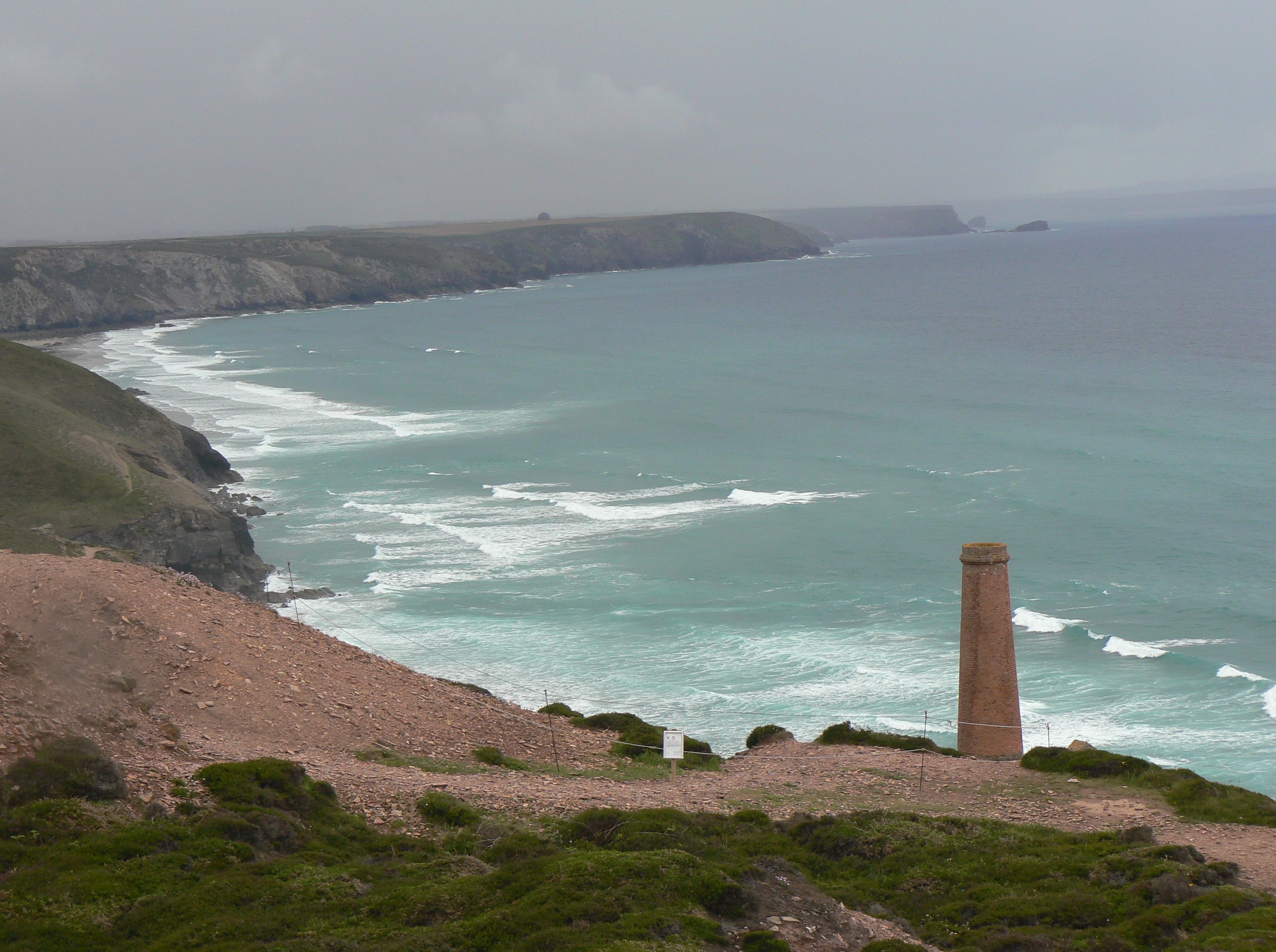
Derelict mine workings in Cornwall
Old wreckers pub in Cornwall with secret smugglers’ passage behind the fire
castle in Cornwall
banksy mural/graffiti on a wall in Cheltenham
sunlight through stained glass window reflected on wall of Gloucester cathedral
Flying buttress hgolding up a chapel wall in Gloucester cathedral
An Ice Wall in Vermont caused when snow starts to melt as the temperature rises, then freezes overnight
stone wall in a garden in Cornwall with plants
Light show projected onto the wall of William Shakespeare’s Birthplace in Stratford on Avon
Light show projected onto the wall of William Shakespeare’s Birthplace in Stratford on Avon
Light show projected onto the wall of William Shakespeare’s Birthplace in Stratford on Avon
Light show projected onto the wall of William Shakespeare’s Birthplace in Stratford on Avon
Oh my goodness this Weekly Photo Challenge was fun but it was really hard not to overload the gallery. I have countless photos of Autumn trees, Icons and Flowers which would have fit the theme, but I was a bit ruthless and just picked a random selection. I hope you like them. I do know that the amber ship is an atrocious photo as it was taken through a shop window but I did so crave that ship that it had to be included!
Entitled Nomad, this is a ceramic sleeping bag to represent homelessness
Beautiful Somerset Sunset
Peaceful sunset over Somerset with sailing boat and Hinckley point Nuclear power Station fading into the misty distance
Vibrant citrus colours in a Stained Glass Window in Krakow, Poland
Hovercraft designed for rescue at sea where there are mudflats or quicksand as in Somerset
Gorgeous orange poppies
Grandchildren on an orange slide with complimentary haircolour!
My daughter looking very pleased with her choice of pumpkin for hallowe’en
I was what was known as a sickly child in the 1940s and 50s. It turned out that I had Rheumatic Fever which left me with a variety of problems and no appetite (how times have changed!). Because of this I was often unwell and my mum would get me Lucozade and a bar of Fry’s Five Boys Chocolate with Five Centres. I guess it could be called a reward because 60 years later I remember every sensory detail!
Five Centres was produced from 1934 to 1992. It was similar to today’s Fry’s Chocolate Cream in that it had a dark chocolate coating, with fondant inside. But instead of peppermint cream there were five different flavoured fondant centres. In the early days they were strawberry, orange, raspberry, lemon and pineapple, all of which I loved. In later years coffee, lime, and blackcurrant replaced strawberry, lemon and pineapple but I don’t remember ever having those.
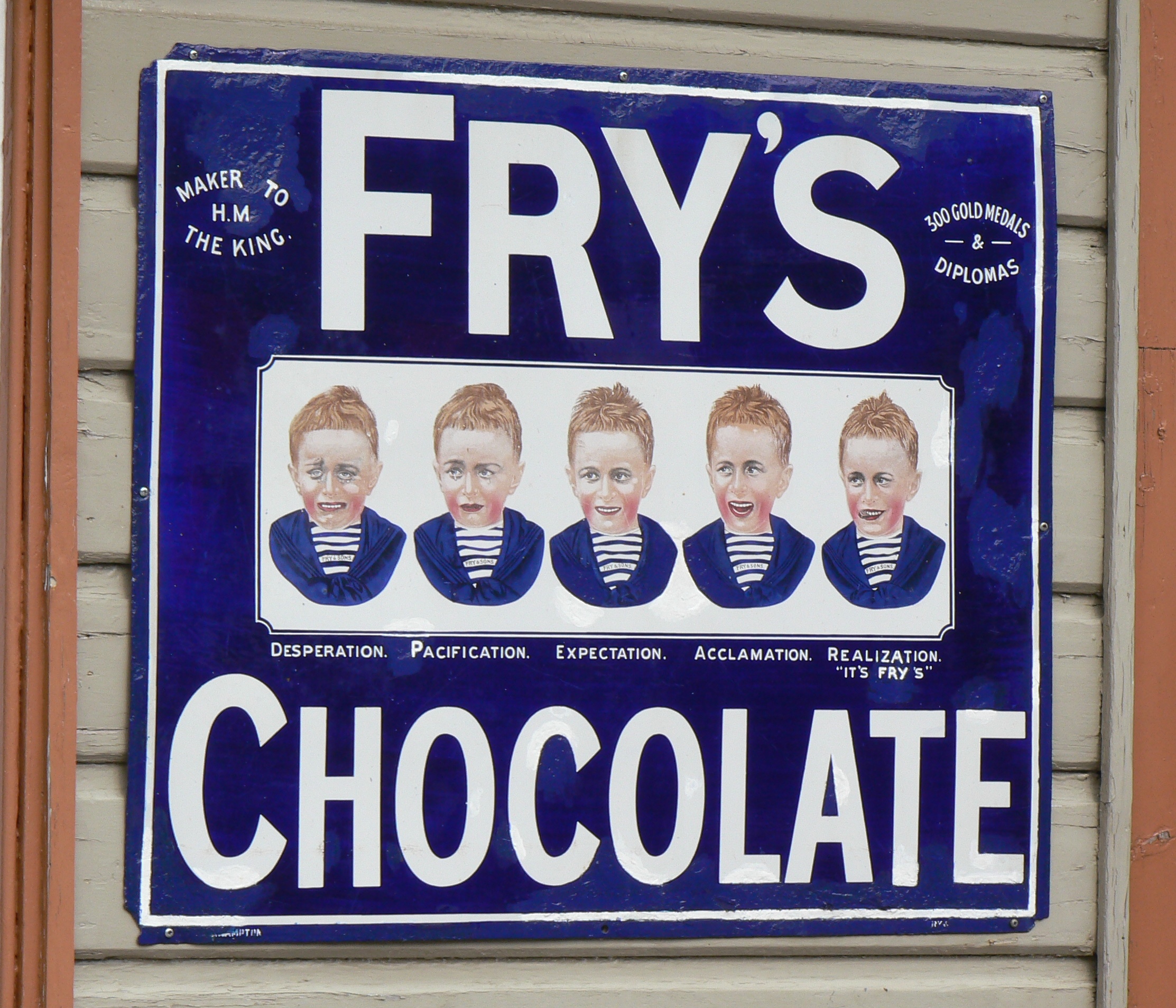
The wrapper was deep blue and it had what looked like 5 boys’ photos on it. But really they were just one boy in a sailor suit who was photographed with five different facial expressions. The photo was taken in 1885 and the boy was called Lindsey Poulton. He was, appropriately, 5 years old. His father and grandfather took the photos and Fry’s chocolate company in Bristol paid them the considerable sum of £200 for exclusive use of the set. The photos appeared in adverts and in shop windows for years. As my grandfather had a little general store in Newcastle on Tyne in the 1950s the enamelled metal sign on the outside wall was very familiar to me.
I’m very grateful to pocketbookuk for explaining the facial expressions and I would urge you to take a look at their fascinating blog.
The five faces of Fry’s Five Boys chocolate on an enamelled metal sign. Desperation – no chocolate, Pacification – the promise of chocolate, Expectation – the prospect of chocolate, Acclamation – happiness at receiving chocolate, and Realization – eating the chocolate, and discovering that it is a Fry’s milk chocolate bar!
I can’t really leave out a couple of photos of my grandson and his rewards. He is such an active lad, 11 now and always busy so he is used to getting rewards for his labours. He is a boy scout and his uniform is covered in the badges he has earned. He also plays football for his school team and a local team. He sometimes plays in goal and is often man of the match, receiving cups and plaques as his reward.
Silver backed Gorilla
Robin taking mealworms to his fledgelings
My first catch, a nice carp
Rewarded by a a basketful of apples
Being a nature lover I have to include a few photos of rewards in the natural world. Firstly there is Jock, the silver backed gorilla who lives in a family of 6 at Bristol Zoo and is a very popular animal. He is so magnificent and such a good role model for his youngsters that he deserves lots of fruit as his reward.
The robin created a grand residence in a large plant tub in my garden. He and his made laid one egg then disappeared. I was really worried that they had abandoned their nest with this egg in it. But weeks later they returned and more eggs appeared. Apparently this is quite normal and the first egg hatched out with the others which surprised me. I was so pleased to see the robins back that I overcame my squeamishness and rewarded them with a daily quota of live mealworms.
The beautiful carp was the first fish I ever caught ~ reward for my hours of patient fishing
Lastly the basket of apples were a reward for finding a beautiful open orchard in a church yard. No-one seemed to be collecting these gorgeous fruits so i helped myself to as many as I could carry after checking with the vicar!
I have to say one of my favourite rewards after a day out is a whippy ice cream. I share this passion with my husband and grandchildren!
Reward for walking all day in the heat at Bristol Zoo
I am still learning about this Weekly Photo Challenge ~ Rule of Thirds and it has made me go back over some old photos which I love to see if they fit into the rule. I am finding it hard but maybe if I draw the grid on some clear cellophane I could put it over my photos and judge them that way. I guess it is going to take some time to learn to see with a photographer’s eye but I am enjoying learning from all the brilliant photographers on wordpress.
Visual of the Rule of Thirds
Weir at bakewell in Yorkshire
Deer at Dyrrham park
Black faced lambs in the Cotswolds
Memorial to the Unnamed Soldier near Red Square, Moscow
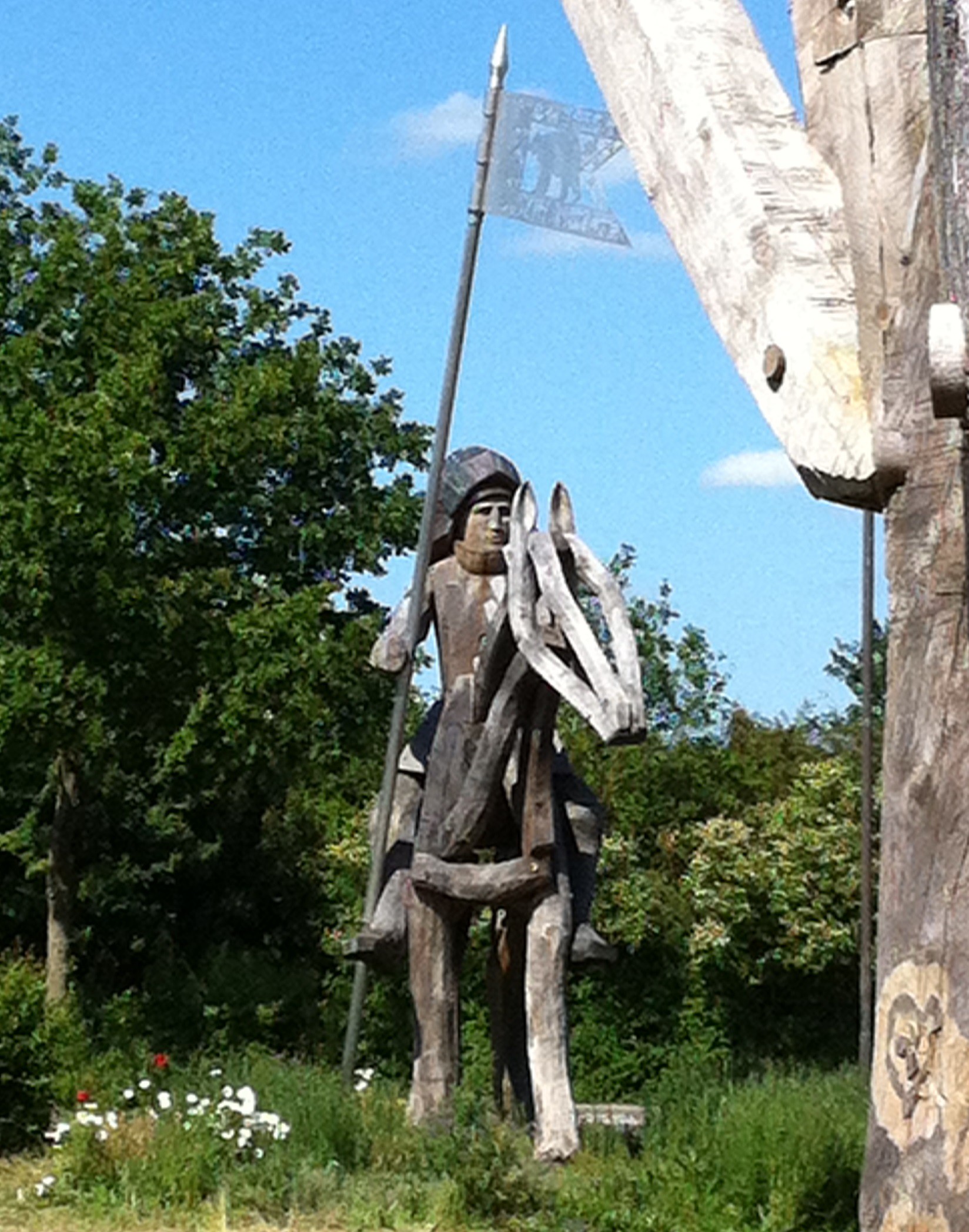 Victor




















 Heavenhappens