The scale of the tragedy

The scale of the tragedy

P1020114

26 foot Knife angel made of surrendered knives

We hear awful things about gun crime in the USA, which is really worrying.  In the UK we don’t have gun crime on the same scale because we do not have the right to own or carry guns thankfully.

However, knife crime is a serious problem here with even quite young teenagers taking knives out with them for ‘protection’.  The consequences for many young people and their families are tragic.

The government, police forces and traders have been working together to tackle the issue in many ways.  One of the ideas was an amnesty on knives that were handed in or placed in ‘surrender boxes’.  These are secure boxes that are placed in police stations and YMCAs amongst other places.

Recently I went to see what has happened to all the knives that have been handed in so far, and I was staggered.  Artist Alfie Bradley has created a 26-foot sculpture in the shape of an angel out of the 100,000 or so  that were surrendered nationwide.  It took him 2 years to create his memorial, which can be seen at Oswestry’s British Ironwork Centre.

The many coloured handles form the surface of the body of the angel, while the blades form the wings.   I can’t describe just how moving this sculpture is, as many of the knives have actually been used in crimes.  It has an expression of such tragedy on its face that it reflects the awful pain felt by those who suffer the consequences of knife crime.

The Knife Angel will be travelling around the country eventually to be displayed in other towns, but for now it is a thought-provoking entrance to the amazing artwork on show at the British Ironwork Centre.

I can recommend spending a day at the British Ironwork Centre.  It is in a beautiful, unspoilt area of the country and the displays of art and craftwork are spectacular.

Here are photos of some of the other pieces of iron art on display.  All are truly beautiful, but the gorilla is very interesting because it is entirely made of spoons donated by  children from many countries after an appeal by the magician Yuri Geller.

Layers of Love

chiselling the slate

I have always been fascinated by stone because in one form or another it has been around since the world began, and, in one form or another, will still be around when we are all gone!

As a youngster I lived for a few years in the Lake District, where slate has been mined for centuries, and still is.  There were wonderful shades of green and  blue-grey, which you can still get today.  The colours depend on what minerals and organic materials were in the shale when it was laid down. There was even a silvery grey called Coniston Old Man! Geologists reckon it was laid down over the course of 500 million years, from sedimentary rock under low heat and pressure.  This natural slate can withstand the most extreme environments and conditions, which makes it ideal as a building material.

But, when slate is turned on its side, it can be easily split with a hammer and chisel into separate layers of differing thicknesses.  It is these qualities of timelessness, strength and layering that were in my mind this week.

I imagine that inside of each one of us there are layers of love being laid down.  Daily life is the mud between the layers and the surface may be riven by life’s ups and downs.  But, hopefully we will all have layers of love laid down for our parents, siblings, children and extended family, whether natural or adoptive, who form the bedrock of our emotional lives.

There will be other layers formed by people we hardly knew but who made a deep impression on our hearts.  I’m thinking of my grandmother who died when I was just 5 but whom I loved with all my heart because she made me feel safe and loved when I was tiny.  They say children won’t remember what you said or what you did, but they will remember how you made them feel.  That was certainly true in her case.

Special friends will lay down other layers, which will still be there even when the friends have passed away.  I’m thinking here of my dear friend, Pat, who died in a cycling accident some years ago.   I have such fond memories of her as we had such fun together at college and for years after.

But there will be other people we meet during the course of our lives whom we respect and admire so strongly that a love develops that transcends normal feelings and is often inexplicable to others.  And this is the point of my post.

When I retired from decades working in education, I was drained in every way; physically, mentally, spiritually and emotionally.  My well had definitely run dry!  I knew that I needed to be in a peaceful place where I could restore my energy and regain my ‘joie de vivre’.  So, I went to work as a housekeeper at St Peter’s Grange, which at the time was a retreat and conference centre run by the Benedictine monks from Prinknash Abbey

This was a labour of love and I learned a great deal about life from the Benedictine monks I shared the chores with.  Fr Alphedge especially was an inspiration.  He was always so happy, building up the fire, sweeping the floor, even scrubbing out enormous pots and pans.  His philosophy was to treat every moment as a sacrament, and every task as a gift to God, not a chore.  He did each menial job with reverence while radiating joy, peace and stillness for almost 40 years.
FullSizeRender

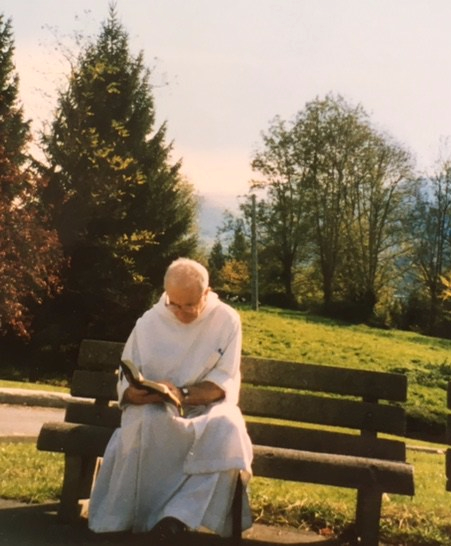
Fr Alphedge in L’Astazou, Lourdes with our ACROSS pilgrimage 1993

Fr Alphedge left this life last month, and I found myself grieving and reflecting on all I had learned from him during those beautiful moments of quiet contemplation that we shared, over the soapy suds, dusty cobwebs and sooty ashes.

And it boils down to love.  I learned to love myself again, to love life, to love the people I come into contact with, and to love the work in-hand.  This is not a shallow kind of love.  As Fr Alphedge would be the first to admit, some people – monks included – can do irritating things that temporarily annoy one.  But, deep inside, love is laid down like the mudstone that changes over time to riven slate.  The people we meet are like the crystals of quartz embedded in it and the formative experiences we have are like the minerals and organic matter that give the slate its colour.

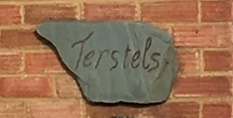
Many years ago, my parents picked up a large slab of slate in the Lake District and carved letters from their names into it, which they painted gold.  It reads ‘Terstels’ from Terry and Stella, and is still on the front of the house where they lived until they died.  I pass it every day and it reminds me that although they are gone, my love for them is still as strong as ever.  I guess it is the first layer of love I laid down.
Terstels 1

I think we each have a limitless capacity for love- it costs nothing, takes up no space, and it is very precious.

Another monk, a Salesian this time, who was rather irreverently known as Bro. Joe, taught me not to hide love but to spread it, share it, give it freely, and let others know that they are loved.  This poem was printed on his funeral order of service and I think it is very good advice!

If with pleasure you are viewing
Any work that I am doing,
If you like me, or you love me, tell me now.
Don’t withhold your approbation
Till the Father makes oration
And I lie with snowy lilies o’er my brow.
For no matter how you shout it,
I won’t care so much about it,
I won’t see how many tear drops you have shed.
If you think some praise is due me.
Now’s the time to slip it to me,
For I cannot read my tombstone when I’m dead.

More than fame and more than money
Is the comment warm and sunny,
Is the hearty warm approval of a friend.
For it gives to life a savour
And it makes me stronger, braver,
And it gives to me the spirit to the end.
If I earn your praise bestow it,
If you like me, let me know it,
Let the words of true encouragement be said.
Do not wait till life is over
And I’m underneath the clover,
For I cannot read my tombstone when I’m dead.


I need to thank Michelle at Honister Slate Mine for the great photos
A Circular Walk

IMG_4886

Tramway Bridge in Stratford on Avon, now just for pedestrians

I lead quite a pedestrian life these days, but I am very grateful that I am still reasonably fit, and can still enjoy regular walks.  Today I am especially grateful, as this autumn is glorious in the Cotswolds.  The sun is shining through the trees in the woods where I take my little dog for her walks, and the ground is covered with golden leaves.

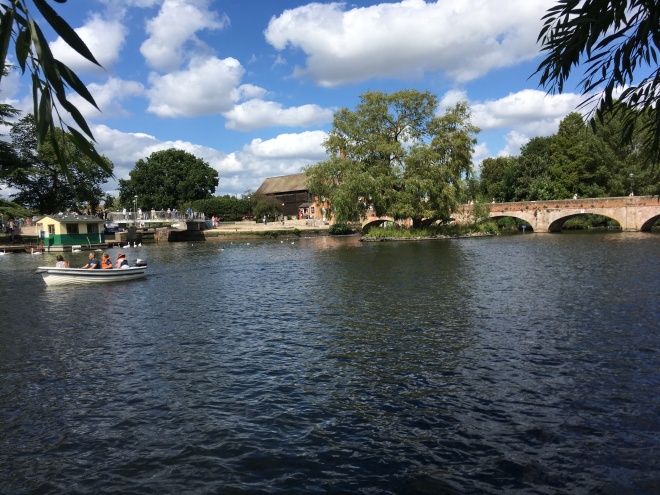
Another walk that I never tire of, and take as often as I can, is the circular walk beside the river Avon in Stratford.  As a teenager I used to walk to school along the old bridge built in 1822 for horse trams.  It is now a pedestrian bridge, which leads to Bancroft gardens and the town.  But if you turn left, instead of crossing the tramway bridge, you can take a beautiful walk alongside the river.  Here you will get the most spectacular views of the Shakespeare Theatre, and Holy Trinity Church, which is the burial place of William Shakespeare.  The path goes on past the ferry, weirs and the old mill, but there is a bridge which you can cross to get into the oldest part of the town.

s on a weir 3

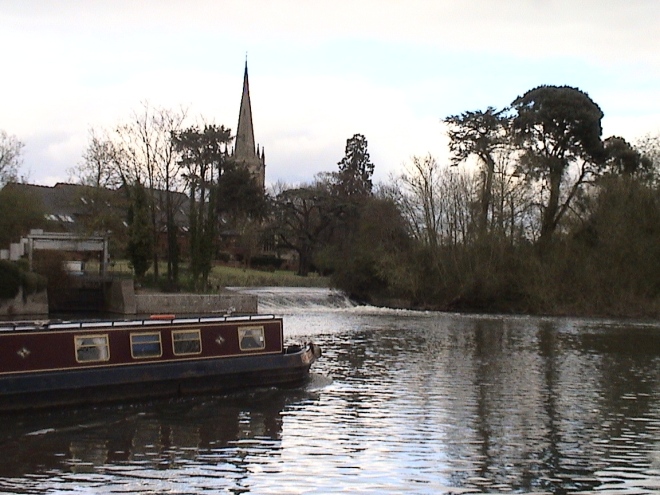
Weir on the Avon at Stratford

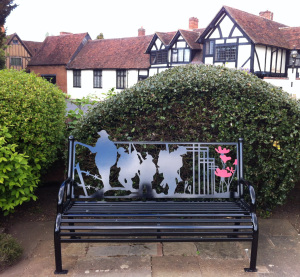
Whenever I have visitors, I take them to the Old Town to see some of the most beautiful places in Stratford.  I start at the British Legion memorial garden which is always peaceful and very moving.  There are several plaques on the wall about both World Wars.  There is also one of the most beautiful garden seats I have ever seen.  It is wrought in iron and has a design of soldiers marching amongst poppies.

WW1 memorial garden seat

British Legion memorial garden bench to remember the centenary of WW1

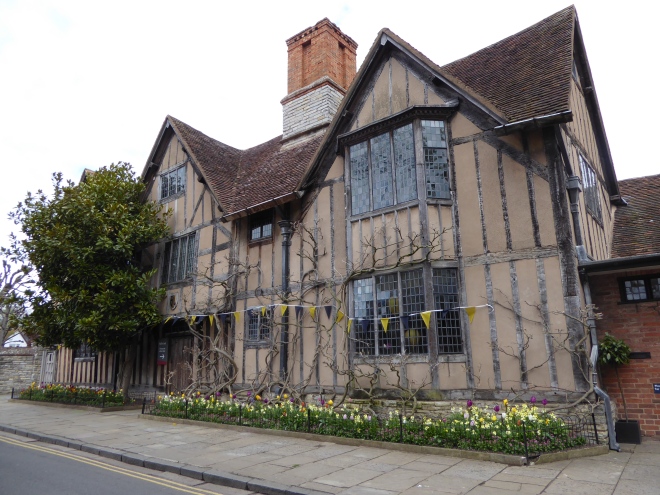
From there I walk past the Jacobean home of Shakespeare’s daughter Susanna and her husband Dr John Hall.  The main part of this beautiful house was built in 1613!

P1000798

Halls Croft

I then turn left into Church Street and walk on to Chapel Lane where there are some of the oldest buildings in the town, which were built for the Guild of the Holy Cross. This guild virtually controlled the town in the middle ages.  First you see a row of almshouses for the poor and needy parishioners.

As a teenager I used to collect shopping for a wonderful old French lady who lived in one of the almshouses.  Inside, the rooms had solid oak floors which creaked, and low timbered ceilings.  I believe they were renovated in the 1980s and brought up to date inside, but the outside is thankfully unchanged.

Next door to the almshouses is the Guild Hall where you can visit Shakespeare’s actual schoolroom.  Then there is the Guild Chapel, with a history dating back to 1269!

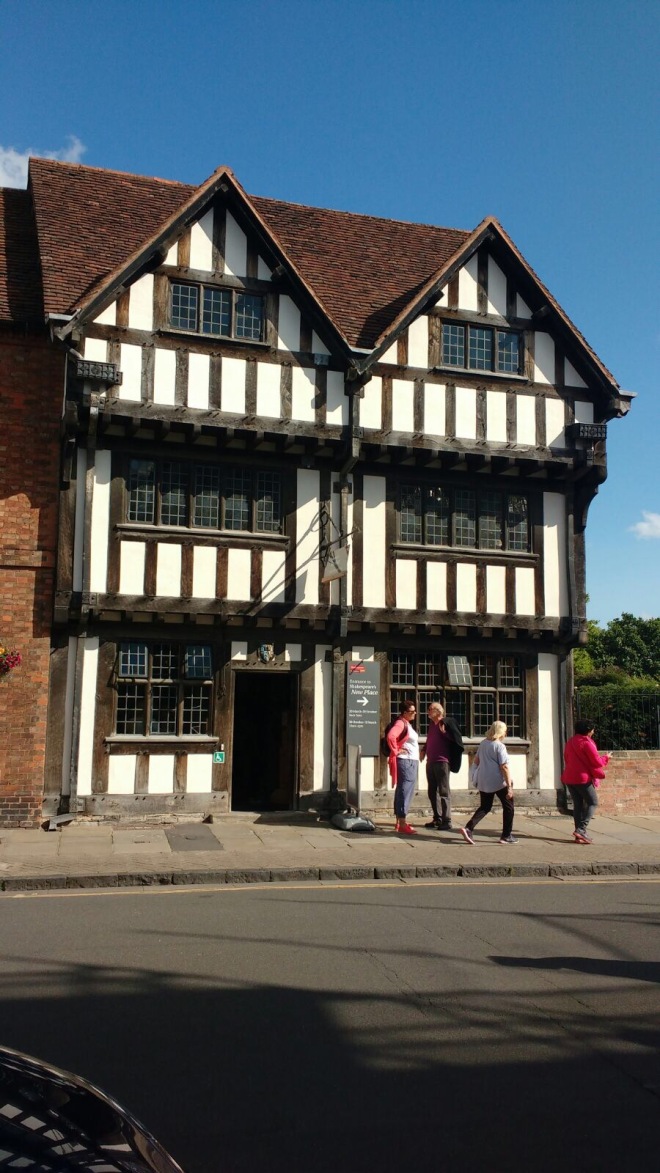
Opposite the Guild Chapel is the site of New Place with its gorgeous gardens.  When Shakespeare bought New Place it was the second biggest house in Stratford.  It was his family’s home from 1597 until he died there in 1616.  Sadly, the house was demolished in the 18th century, but visitors can really connect with Shakespeare in the garden through imaginative artworks reflecting the plays.  It is believed that Shakespeare wrote the Tempest here and this summer there was wonderful artwork on that theme.

Nash's House next to New Place

Nash’s House next to New Place

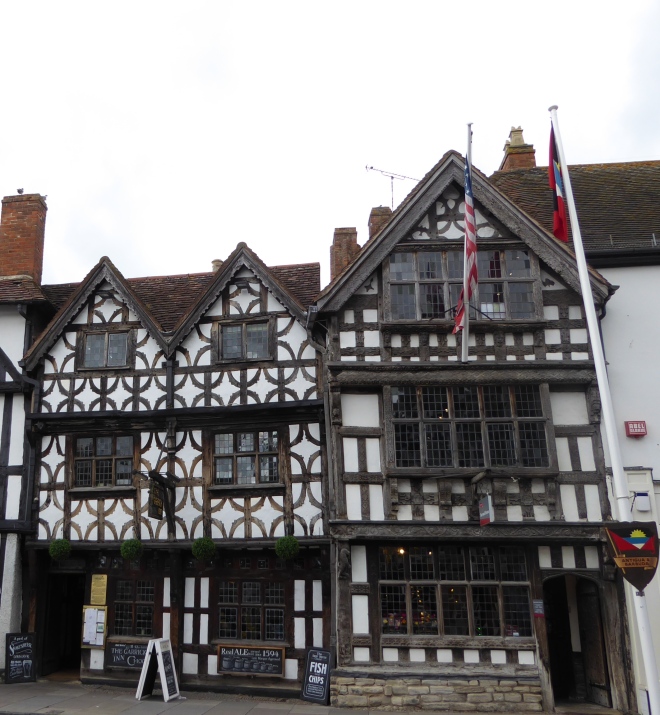
On the other side of the road, on the High Street, is the oldest pub in the town.  The Garrick Inn, like many buildings in the old town, is a timber framed and dates back to the 1400’s.  It revels in its colourful history of plagues, fires, priest holes, and ghosts!


The Garrick Inn and Harvard House

The Garrick Inn and Harvard House

Next door to the pub is Harvard House, where John Harvard was born in 1607.  He married and emigrated to Massachusetts in America where he was a preacher and teaching elder.  When he died of TB he left 230 books and a very generous legacy to a fund for the founding of a new college.  This was to become Harvard College, the oldest institution of higher education in America.  The house is preserved thanks to the work of Marie Corelli, the writer.  She lived in Stratford at the height of her fame and was passionate about preserving the old buildings in the town.  She bought Harvard House in a dilapidated state and was determined to save it.  In 1905, Marie met an American couple, Mr and Mrs Morris, who agreed to help pay for the restoration as a sign of friendship between UK and USA.   Between them, they donated the house to Harvard University, and, at the grand re-opening in October 1909, the American ambassador, Whitelaw Reid, declared it ‘free to all visiting sons of Harvard, and a rendezvous for all visiting Americans’.

I would probably go on to Shakespeare’s birthplace from here.  It really is worth going into the Birthplace Trust just to find out what Stratford was like in his day.

From there I would go back towards the theatre and the Bancroft Gardens and return to my car via the Tramway, picking up a whippy ice-cream on the way.

I have written other posts about Anne Hathaway’s cottage, the Theatre and Holy Trinity Church, which you can read by clicking the links.  But for now, you can enjoy some of the photos from my last circular walk!


Layers of Leaves

Layers of Leaves

I can’t resist the photos of my grandchildren, layered in clothes, playing in layers of leaves in the woodland.  Autumn has arrived in the Cotswolds, and it is certainly a magical time of year.

IMG_1686

Layers of leaves lie

Overwhelming the senses

Deep in the forest


No more Waiting for Wags

No more Waiting for Wags

Let me introduce you to Wags.  He was found as a stray and taken to an animal shelter in California, where my daughter lives.  This shelter has a high rate of putting down unwanted dogs, so kind volunteers, like my daughter, go in regularly to check for cases just like Wags, who are older and in need of veterinary care.  Peace of Mind Dog Rescue sponsored him and took him to a vet for evaluation.  He was only waiting there for 2 days before my daughter decided to foster him herself.

By piecing together what was known, it seems that Wags had been living on the streets for a while, probably with a homeless person judging by his behaviour – he has a habit of climbing into cardboard boxes to hide or sleep.   No-one knows for sure but he was possibly abandoned because he needed very expensive treatment for his many medical problems.

He had periodontal disease which was so severe that his teeth had to be removed along with half of his lower jaw.  As well as that he has occasional epileptic fits if he gets stressed.

But, for my daughter, he is the perfect pet.  He just loves to sit on her lap at the beach or in the park, ride in her bicycle basket to the woods, or snuggle into his special car seat on her way to work.

He still has medical needs and he has a special soft diet, but he could not be in better hands.   I am so glad they found each other.

My own little dog Toffee just celebrated her first birthday by being spayed!  She has recovered really well and is back to her usual bouncy self, haring at full speed across fields, or picking her way through the woods with her nose to the ground.  She is a joy to be with and I feel very lucky to have her.

Her life could have been very different as she was born, unknown to me, in a barn on a puppy farm owned by gypsies who had been banned by the RSPCA from keeping animals.  Thankfully I was able to adopt her at just 8 weeks old so I don’t think she had suffered.  What it does mean is that I have no paperwork for her and no proof of what breed she is.

I was told that she was a Pembroke corgi crossed with a dachshund, but everyone who sees her says she has a lot of beagle in her!  I don’t really mind what her pedigree is because I love her.

I had her spayed because there are too many unloved and abandoned dogs in the world like Wags who need a home, so I feel it is unnecessary and a bit anti-social to breed more.

Here are some more adorable photos of Wags now that he is healthy.

Walk this Way

Walk this Way

P1020105

Almost the end of the summer here in the UK and Autumn is definitely in the air.  So, I went with the grandchildren to Westonbirt Arboretum.  The arboretum is so popular that the car park was overflowing, but once inside the woodland is so vast that it didn’t seem crowded at all.   The aim of the visit was to go on the Gruffalo trail but we found that a bit disappointing.

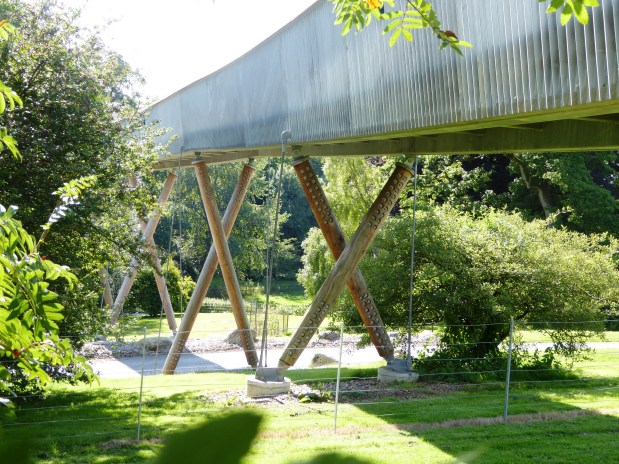
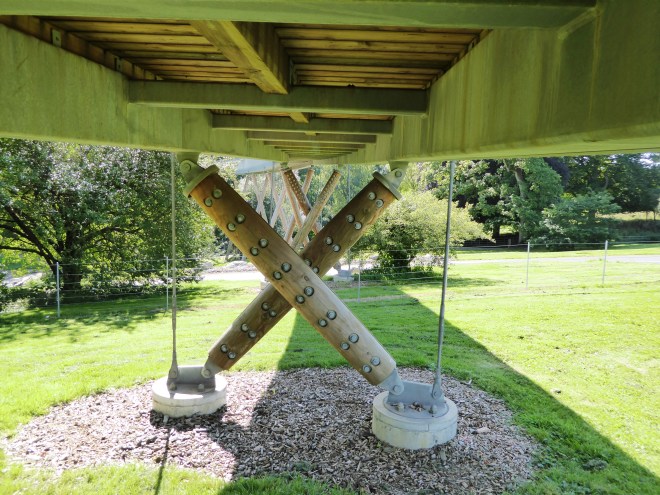
However, a new experience for us was the bridge-like structure which takes visitors right up into the canopy of the trees.  The bridge is very cleverly built with angled slats on the sides so that even the smallest children or wheelchair users can see the trees every step of the way.  At intervals, there are viewpoints like ‘crow’s nests’ with information and pictures of the wildlife you can find.  Some of the wildlife was a bit too realistic as there were swarms of bees building hives in some trees!

Up there on the walkway you get a totally different view of, and perspective on the 15,000 trees from all around the world which thrive there.

All around the arboretum there are woodcarvings and buildings created from the trees in the woods.  They are magnificent.  But the grandchildren’s favourite was in the adventure play area.  There was a sea theme with a huge pirate ship, small canoes, sharks and fish, all carved from the wood.   The grandchildren loved it and I can’t wait to go back in Autumn when the trees have turned golden and red.

Wooden Walkway and other structures at Westonbirt

Trees are structures just made for climbing up and over, or jumping off!

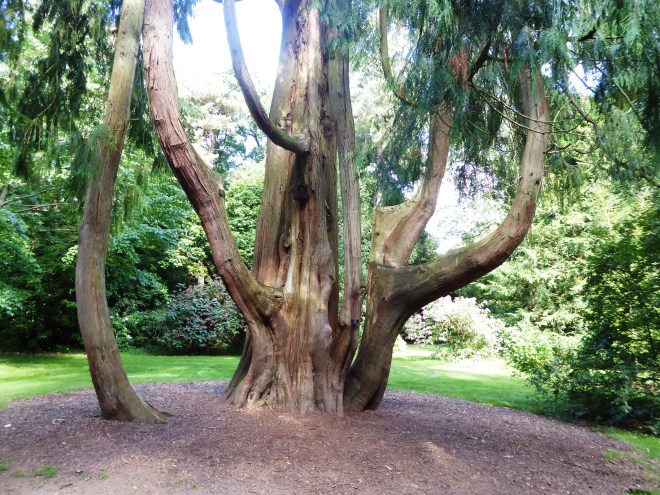
The Western Red cedar is a spectacular structure

P1020080

And lastly,  a woodcarving

A crocodile in the corner


There is a fascinating corner of the Cotswold’s in Compton Abdale with a very unusual spring, which a respected builder from the nearby village of Hazleton built from Cotswold Stone in the 19th Century.  Presumably some local landowner paid for it.  The feature is shaped like a crocodile’s head and the spring water has been gushing out of the crocodile’s mouth ever since.  Some days after lots of heavy rain, it is a truly spectacular sight.

I wish I could capture the sound of the pure rushing water for you but my photos will have to do.

I marvel at the fact that nature produces a constant supply of fresh water for us here.  Would that other parts of the world were so lucky.

My corner of the world

corner-of-manor-by-the-lake-1.jpg

When I first arrived in my little corner of the Cotswold’s 50 years ago it was a very rural scene.   I lived on the edge of the countryside with farms and fields all around.  There was some post war prefabricated housing nearby, and a few ancient cottages.  There was one unobtrusive industrial area with factories linked to the aviation industry, and their offices were in a manor house which was known as Arle Court.  The manor was built in the mid1800s to replace the Butt family’s original Elizabethan house of the same name and it has a fascinating history.

Today the area around the manor house has become very built up with a supermarket and DIY store, a pet shop, a park and ride bus service, new housing, and an enormous car showroom and garage!  Most of the old factories have been converted and now house a private hospital, a gym, offices, and a film studio.

But when I go to the area these days, I make a point of taking a little detour to what can only be described as an oasis of peace and a little treasure trove of nature.   Despite everything around, there is still the stunning manor house set in 7 acres of beautiful formal gardens with a lake and woodland hiding it from the busy modern, commercial world.  It is called Manor By The Lake now and is a quirky hotel, perfect for weddings, special events and conferences.  The decor inside is simply gorgeous as you will see if you look on the website.

There are herons and ducks in the lake, woodpeckers galore in the gardens, and an abundance of wildlife in the woodland.  I used to be able to walk my dog there, but now it is all private and there are development plans afoot for the woodland.  I just hope that a little corner can be preserved for future generations to enjoy.


The Cotswold Lion

The Cotswold Lion


P1000097

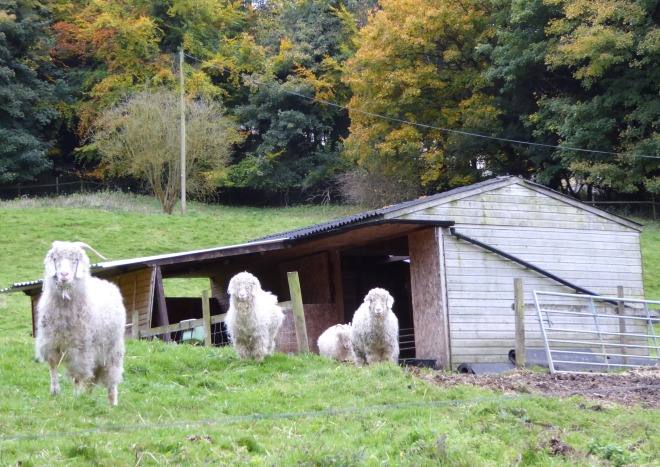
Cotswold Lions at Prinknash Abbey farm

‘In Europe the best wool is English and in England the best wool is Cotswold’
(12th century saying).

This week I am thinking about texture.  

There are two types of texture, actual texture which you can feel or touch, and visual texture which uses marks to give the illusion of a textured surface.  It fascinates me that the word texture originated from from the Latin textilis ~ woven, from texere ~ to weave and the 17th century word Textile has the same root.  A textile is literally ‘that which has been woven’.   So this weekend I set out to learn more about it.

There can’t be a more random selection of textures than stone, wool, water, grass and brass; however, there is a link!  And it is at the heart of this beautiful area I live in called the Cotswolds.

The Cotswold land is ideal for sheep grazing and in medieval times the Abbeys and Monasteries kept huge flocks of the native breed, which was, and still is, known as the Cotswold Lion, because it has a long shaggy mane over its eyes.  These are stocky animals that breed well and grow quickly.  Their wool is so long, fine, white and soft that it was known as the ‘golden fleece’ ~ because of the wealth it created, not the colour.

From the earliest times the wool itself was traded, but by the middle ages whole cottage industries grew up to process the wool into cloth.  The clothier and his family prepared the raw wool then gave it to his neighbours to be spun by the women and children.  It was then woven by men in their homes.  The weavers’ cottages had long, low windows in order to give maximum light to the looms.  After processing the cloth was extremely dense and almost waterproof due to the nap, which was ideal for the military, huntsmen and landowners.

The merchants who traded in this fine cloth became extremely wealthy. They used their wealth to build wonderful houses out of the local Cotswold stone and to build and furnish exquisite churches in the market towns and villages, with stained glass, stone carvings and brasses.

Yes, the rolling fields, honey coloured stone cottages, ancient mills and beautiful churches that make up our landscape are all here because of sheep.  The names of the villages such as Sheepscombe reflect the trade, and even our pubs and inns like the Fleece or the Ram are reminiscent of the wool trade.

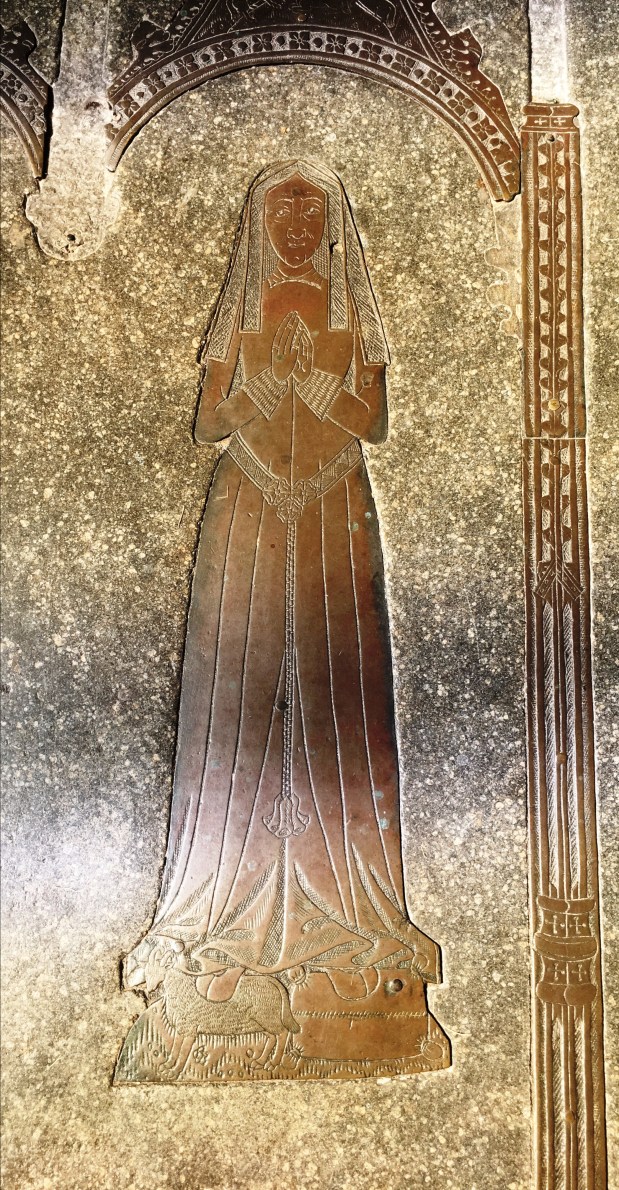
I visited the church of St. Peter and St. Paul at Northleach today.  It is one of the largest and finest wool churches in England.  There are some fascinating brasses in this church with images of the merchants with sacks of wool or sheep as their footrest.  They date back to the 1400s.  One or two of the brasses were particularly interesting as they showed that women could be wealthy merchants too.  And, one particularly striking couple had their 15 children shown on the brass!

By the 16th century the industry was moving away from the small towns and villages to be nearer to the Stroud valley where the fast-flowing streams supplied the power to drive the fulling mills.  In its heyday, there were around 200 mills in the Stroud valley and many of them are still standing today.  They are converted for other industrial uses now or renovated into rather swish apartments.

I learned some fascinating facts today.  Who knew that subsequent to the ‘Burial in Wool acts of 1667 and 1668’, all bodies had to be buried in wool unless they died of plague.  This law was only repealed in 1814.  It stated that,

“No corps should be buried in anything other than what is made of sheep’s wool only; or put into any coffin lined or faced with any material but sheep’s wool, on pain of forfeiture of £5.”

The old saying – “You can’t pull the wool over my eyes”, came from being buried in a shroud of wool, and meant that “I am not dead!”

You may know that there is a large wool-stuffed cushion or seat covered in red cloth in the House of Lords.  This is called the Woolsack and is where the Lord Speaker sits during Parliamentary proceedings with the Mace on the woolsack behind him.  It was introduced by King Edward III (1327-77) and originally stuffed with English wool as a reminder of England’s traditional source of wealth – the wool trade.  There is also a larger woolsack where senior Judges sit during the State Opening of Parliament.

Here are some photos from Northleach where wealthy cloth merchant John Fortey paid for the church renovations


Here are some photos from Bibury where wool was treated on Rack isle


And lastly some photos from Nailsworth where the Fulling Mills refined the texture of the cloth.


And lastly, to the pub, The Fleece at Bretforton!


I could write so much more, but if you are interested I can recommend these very knowledgeable and interesting websites:

http://www.cotswoldjourneys.com/cotswolds-guide/the-cotswolds-wool-trade/

http://stroud-textile.org.uk/history/background-to-the-local-wool-industry/


Satisfaction achieved

IMG_3668

This photo shows me and my four children just before setting off for my son’s wedding.  It is definitely the moment that sums up my feelings of deep pride, joy, and satisfaction.

If my children ever read my blog, which they don’t, they would be mortified to see themselves publicly displayed.  Young people are never satisfied with how they look, and mine guard their privacy to greater or lesser degrees!  However, I am so proud of having raised these wonderful, kind, caring, funny, hard-working and loving people that I am going to risk it.

We are so rarely all together, as three of them live abroad.  But when we are together there is a bond so strong it feels incredible.  We will all be together again in less than 2 weeks for my 70th birthday and I can’t wait.

I feel blessed to have such a family.

What are the streets that have no memories

What are the streets that have no memories

gerry 138

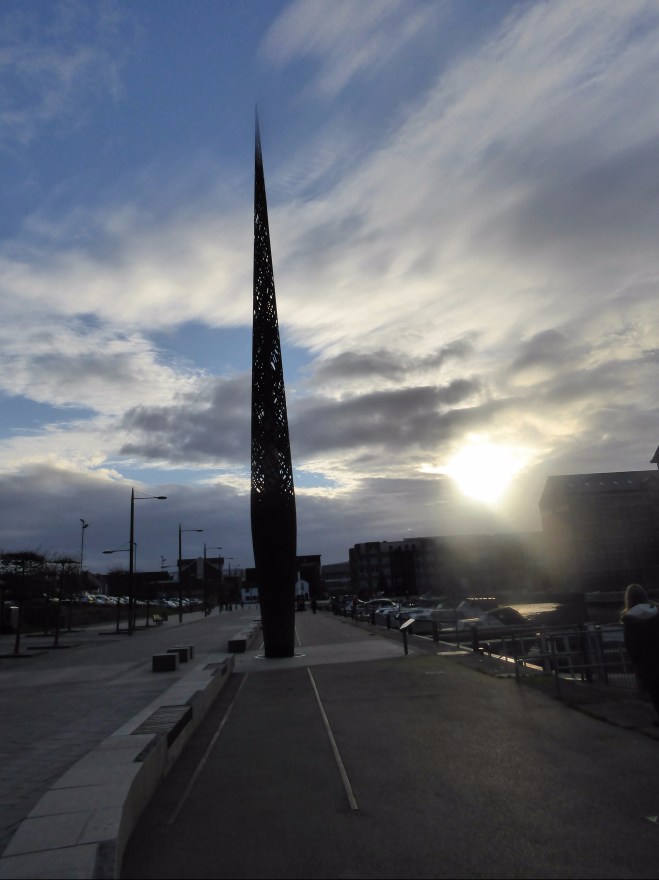
This unusual public art by Wolfgang Buttress is a 22-metre-high beacon and landmark on the way between Gloucester Docks and the city centre.  It symbolises a candle as a reference to the nearby Cathedral, or a flame to remind us of the many fires which have devastated the old buildings over the years.  The most recent fire was at Bakers Quay, which I wrote about a couple of years ago.

The structure is made of ‘Cor-ten’ steel, which I’m not a great fan of!  It seems to be cropping up all over the place on public buildings and local businesses such as restaurants.  It is supposedly a ‘high strength, low alloy, weldable structural steel, which possesses excellent weathering resistance due to the formation of a protective oxide coating which seals the surface’.  This is supposed to give an attractive finish, but to me it just looks rusty!  I think it is a case of the ‘king’s new clothes’.  I can’t imagine what my old dad would have thought of it, as he spent his life in the steel industry and presumably was not a great fan of rusty structures!

 The structure is etched with the words of Ivor Gurney’s poem, Requiem;

Requiem

Pour out your light, O stars, and do not hold
Your loveliest shining from earth’s outworn shell
Pure and cold your radiance – pure and cold
My dead friends face as well.

Requiem

Pour out your bounty moon of radiant shining
On all this shattered flesh, on all these quiet forms;
For these were slain, so quiet still reclining
In the noblest cause was ever waged with arms.

I have written about Ivor Gurney (1890-1937, a gifted composer, musician and poet, in a previous post. He was born in Gloucester and became a chorister at the Cathedral.  Later, he played the organ at the Mariners’ Chapel which I also wrote about recently.

While serving in the trenches during the first world war Ivor wrote very moving poetry about his experiences, and memories of his beloved Gloucestershire, the people, the history and the beauty of its nature.

A truly thought provoking poem written by Gurney is Thoughts of New England.  It really moves me as it speaks of the Gloucestershire people who emigrated to the New World. Three of my children emigrated, one to New England, so it has a special relevance to me. And, while I can see the appeal of a new life in a vast country with seemingly endless opportunities, like Gurney, I am tied to this tiny island country with it’s history and heritage.  I feel the weight of the past in the rivers, the buildings, the countryside and the people.  Hence the title I chose, which is a line from Gurney’s poem…

Thoughts of New England by Ivor Gurney

Gloucester streets walking in Autumn twilight,
Past Kineburgh’s cottage and old Raven Tavern,
That Hoare he kept, the Puritan, who tired
Or fired, and took a passage in the ‘Mayflower’,
Gloucester streets walking in frost-clear hour —
Of ‘Captains Courageous’ as a boy read, thinking,
And sea-ports, ships, and all that boy desired . . . .
Walt Whitman, history-scraps and Huck Finn’s cavern:
My thoughts went wondering how the New England Folk
Walked twilight now, watched stars steady or blinking —
If thoughts came Eastward as mine Westward went.
Of our ‘Citizen’, the ‘Massachusetts Times’,
And the boys crying them perhaps about their lanes.
But those no historied ground of Roman or Danes.

What are the streets that have no memories,
That are not underset by ancient rubbish?
Where gables overhang, and the quarters clang
From Cathedral towers, and the slops or dinner dish,
Hurried a man voids handily into the gutter:
And ghosts haunt the streets and of old troubles mutter.
Where steel and scarlet of the military
And routine use flash vivid momentarily;
Imagination stricken unaccountably
At full day into pictures not looked for even,
And children from their play by curfew driven.

Are there men of my blood over Atlantic
Wondering there what light is growing thick
By Severn and what real thing Cotswold is?
Are there men walking slow till tiredness leads in
To write or read till the night’s veil grows thin;
Insatiate desiring what hope would win?
Is the air clear there as Thoreau’s prose,
With frost and sparkling water, and day’s close
As mild, as soft as shows in ‘Evangeline’?
(Since all verse from the air or earth does win).

Do they hear tell of Domesday Book, and not
Think of this Gloucester where the scrivener wrote
Command of reeves first set their lists to begin?
Do they wish walk at evening where the earls went in
And William: Are there not crowns of England old
That first in Gloucester’s Abbey showed their gold?
Can villas contain man in unloving hold
As here the cornered, the nooked low-ceilinged beetle-browed
Houses cloak man in; or the strict thoroughfares
Stone or asphalt-paved ally to man?

Are there great joys in April her high days
For those who cannot high imaginations see
Of other men builded, stirred to a great praise?
Cotswold earthing profound for white material,
Masses of stone gone slender as a silver birch,
Upwards in dazzle to an arching azure.

O where in the new towns shall recompense come,
For the market-days, the week-end trouble without measure,
The crowded four ways and cattle markets boom,
And country faces seen often with so much pleasure?

Can New England think deep thoughts of her bye-ways,
Is Abana and Pharpar a balance for
Severn receiving Avon, at her knot of highways,
Her Abbey township, beneath so high a cloud floor?

But nevertheless one would go very willingly
At the year’s turn, where Washington or Lincoln walked,
Or praise ‘Drum Taps’ or ‘This Compost’, and hear talked
Speech of Lowell, or Hawthorne, or Holmes and be
Pleased with citizenship of Gloucester or Worcester
And companionship of veterans or veteran’s sons
Of the Wilderness or Richmond, see the old guns
That set Chattanooga’s thronged woods astir;
Or woke terror in steadfastness with red anger.

But not for longer than the strangeness lasted.
Severn yet calls not to be resisted:
And the mix of Dane thoughts, Roman, with Middle-Age
Calls all love out to mark on any page.

The glory of Peter’s Abbey high up in Summer,
Or low in Winter’s gloom, and a wavering shape,
Are more than is ever seen by foreign comer
To Connecticut, or Staten or Providence with its cape,
Being loveliness and history and height in one.

And there is nothing uprooted that is not changed.
Better to stay and wonder in the half light
How New England saunters where Kipling loved and ranged, so
And watch the starling flocks in first autumn flight.

The New World has qualities its own,
But the Old not yet decrepit or withered is grown,
And brick and timber of age five centuries known
Are consolation for poverty enough
Against New York, where they say Opera is brilliant,
And the byeways with five dollar notes are strown.
The stuff of Liberty is a varying stuff,
But from Grant’s men. Lee’s men, nobleness should never want.

Here are some of my photos of historic Gloucester to enjoy…


Cotswold Collage

Cotswold Spring2

Someone asked me this week if I could recommend places to visit in the Cotswolds for some travellers from USA. Well I am always delighted to boast about just how special the Cotswolds are so I decided to use this as the basis of my weekly photo challenge theme, which is ‘Collage’.

Of course, the best way to truly get to know the Cotswolds is to walk the Cotswold Way.  This walk is literally 100 miles of quintessentially English countryside.  It stretches from Chipping Camden to Bath, taking in picture-perfect villages and ancient sites of historic interest.  The entire area is designated as a place of outstanding natural beauty.

There are bus tours and mini-bus tours of the Cotswolds from towns like Stratford, which I would heartily recommend if you don’t mind being herded with the crowds.  However, if money is no object, I would recommend one of the expert private tour companies who provide beautiful cars and knowledgeable drivers.  They will plan a tour to reflect your interests, whether they be literary, historical, sporting, spiritual, or whatever.

You could even discover the area on horseback, glide along the rivers and canals on a boat trip, or fly over it in a hot air balloon or helicopter.

But for lucky people who live in the Cotswolds, we can spend a lifetime enjoying the scenery and discovering fascinating facts about the people and places that made the area what it is today.

There are honey coloured thatched stone cottages dotted around villages such as Wick and Winchcombe; Stately homes, Castles and Palaces like Sudeley, Warwick and Blenheim; Abbeys, Monasteries, Cathedrals and ancient Churches like Tewkesbury, Prinknash, Gloucester and Ampney St Mary.

There are also glorious rolling hills and farmland bordered by dry stone walls, where healthy sheep graze.  Much of the area’s wealth arose from the wool these hardy sheep produced.

There are also majestic forests, ancient oak woodland and more recently planted specimen trees at Westonbirt Arboretum.  And if gardens are your thing, we are spoilt for choice with Hidcote and Kiftsgate among many others, which include Prince Charles’s own garden at Highgrove.

The Cotswolds also has plenty for the water lovers, with beautiful rivers, canals, docks, quays and lakes.  The great River Thames actually starts in the Cotswolds and we have the tidal River Severn that flows to the sea.

If that is enough to entice you to visit the Cotswolds I will now add a collage of my photos…


Bridging the years

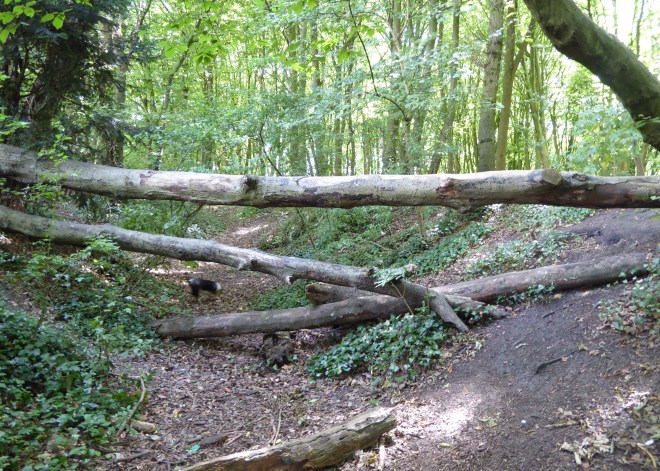
Benhall Woods Bridge

This fallen tree bridges a deep dip in Benhall woods.  As I walk there each day with my little dog, Toffee, it also bridges the years and the generations for me.

I have lived opposite Benhall park and woods for over 30 years now.  It is a delight to have such a wild and wonderful place in the heart of a residential area.  It is filled with Silver Birch, hazel and oak trees as well as blackberry bushes.

I used to bring my children here to play when they were very young.  Then, as teenagers they would play endlessly among the trees, riding their bikes (BMXs in those days) over the natural obstacle course formed long ago by the spoil from the construction of the railway that runs alongside.  The bumps, dips and trenches make a perfect playground and the fallen trees add to the excitement and interest, providing endless hiding places and material for dens.

These days I bring my grandchildren to play in the woods and they love it just as much.  There are always squirrels to spot and birds galore, including owls and woodpeckers that nest high up in the trees.

There is a stream running alongside the woods through a lovely park.  In the stream there are ‘millers’ thumb’ fish, and this week I saw a Great Egret fishing for them!

In spring there was a carpet of snowdrops around the edges of the wood followed later by banks of bluebells in wild areas where nettles flourish.

I love the place.

Recently there has been a lot of controversy because the local council want to allow trainee tree surgeons to practice cutting down trees in the wood.  I have to say I have mixed feelings about this.  I do love the wildness of the wood, but, I can see some work has been carried out to good effect.

One of the saddest aspects of the wood is the tragic suicides that have taken place there in recent years.  A young man hanged himself there some years ago.  Then, tragically, a 15-year-old boy did in 2015 after possibly being bullied.  And a 29-year-old woman sadly did the same last November while suffering from depression.

Since then I notice lots of the lower branches have been removed from the trees, making them difficult to climb and so less likely to be used for this sad purpose.

Sands of Time

IMG_3744

A fascinating challenge this week ~ to share a photograph that signifies transitions and change, to explore the ways in which a single photograph can express time, while only showing us a small portion of any given moment.

I spotted this man building a sand sculpture at Gloucester Docks recently.  It was to celebrate the Tall Ships festival, which was taking place over the weekend.  He worked, oblivious to all around him, with patience and skill.  It was wonderful to see his pile of sand change into a beautiful work of art.  I was mesmerised.

I have written about Gloucester Docks before as it is one of my favourite places locally.  The whole area signifies transitions and change to me.  The wonderful old warehouses, which were once the thriving heart of business in the area are now recycled as accommodation for students, restaurants, museums, or offices.

The old Mariner’s Church in the background of my photo tells its own story  of how the area has changed over time.

In Victorian times a visitor to Gloucester would have found the docks teeming with sailors from all over the world as well as British emigrants preparing to set off for a new life in North America.

Spanish seamen brought onions to Gloucester and sold them in the streets to local housewives. A local newspaper account in 1860 describes the many nationalities that could be seen and heard at the Docks:

‘Here we see a Frenchman from the rich vine districts of Brittany, an Italian from the fertile plantations around Palermo or a swarthy Negro escaped from the Slave States of America. These, with a few Americans and a sprinkling of Norwegians, Danes, Dutchmen and Germans, compose the motley crews of the arrivals in our port’.

In those days, seamen and bargees were distinctively dressed and there was a social barrier between them and other citizens, especially on Sundays when citizens would wear their Sunday best to go to church.   It was decided by a local wealthy businessman that the mariners needed a chapel in which they could be welcomed regardless of language or dress.   And so it was that the simple Mariners Chapel was built in 1848, primarily for the workers at Gloucester Docks and crews of vessels moored there.

The first chaplain, Rev James Hollins, must have been an inspirational man.  He organised services in foreign languages when necessary, and used a portable organ for services on the quayside. There was a Sunday school for boatmen’s children. Religious tracts were given out in many languages, including Welsh, Hindustani and even Chinese. In its first five years, 2,000 copies of the Bible and over 14,000 leaflets in 12 different languages were distributed.

The local watermen and families were often uneducated and living very basic lives. Drunkenness and bad language were common social problems among them. In 1884, an old cheese warehouse with two flats was purchased nearby, for use as a meeting hall. Mariners church started up a coffee bar there, and gave reading and writing lessons. The hall also provided a place simply to relax.

Today this is where I take my granddaughter to a ‘mini-mariners’ playgroup.  it is also where the Galley serves hot lunches every Friday to the local homeless community, or anyone needing help for whatever reason.

Mariners is a proprietary church, independent of the local diocese.  It was set up specifically to meet the spiritual needs of the docks’ community.   There was no dress code and no language or social barrier.  Just a christian desire to help and support the community.  Today this work continues.

Enjoy some of my photos from the tall ships weekend.


I had quite a nautical June as I also went to Bristol Quays on a day trip.  The SS Great Britain is fully restored sitting proudly by pleasure boats, ferries and old warehouses now turned into luxury flats.


. “A Wet Sheet and a Flowing Sea”, written by Allan Cunningham, is one of the best British sea-songs, although written by a landsman.

A Wet Sheet and a Flowing Sea

A Wet sheet and a flowing sea,
A wind that follows fast
And fills the white and rustling sail
And bends the gallant mast;
And bends the gallant mast, my boys,
While like the eagle free –
Away the good ship flies, and leaves
Old England on the lee.

“O for a soft and gentle wind!”
I heard a fair one cry:
But give to me the snoring breeze
And white waves heaving high;
And white waves heaving high, my lads,
The good ship tight and free –
The world of waters is our home,
And merry men are we.

There’s tempest in yon horn’d moon,
And lightning in yon cloud:
But hark the music, mariners!
The wind is piping loud;
The wind is piping loud, my boys,
The lightning flashes free –
While the hollow oak our palace is,
Our heritage the sea.


Reflecting on a Rose

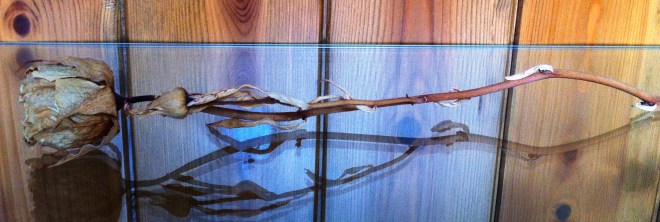
IMG_4190

The photo I am posting for this week’s WPC theme is of a yellow rose which I keep in my glass cabinet.

Among the Ancient Romans, the rose was the symbol of victory, pride and triumphant love.  But for me it is a reminder of many happy times when I travelled on pilgrimages to Lourdes in Southern France with ACROSS on the Jumbulance.

Lourdes is where Mary, the mother of Jesus, appeared to the peasant child, Bernadette Soubirous in 1858.   She was described as having a yellow rose on each foot.   I have been devoted to Our lady of Lourdes since I was a small child.  She is my role-model, my refuge and my strength.

I consider Lourdes to be Holy ground.   God’s Spirit moves there in the rushing waters of the River Gave, and in the gentle breeze that wafts down from snow-covered mountains.  The Spirit moves there in the grand Basilica bathed in sunlight, and in the peaceful Grotto silent in the moonlight. Even the souvenir shops, where the staff will literally move the doors, displays and furnishings to enable a wheelchair bound customer easier access, are filled with the Holy Spirit..   For almost 160 years the sick, dying, troubled and faithful have travelled to Lourdes in the hope of finding relief, comfort, healing and grace.

But, today I am reflecting, not on Lourdes but on Fatima in Portugal. 13th May 2017, is a very special day for anyone who is devoted to Mary, as it is 100 years since she appeared to three peasant children there.  This is such an important event that Pope Francis is attending the celebrations.  He arrived yesterday, and one of the first things he did was to place a golden/yellow rose in the Little Chapel of the Apparitions.

For readers who are interested, there are detailed accounts of the celebrations with live recordings on the Vatican website.

Having been to Lourdes and experienced the powerful atmosphere created by 50,000 pilgrims praying, singing, or standing in silence together, I can only imagine how moving it must be in Fatima this weekend, where hundreds of thousands of pilgrims from all over the world, have gathered to pray in many different languages for unity and peace on Earth.

I am joining them online!

“Whoever saves one life, saves the world entire”

IMG_3577

Beached

For this week’s, WPC theme of ‘danger’, I thought I could post my daughter’s photo of the injured seal that had worn itself out and washed itself up on the beach near Santa Cruz, where she lives.  It was in grave danger until Lisa called Marine Rescue, who turned up quickly and returned to poor creature safely into the ocean.

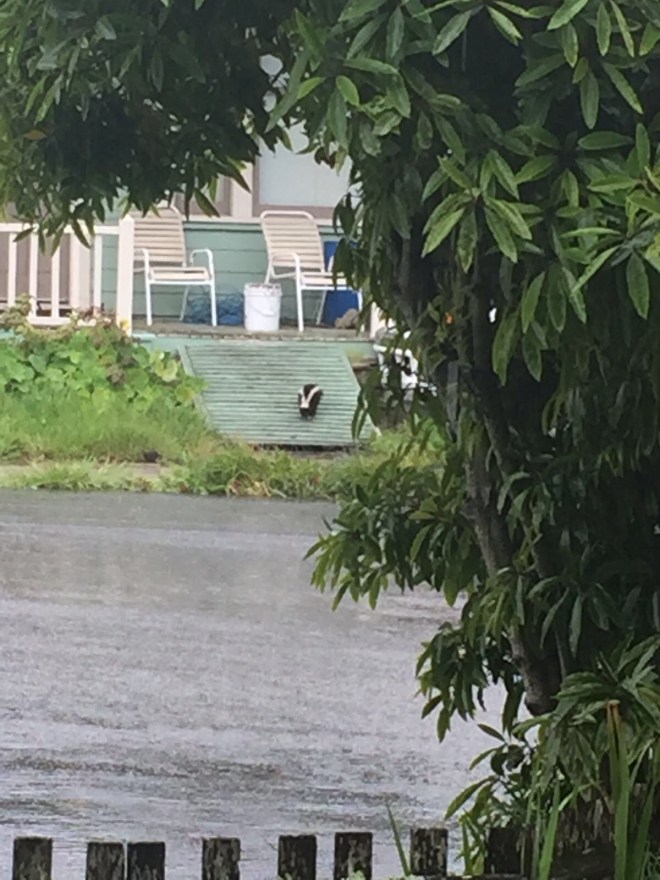
IMG_3061

There was also a photo of a skunk walking down the garden path between Lisa and her front door!  Skunks are notoriously aggressive, unafraid of humans, carry diseases and smell disgusting.  She was in great danger of being attacked or sprayed as she carried her shopping in from the car.

But then, as I was reading Shakespeare’s Merchant of Venice for my Open University course, I suddenly realised just how much danger some persecuted individuals or groups have faced, over the centuries.

In the Merchant of Venice, it is Shylock who is hated for being Jewish.  Shakespeare explores this brilliantly as only he can.  But it reminded me of places I have visited where evidence of the dangers of being Jewish is still clearly visible, or just below the surface.

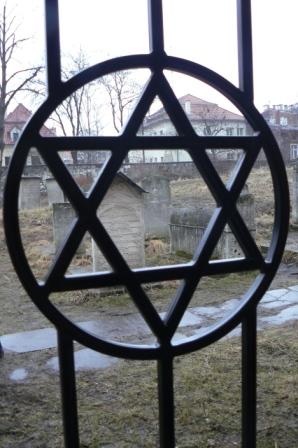
Danger 2

Wrought Iron Star of David on the Cemetery gate in Krakow

Last year I visited a little Catalan town called Empuriabrava.  In the old town, I was horrified by the evidence of past abuse of Jews. There was a cemetery dedicated specifically to those who had been coerced into converting to Christianity.
“On 18th February, 1417 more than 100 people were baptised at the font of the Basilica of Santa Maria, surrounded by their godfathers and authorities.
In 1415, there was the first wave of mass conversions to Christianity as a result of the Perpignan ordinations driven by Benedict X111, known as “Papa Luna”. From that moment on, the converted Jews were buried in a delimited space of the Christian cemetery. The cemetery was attached to the Northern wall of the apse of the basilica. This area has been known for centuries as “the cemetery for the converted Jews”. Nowadays part of the old cemetery is occupied by the Cappella del Santissim, built in 1724, and the other part has been restored as a pedestrian walkway. “
It is a beautiful, peaceful town now but I have to say the references and reminders of those dark times were everywhere, and quite menacing.

IMG_8265

wrought iron representing barbed wire on the cemetery wall

At Gettysberg, Maj. Gen. Joshua L Chamberlain said,

“On great fields, something stays.  Forms change and pass; bodies disappear; but spirits linger, to consecrate ground for the vision – place of souls”.

I knew exactly what he meant when I travelled to Krakow in Poland.

The city of Krakow is beautiful, compact, well preserved and a joy to walk around.  But my visit to the old Jewish quarter in Kazimierz as well as my visit to Schindler’s Enamel factory in Zablocie, which is now a museum, was a revelation.  It happened that I was there on 14thMarch 2012, 69 years to the day of the “final purge”.  The fact that this holocaust happened within living memory is horrific.  The fact that slaughter of innocents on this scale may be happening in parts of the world today is unbearable.

There were about 225,000 Jews living in Krakow before the war but only about 15,000 managed to survive it with the help of brave Poles who kept them hidden, and the enigmatic German Oskar Schindler who needed the cheap labour force they provided.

In March 1941, all Krakow Jews who previously lived in areas such as Kazimierz were forced to live in the new ghetto of Podgorze. The area comprised 320 buildings which had been home to the poorest Poles.  Almost 17000 Jews were now crammed into these buildings and the area was surrounded by barbed wire and walls.  By the autumn of 1941 the jobless Jews who did not have the correct paperwork were transported to concentration camps or shot where they stood.

On March 13-14th 1943 the final extermination was begun.  The first-hand accounts of the few who survived these events were recorded and can be heard at the Schindler factory which is now a museum.  I heard that the remaining men were separated from the women and children.  They were marched off to be used as forced labour.  Any who could not walk unaided were shot on the spot.  Then German soldiers went through the buildings clearing out the women and children to be loaded onto transport which would take them to the extermination camps.  Children and babies were just thrown out of the windows onto the waiting carts, not all landed safely.  The sick and elderly were just killed where they lay.
Literally thousands of Jews were loaded onto transport to the Plaszow camp where they gradually died from starvation, beating, disease, hard labour or execution.   Thousands of others were taken to the extermination camp at Auschwitz-Birkenau over the next few months.   The Auschwitz archives record the fate of those transported.  In February 1944 the remaining men arrived, in May the rest of the children and in August the women.  They all died in the gas chambers shortly afterwards.  The final transport of prisoners from Krakow arrived in Auschwitz the day before the camp was liberated by the Soviet army.
For a harrowing first hand eyewitness account of all the deportations including the final purge there is the memoir, The Cracow Ghetto Pharmacy by Tadeusz Pankiewicz.

Here are some photos from the displays at the Schindler factory or the Jewish Museum which touched me greatly.  They show families and groups of Jews being taken or led away from the ghetto to the camps.  They had to carry whatever they could and abandon the rest.  The last picture shows the Plaszow Camp between 1943-44 where women are being marched to forced labour.


Bluebells with the Brontes

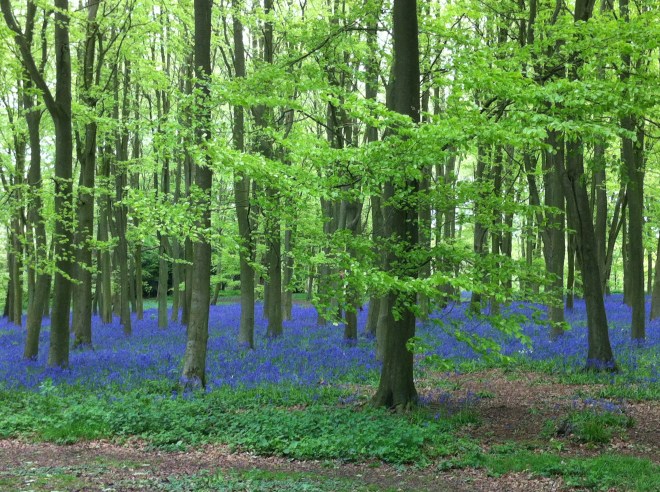
IMG_6482

While taking my little dog, Toffee, for her walks this week, I have been thinking about WPC’s cue for my blog ~ ‘Earth’.

It struck me as I wandered across the park and through the woods near my home, just how marvellous the earth is at recovering from what nature, and we humans, subject it to.

We had a short cold spell when the grass was covered in frost and the earth in the woods was as hard as rock underfoot and twisted ankles were a real danger.  Then as the long and wet winter dragged on, the grass became waterlogged and sodden, and the woods were a quagmire with mud.  But through it all, the snowdrop, crocus and daffodil bulbs survived, and bloomed.  When the weather turned milder a few weeks ago, the blackthorn hedgerows were covered in blossom and the daisies started to appear.  Then, just in time for Easter, the sun came out and transformed everything.

Suddenly the grass over the park is green and dry and covered in bright yellow dandelions alongside the daisies.  In the woods the mud has dried up and carpets of bluebells have miraculously appeared in vast swathes of violet among the weeds, ferns and tree roots.  The smell is wonderful and indescribable.

I can see why they are called the fairy flower, they are just so delicate and beautiful and seemingly appear from nowhere.  They seem to speak of childhood and innocence.

As I wandered with my puppy, a poem started to form in my mind.  Then it struck me that many poets, including Shakespeare, have crafted lovely verse about Bluebells, which I could never match.

So, I will include a couple of my favourites here from the Bronte sisters.

Firstly, a really poignant poem by Anne Bronte who suffered so much sadness in her adult life and died far too young.

A fine and subtle spirit dwells
In every little flower,
Each one its own sweet feeling breathes
With more or less of power.

There is a silent eloquence
In every wild bluebell
That fills my softened heart with bliss
That words could never tell.

Yet I recall not long ago
A bright and sunny day,
‘Twas when I led a toilsome life
So many leagues away;

That day along a sunny road
All carelessly I strayed,
Between two banks where smiling flowers
Their varied hues displayed.

Before me rose a lofty hill,
Behind me lay the sea,
My heart was not so heavy then
As it was wont to be.

Less harassed than at other times
I saw the scene was fair,
And spoke and laughed to those around,
As if I knew no care.

But when I looked upon the bank
My wandering glances fell
Upon a little trembling flower,
A single sweet bluebell.

Whence came that rising in my throat,
That dimness in my eye?
Why did those burning drops distil —
Those bitter feelings rise?

O, that lone flower recalled to me
My happy childhood’s hours
When bluebells seemed like fairy gifts
A prize among the flowers,

Those sunny days of merriment
When heart and soul were free,
And when I dwelt with kindred hearts
That loved and cared for me.

I had not then mid heartless crowds
To spend a thankless life
In seeking after others’ weal
With anxious toil and strife.

‘Sad wanderer, weep those blissful times
That never may return!’
The lovely floweret seemed to say,
And thus it made me mourn.

And one by her sister Emily, who also died tragically young:

The Bluebell is the sweetest flower
That waves in summer air:
Its blossoms have the mightiest power
To soothe my spirit’s care.

I was going to write a learned post about Shakespeare and Bluebells but then I thought I could just add this link about the bard’s garden.

Then I thought I could write about the beauty of bluebells but then I realised that I could never match this one by bookishnature

So I think I will just post photos of bluebells from my walks with Toffee instead!


A Lego Doughnut

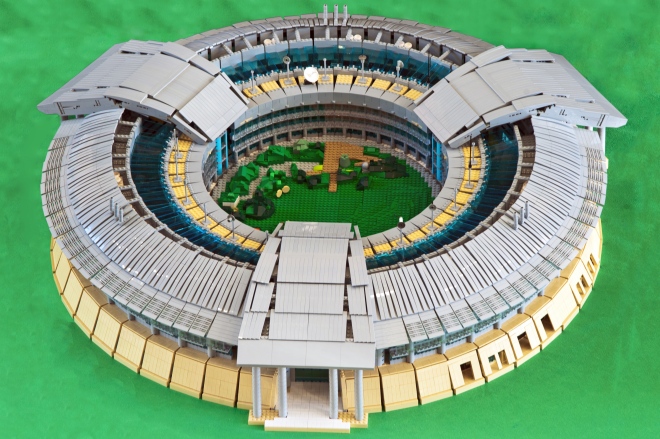
lego_finished_model-3707x2471px


I have made a rather obscure link to this week’s photo challenge theme, which is ‘security’.  But, as regular readers of my blog know, I will use any excuse to write about my grandchildren!

One of the many advantages of spending lots of time with the grandchildren is that I can have fun playing with their toys.

Currently I am enjoying Lego Duplo with Stanley who is 4 and Thea who is 2.  The sets are a far cry from the uninspiring little pieces I remember from when my children were young.  They are so colourful and child friendly now, with animals and themed sets.   Yet they still stimulate the imagination and encourage a world of creative play.

Fortunately I don’t have a tablet, or an ipad, or a kindle, or any of the gadgets they seem to get addicted to as soon as they can hold them these days.  And, horror of horrors, I only have terrestrial TV channels, not games on demand!  So at grandma’s house creative play still rules.

Thea is particularly enjoying the Forest Park and Family Pets sets because she loves animals while Stanley loves the vehicles and characters.  But, however many sets they get, their first desire is still to build the tallest tower!

My older grandson, who has reached the ripe old age of 13, is also into Lego.  He has a bedroom full of it and is very expert.  I don’t even attempt to meddle with his models though, as they are very technical and way beyond my skills.

So, you can imagine how impressed I was to hear recently that part of our national security agency, the Government Communications Headquarters (GCHQ), which is based near my home, had set it’s employees the challenge of modelling the building out of Lego. This is not just any regular building,  it is shaped like a doughnut, which must be really difficult to model.  But they did it and the result is impressive as it would be with all their skills brought to bear.

I can’t take credit for the photo as it was on the official GCHQ website, but I do have permission to use it.  I think it is brilliant, especially as it was created in order to raise funds for a local charity, Elisabeth’s Footprint, which is very dear to my heart.

Do click on the links to see more blogs on the theme of ‘security’ and if you want to know more about the Doughnut Lego model, or the inspiring story of the marvellous woman behind Elisabeth’s Footprint.

What else can you do with grandchildren in the absence of gadgets? Well, We build dens, paint, play with sand and water,  picnic in the woods, take the dog for walks, or go to farms, parks and forests.  If it is cold or wet we make up stories, poems and fantastical adventures…

What did you do today?

Did you go to the airport with an alligator,

Or go to the beach with a bear?

Did you eat in a café with a camel

And frighten the people there?


Did you build a den for a dinosaur,

Or run through the grass with emu?

Did you go to the fairground with a fox?

Did he win a goldfish for you?


Did you play houses with a hedgehog,

Or go ice-skating with an impala?

Did you drive a jeep with a jellyfish,

Or fly a kite with a koala?


Did you eat lunch by the lake with a lamb,

Or play marbles with a monkey?

Did you go on a nature trail with a newt?

Now that would be quite funky.


Did you eat an orange with an octopus,

Or splash in a puddle with a pig?

Did you quiver and quake at a queen bee,

Then go out and dig?


Did you ride the rails with a reindeer,

Or go to the seaside with a snake?

Did you climb a tree with a tiger?

Now that would be a mistake.


Did you race upstairs with a unicorn,

Or drive a van with a vole?

Did you make a wish with a wallaby,

Or did you do nothing at all?


Did you swim with an x-ray tetra,

Or sail on a yacht with a yak?

Did you go to the zoo with a zebra?

Tomorrow ~ are you coming back?

 Poem by Brenda Kimmins.