Autumn is one of my favourite times to go out and about in the Cotswolds. When the children are back at school and most of the tourists have gone home, the villages and parks are reasonably quiet. It is a pleasure then to stroll around them and enjoy the peace and quiet and natural beauty.
I live in a Spa town which was founded on the health giving properties of the natural spring water so water is a common feature around here. Indeed just off the old Roman Road to Cirencester is an area called Seven Springs.
One of the most unusual Springs is where the water gushes out of a stone crocodile head. I love the fact that a respected cotswold stone builder from the nearby village of Hazleton built this feature in the 19th Century. Presumably some local landowner paid for it. The spring water has been gushing out of the crocodile’s mouth ever since. Some days, like yesterday, after lots of heavy rain, it is a truly spectacular sight.
Many Cotswold villages have delightful streams or rivers running through them and none is more beautiful than Bourton on the Water. This delightful town is a favourite of mine when the sun is setting and the only activity is the ducks settling down for the night.
This week I am just posting some photos that I love for WPC on the theme of curve
The first batch are from Stratford on Avon taken this April at Anne Hathaway’s Cottage and along the curve of the River Avon looking towardfs Holy Trinity Church where Shakespeare and Anne are buried.
Next are some exquisite photos of Calla Lilies taken by a friend, Anne Bate-Wiliams, in her garden. The curves are delicate and totally unmatched in the manufactured world for beauty I feel.
Lastly, some beautiful curves both natural and man-made that I spotted in Dorset. The Ammonite-like decorative lampposts are in Lyme Regis and reflect the fact that many fossils are found on the Jurassic Coast.
The Cotswold countryside, parks and gardens are a almost swamped by luscious green foliage this year. The early spring and wet May seem to have benefited the trees and lawns. It is a joy to walk amongst them.
There are lambs, foals, baby rabbits and ducklings to be seen all around and my garden birds are working overtime to feed their young. They beaver away all day long in choreographed movements almost like a dance.
I went to a local park with my little granddaughter at the weekend and she was delighted to see six cygnets that have hatched out recently. The swans nest on an island in the lake but they come over to the grass to feed and walk their little ones. It is amazing and heart-warming to see how many adults and children turn up in their spare time to see and photograph the new arrivals.
Swans are very protective parents so it is best not to get too close! As Shakespeare says…
So doth the swan her downy cygnet save,
Keeping them prisoner underneath her wings.
Eggs laid at Abbotsbury Swannery
Mother protecting her eggs
Swans mate for life and are very protective parents
In honour of Shakespeare I found appropriate quotes for my grandchildren. They are my treasures, full of life, fun, personality and potential. But what are their prospects?
Thankfully, they are too young for school yet. They are busy enjoying whatever experiences their family can offer. They are soaking up knowledge, developing skills, growing in understanding, and learning a rich vocabulary, as they play. They don’t have a target in sight except to have as much fun as they can with people they love and trust.
“O this learning, what a thing it is!”
With all the furore in UK over proposals to turn all schools into academies over the next few years, I do worry for their future.
I am so concerned that I wrote to my MP and we continue to have a very rational debate about the issue. But it is always on my mind. That and the educational methods employed these days.
While wallowing in the peace of Kew gardens, I observed the various stages of development of the different trees and wished that one day we could have a Minister for Education who truly understands child development.
As the bard said~
“No profit grows where no pleasure is taken In brief, sir, study what you most affect”
But sadly we often seem to be saddled with pompous people who, as in the present case, have never studied either education or child development. And, as the bard knew~
“A fool thinks himself to be wise, but a wise man knows himself to be a fool”
As Shakespeare knew, it is so much easier to tell teachers what to do, than to train, gain experience, develop your skills, complete further study and work night and day for the good of your pupils~
“It is a good divine that follows his own instructions I can easier teach twenty what were good to be done, than be one of the twenty to follow mine own teaching.”
I believe that each and every person, of whatever age and ability, has the right to an education which equips them with the knowledge, skills and understanding they need, to discover and learn from the past, to experience, explore and enjoy the present fully, and to enrich the future.
For this they need stimulating experiences and active learning to trigger their interest;. They need a variety of ways to express themselves (poetry, art, music, drama). And they need enthusiastic, knowledgeable facilitators/teachers/mentors/carers to work alongside them, enabling their learning.
They do not need arbitrary targets to aim for, endless tick sheets and multiple choice questions to answer, and pointless tests at the end of every learning opportunity. Having watched my older grandchildren doing homework I can say that these methods kill any potential excitement in learning and discovering.
What was, What is, and What will be! 3 Trees on the same day, all beautiful, all allowed to develop at their own pace. Would that children were! Shakespeare knew it, even Solomon knew it! Pete Seeger, the influential folk singer and activist of the 60s paraphrased Solomon’s words from Ecclesiastes 3:1-8 in his song released by the Byrds in 1965 ~ Turn, Turn, Turn. You can hear the song by clicking on ‘when they are ready’ at the end of this post!
“To everything there is a season, and a time to every purpose under heaven”
London Plane Tree not yet blooming
Tree in full bloom April
Magnolia Tree in full flower
I believe children need to learn about the past, enjoy the present, and enrich the future and they will ~ given the opportunities ~ when they are ready!
My photos for the weekly photo challenge come from my visit to Kew Gardens. The weather was so glorious that visitors and school groups chose to eat outside in the beautiful surroundings.
Kew Gardens are in Richmond, London and we went there yesterday for a Spring time coach trip with Carers Gloucestershire. This is a wonderful charity that can be a real lifeline for both carers and the cared-for. For myself it provided a very rare opportunity to go somewhere beautiful with my husband and enjoy a stress free day. The volunteers and staff of Carer’s Gloucestershire did everything they could to make the day as relaxing as possible. I am deeply grateful to them for their organisation, their practical support and the funding that subsidised the trip.
The weather was glorious with blue skies and warm sunshine ~ just perfect for seeing the abundant cherry blossom, exotic magnolia and camellia, fabulous fritillaries, drifts of daffodils in the gardens, and woodlands blanketed in bluebells in this glorious and historic park.
Apart from the beautiful plants and impressive landscapes at Kew, we saw some lovely lakes with swans nesting, ducks flying or ambling about, and grumpy geese arguing with each other. We also saw Jays, peacocks, and lots of noisy green parakeets, which have taken up residence in the trees and are the cause of lots of damage to fruits and buds we were told.
We loved the historic buildings and mock roman ruins situated near the gateways, which also sport beautiful sculptures. My favourite was the Unicorn near the Victoria Gate.
There are some truly enormous glass buildings, including the world’s largest Victorian greenhouse, which was closed for restoration while we were there. I can’t wait to see it when it opens. But the Palm House, Orangery, and various conservatories were open to view.
Sadly, it was impossible to see everything in just one afternoon. I walked miles as it was and only managed to see about a quarter of the gardens. There is a road train which does a tour taking an hour and a half which would have been a good idea, but there is nothing better than just walking around soaking up the sights, sounds and smells of this beautiful park.
I really hope to be going back!
I have posted just some of my photos below, but if you want to read the fascinating history of Kew Gardens and how Henry V111 was involved in it click on
In the UK Autumn is well underway. The trees have been turning all shades of gold, orange, amber and red for some time. But now that the rain and wind has come, the leaves are blowing horizontally off their branches to cover the pavements, fields and gardens.
My precious Japanese maple tree, sheltered from the weather between the wall and the fence outside my window, is absolutely aflame with red leaves. While those at Westonbirt Arboretum are sensational as always.
But my fruit trees are now just skeletons of their former selves. The apple trees look so ordinary and drab there is no hint that 2015 was the best apple season for 20 years or more! We had perfect conditions for them due to the mild winter and warm spring. Spring was followed by gentle rains then a gorgeous hot early summer. This weather combination produced masses of blossom very early and with plenty of bees around to pollinate the seeds, an abundance of fruits developed.
In my garden the apple trees are trained in the ancient way, horizontally along wires beside a fence. It’s called Espalier and makes picking the fruit very easy. It also helps with pruning which I do quite drastically each year because the best fruit grows on the older branches.
I think these apple trees must be over 40 years old. The thick trunks are gnarled and misshapen, but the fruit is fabulous. One of the trees is a local early eating variety called Worcester Pearmain. The apples are small, crisp and wonderfully juicy. They taste sweet but not cloying, almost with a strawberry flavour. I haven’t managed to store them well so I use them all up in desserts, cakes and picnic boxes. The grandchildren love them and eat them straight from the tree. When I have a glut of apples, like this year, I put a big basket outside on the garden wall with a sign saying ‘help yourself’. It would grieve me if any were truly wasted, but of course there are always damaged windfalls. The birds and squirrels love those and feast on them.
My other tree is a Bramley apple tree. This is by far the best cooking apple around. It has been grown commercially in the UK for over 200 years but probably a lot longer in orchards and country gardens. The fruits grow really big, firm and juicy. They are tart to taste but when cooked they have a sensational flavour. I make lots of Dorset Apple Cakes, Blackberry and Apple Crumbles and Apple Charlotte. For my Charlotte I just slice up the apples then drizzle them with lemon and lay them in a deep ovenproof dish. I then melt some butter, and whizz up some breadcrumbs in my grinder. I mix brown sugar into the breadcrumbs and maybe a bit of cinnamon or nutmeg. Then I just sprinkle the breadcrumbs and sugar over the lemony apples, and drizzle them with melted butter (quite generously!) I repeat these layers a couple of times and finish by sprinkling lemon rind and brown sugar on top of the last layer of breadcrumbs. Pop this in the oven until it looks golden brown and the smell is mouth-watering. Then eat it with loads of cream or custard or icecream. That’s a real treat!
The apples that are left over, I cook down and freeze for apple pies or apple sauce, which will keep us healthy over the winter. Enjoy the life cycle of my apple trees through my photos ~
Apple Tree trained to grow along wires, Espalier style
There was not a cloud in the sky on Sunday evening. As I stood gazing upward the only sound I heard was the plaintive hooting of an owl in the woods opposite my house. It seemed to me that every star was visible in the blackness, and I was mesmerised as the shadow of the earth started to creep over the moon, gradually changing its shape. I watched and waited and tried to take photographs but soon abandoned that and just enjoyed the spectacle. This was the perfect end to a wonderful, and surprising, spontaneous day out.
I often get the urge to be near a river, a lake, a waterfall, or the sea. Any body of water will do. I assume this attraction is because I grew up by the River Tyne. I have the North Sea in my blood. Although I love the rolling hills, golden fields and honeyed stonework in the ancient villages of the Cotswolds, which is now my home, I do miss the coast.
One of my favourite poems remembered from schooldays is Sea Fever by John Masefield (1878–1967) and it sums up my feelings perfectly:
I must go down to the seas again, to the lonely sea and the sky,
And all I ask is a tall ship and a star to steer her by;
And the wheel’s kick and the wind’s song and the white sail’s shaking,
And a grey mist on the sea’s face, and a grey dawn breaking.
I must go down to the seas again, for the call of the running tide
Is a wild call and a clear call that may not be denied;
And all I ask is a windy day with the white clouds flying,
And the flung spray and the blown spume, and the sea-gulls crying.
I must go down to the seas again, to the vagrant gypsy life,
To the gull’s way and the whale’s way where the wind’s like a whetted knife;
And all I ask is a merry yarn from a laughing fellow-rover,
And quiet sleep and a sweet dream when the long trick’s over.
This particular Sunday the pull of the sea was stronger than usual so my husband and I set off for our nearest quiet coastline, which is at Burnham on Sea.
I love this little town so much; the wide sandy beaches, the working boatyard, the Victorian parks, the holiday camps, the seaside cafes and ice-cream sellers, the long flat promenade, the shortest pier in the country ~ and the Rivers Brue and Parrett that meet the Severn in the estuary that stretches between England and Wales. When we arrived it was lunchtime and the tide was out, so the beaches were almost deserted. But there was plenty to do. Apart from the usual things to see, there were assorted cowboys and cowgirls to be seen. Luckily for us it was Country and Western weekend in nearby Brean and you simply can not imagine how seriously the fans take this event unless you have seen it.
It is literally like walking through a goldrush town in the wild west of the 1850s. The men all look like cowboys, prospectors or sheriffs, wearing the regulation jeans, boots, fringed jackets and hats while toting holsters and pistols. The women are something else! Many were wearing very beautiful long dresses of the sort well to do wives of the wealthier businessmen or successful prospectors would wear I guess. They carried parasols and wore shawls. It was amazing ~ like walking into a Disney set, or being transported back to a totally different place and time.
The afternoon raced by, helped by fish and chips on the shortest pier in the country and a whippy ice cream by the slipway. The town started to get really busy and there was an air of expectation. I noticed that there were lots of jet skis down on the beach and a convoy of boats on trailers pulled by tractors heading for the boatyard. The coastguard was around and there was a lifeboat ready prepared for action. I was walking my little dog on the sea wall when I noticed the tide was coming in rather quickly.
The River Severn has the second highest tidal range in the world and I am used to seeing very high tides in Spring. But little did I know that this weekend was expected to be even higher due to a rare set of astronomical events happening together. Everyone knows that the tides are caused by the gravitational pull of the moon. And this weekend there was an extremely rare ‘super blood moon’ eclipse. The tide on the Severn was expected to be about 12 metres and it was coming in fast.
So after taking a few more photos, we reluctantly headed for home determining to set an alarm for 2.30 in the morning to watch the total eclipse of the moon. I noticed on the way home that the tidal River Avon, which meets the Severn at Avonmouth, was almost up to the top of the banks under the Clifton suspension bridge. I have never seen it so high. And the moon seemed much larger than usual. It looked golden and reddish at sunset, like a huge 3D ball suspended in the sky.
It reminded me of the paintings my pupils used to do to illustrate the C S Lewis story of The Magician’s Nephew. They used to put a plastic circle on their art paper and paint a colour wash all over the page. When the circle was removed it left a beautiful full moon that stood out from the background in 3D. Simple but effective!
My photos aren’t brilliant as I took them with my phone but they do show the changes that occurred during the day due to the tide.
Well September, always my favourite month, has been particularly exciting this year. I was lucky enough to take a trip to Empuriabrava in Spain with some of my family, to celebrate my daughter’s 40th birthday. My photos come from there. Thanks to WPC, I became obsessed with grids and spotted them everywhere in the old town!
Empuriabrava is a wonderful place, especially in Autumn, when the vast majority of foreign tourists have gone home. It is built around national parks ~ lush and green thanks to the fresh water springs, and there are magnificent views of the Pyrenees in the distance. The beautiful beaches are deserted except for fearless young windsurfers. The parks are left to local children and older folk who make good use of the play and exercise equipment freely provided. The seemingly endless footpaths are given over to dog walkers, runners and cyclists. While walking along the footpath, I was surprised and delighted by a herd of extremely well-behaved goats following a farmer. They stopped occasionally to feed or explore the hedgerow, but were easily coaxed onward by the goat at the rear with a bell round his neck. They seemed happy and even managed what looked like a smile for the camera. The wide river Muga flows along one side of the footpath on its journey from the Alberes mountains of the eastern Pyrenees to the Mediterranean Sea at the beautifully named Gulf of Roses. The bamboo, rushes and trees beside it were filled with birds and butterflies while the steps leading up to the path were dotted with sunbathing lizards. Nearer the town, the fig trees were filled with the sound of squabbling parakeets. There seemed to be masses of these bright green birds with grey breasts nesting in every palm tree, which delighted my little grandson. They are feral monk parakeets apparently and they are quite common.
The new part of Empuriabrava is often referred to as the Venice of Spain. However, it reminded me strongly of St Petersburg. There is no Hermitage, and no Palace or fort, but the whole town is criss-crossed by canals, just like St Petersburg. Many of the luxurious white houses, villas and apartments back onto the canal and have their own moorings. Sleek boats of all shapes and sizes can be seen everywhere and they can be hired quite cheaply. It is such a leisurely way to get around.
The old town of Castello d’Empuries is only about 4km from the new town and is connected to it by the footpath that we walked each day. It is so quaint that if it were possible to remove the occasional car and delivery lorry, it would be easy to imagine yourself back in the Middle Ages. There are unspoilt historical monuments, including roman baths, and a fascinating Jewish Quarter. But the most exciting place for me was the restaurant in the Gothic Portal de la Gallarda. It is sited over the Gallard gate, which was the fortified entrance to the old town. There is an ancient moat around the wonderfully conserved walls, which extend to the Basilica of Santa Maria. We had a superb meal there, contrary to negative TripAdvisors’ reviews ~ and lots of lovely Cava!
My trip was the perfect restorative holiday, and it was rounded off at the airport in Girona when the Spanish ‘Red Arrows’, known as the Patrulla Aguila (Eagle Patrol), flew in. They had been performing a display in Mataro near Barcelona at the Festa al Cel. The display team is normally based at San Javier in the Murcia region so we were very lucky to see them. This was a week earlier than usual to avoid the regional elections for the government of Catalunya which take place this Sunday. These elections are hotly contested and there were flags on many of the houses displaying their allegiances.
Below you can see some of my photos. They are all connected with my trip and some are in monochrome.
My favourite villa
Playground by the beach
Almost Deserted Beach
River Muga and pathway
canals in Empuriabrava
James Bond’s house?
Wind surfers getting ready
Feral Parakeets
View from the cafe
Deserted Beach
Rear of Basilica and the site of the Cemetery of Converted Jews
Altar in Basilica made of alabaster
Basilica of Santa Maria
Goats
Smile for the camera
Roman baths
In this building, in the original medieval jewish quarter, was the first synagogue or school of the Jewish community of Castelló until the expulsion of the Jews in 1492.
There’s a well-known joke, which has been around since at least 1924 about a tourist in Ireland who asks one of the locals for directions. The Irishman replies: ‘Well, if I were you, I wouldn’t start from here’.
That’s the way I feel about today’s weekly photo prompt!
The prompt is “Today was a good day”. But recently every day seems to present a challenge of almost unmanageable proportions so I am just going to imagine what ‘a good day’ would be for me.
I think my good day would start with a breakfast of fresh fruit with muesli and natural yoghurt. I would eat this sitting in a Cotswold garden, by a stream with fish swimming lazily by. To drink I would have fresh orange juice followed by the perfect cup of coffee. I imagine it to be an autumn day, early September, when the trees are still laden with fruit, the harvest from field and hedgerow is in, and the birds are well-fed and singing happily.
I would be content for a while sitting with my husband and little dog reading a good book; I can recommend ‘The Snow Child’ by Eowyn Ivey; or doing the puzzles in my favourite daily newspaper. But pretty soon I would want to meet up with my grandchildren for an adventure.
I would take them anywhere with trees and animals, a playground and a picnic area. We are spoilt for choice in the Cotswolds with natural woods and ancient forests on our doorstep, as well as Burford Wildlife Park, Bourton on the Water Birdland, and Prinknash Bird Park, which are among my favourites. Westonbirt Arboretum and Cotswold Wildlife Park are close behind. There we would run free, or explore on cycles, skates and scooters with the youngest in her pushchair. We would climb trees, collect berries, nuts and seeds, cross wobbly rope bridges, build dens, swing, slide, feed the animals, sing songs, take photos and make up stories. Then we would have an enormous feast of a picnic washed down with ice cold spring water and followed by a soft whippy ice cream.
The children would have a nap on the journey back and wake refreshed to capture their memories of the day in collage, painting and drawing, or stories and poems illustrated with their photos. Later we would bake yummy pies and crumbles with the fruits and berries they collected. We would enjoy them with their parents before sending them home to sleep well and dream of their good day.
I would return to my seat in a Cotswold garden, by a stream with fish swimming lazily by. My hubby would be there with our sisters and some special friends. Someone would barbecue a perfect steak for me and serve it with a fresh salad from the garden. I would have a large glass of beautiful red wine and watch the hot air balloons float overhead as the sun set. No doubt one of them will be pig shaped!
In 1994 we took the trip of a lifetime to the North West of America and into Canada. It was a self-drive trip lasting 3 weeks and covering up to 350 miles a day of the most spectacular scenery I have ever seen. I have rather craftily used my memories of this trip to illustrate both the Half and Half prompt, and the Close Up prompt for the Weekly Photo Challenge.
Half and Half
My very young looking husband with a very old looking camera getting close up!
Here I am standing at the North American Continental Divide in Yellowstone national Park which is part of the Rocky Mountain range. The Continental Divide is the separation between the Atlantic and the Pacific Ocean drainage systems. In Spring, rain water and melting snows flow into the Isa Lake which sits astride the divide and it overflows. Oddly, the water that drains to the East eventually flows into the Pacific Ocean through Shoshone Lake and the Lewis, Snake and Columbia rivers. The water that flows West, eventually reaches the Gulf of Mexico and the Atlantic Ocean via the Firehole, Madison, Missouri and Mississippi Rivers. So I think that qualifies as half and half!
Our round trip started off with an exciting few nights in Seattle, Washington, followed by a flight to Vancouver in Canada and a ferry trip to the gorgeous Vancouver Island. From there we drove to Jasper National Park in Alberta and on to Banff. The drive between Jasper and Banff taking in Lake Louise has got to be the most beautiful stretch of scenery in the whole world. It just took my breath away. From there we drove back into the USA to Glacier National Park via the ‘Big Sky Country’ of Montana. I absolutely loved everything about Montana, the wide open spaces and the Rocky Mountains, but especially Yellowstone National Park. There are no adjectives extravagant enough to describe the Natural Wonders of Yellowstone. It has to be seen to be appreciated. It is simply other-worldly. The bubbling geysers and hissing hot springs remind visitors that they are walking on an active supervolcano! The pastel colours of the thin crust over the volatile earth are tempting to walk on but treacherous. The lakes, rivers and waterfalls are spectacular, while the fireholes and popping mudpots are what I imagine hell to be like! Everything about the wildlife in Yellowstone is remarkable. We watched soaring ospreys carried by the thermal currents in deep canyons. We saw petrified trees, herds of bison, families of elk, prowling black bears and yellow bellied marmots, all reasonably close up!
This Weekly Photo Challenge. is the word Muse and it has given me a lot to think about. On reflection I believe my muse is the natural world. It provides memorable, magnificent moments when my spirit soars with the spectacle before me. This is usually when I am on my own, in silence, in the countryside. Wide open pastures, woodland filled with wildflowers and birdsong, snow-capped mountains, cool crashing waterfalls, tumbling streams and majestic rivers. These are what excite me. Acres of colourful, cultivated flowers, or a single poppy bursting into life uplifts me and carries me away from the mundane. These are the moments that matter. this is when heaven happensand I just have to capture it with my camera or with a blogpost.
These days I don’t do much travelling, but I am blessed to live in a beautiful part of the world. Whatever the season there is always something sublime to see within a short journey. And, if I can’t get out, I can always enjoy nature’s efforts in my garden.
In January there are snowdrops, crocuses and hellebores, and often snow on the Cotswold Hills. Then I take myself off to Painswick or Sherborne to enjoy them.
In February the first primroses and wild daffodils appear. There is frost on the ground and skeletal trees when the first lambs and goat kids are born. That’s when I go to the Golden Triangle.
In March the magnolias burst into flower and blackthorn gleams white in the hedgerow. Hyacinths smells fragrant and frogspawn appears in the pond.
In April there are cowslips on the Common and blossom on the fruit trees and in hedgerows. This is the prefect time to go on the Blossom Trail around Evesham. By the time Easter arrives the new lambs and baby rabbits are out in the fields and the lilac trees are in full flower.
In May fields of yellow rapeseed sweep far into the distance, and yellow and orange poppies brighten up the roadside. Self-seeded Lily of the Valley fill the border under my fruit trees.
In June it’s off to the woods to see the Bluebells and wild garlic which grows by the roadside. Bright red poppies appear in the fields and roses fill the gardens
In July I go to Wick near Pershore to see acres of delphiniums, which are grown to be dried and sold as natural confetti. On the way back I stop to admire the blue Linseed fields outside Elmley Castle. Now is the time to pick cherries from the trees and strawberries from the fields.
By August I am picking apples, pears and blackberries daily and storing or freezing them for winter. In Pershore the plum festival is held and there are sunflowers to see and lavender fields to visit!
But September is my favourite time. There are conkers and cob nuts to collect. The Cotswold countryside is a giant nature table with a cloth of autumnal colours.
October means pumpkins, root vegetables, toffee apples and fudge. It’s time to go to Westonbirt Arboretum for the best display of Maples turning red outside of Japan.
November means baked potatoes, nourishing soups and bonfires, foggy mornings and falling leaves. Time to head to the park to watch them dance in the wind!
Things quieten down in December but there are fir trees and holly bushes to admire. Christmas lights glisten in the houses, shops and streets. I head off to Stratford on Avon to see them at their best.
naturalised snowdrops
snowdrops and hellebores
Bluebells in Bradbury Clump
Yellow Rapeseed in Cotswolds
Red Poppy field in Cotswolds
Spring lambs enjoying the fresh green grass at hailes Abbey
Violet coloured Delphiniums growing near Pershore
Yellow rapeseed Kimbolton, Herefordshire
Rapeseed viewed from Warwick castle
Glass-Painted Summerhouse Doors My sacred space in winter
River Avon at Stratford on Avon
Apple blossom in my garden
Robin redbreast gathering food for his young in my garden
Me gathering apples at Willen
Daffodils
Light show projected onto the wall of William Shakespeare’s Birthplace in Stratford on Avon
Fields of Linseed growing between Elmley castle and Hinton
stone wall in a garden in Cornwall with plants
Peaceful sunset over Somerset with sailing boat and Hinckley point Nuclear power Station fading into the misty distance
The differences between being a child in postwar Britain, a parent in the 1970’s, and a grandparent today are amazing to me. When I was a child there were still shortages of food which meant essential supplies were rationed while luxuries were just none existent for the ordinary family. This made for a simpler diet with few choices and little chance of overindulging. However, undernourishment was such a big issue for children at the time that the government provided orange juice, cod liver oil, malt extract and often a tonic like Minadex for every school age child. Babies and schoolchildren were given free milk.
Food was basic, grown, fished or farmed, and home cooked. There was very little processed food and no such thing as ready meals! Packaging was practical and simple too. Butter and cheese was cut off a large block and wrapped in greaseproof paper then put in a brown paper bag. Sugar, flour and dry goods were scooped out from large sacks, weighed and poured into paper bags. Fresh fish was bought straight from the quayside or from a man who brought it round the houses in a horse and cart. Bread and pastries were usually baked at home or bought from the local baker, while meat was from the local butcher and chickens were often still alive! Every town had a High Street which had a selection of specialist shops and there were ‘corner shops’ in most residential areas. In fact when my grandfather left the army in 1952, he bought a corner shop right next to the hospital off the West Road in Newcastle. Some shops, like Woolworth’s, were quite large, but nothing like the huge supermarkets of today.
Women, and it was almost always women, had large sensible shopping bags, which were used over and over again. Plastic bags had not been invented. Often the shopping was delivered to the housewife in a cardboard box by a lad on a bicycle or a man in a van. This was essential as working class women, or indeed men, would not have had a car. We have gone full circle here as so many supermarkets deliver shopping now, but not for the same reason!
But to get back to childhood, babies as far as I remember were dressed and treated as babies until they were about 3 years old. They would be put in a big pram and stuck outside in the garden or yard, or often, on the street outside the front door. Here the child would sleep or watch the world go by for hours between feeds with a few toys. My soft toys would have been knitted by my mum while my dad would occasionally make wooden toys. Toys, being few, were treasured. I still have the doll I had when I was 1 and the golly (sorry) my mum knitted when I was 4. Boys would often have tin cars or lead soldiers, both of which would be considered dangerous now.
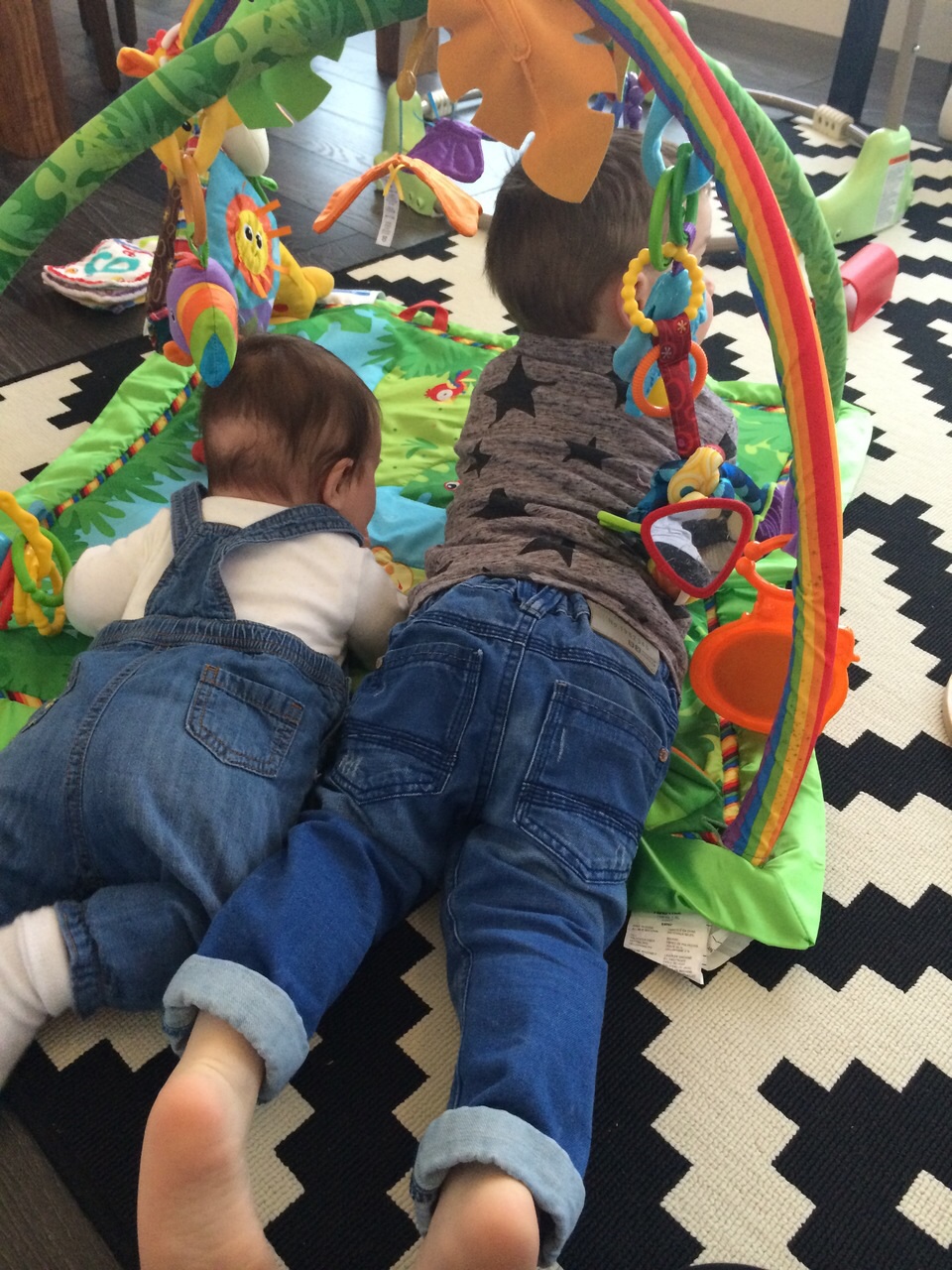
Today things are so different. Babies are socialised and stimulated from the earliest age. My grandchildren are taken to ‘bounce and rhyme’, baby gym, play barns, swimming classes, baby massage etc. etc. It amazes me to see the speed of their development. And at home the range of toys is breathtaking. Everything seems to have movement, music, colour and lights built in. Even books have appropriate sounds alongside the story. And, before babies can even crawl they have play mats like the one in my photo. This 3D mat has all the colours of the rainbow in it. It is based on a jungle theme so there are animals adorning it. It is soft, safe, supportive and stimulating. It plays a variety of music, animal noises, and even waterfall sounds. It has given my grandchildren hours of pleasure. I chose this photo for a couple of reasons. It shows my two and a half year old grandson teaching his 8 month old sister how to roll over. It is so cute and the clothes just tickle me. Denim jeans on a baby I find hilarious and absolutely adorable.
So this week’s photo challenge was to illustrate the colours of the rainbow and I think this photo does that. The denim jeans qualify as Indigo while all the other colours of the rainbow are in the playmat. but just in case you want more I have added a little group of colourful shots below.
Red Poppy field in Cotswolds
Orange Lifeboat on Porthtowan Beach
Yellow rapeseed Kimbolton, Herefordshire
Deep Green Leaves of Lily of the valley in my garden
Gorgeous green grass of Cotswolds
lavendar fields at Snowshill
Blue Stained Glass Window at Gloucester cathedral detail
As soon as we arrived at Church Farm for Open Farm Sunday I was captivated. At the entrance there were Shetland ponies and goats to pet, as well as a great display of crops and posters giving information about oats, barley and oilseed rape. It was like the best nature table you could possibly arrange! As a primary school teacher many years ago, I would have loved to put on a display like this for my pupils. But even as an adult I found it fascinating. What appealed to me most was the opportunity to learn about the oilseed rape.
I love to see the fields of gold that stretch across the Cotswold in late Spring each year. I go out and take photographs and take the grandchildren to admire them. I usually say something simple like, “It’s used for cooking oil”, but I honestly hadn’t a clue what really happened to those gorgeous yellow plants.
Well, having chatted to the farmer and a seed merchant, I now know a great deal more. Rapeseed belongs to the Brassica family of plants like turnips, cabbages, Brussel sprouts and cauliflower among others. In fact the word Rape comes from the Latin, Rapum which means turnip! Who knew? Natural rapeseed has been grown, and used to produce fuel, for centuries. In fact Brassica are some of the oldest plants around. There are records of Brassica oilseed varieties being grown in India 4000 years ago, and China and Japan 2000 years ago. It is likely that the Romans introduced it to Britain. It was found to be a useful ‘break crop’, which means that it keeps down weeds and helps enrich the soil in between growing other crops. By the middle-ages rapeseed oil was being used as fuel for lamps. But it was not until the Industrial Revolution, when steam power came to the fore, that machinists discovered its suitability as a lubricant.
During the Second World War huge quantities of oil were needed to keep the engines of naval and merchant vessels seaworthy, but because of blockades it was difficult to source from Europe and the East. So Canada greatly increased its rapeseed cultivation.
The original, natural strains of rapeseed had been used for centuries to feed animals, but not people. It had a bitter taste and was high in erucic acid, which is toxic to young children. However, following research and development in Canada, a strain was developed that had low levels of erucic acid and a pleasant nutty taste, making it suitable for human consumption. The Canadian climate was good for growing it, so in 1978 a company was set up to produce Canadian Oil, Low in Acid, hence the name Canola! Although this was a brand name it is now accepted as a generic term for oilseed rape.
I have used Rapeseed Oil for years at home for frying and roasting food, as well as baking carrot cakes and biscuits. It is also suitable for bread and pastries, and of course, it makes delicious dressings, marinades and mayonnaises. A knowledgeable doctor told me years ago that Rapeseed oil is high in Vitamin E and contains less than half the saturated fat of olive oil, which helps to keeps cholesterol down. Rapeseed oil is also rich in omega 3, 6 and 9 and contains no preservatives or additives, making it a healthy alternative to butter or other vegetable oils.. I buy the locally produced ‘Cotswold Gold’ rapeseed oil as it is made in small batches by methods which preserve the goodness of the oil and it is not genetically modified as some mass produced or foreign oils are.
In recent years, celebrity chefs have made rapeseed oil very popular, which is one reason why there is so much grown in this country now. Another reason is its use in the biodiesel industry. In fact over 60% of the rapeseed grown in Europe now is used for fuel. This would be a worry if it was taking up land which could be used for food production. But apparently it can be grown on ‘set-aside’ land, which would otherwise not be used.
I was very pleased to learn that not a single bit of the rapeseed plant is wasted. Once the oil has been pressed out of the ripe black seeds, the left over pulp provides a rich feed for the animals on the farm and the rest of the plant goes into the forage which provides food for the animals in winter.
If you would like more information or facts and figures, the website ukagriculture.com produces a wonderful poster called The Story of Oilseed Rape. And, you can watch a short video on the oil extraction process in Ireland here on youtube.
Today I went to a May Bank Holiday Fete in a beautiful Cotswold village. On the way back I had to pop in to Ellenborough Park, which is a beautiful hotel at the foot of Cleeve Hill near the Cotswold Way. It is a gorgeous hotel, traditionally built in Cotswold stone. It dates back to the 16th century and it shows! It just oozes history. I have a soft spot for the hotel because my youngest daughter was married there in a most romantic ceremony.
In front of the hotel, facing Cheltenham racecourse, there is a magnificent life-size sculpture ~ of a horse. It is created from what looks like bronze wire and is very intricate!
I just love wire sculpture, especially natural subjects like horses and hares. I have added a link to an amazing artist in case you would like to see more. http://www.ruperttill.com/retrospective.html
Cheltenham is famous for horse racing and of course the Cotswold countryside lends itself to lots of equine establishments and pastimes. In 2011 the centenary of the Racecourse was celebrated with a Horse Parade with a difference. 10 Life size sculptures of horses were created and decorated to reflect their sponsors. The horses were displayed in prominent places around the town before being auctioned at the racecourse for various charities.
This photo is a fluke but I love it. I had been hoping to get a photo of my cheeky, but very friendly, fledgling long tailed tit as he pays his daily visit to my door. I snapped quickly with my phone and this is the result. It is literally as he is landing and it looks as though his feathers are screeching to a halt. He is still learning how to fly after all ~ And I’m still learning about photography!
One of the things I love about blogging is communicating with fascinating people who enjoy the same things as I do. Recently, through various posts, I have discovered that Sarah Longes who blogs “One Day at a Time” at Mirador Design, loves garden birds as much as I do. Recently we were conversing in the comments section about all the fledging birds we have in our gardens. In mine there are robins, blue tits, blackcaps, blackbirds, pigeons, sparrows, chaffinches and a very cheeky long tailed tit. This little bird is a bit of a rebel. While all the others are happy to hop about under the apple trees or sit on the fence, this sociable little bird gets very close and personal on a daily basis. His mother must despair of him. He shows no fear, but great curiosity, as he flies right up to my french windows and perches on the door handle. He seems to enjoy watching me as I potter about the house and when I sit down by the window he stares straight into my eyes. It truly is amazing and I have got so used to it that I look forward to seeing him now. I will be really sad when he grows up a bit and flies off to pastures new. I promised Sarah I would take some photos of him so here they are. They qualify in a post on ‘Motion’ as they show my little bird landing and getting ready for take off. I love the blurred one as it literally caught him as he landed and it looks like he had to do an emergency stop!
My friendly long tailed tit landing
My last group of photos are from a day out by the lake yesterday. While my husband was enjoying his fishing I was amused by a family of ducks. There was a mother and father and 9 ducklings which were obviously very young. 8 of them were very adventurous and wandered off all over the lake but one seemed quite nervous and often stayed very close to mum. It was charming to watch so i took lots of photos of the ducklings in motion.
Goodness this weeks photo challenge was a nightmare for me. I’m often awake early but the thought of getting out before dawn with a camera or anything else for that matter is anathema to me.
There have been times of course when travelling, that early starts have been enforced. You can read about my trips to Lourdes or America by clicking the links. But I am really an evening person. I would happily do housework at midnight or write poetry and my journal at 2am. But I don’t really come back to life before 8.30 in the morning.
However, I did make a special effort just for the challenge and was rewarded, not by a visual revelation as it was quite dull, but by the dawn chorus of birds. There was an owl hooting plaintively in the woods over the road and countless little birds singing their hearts out in the bushes in my garden. I know their song is just a warning to competitors to stay away but it does sound delightful. I wish you could hear it!
5.20am from my front window
I did however want to make my day worthwhile by taking more photographs so I am posting photographs of the early apple and cherry blossom in my garden. A bit of a cheat I know but I hope you enjoy them. We are having a wonderful spring, warm, sunny and dry so the blossom is perfect.
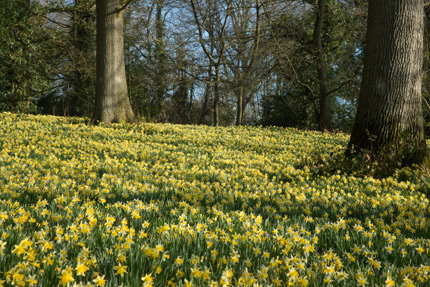
I finally managed to get to the ‘Golden Triangle’ I mentioned in a previous post to see the wild daffodils, also known as Lent Lilies. I got some lovely photos and had a wonderful time but because of heavy mud I couldn’t get deep into the woods and fields. However I can recommend Eddie Oliffe’s blog for his beautiful photos. My much less dramatic ones from the weekend are above!
Dymock Woodsare made up of 17 separate woodlands on the UK’s Gloucestershire and Herefordshire county border, close to the Forest of Dean. Probably the best known of these woodlands is Shaw Common, registered also as a special ‘seed-stand’ (where acorns are collected in the autumn for use as seedlings) for the Sessile Oak, one of two species of oak tree native to Britain.
Around Eastertide each year, these woodlands are the scene of intense visitor activity as people come to view surely one of the most beautiful – and increasingly rare – sights in Britain; the diminutive and lovely wild daffodil. These were once relatively common in damp woodlands and undisturbed grassland. The countryside around Newent, Ledbury and Dymock constitutes such an area, known locally as the ‘Golden Triangle’ containing as it does large numbers of these exquisite little daffodils. Nowadays loss of habitat and cross…
As always I found this week’s photo challenge fascinating in where it leads me. If you manage to read to the end I think you will be as amazed as I was!
The word ‘Fresh’ immediately led me to photographs I had taken of my adorable granddaughter picking fresh fruit and vegetable from my garden. I love to do this in season and then cook with the children, soups, pies and crumbles.
Rosie struggling with her produce
Rosie with her harvest of fresh fruit and veg
But then yesterday was rather special in many ways, not least for a solar eclipse!
solar eclipse from my house
Robin sang his heart out during the darkest part of the solar eclipse
It was also officially the first day of Spring yesterday here in the UK; a fresh season with fresh delights. This is when I switch from sauntering through the Gloucestershire countryside seeking out snowdrops, to heading for the Herefordshire borders hunting out wild daffodils. The best place to see these beautiful fresh flowers is in what is known locally as the ‘Golden Triangle’, namely the villages of Dymock, Kempley and Oxenhall.
I have mentioned before that snowdrops were picked commercially by the local women and children of Sherborne to be whisked off by train to London and sold for 6d a bunch in flower markets like Covent Garden. Similarly, daffodils were picked commercially in the golden triangle. You can read about the daffodils and see some beautiful photographs on the Glos Oracle website if you would like to know more.
And enjoy this poem by A. A. (Alan Alexander) Milne (1882-1956), famous for his stories about Winnie the Pooh and Christopher Robin, Tigger, Piglet and the rest, who wrote that, ‘winter is dead’ in his poem Daffodowndilly
She wore her yellow sun-bonnet,
She wore her greenest gown;
She turned to the south wind
And curtsied up and down.
She turned to the sunlight
And shook her yellow head,
And whispered to her neighbour:
“Winter is dead.”
As is often the way on my days out I got totally sidetracked and ended up in a fascinating little place called Upleadon. Named after the river Leadon, this is a small village with a fascinating history and some superb buildings. But what struck me as I drove over the hill in glorious sunshine was what looked like snow covered fields in the distance. As I got closer I realised it was actually a vast expanse of farmland covered in polytunnels.
polytunnels in the distance at Upleadon
other side of farming in Upleadon
Having explored, investigated then googled I discovered that Upleadon has been a fruit growing area for hundreds of years.
Cider orchards were cultivated next to many of the farmsteads including Middletown before 1700. In 1627 a garden was known as the cherry hay and in 1678 an arable close was called perry grove field.In 1739 it was reported that Thomas Hammond’s estate included several thousand fruit trees from which one tenant had made 100 hogshead of cider in a year and in the late 1770s it was said that the fruit from orchards in Upleadon made excellent cider. Among orchards planted in the corn fields by the early 19th century were several of squash pears and in leasing Lower House farm in 1817 the landowner James de Visme reserved pear but not apple windfalls. Both apple and pear trees were also cultivated at Middletown which was one of the farmsteads with its own cider mill.
I was really struck by the juxtaposition of the ancient church of St Mary the Virgin which has a thousand years of history, and the really modern cultivation methods. It appears that polytunnels have caused some controversy as they can be rather unsightly when they cover large areas of farmland. However, as a consumer I have to say I am delighted that I can buy (or pick) fresh local strawberries, raspberries, gooseberries, Victoria plums and blackcurrants from mid-June to August and different varieties of apples and pears from September to Christmas. An added bonus is that growers use much less herbicides and insecticides on fruit grown in polytunnels as they are not as prone to rot or disease.
Now here is the bit that just took my breath away literally and gave me a fresh lead in my family history search.
As I was searching online for the history of Upleadon I came across a fascinating document held by the Gloucestershire Archives. It was the file of documents re: Thackwell Roche estate. The former Roche estate at Aghada (in county Cork, Ireland) came into the possessionof the Thackwell family in the second half of the 19th century. The Thackwells were related to the Roche family of Trabolgan. Another document describes how the Thackwell Roche estate comprised Norman’s Land estate near Old Rock, Dymock, (here on the Gloucestershire/Herefordshire border in the Golden Triangle) as well as lands in Ireland. Believe it or not my great grandfather William Roche was the son of James Roche and he comes from that very area. I have searched for years for information on his family. I know his mother died when he was young so his father remarried and took his new wife and the other children to America in the second half of the 19th century. William, being 15 was old enough to join the Royal Navy as a boy sailor so he was left behind. he joined a training ship, HMS Conwy in 1855 and spent the next few years rising through the ranks. By 1861 he was sailing on the Victor Emmanuel, and thereafter he sailed the China seas on tea clippers as First Mate. He never saw any of his family again and I have searched for clues as to their home and their destination.
Who would have thought that a trip to take photographs of daffodils in Gloucestershire would throw up a fresh lead for me to follow in the archives. It is just amazing and I am thrilled. You can see Normanstown just near Kempley on the map of the Poets’ Walks by clicking on this link Poets Paths
The cheek of this little Blue Tit! I thought he was building a nest in my house wall but actually he was just helping himself to my cavity wall insulation to feather his nest in a nearby tree!
This week’s Photo Challenge is a great one for me living in the Cotswolds as one of the defining features of our area is the ancient dry stone walling that lines the sides of roads and divides fields. In the 18th and 19th centuries there was a law passed called ‘The Enclosures Act’, which literally required areas of land to be separated or ‘enclosed’. In the Cotswolds plentiful supplies of stone meant it was cheaper to enclose the Cotswold fields by walls than to plant hedgerows. Although there have been stone walls here since Neolithic times most of the walls we see today are from the last 300 years. But there are some magnificent buildings around which have stood for much longer, including churches, pubs and grand houses.
The ‘Oolitic’ limestone found in the Cotswolds is from the Jurassic period about 150 million years ago, This was a time when dinosaurs roamed over the earth. There have been periods when most of the Cotswolds was under water and some fascinating fossils have been found during quarrying for stone. There is evidence that people have lived and worked in the Cotswolds since prehistoric times, with Iron Age Forts and Neolithic Barrows having been excavated by archeologists.
The Cotswolds is a huge area that stretches over the counties of Gloucestershire, Oxfordshire, Wiltshire, Worcestershire and Warwickshire. It is defined by gentle hills, rolling pastures where sheep graze, and deep wooded river valleys. The stone is of different shades from warm gold to deep grey depending on where it is quarried. It also has different qualities, the best being used to build some exquisite houses that will stand for hundreds of years. I have often written about the beautiful unspoilt town of Painswick, which has some of the best preserved Cotswold stone buildings around. Parts of the church date back to the 1300s and there are holes in one wall reputedly made by cannon balls fired during the English Civil War.
I could go on and on about the beauty and history of the Cotswolds but as this is a photo challenge, I will just add some photos!
Some very old Cotswold stone buildings
Next the beauty to be found in dry styone walls and beyond them.
Fields of Linseed growing between Elmley castle and Hinton
The next two photos show the walls of the Tower of London during the recent installation called Blood Swept lands and Seas of Red. which I wrote a blog about previously.
And lastly some pictures of walls which appeal to me. You can read captions by hovering over the photo or read about the wall painting on the ivy covered church here
Wall painting in the Ivy Church
Derelict mine workings in Cornwall
Old wreckers pub in Cornwall with secret smugglers’ passage behind the fire
castle in Cornwall
banksy mural/graffiti on a wall in Cheltenham
sunlight through stained glass window reflected on wall of Gloucester cathedral
Flying buttress hgolding up a chapel wall in Gloucester cathedral
An Ice Wall in Vermont caused when snow starts to melt as the temperature rises, then freezes overnight
stone wall in a garden in Cornwall with plants
Light show projected onto the wall of William Shakespeare’s Birthplace in Stratford on Avon
Light show projected onto the wall of William Shakespeare’s Birthplace in Stratford on Avon
Light show projected onto the wall of William Shakespeare’s Birthplace in Stratford on Avon
Light show projected onto the wall of William Shakespeare’s Birthplace in Stratford on Avon
I was what was known as a sickly child in the 1940s and 50s. It turned out that I had Rheumatic Fever which left me with a variety of problems and no appetite (how times have changed!). Because of this I was often unwell and my mum would get me Lucozade and a bar of Fry’s Five Boys Chocolate with Five Centres. I guess it could be called a reward because 60 years later I remember every sensory detail!
Five Centres was produced from 1934 to 1992. It was similar to today’s Fry’s Chocolate Cream in that it had a dark chocolate coating, with fondant inside. But instead of peppermint cream there were five different flavoured fondant centres. In the early days they were strawberry, orange, raspberry, lemon and pineapple, all of which I loved. In later years coffee, lime, and blackcurrant replaced strawberry, lemon and pineapple but I don’t remember ever having those.
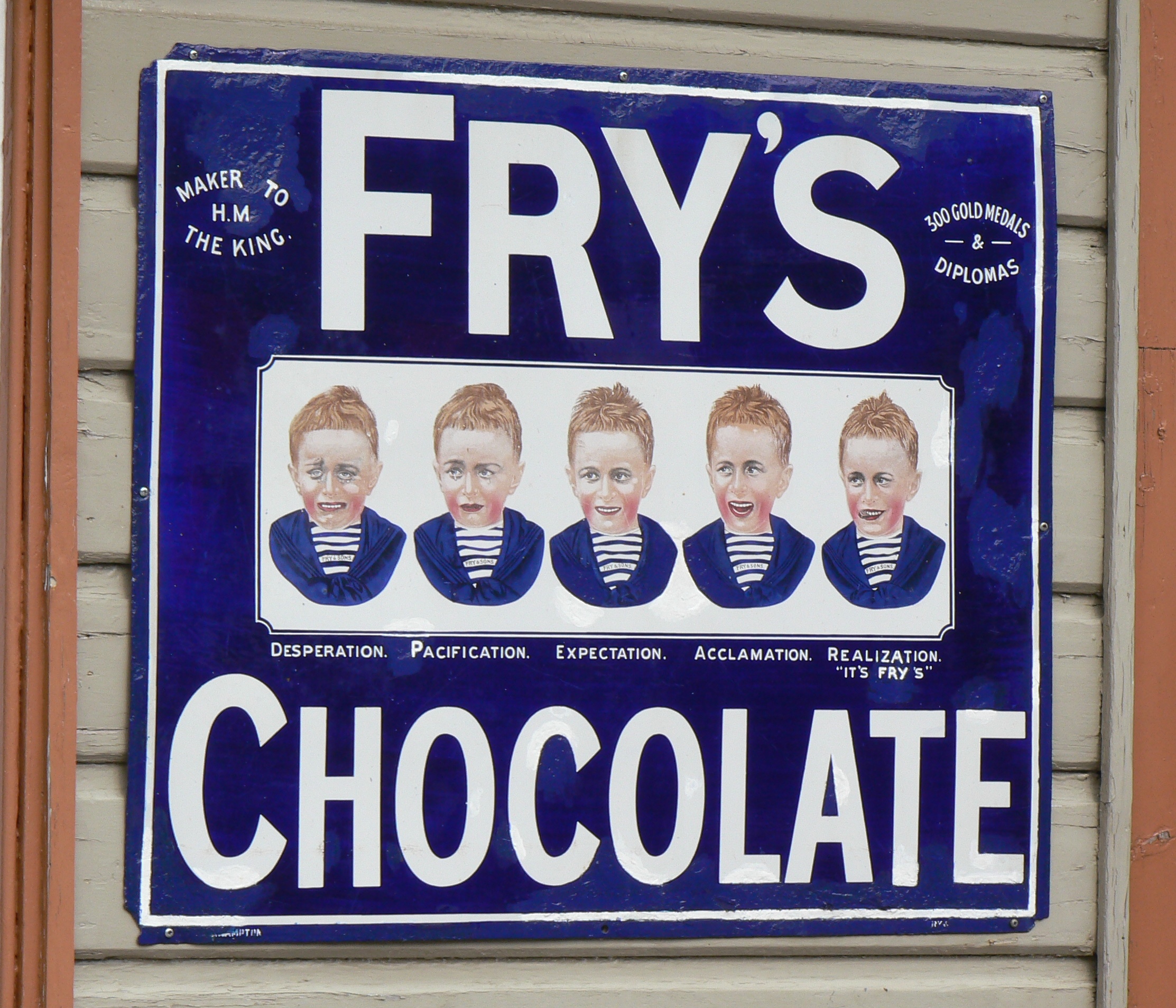
The wrapper was deep blue and it had what looked like 5 boys’ photos on it. But really they were just one boy in a sailor suit who was photographed with five different facial expressions. The photo was taken in 1885 and the boy was called Lindsey Poulton. He was, appropriately, 5 years old. His father and grandfather took the photos and Fry’s chocolate company in Bristol paid them the considerable sum of £200 for exclusive use of the set. The photos appeared in adverts and in shop windows for years. As my grandfather had a little general store in Newcastle on Tyne in the 1950s the enamelled metal sign on the outside wall was very familiar to me.
I’m very grateful to pocketbookuk for explaining the facial expressions and I would urge you to take a look at their fascinating blog.
The five faces of Fry’s Five Boys chocolate on an enamelled metal sign. Desperation – no chocolate, Pacification – the promise of chocolate, Expectation – the prospect of chocolate, Acclamation – happiness at receiving chocolate, and Realization – eating the chocolate, and discovering that it is a Fry’s milk chocolate bar!
I can’t really leave out a couple of photos of my grandson and his rewards. He is such an active lad, 11 now and always busy so he is used to getting rewards for his labours. He is a boy scout and his uniform is covered in the badges he has earned. He also plays football for his school team and a local team. He sometimes plays in goal and is often man of the match, receiving cups and plaques as his reward.
Silver backed Gorilla
Robin taking mealworms to his fledgelings
My first catch, a nice carp
Rewarded by a a basketful of apples
Being a nature lover I have to include a few photos of rewards in the natural world. Firstly there is Jock, the silver backed gorilla who lives in a family of 6 at Bristol Zoo and is a very popular animal. He is so magnificent and such a good role model for his youngsters that he deserves lots of fruit as his reward.
The robin created a grand residence in a large plant tub in my garden. He and his made laid one egg then disappeared. I was really worried that they had abandoned their nest with this egg in it. But weeks later they returned and more eggs appeared. Apparently this is quite normal and the first egg hatched out with the others which surprised me. I was so pleased to see the robins back that I overcame my squeamishness and rewarded them with a daily quota of live mealworms.
The beautiful carp was the first fish I ever caught ~ reward for my hours of patient fishing
Lastly the basket of apples were a reward for finding a beautiful open orchard in a church yard. No-one seemed to be collecting these gorgeous fruits so i helped myself to as many as I could carry after checking with the vicar!
I have to say one of my favourite rewards after a day out is a whippy ice cream. I share this passion with my husband and grandchildren!
Reward for walking all day in the heat at Bristol Zoo












 Heavenhappens