Breeze

This post is inspired by haiku Heights prompt word “Breeze”.

On of my favourite places is London.  There is nothing so inspiring as the city skyline viewed from the South Bank of the Thames on a summer’s evening.  Imagine feeling a gentle breeze drifting over the river at sunset and listening to the birds singing in nearby trees ~ magical!  Do click on my link to hear the fabulous Glenn Miller Band playing one of my favourite songs ~ the inspiration for this haiku ~ with a nod to one of my favourite poets too ~Thomas Hardy.

Nightingales

Nightingale Nightingale

As gentle breezes blow

Nightingales in bushes sing

Sublime serenade

P1080455 Tower bridge 1

 One of my favourite times of year in the Vale of Evesham and generally in the Cotswold, is Spring, when the blossom covers the fruit trees and the ornamental cherry is out.

 Boughs bend to the breeze

Covering the earth in a

Blanket of blossom


Watching butterflies

Their beauty borne on the breeze

Children barely breathe


There are times when a gentle breeze can have a powerful effect, as can a still small voice.

Gazing on Taize

Sunflowers bow to the breeze

And my spirit soars

I will never forget the time I went to Taize.  In the 1940s Roger Schutz was appalled by the violence and suffering he saw across Europe.  Throughout the war years, he sheltered political refugees, especially Jews, whom he helped cross the border into Switzerland from the occupied region of France.  He began to develop the idea of a community based on mutual understanding and respect for all.  He found a suitable site at Taize near Cluny in the Burgundy region of France and on Palm Sunday of 1948, seven men took monastic vows.  They dedicated their lives to working and praying for ‘outsiders’ of all kinds; especially those living in extremes of poverty, hunger, or disease.  Taize is now famous for its gentle and powerful worship built on meditation through repetitive chants, a model of worship which has spread around the world.  Brother Roger’s work continues; to bring reconciliation, unity and peace to all the peoples of the world. www.taize.fr

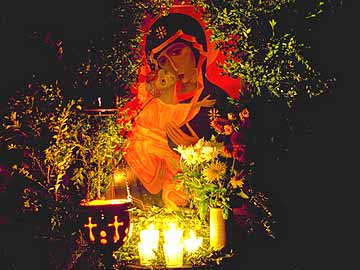
There is a beautiful icon of Mary in the Church of Reconciliation in Taize.  I would recommend anyone who travels to France to make a detour so that they can spend some time there and see this Icon.
Icon of Madonna and child from the chapel at Taize Icon of Madonna and child from the chapel at Taize
When I went to Taize one summer I had an amazing experience.   I stood alone in a field full of sunflowers, at the foot of the hill looking up towards the church, as a gentle breeze blew.  The wind caused the flowers to bend and the sound they made was so strange.   It reminded me strongly of the beautiful words of one of my favourite hymns:
 Be still for the presence of the Lord
Be still for the presence of the Lord  The holy one is here
Come bow before him now  With reverence and fear
In him no sin is found  We stand on holy ground
Be still for the presence of the Lord  The holy one is here
Be still for the power of the Lord  Is moving in this place
He comes to cleanse and heal  To minister his grace
No work too hard for him  In faith receive from him
Be still for the power of the Lord  Is moving in this place

Picture Perfect Painswick

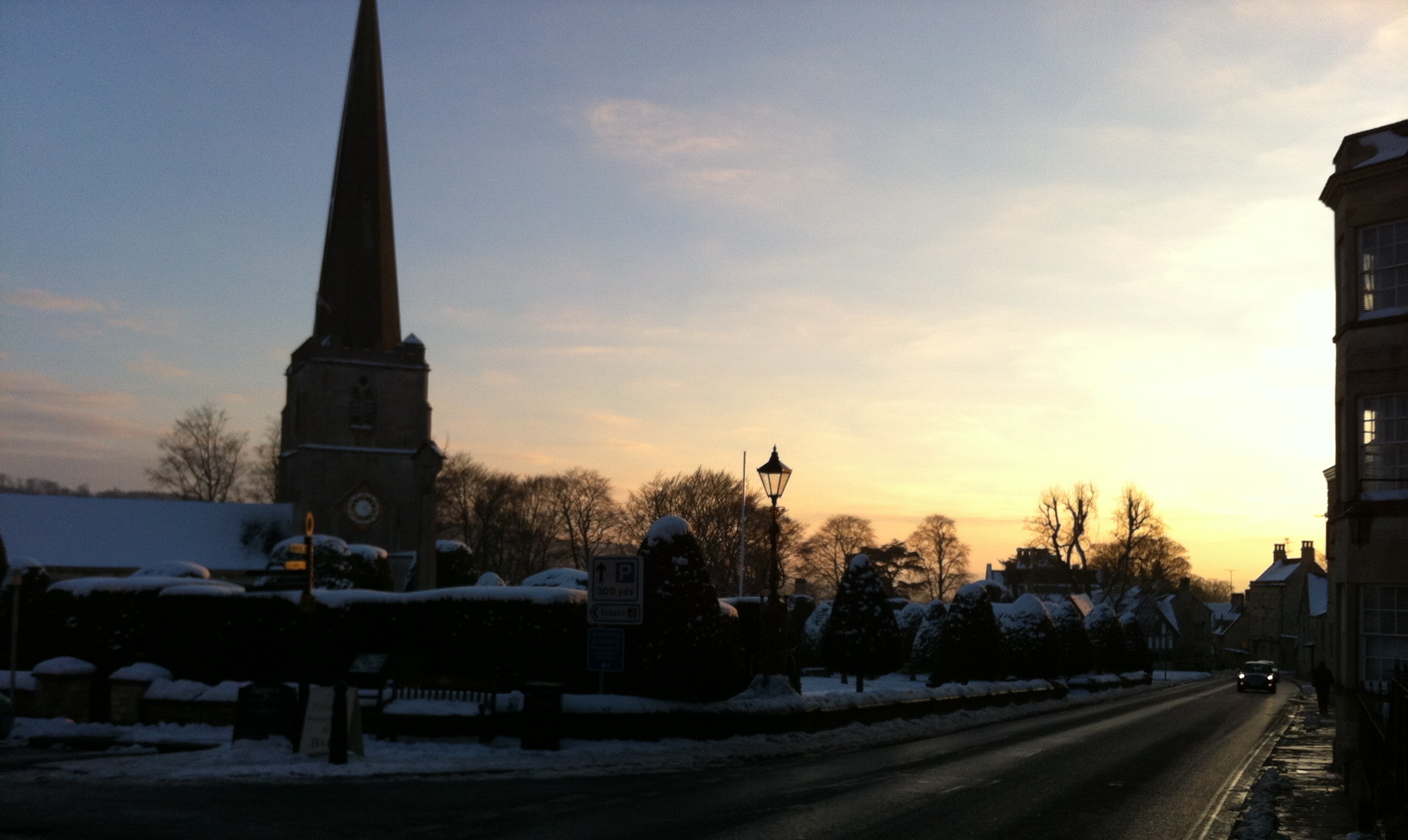
I went to Painswick yesterday to eat carrot cake and to see the snowdrops at the Rococo gardens ~ failed on both counts but had a great time enjoying spectacular scenery in wonderful company.  Painswick is quite high up in the Cotswolds so the snow is much deeper there and lasts far longer than down in the town.  But we had a lovely time, so here for my friends are my impressions in picture and haiku.  Apologies for the poor quality of the photos, I forgot my camera and had to use my phone!  ~

Ice daggers dangle

from ancient lead gutters on

St Mary’s lych gate

St Mary's Lych gate

St Mary’s Lych gate

Snow covered Yew trees

in picture perfect Painswick

Christmas card village

St Mary's Churchyard

St Mary’s Churchyard

Sun sets on Painswick’s

 honeyed stone cottages, and

cold Cotswold churchyard


Rococo gardens at Painswick

Rococo gardens at Painswick

White winter woodland,

following in the footprints

of the fallow deer

Dusk ~ Haiku

This post is inspired by Haiku Heights prompt “Dusk”.

When daylight departs

Choirs gather to sing Vespers,

Most ancient of prayers.

After I retired from teaching, one of the jobs I did was running an after school creche for children at King’s School in Gloucester.  This was a delight and a privilege as the school is set in the grounds of Gloucester Cathedral to which it is attached.  The children were cared for and amused until 6pm or whenever their parents picked them up.  During this time we could hear the choir singing Evensong or Vespers which they do daily at 5.15pm.  It is a beautiful time of day when the sun is going down, the body clock is slowing down, and children need to unwind.  Nothing could be better than to relax to the sound of well trained choristers singing their thanks for the day before their evening meal.

While I was at King’s, the Cathedral was being used as the setting for a part of the Harry Potter film.  The playground of the Junior school was filled with enormous luxury camper vans in which the crew and stars stayed.  We often saw them, and some of the King’s pupils were even used as extras in the film.   The local BBC recorded the events:

Gloucester’s historic cathedral cloisters were transformed into the corridors of Hogwart’s School of Witchcraft and Wizardry in the films of JK Rowling’s first two books – Harry Potter and the Philosopher’s Stone and Harry Potter and the Chamber of Secrets.  There was the strictest of security to keep out the curious world’s press while filming took place – but now some of the movie-makers’ secrets can be revealed.  In fact there is a Harry Potter trail at the Cathedral which visitors can follow and there are still signs of Hogwarts to spot!

Let there be (hidden) lights

Hidden light-switch
Spot the hidden electrics

All modern signs, locks and electrics had to be disguised under panels painted to look like the stone walls. There are cunningly concealed electric light switches inside the East Cloister door?

Harry Potter and the Hidden Haloes

For the films anything that would give away the set as a church had to disappear. The haloes on the stained glass figures in the cloister windows were painstakingly covered with coloured plastic filter paper to blend in with the surrounding glass.

One window has figures of Adam and Eve, and because these might have been in shot in the movies, they were given clothes and even the trademark Harry Potter ‘lightning flash’ on their foreheads!

Harry Potter and the Buried Tombs

Stained glass windows
These figures of Adam and Eve were ‘dressed’ and given forehead marks like Harry’s

There are nearly 100 tombstones on the cloister floors which had to be disguised during filming.

They were covered with roofing felt, which was then painted, marked, polished, varnished and made to look faded to match the rest of the stone-flagged floor.

Water Wizardry in Dark Entry

The red door in Dark Entry, at the north-eastern corner of the cloisters, was where the flood from the girls toilets was filmed.

Dark Entry doorway
The Dark Entry doorway

Water from a tanker parked in the road outside was pumped through the doorway, into a huge specially constructed container and out to a drain in the Garth (the cloister’s central garden).

Written in Blood

The wall by Dark Entry is where panelling, made in the studio to look just like the stone walling, was hung with the chilling message in ‘blood’ – really a film-maker’s magic potion – that read: The Chamber of Secrets has been opened – enemies of the heir BEWARE!

The Poltergeist’s Cut

In Harry Potter and the Philosopher’s Stone, Rik Mayall, as playful poltergiest Peeves, set all the broomsticks zooming about in the East Cloister walk.

Unfortunately the scene was one of several that ended up on the cutting room floor because the film had to be cut to a manageable length.

Troll Terror in the Lavatorium

Lavatorium
Harry and Ron hid in the Lavatorium

The Lavatorium on the left hand side of the North walk (yes, it’s really called that – and it wasn’t the ancient Abbey monks’ loo but the place they washed) is where Harry and Ron hide from a giant troll behind the pillars.

The troll in the film is mainly computer-generated, but huge legs were used in filming to make it look more realistic – so big that there was some difficulty in getting them in through the cathedral’s massive main doors!

Harry by Gaslight

For filming the cloister walks were lit by special gas-fired torches using a special gas that would not harm the ancient stonework.

The Gryffindor Door

As you come to the end of the West Walk the oddly-named West Slype door is on your right. A slype is the name for a covered passage from a church or monastery cloister.

The West Slype doorway

In the films it was made to look smaller by means of a plastic mould placed over the real doorway, with a hinged portrait of the Fat Lady in front of it, and became the entrance to the Gryffindor Common Room.

In real life steps lead down from the other side of the doorway but more film wizardry was used to make it look like the common room.

A false floor on stilts was built sloping slightly upwards to a backlit screen with a picture of the common room – a film-making device called a translight.


No School Day

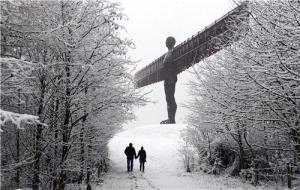
angel of the north in snow

It snowed overnight and the roads are a fright,

So the schools are all closed ~ on a Friday!

Mums and dads can’t drive, their cars slip and slide

So its family fun on a school day.

Dogs in bright jackets are leaping for joy

Taken out for a walk, on a school day.

Babies and toddlers peep out of their prams

They’re going to the park, on a school day.

Tiny tots muffled in mittens and hats,

Squeal in delight, on a school day.

Giggling girls, hugging their friends,

Slide down the hill, on a school day.

Teen terrors in hoodies become little boys

Throwing snowballs at girls, on a school day.

Steep slopes draw the daring on sledges and boards,

They hurtle downhill, on a school day.

I sit at the window and, like falling snow,

My thoughts pile up into drifts.

My smiles turn to tears at the sights and sounds

Of my school days, as the frozen scene shifts.

Of ink wells and blotters, of wafers and milk,

Of chalk boards and outside loos;

Of walking to school by the RiverTyne,

Of castles, and coalmines and ships.

And then there are people, who wave as they pass,

Loved aunties and cousins and friends

A sister and brother no longer in touch

A mother and father I mourned.

There are icicles hanging near a frozen stream,

The snow covered branches are bending

The field is a snow frosted wonderland

Its beauty my broken heart mending.

Small stone ~sparkling studmarks!

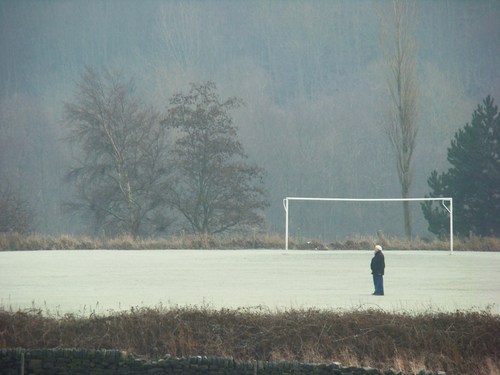
Took my little dog, Dayna, for her walk today to our favourite spot ~ the football pitch.  Dayna loves it as not many people go there in the week and I love it as she can run about safely without a lead. I promise I do not let her make a mess there!  Anyway it was icy cold today and the snowflakes were fluttering down.  I was mesmerised by the beauty of the potholes and stud marks which had filled with water and were frozen into little diamond divots.  So of course I had to write a haiku:

Glittering goalposts

Iced sparkling diamond divots

Frozen field of dreams

Fractured families ~ Haiku

These haiku are written for this week’s prompt at haiku Heights which is the word “Death”

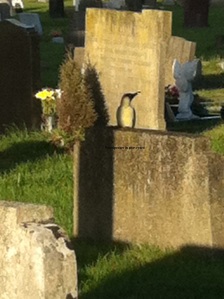
Woodpecker on  gravestone

Woodpecker on gravestone

The Boy

Fragile and different

Defeated by the bullies

He jumped to his death

The girl

Remnants of ribbons

And fading flowers weep, where she

Fell to her death

The father

The death of his son

Drove him to despair.  Destroyed,

His life he ended.

The cemetery

Lawned garden of grief

Compassion carved into stone

Too late to show love

Small Stones 8 ~ bare branches

Yew No. 40
Life has formed you, twisted you,
Smoothed you, soothed you
Jagged, dark, and fragile you stand.
Where is your soul?
In the branches you gave life to,
The gnarled core split open to the world,
Or the smooth, worn bark that covers your pain.
You have lived, three hundred years and more
You have grown and changed.
You are beautiful still.
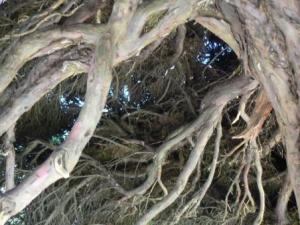
Roots of the ancient Yew Tree at painswick

Roots of the ancient Yew Tree at painswick

Small stones 7 ~ snowdrops and hellebores

Spring was in the air today.  The hellebores flowers are just about open in my garden and the snowdrops are already out at the Rococo gardens.  I love this time of year.

Our local newspaper (Gloucestershire Echo) today reported that,

SNOWDROPS have started to bloom at a garden in Painswick following a mild start to the new year.

With temperatures hovering around the 10C mark so far this January, dozens of the white flowers have emerged earlier than expected at Rococo Garden.

  1. blooming:   Snowdrops on the hidden slopes of the  Rococo Gardens, Painswick. Inset, Paul Hervey-Brookes.
  1. blooming: Snowdrops on the hidden slopes of the Rococo Gardens, Painswick.

Paul Hervey-Brookes, garden adviser at Rococo, said: “They usually start to bloom around the second week of January and the last to flower finish by the end of March.

“But because it has been mild this year so far, they have been tricked into thinking it is later in January than it is, and they have started to come out.”

Temperatures are predicted to plummet in Gloucestershire this week, but Paul says the snowdrops will survive.

He said: “The cold weather will not kill them, it will just stop their bloom, and then they will continue when it starts to get milder.”

Forecasters are predicting a progressive drop in temperature as the week goes on, with a night time low of -1C possible by Thursday.

There should be a let up for areas affected by flooding, as no heavy rain is predicted.

Snowdrops at Painswick Rococo Garden
I happened to be at Painswick when the sun was shining, the views long, the trees magnificently silhouetted against a blue sky. I like trees better in winter than summer. The form becomes the chief point of them, not just the mass of green that is all we see in summer. And because the situation of the Painswick garden is so extraordinary, you get long views both across and down, snowdrops clothing the steep banks below the renovated Eagle House, snowdrops, many of them fat doubles, thick on the grassy bank that leads up to the viewpoint above the maze, snowdrops down by the fish pond and the square, rather dark plunge pool where surely only the most muscular of Victorians would have wanted to plunge. A bonus at Painswick was the best bank of winter-flowering cyclamen I’ve ever seen, pink and magenta Cyclamen coum seeding itself through the grass with an abandon I could only envy.

The Independent 2008

Small Stones 2 ~ Pigeon patrol

pigeon1Plump pigeons patrol

Seeking seeds dropped by sparrows

Beneath bare pear tree

 I am starting 2013 by clearing space for beauty and joining the Mindful Writing Challenge entitled Small Stones.  A small stone is a short piece of writing (prose or poetry) that precisely captures a fully-engaged (mindful) moment. The process of finding small stones is as important as the finished product – searching for them will encourage you to keep your eyes (and ears, nose, mouth, fingers, feelings and mind) open.

Why don’t you go out and buy yourself a gorgeous notebook, start writing your small stones, and you’ll be in the river too.

Mindful Writing Challenge

ilovesmallstones

ilovesmallstones

Frozen fixtures

I took my little dog, Dayna, for a walk in my favourite sports field the other day.  Recently it has been too muddy to walk on the grass but today it was frozen rock hard.  The trees around the field looked amazing, their bare branches covered in frost.  There was also a heavy mist which gave the whole place a surreal quality.   Great for dog walking but no good for playing football!

Hoar frosted pitches

on a frozen field; fog bound

fixtures abandoned

frosty football pitch

Storm Haiku

On far distant hills

Dark storm clouds are gathering

Threatening thunder.

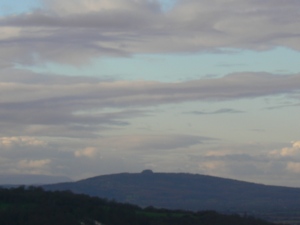
May Hill seen from Prinknash Abbey grounds today

May Hill seen from Prinknash Abbey grounds today

Today’s haiku prompt at haiku heights is ‘Storm’.  It brought to mind the time when I worked at St Peter’s Grange, Prinknash Abbey, which I have described in earlier posts.  The view from Prinknash is amazing as the Abbey is set high in the hills near Cranham and Painswick.  Although there are wonderful woods behind the Abbey, the front has a clear view over the vale towards Gloucester City with its beautiful Cathedral.  One day I will write about my time working at the King’s School in Gloucester (founded by Henry V111) while Harry Potter was being filmed in the Cathedral.  However, today I will stick to the point of my blog!  On a clear day there is a wonderful view from Prinknash, of May Hill, with its clump of trees on the summit.  They were planted in celebration of Queen Victoria’s Diamond Jubilee in 1897 and are visible for miles around.  Beyond that there are the Brecon Beacons and the Black Mountains.

Having observed that view on a daily basis, the monks were very good at forecasting the weather merely from looking at May Hill.  If the hill looked a misty blue they knew there would be rain at Prinknash later.  If the crown of trees was lost in cloud there would be a storm.

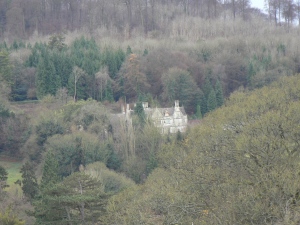
Interestingly, I discovered while working at St Peter’s Grange that it was built in this position, sheltered by the hills and trees, as protection from the plague.  There is documentary evidence, as well as internal evidence in the Grange, that some parts were built in the 14th century.  In 1339 the Bishop of Worcester granted a licence “For the Abbot of Gloucester and his fellow monks to celebrate Mass or to have it celebrated by a suitable chaplain in an oratory within their manor of Princkenasch.”  So we know that there was a chapel on the site then.  By the time the Grange was built the Black Death had already swept through England and people thought it was carried on the wind.  Wealthy people therefore built their homes on the side of a hill sheltered from the wind in the hope that this would protect them.

St Peter's Grange at Prinknash Abbey on the side of the hill, sheltered by trees

St Peter’s Grange at Prinknash Abbey on the side of the hill, sheltered by trees

One of my jobs at the Abbey was to polish the Parker room.  This room was named after William Parker who was Master of the Works in the Abbey before he was elected Abbot in 1515.  He was responsible for many improvements to the building.  In July 1535 Abbot Parker entertained King Henry V111 and Anne Boleyn for a week.  They used St Peter’s Grange as a hunting Lodge as there were many deer around – as there are today nearby.  One fascinating snippet that appeals to me is that Abbot Parker had windows put in positions from which he could watch the monks about their work.  He used to spy on them.  I believe, contrary to what Wikipedia says, that this is where the phrase “Nosey Parker” comes from.

St. Peter's Grange, Prinknash

St. Peter’s Grange, Prinknash (Photo credit: Wikipedia)

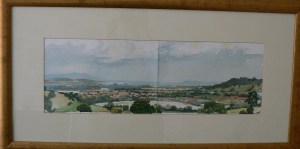
At Prinknash the monks have long been known for their art and craft work.  They made beautiful pottery for many years from the local clay.  They still make Incense that is exported all over the world.  One of the monks who has sadly passed away created a wonderful painting for the millennium which was displayed in the Abbey Church.  he also painted and created stained glass.  Many of his pictures were made into lovely cards which were sold in the Abbey Shop.  Today there is a gallery displaying the artwork of a prolific painter monk, Fr Stephen Horton.  I was fortunate enough to buy some of his original paintings while I worked at the Grange.  They are my pride and joy.  The one I love especially is a watercolour of the Vale of Gloucester as seen from the roof of the Abbey.   When inspiration struck him for this painting he had no suitably sized paper on which to paint the panorama.  Being a monk and used to making use of whatever is available, he used two pieces of A4 paper side by side.  This painting speaks to me of so much more than the view.  It is creativity at its most basic I feel.  The painting had to be painted there and then using whatever was to hand.  The muse could not wait for a trip to the art suppliers!  It also speaks to me of the way of life of the monks.  They waste nothing and ask for nothing.  They live such a simple life yet produce beauty all around them from whatever is there to be used.

Painting by Fr Stephen Horton OSB

Painting by Fr Stephen Horton OSB

One of the saddest things that happened at Prinknash was the theft of  a statue of Our Lady of Prinknash in 2002.  There are many statues at Prinknash but this one was extremely beautiful and so special.  It was about 20 inches tall, carved of Flemish Oak, and had belonged to St Thomas More. After the Reformation, it was taken abroad but returned in 1925 when the Benedictine monks founded their new abbey at Prinknash.  Of course this means it was hundreds of years old and priceless in the truest sense.   The Abbey Church was always open for visitors and those who wished to pray, and the statue used to stand on a shelf to the left side of the church.  One day it just disappeared while the monks were at tea, stolen to order presumably as nothing else was taken.  It devastated the community in the abbey and the wider community, including myself, who attended mass there.  I almost believe it took the heart out of some of the monks and the community itself.  I have a picture of that statue and I often think that one day it will return to its rightful home.  Maybe when the current unrightful owner dies he will leave it in his will to be returned to Prinknash ~ after all he can’t take it with him!

  • Prayer (heavenhappens.wordpress.com)

Desert

Sahara Marathon ~ ultra long distance race in the desert’.

We had a great speaker at WI who fits in beautifully with our Haiku Heights prompt word for this week, Desert.

Tortuous terrain,

Melancholy Marathon,

Desert of Despair

Celia Hargrave, talked about her experience of running in The Marathon Des Sables.  No British woman had ever taken part in the race and it was advertised as “The Toughest Footrace on Earth”.  Both of these factors were a challenge to Celia so she decided to sign up!
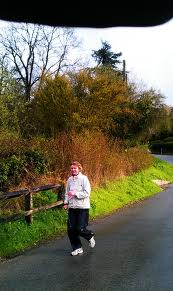
Celia running near her home

Celia is quite an amazing woman.  She is over 60, a former head teacher of a large Birmingham school, and a member of Sheepscombe WI.  Like many WI members, Celia contributes hugely to her community.  She is a magistrate, a fundraising co-ordinator for Sheepscombe Village Hall, and she and her husband open their garden for the National Garden Scheme.  Her garden is about 3 acres set in small woodland with panoramic views.  She has a variety of herbaceous and mixed borders, a rose garden, extensive vegetable plots, and wild flower areas, plantings of spring bulbs with thousands of snowdrops and hellebores, a woodland walk, 2 small ponds, a waterfall and a larger conservation pond.  There are also wooden sculptures in the garden, which is all grown on organic principles.
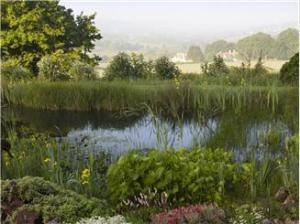
Panoramic View from Celia’s garden ~ Trench Hill

And, as if that were not enough, Celia co-ordinates a club for the elderly and housebound in her area!

Celia had run before competitively in the Stone Masters Marathon, The Chelmsley Wood 24 hour track Race, the London Marathon in 2 hours 46 minutes, London to Brighton Race and Lands End to John O’Groats so she was no novice!  Her longest distance was over 120 miles for which she was ranked sixth in the world. However the Sahara Marathon or MDS is a 6 day 243 km or 151 mile endurance race in which all competitors have to carry everything they need for their survival.  So this was to be an enormous challenge.

Celia sought medical advice and drew up a training programme which involved running every day.  She did some 50 mile races for charity and started to raise money for her challenge.  Fortunately Celia’s own WI at Sheepscombe organised her fundraising and got TV, radio and press coverage for her.  In order to adapt to running in extreme dry heat conditions, Celia started running in her local sauna!  This caused some consternation among other spa users but helped Celia get used to taking in fluids while running.

Eventually Celia took off for Casablanca in Morocco and travelled to Ouarzazate to meet the other competitors.  The majority seemed to be French that year but there were 20+ from the UK.  Other competitors came from all over the world.  They spent one wonderful night in a 5 star luxury Moorish hotel before setting off on a coach out into the desert.  After several hours they had to get off the coach and walk the rest of the way to their campsite.  Two things that impressed Celia there were the desert orchids and a woman in red high heeled shoes both of which seemed incongruous!

The campsite seemed to be in two halves: one for the competitors, which was very basic; and one for the non-competitors, which was comparatively luxurious.  Celia was sharing a ‘tent’ with 12 to 14 men and women competitors and they had very little space.  In the tent they had to store everything they had brought and carry it on their backs in a rucksack daily.  The rucksack was to be no more than 7 kilos in weight when filled.  Celia had reduced her packing to a minimum but still had to carry her map, day book, compass, medical kit, sleeping bag and food.  Each competitor was allowed 9 litres of water a day which was rationed and given out at each checkpoint along the way.  The 9 litres was for everything ~ drinking, washing clothes and self!

When at last the first day of the race proper arrived, the tent was removed at 6.30am ready to be transported to the next stopping point 15 miles away.  As the temperature can quickly reach 120°F Celia was hoping for an early start, and was not happy to be kept hanging around for hours in the heat.

The Marathon Des Sables is run in sections over 6 days, or 7 for some slower runners.  This is the equivalent of 5½marathons.  That is a speed of between 3 and 14km an hour.  Competitiors can be aged between 16 and 78 years old.

Day 1 ~ 25 km, Day 2 ~ 34km, Day 3 ~ 38km, Day 4 ~ 82km, Day 5 ~ 42km, Day 6 ~ 22km

Celia described the terrain on the first day as ‘dunettes’ and the second day as much higher dunes.  Over the course of the race she would run on sand, rock, dried river beds, oases and dunes. She remembered the wind as well as the heat; but her abiding memory was of the horizon which never seemed to get any closer, and the breathtaking vision of a huge sky where every star was visible because of the total darkness.

By the third day Celia had developed a blister which was treated with iodine in the medical tent.  This was so painful that she determined not to go back there again.  The heat and rubbing really takes its toll on the feet.  Some competitors lost nails or got infections in blisters which can put them out of the race.

Day 4 was a rest day. Then day 5 was the toughest day.  It took Celia 13 hours of non stop running/walking to cover the 50 miles of barren wilderness.  Some competitors had to run right through the night, some taking 32 hours altogether to cover the 50 miles.  Celia had the deepest admiration for these slower runners for their self discipline, determination and sheer perseverance.  Those who know reckon that, while physical fitness is really important,  mental stamina constitutes at least 50% of whether competitors finish the race or not.

By this time Celia was on a high and pleased to be coping so well.  She was way ahead of some competitors, male and female.  But on day 6 all that changed.  Instead of relying on her compass, Celia took a route that others seemed to be following.  This led her to high rocky ground and a precipice which she fell over.  Amazingly her rucksack got wedged in the rocks.  Celia became disorientated, being in pain and in shock.  She began hallucinating.  However she managed to release her bag and carried on a further 11 miles to the end of the stage.  All the time she was worried and anxious in case she could not finish.  But at last she arrived on the tarmac road which marked the last kilometre leading to the finish at the small town of Tazzarine.  Here Celia kissed everybody she met with sheer relief.  She was then taken by jeep to a mud house with a fireplace in the wall and a wellspring of hot water.  This she played in, delighting in being clean for the first time in a week.  She then had some food and was taken by coach back to a hotel for a celebratory Gala Dinner.  It turned out that Celia was 1st among the UK entrants, beating all the men as well as the women.

It was later discovered that the fork in Celia’s rucksack had stuck in her back during her fall over the precipice causing the injury which was causing her so much pain.

Celia has done two other desert events since then, one being the Trans 333, a 208 mile race which she did in 86 hours with only two lots of two hours sleep.86 hours!

She truly is inspirational.
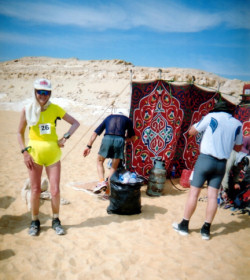
Celia at a checkpoint in the desert

Trees Haiku

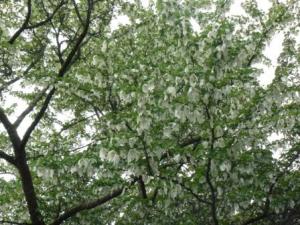
A Handkerchief tree at Minterne Gardens in Dorset

I am fascinated by trees, not only for their beauty, but for the stories they could tell.  Some trees have lived through amazing times and been part of the lives of such interesting people.  If only they could talk!

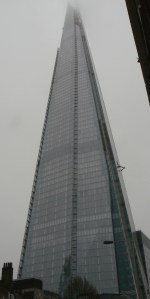
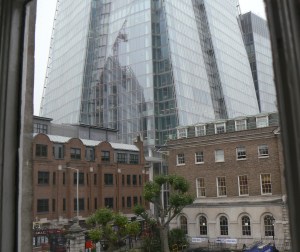
This week I went to the city with a couple of friends. We visited two wonderful museums and wandered along the streets of London where the trees are at their glorious Autumn best.  We strolled along the Embankment beside the River Thames and marvelled at the changing skyline.  I was struck by the juxtaposition of old buildings and new, especially the magnificent Shard which is so close to the old St Thomas’s.  It is a breathtaking sight and a brilliant feat of engineering.  Yet even in front of this awesome glass building my eyes were drawn to a row of trees nearby.

Consumed by the clouds

Engineered to perfection

A giant in glass

The Shard with trees in the foreground

The enormous Shard disappearing into the clouds

Sheer face of the Shard

Glass monument to mammon

Shatters the skyline

View of the Shard from St Thomas’s

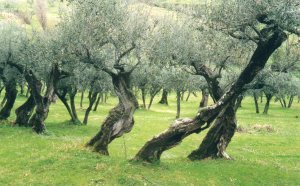
One amazing tree I have seen is an ancient olive tree at the site of St Francis of Assissi’s remote hermitage, the Eremo delle Carceri on Mount Subasio.   Olive trees are the longest living trees.  Indeed in good conditions some live to a thousand years old.  This tree is one of them.  It is protected and propped up by poles.  I find it breathtaking to think that St Francis actually touched this tree, walked by the stream and slept in the cave, all of which can still be seen.  I found it very moving when I visited in 2000 and I have to admit to picking some leaves from the tree.  I have pressed them and kept them in my travel journal from Rome and Assissi.  St Francis lived a simple life and slept in the cave on a bed of stone and a pillow of wood.  Some of his followers lived there as hermits too in prayer and meditation.  The warren of caves still exists in a clearing with a stream and lots of trees.

The ancient Olive Tree that St Francis would have seen

Birds stopped to listen

As the humble hermit preached

At one with the trees.

Leaves from the Olive Tree on Mount Subasio

An early picture of St Francis of Assissi

St Francis’s cell in the cave at Mount Subasio

Olive Trees in Italy

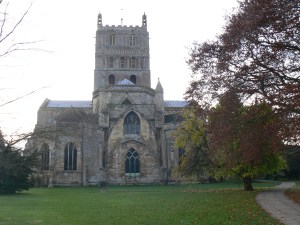
Another tree that inspires me is the Mulberry tree which was in the garden of St Thomas More’s home when he was Lord Chancellor in the time of King Henry V111.  Sir Thomas More, as he was then, bought some land in Chelsea and Kensington in 1524 in order to build his Great House.  Sadly his house is long gone, but the Mulberry tree he planted is still there.  On the site today is Allen Hall, the Seminary of the Roman Catholic Archdiocese of Westminster.  Visitors can visit the seminary by appointment and walk to the secluded walled garden where Thomas More’s Mulberry Tree still stands.  Outside and nearby is a beautiful statue of St Thomas More in a garden facing the river Thames.  In the grounds of Tewkesbury Abbey near where I live there is a Mulberry tree grown from a seed from St Thomas More’s tree.  I often visit this tree and sometimes pick the delicious fruit.

Mulberry Tree at Tewkesbury Abbey

Tewkesbury Abbey and Trees

Portrait of St Thomas More

He planted his tree

And dreamed of Utopia

In turbulent times

The Yew trees in the beautiful village of Painswick in the Cotswolds are also very interesting.  There are 99 of them in the grounds of St Mary’s Church and many of them are hundreds of years old.   They lived through the English Civil War (1642-1645).  There is evidence of Royalist cannonballs high up on the walls of the church to this day.  At times people have tried to establish more Yew Trees in the churchyard but a hundredth will never grow.  It seems as if 99 is the maximum for some reason.  There is an old story that if a hundredth tree ever grows, the devil would pull it out.  It is one of our old Cotswold mysteries!

Last but by no means least, is a historic small-leaved Lime tree at Westonbirt which is unbelievably ancient.  It is reputedly 2000 years old!  It is so big that it seems as if it is many trees.  However, it is actually a clump of around 60 trees all growing from one original.  This was the result of coppicing which was a way of managing woodland for fuel established in Anglo-Saxon times.  Over hundreds of years of repeated cutting, the stump gradually spreads outwards in a ring until it reaches enormous proportions.  My photo does not do it justice!

Ancient Lime tree at Westonbirt

The Dangers of Cycling

Pat at Christmas just a few short weeks before she died

What a strange coincidence, UK’s top cyclist, Bradley Wiggins and head coach for the GB cycle team, Shane Sutton both had cycling accidents within 24 hours. Fortunately, both men survived their accidents. Bradley Wiggins, the Tour de France winner, was discharged last night with broken ribs and a bruised hand according to the news.

British Cycling reported that,

Shane was taken into hospital where it was identified he has suffered bruising and bleeding on the brain. Shane was wearing a helmet. He is set to undergo more tests, and is likely to stay in hospital for the next few days. It is extremely rare that our riders and coaches are hurt while out cycling on the road, even rarer that two incidents should occur in a short space of time, and we wish Shane and Bradley a speedy recovery

Sadly, cycling accidents don’t always have this outcome. On Saturday 15th January 2011 my dear friend from college days was killed cycling on an organised 100 km club run for charity in the Severn valley. It was a foul morning, windy and pouring with rain. But Pat was a very experienced cyclist who used to be a racing cyclist and had cycled in France. I clearly remember my 60th birthday when Pat turned up in full cycle racing gear although she was a bit older than me, having ridden all the way from Berkeley to Cheltenham.

On the day she died, Pat was almost home when she was in collision with a van towing a trailer beneath a narrow railway bridge. It was no-one’s fault, simply a tragic accident. It happened near Old Westfield Farmhouse and there was a retired doctor at lunch there. He gave Pat CPR immediately; the emergency services arrived quickly, and Pat was airlifted to Hospital. It was comforting to hear from that kind doctor that Pat would not have suffered at all.

Pat was definitely one of life’s great characters and we used to have a lot of fun at college and afterwards when we shared a flat in Cheltenham. Before she came to college Pat had been a riding instructor and she continued with this in holidays from college. In the first year at college we shared a tiny bedsit behind Coventry Football Club. We had a wonderful time causing havoc in the local area with our practical jokes and outrageous (but very innocent) behaviour. We had our own favourite corner in the local pub and used to tease the local shopkeeper by asking him for exotic foodstuffs that he had never heard of.

In our second year we moved into college at Newbold Revel (the middle of nowhere) in Warwickshire, and again shared a room. Here we had more fun than ever, breaking every rule we safely could, and bending the rest. Pat loved all animals and our room was soon home to all sorts. We had snakes, guinea pigs, gerbils and hamsters, all of which Pat hid and bred from. On one hysterical occasion I remember, we had a young novice nun visiting our room ~ did I mention our college was a convent? She saw a lovely fur hat on the bed and without asking picked it up and put it on her head. Unfortunately for her, the hat was a nest full of gerbil babies. I’m not sure who got the biggest fright ~ the nun or the gerbils.

Pat’s most adventurous pet was a very young, tiny and absolutely adorable Shetland pony. I remember going to collect the pony. Pat borrowed a car and took out the back seats to put the pony in. We drove it back to college and installed it in the grounds. This Shetland pony was called Rupert and it went almost everywhere Pat went, except the Bahamas. Rupert eventually moved to Berkeley where Pat settled with her husband John and children, Lindsey and Robbie. Rupert lived for over 30 years, joined later by Old English Sheepdogs which Pat bred, and a goat called Fosbury.

After College Pat and I decided we would look for teaching jobs together. We applied in Gloucestershire because Pat had been born here in Cheltenham. Her father was the Chest Consultant at Salterley Grange when it was a TB hospital. We got a flat together and started our careers. Pat taught in a secondary school and I taught in a primary school. Every evening after school we would meet for malted milk in a Montpelier café before going back to our flat to work. We loved Cheltenham and again had a very good time and lots of fun.

Eventually we both got married. Pat’s husband went off to teach in the Bahamas and as Pat was expecting a baby, she came to live with me again. She stayed for a few months until her beautiful baby, Lindsey was born. As Pat’s husband, John, was in the Bahamas, I was allowed to be with her at the birth. Typically for Pat, the delivery started dramatically. Pat was at the dentist having her wisdom teeth out when she realised her contractions had started. When the dental treatment had finished she said we ought to go straight to the maternity hospital as she was in labour. In those days I had no car so we caught a bus!! While I got dressed in a gown and green willies.  Pat was whisked off to the labour room. Before long the baby arrived. It was the most moving thing I have ever been privileged to see. When Lindsey was a few weeks old she and Pat set off for the Bahamas to join John. They were there for 5 years altogether and Robbie was born there. When they came back they lived in Cheltenham for a while before moving to Berkeley. They bought a lovely old cottage which they set about restoring. Pat was often to be found up a ladder as she personally reroofed the house. There was a large garden where Pat grew her fruit and veg. There was also a little paddock where she kept Rupert and later Fosbury. Indoors she bred her Old English Sheepdogs. Pat was an outdoor person so although she taught for a while in Gloucestershire she soon gave teaching up and became a Postwoman. This was when Pat discovered her love of cycling. She was never happier than when cycling around the villages delivering mail and chatting to people.

When Pat was killed both of her children were expecting babies. Lindsey, who already had 3 children, gave birth to a little boy called Isaac and Robbie’s wife had a little boy called Ollie. They were both born in March 2011 so Pat did not see them. But she would have been so thrilled with them, as she was with Lindsey’s other children. The boys are delightful and I am sure they have a lot of Pat in them.

 Pat’s cycling friends said she brought a touch of eccentricity into cycling. She did time-trials with Dursley RC for many years as well as road racing and taking part in numerous cycle-cross meetings. She also joined the Stroud Valleys Cycling Club competing in time trials and races as well as fun events such as ‘man versus horse’ in Wales. Pat was a brave lady, a regular Hard Rider and particularly enjoyed the hill climbs. Her forte was as a cross-country mountain biker, and she regularly featured in the national results. One season she took the National Lady Veteran’s title. The fun touch, though, was never far away.

I remember Pat once did the 58 mile London to Brighton race on a unicycle! My children had great fun learning to ride her unicycle when they were young. In later years she took up bog-snorkelling and of course won at the Llanwyrtyd Wells mountain bike event. Pat’s determination stood her in good stead some years ago when she fell out of a fruit tree in her garden and broke her back. When the ambulance men arrived she told them not to move her as she knew she could be paralysed. She made them put her on a spinal board and drive at 4mph all the way to Bristol Hospital. Once there it was confirmed that her spine was indeed broken and she had a permanent metal framework inserted around her spine. One of her party tricks after she had recovered, which of course she did, was to put magnets on her back to amaze people. In a few months bionic Pat was back in the saddle doing what she loved most, riding her bike.
Pat she taught herself to ski and to speak French so that she could join a cycling club in France where she and John had a second home.

She was a great friend and she is sorely missed.  Today’s news just brings it all back for me as I am sure it does for all her cycling friends, and especially her lovely family.  The world is a sadder and duller place without her.

Pat on her much loved bike.

Nature

Having just come back from a restorative week in the log cabin by the fishing lakes, I am full of the sights and sounds of nature. So I have written for this week’s Haiku Heights prompt word which very conveniently is Nature!

Alone with my thoughts

Recharging my batteries

Immersed in nature

Sunset at Hillview

Walking in woodland

I catch glimpses of heaven

Revealed in nature

Butterfly in the Forest of Dean

Cormorants circle

Round reservoir full of fish

And herons hover

A cormorant resting

In ancient woodland

Birch, Rowan and Oak survive

And sweet chestnuts thrive

Forest of Dean at Lindors Country retreat House

Mosses and lichens

Green carpeted forest floor

Celtic rainforest


The Forest of dean

Is a haven for wildlife

As nature intended

Autumn haiku

These haiku are inspired by Haiku Heights prompt ~ Conscious

Conscious commitment

Finding fulfilment

Committed to following

A creative path


Conscious of time passing

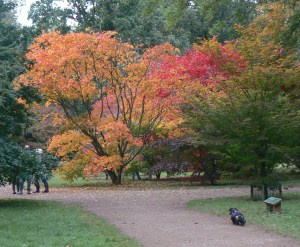
Dog days are over

Awesome autumn has arrived

Attracting the crowds

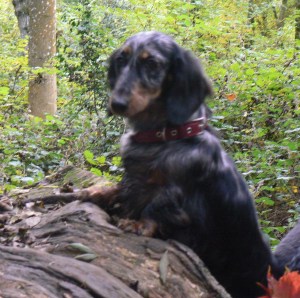
Dayna ther dachsund

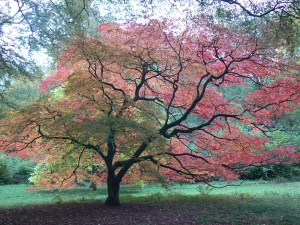
Conscious of colours

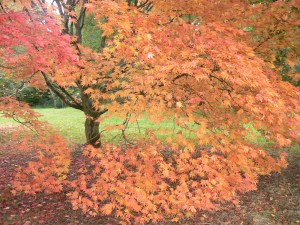
Japanese jewels

Seasonal spectacular

Autumnal Acers


Conscious of nature

Conscious of nature

Arboretum in autumn’s

cascading colours


Haiku ~ Shroud and Home

I am following Haiku Heights’ weekly prompts in October.  Last week’s word was Home and this week’s word is Shroud.  As I was in London last week I thought I would combine the two and put my musings here with a few photographs.

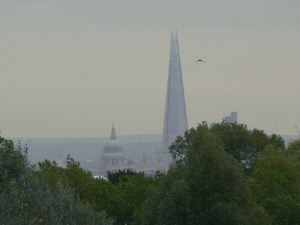
The first photos are from Hampstead Heath in London.  In the distance is the ancient St Paul’s Cathedral, once the most illustrious feature of the skyline, but now overshadowed by the Shard.

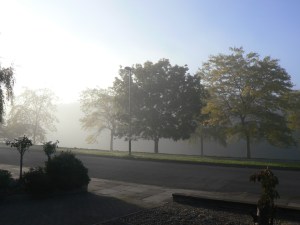
Next are some very misty views from my bedroom window at home.  When I woke up this morning the field opposite my home was shrouded in mist.  The beauty of the trees is enhanced by the Autumn colours and the mist just makes them more beautiful in my opinion.

I also squeezed in a photo of Dayna, my little Dachsund lying at my feet in the front bedroom.  She is never far away and I am happy to say she has settled into her new home beautifully.

So here are my Shroud Haiku:~

High on Hampstead Heath

Misty miles mellow the view

of a city spoiled.

The Shard overwhelming St paul’s Cathedral

St Paul’s stands subsumed

Skyline shattered by the Shard

Crystal Colossus.

The Gherkin shrouded in mist seen from Hampstead Heath

And here are my rather sombre Home Haiku:~

Hopeless the homeless

their troubles unrelenting

as winter approaches.

~

Despairing.  In debt.

Brow-beaten by bankers.

Deprived of their home.

And a much more cheerful one:~

Dayna at rest in the sun

She wallows in warmth

with the sun on her body.

It’s heaven at home

Misty view from my bedroom window today

Heaven is outside my home