Banksy ~ A rebel with a cause?

I recently wrote about our concert at the Tuckwell Open Air Theatre.  For several weeks before the concert we rehearsed in a room above a pub in one of the older parts of Cheltenham.  Right opposite the pub, on the corner of Hewlett Road and Fairview Road, was an ugly modern telephone box.    I will never understand why the powers that be got rid of our lovely red telephone boxes and replaced them with these ugly grey plastic things.  But I guess beauty is in the eye of the beholder!

red telephone box modern telephone booth

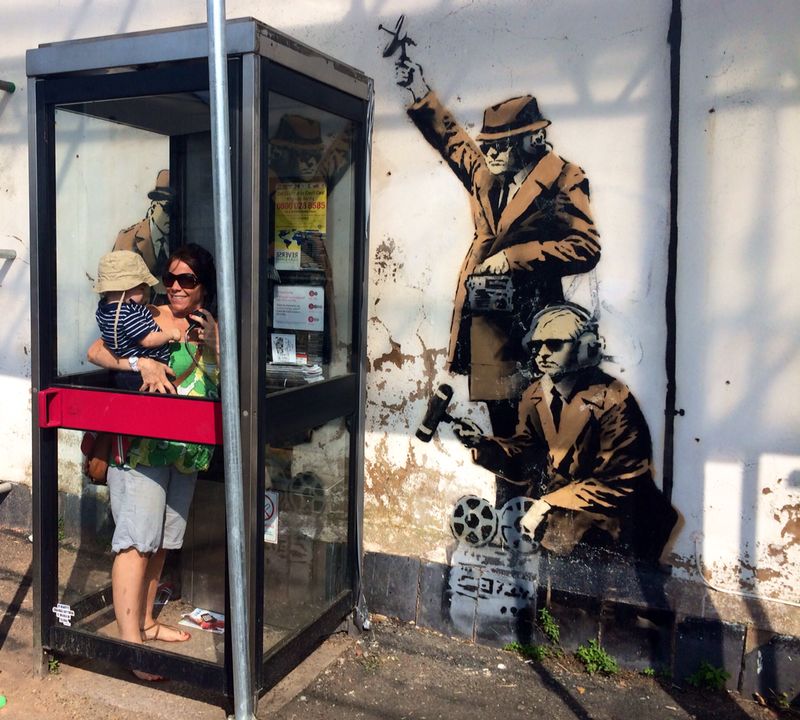
However, I digress.  The telephone box was attached to the side wall of a very insignificant rented house.  Insignificant that is until one Saturday night in April this year when a van turned up and a man covered the wall of the house with tarpaulin.  He then proceeded to paint a mural around the phone box which showed three men apparently using listening devices to hear and record the conversations of people using the phone box.   The trenchcoat-wearing men were obviously meant to be spies.  Now this was clearly a reference to the fact that GCHQ, the Government Communications Headquarters, is based in the town.  GCHQ had been controversially in the news because of Edward Snowdon’s revelation that they listen in to private telephone calls, though quite why anyone is surprised by that I fail to see.  I may be missing something, but if this is done in the quest to prevent terrorism and serious crime ~ isn’t that their job?

When the tarpaulin, the man and the van left, there appeared an amazing piece of very professional street art or graffiti, depending on your point of view.

It was quickly established that the art was the work of the world famous elusive Bristol based artist known as Banksy, which made it extremely valuable to whoever owned that wall.  Banksy owned up to the work, which is now known as Spy Booth

People came from miles around to have their photograph taken inside the Spy Booth including my daughter and my grandson!

Jenny and Stanley in the Spy Booth

Of course all of this attention had negative consequences too.  The painting was very soon badly vandalised, which is tragic, but also rather ironic as it was originally an act of vandalism itself.

Banksy vandalised

The debacle which has rumbled on ever since verges on the ridiculous with the owner, the tenants, the council, local business people, millionaire prospective buyers and art experts all proclaiming their views loudly in the local newspaper.   But most residents agree that it livens up a rather dull area, is a tourist attraction and definitely belongs in Cheltenham.  It would be irrelevant as a political statement if it were not linked to the phone box and the home of the Government communications Headquarters.

Banksy himself has said, “As a kid I always dreamed of growing up to be a character in Robin Hood”.  It seems now his street art is so valuable that he doesn’t need to steal from the rich.  They are queuing up to buy his work!   Today I heard that another of his paintings, Mobile Lovers, attached to the side of a community building in Bristol has been sold for a six figure sum and all the money is going to secure the future running of the premises as a Youth Club.

Mobile Lovers appeared in April on a doorway by Broad Plain Working With Young People

Miss Margaret’s New House

When I was a student in the 1960’s I started collecting nursery rhymes and poetry which I could use once I started teaching.  I built up quite a collection in a folder.  I also got into the habit of cutting poems out of the daily newspaper if they appealed to me.  One poem impressed me so much I have treasured it for the last 50 years.  I still have the original cutting.  Brown with age, I’ve now laminated it so that it doesn’t get damaged.  It is called Miss Margaret’s New House and it chimed with me really strongly.

As regular readers of my blog will know, my much loved mum died in 2012.  She lived just a couple of doors away from me, which was really handy when I was caring for her.  But once she had died, the house being so close was a constant source of sadness which I could not escape.

The house was empty and forlorn for months but now new people have bought the house to ‘do up’ and live in.  It seems to me that there will be nothing left of the original house soon.  It now has a huge extension on the back, the lovely hardwood window frames have been replaced with white plastic and the leaded lights are gone.  The kitchen has been ripped out and a new one built in the extension.  The wall between the bathroom and toilet has been knocked through and all the fittings have been replaced.  The climbing roses have been cut down and the rambling hedgerow tamed and trimmed.  All the carpets are gone and modern wooden flooring installed and the walls have all be painted in neutral tones.

I’m sure it will all be lovely by the time they move in, but no longer will it be ‘my mum’s house’.  This is a blessing in a way as I will no longer feel those pangs of sadness as I pass by on my walks with the dog or my grandson.  Every trace of my mum’s taste and personality has gone from the house now, along with her fixtures and fittings, into the skip.

Her style was plain and simple.  She loved the soft pink on the walls, pale green on the floors ~ always Wilton, always 80/20 wool.  She loved roses in the garden, flowers in the house, and dark oak Ercol furniture.  She loved soft cushions and silver ornaments.  Her door, like her heart, was always open to visitors, especially her family.  She never forgot a birthday and was generous to a fault.  Not a day goes by when I don’t miss her.

Now to get back to the poem!  I hope you enjoy it as much as I do.


 She never liked The Firs.  She said

‘Give me simplicity.

Pretentious roofs and leaded panes…

Lord, how they sicken me!


I’ll have an honest house one day.

Clean-shaped outside and in.

Where need shall take its dues, and oust

The merely finikin.


A downright house, a compact house;

A small house – I am small;

The lone pea in its vasty pod

Is not my role at all.


Nor yet for me pert painted doors,

Flame yellow, scarlet bright;

A low house with white window sills,

And trees to left and right.


A quiet house, a peaceful house…

Cool in the August heat,

But snug and safe when parching winds

Drive brown leaves down the street…


This will I have’, she said and let

It cost me what it may

I shall not grudge that dwelling’s price…

She moved in yesterday.


It took the sum of all she had,

But well content she seemed;

She has them all-the sheltering trees,

The quiet that she dreamed;


The low pitched roof, the straight bare walls-

All hers, and perfect, save

For the white window sills.  There are

No windows in a grave.

By Ana Jackson

Miss Margaret's House? No, its mine!

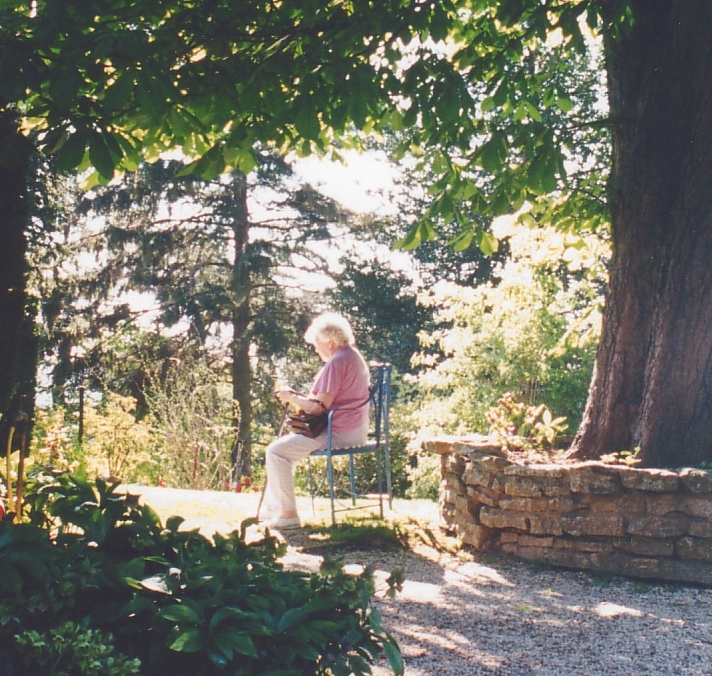
My mum painting in Painswick Rococo Gardens

My mum painting in Painswick Rococo Gardens

My Life in the Glass Cabinet

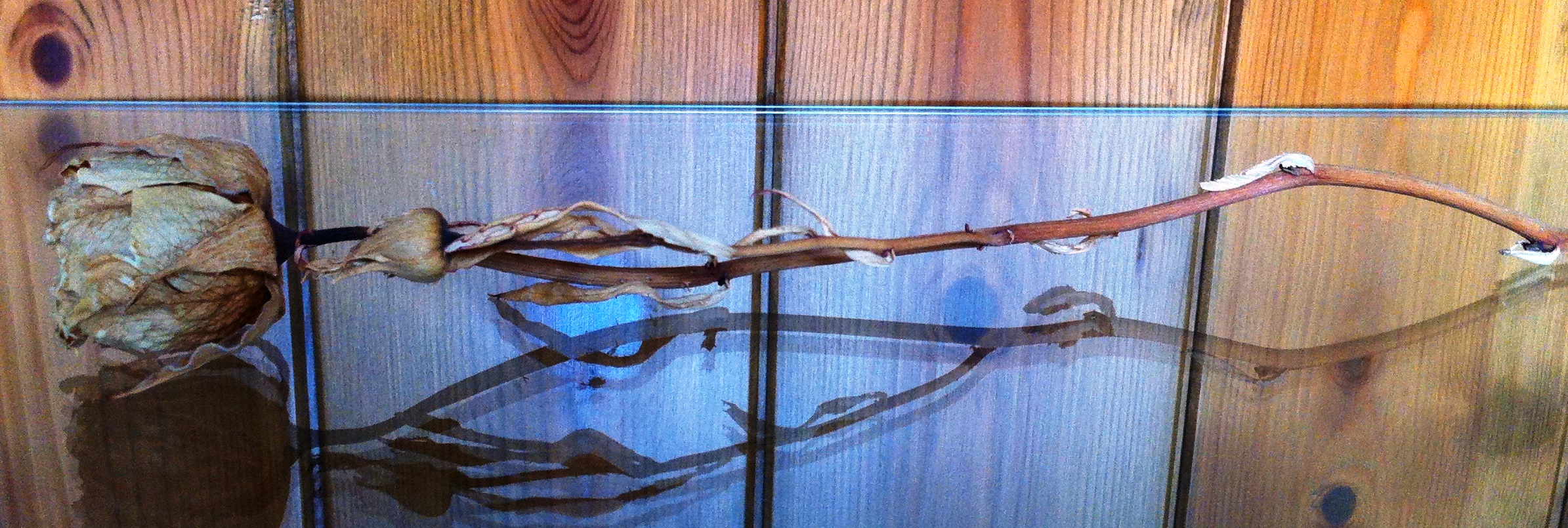
Preserved Rose from Lourdes

Preserved Rose from Lourdes

August has been challenging to say the least. We needed a new gas boiler ~ expensive but not a disaster you would think. However…one thing leads to another … a burst water pipe in the loft filled up the loft space and soaked the insulation; water came through the ceiling and the loft door soaking all the carpets in the hall, bathroom and airing cupboard. Water then came through all the electric light fittings and the alarms. The gas fitters trying to stop the water managed to put their foot through the ceiling and made a hole in the bathroom wall. We then had a gas leak where the pipes were connected to the meter!
Result ~ 2 regular gas fitters to fit the new boiler, 2 emergency gas fitters to fix the gas leak, 2 emergency electricians to change all the fittings and make it safe, 2 plumbers to change the pipes, 1 handyman to fix the hole in the wall, 2 builders to take down the ceiling and build a new one, 2 decorators to repaint the ceilings and walls in the hall and kitchen, 2 carpet fitters to lay new carpets to hall and bathroom, 1 carpenter to make new loft door, 1 man to replace loft insulation, several insurance assessors and surveyors and a very frazzled housewife!
As if all this weren’t enough my husband then had a nasty fall and injured his leg. It will take some weeks to recover and he is in a wheelchair until it does. Undaunted we decided to go away for a couple of days as it was my birthday on Monday. Not being used to worrying about access I booked a hotel which involved getting said husband and wheelchair up and down several stairs countless times daily. Finding this rather awkward I managed to jam my little finger causing a deep gash, and losing copious amounts of blood in the beautifully tiled reception.
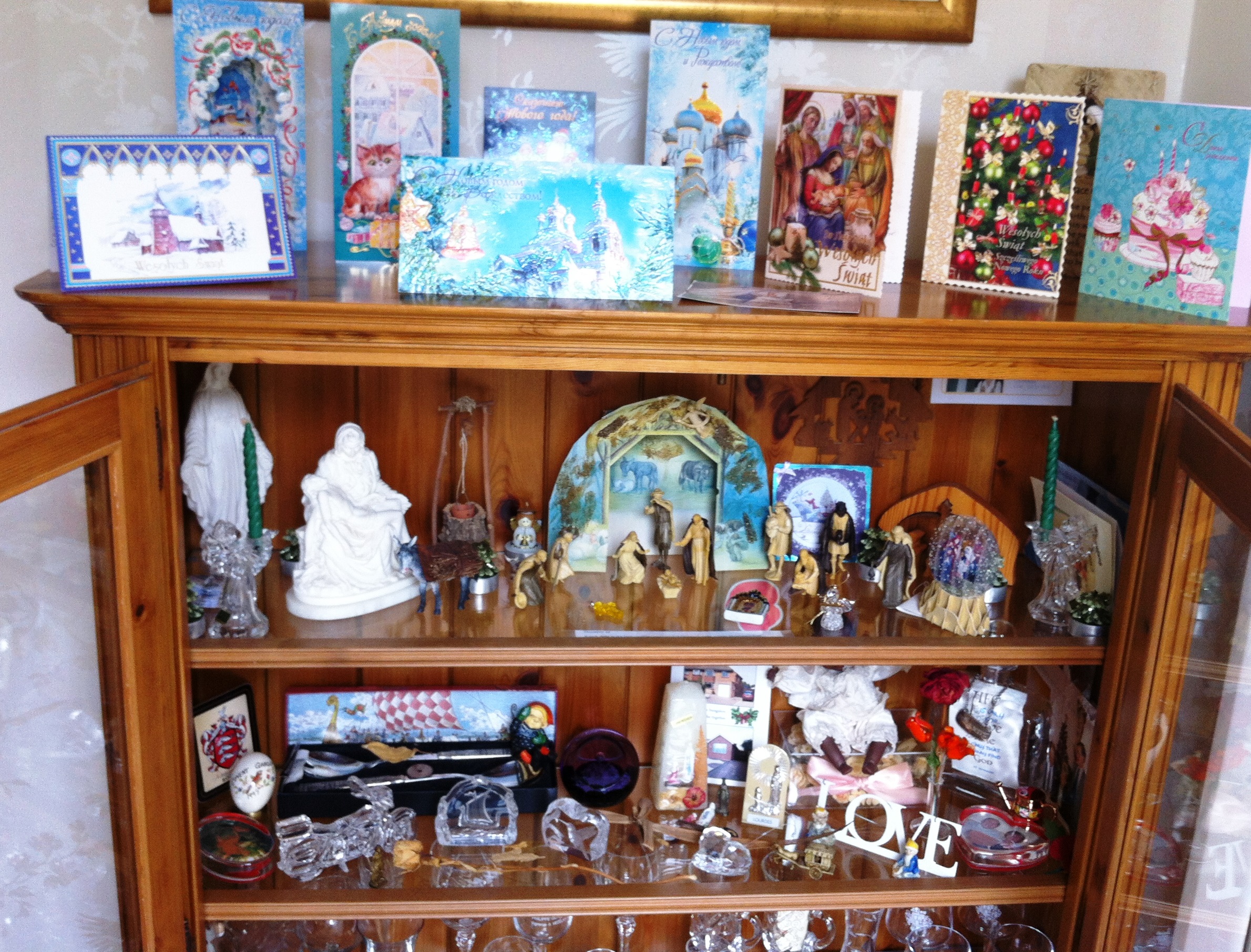
And so dear reader as August draws to a close I am busy getting my little bungalow back in some kind of order. I had to empty the glass cabinet so I could move it for the carpet fitters and today’s job was to clean it and put everything back.
Glass Cabinet
I realised as I put things back that this glass cabinet is a treasure trove, preserving significant moments and key memories spanning almost my whole life.
There are the two little pixies that I bought in Woolworth’s on Felling High Street in 1952 for my mother with my sixpence pocket money. When she died and the house was cleared they turned up amongst her possessions. She had kept them for 60 years and I will keep them now.
Glass cabinet ceramics

Felling High Street when i was a girl

Felling High Street when i was a girl

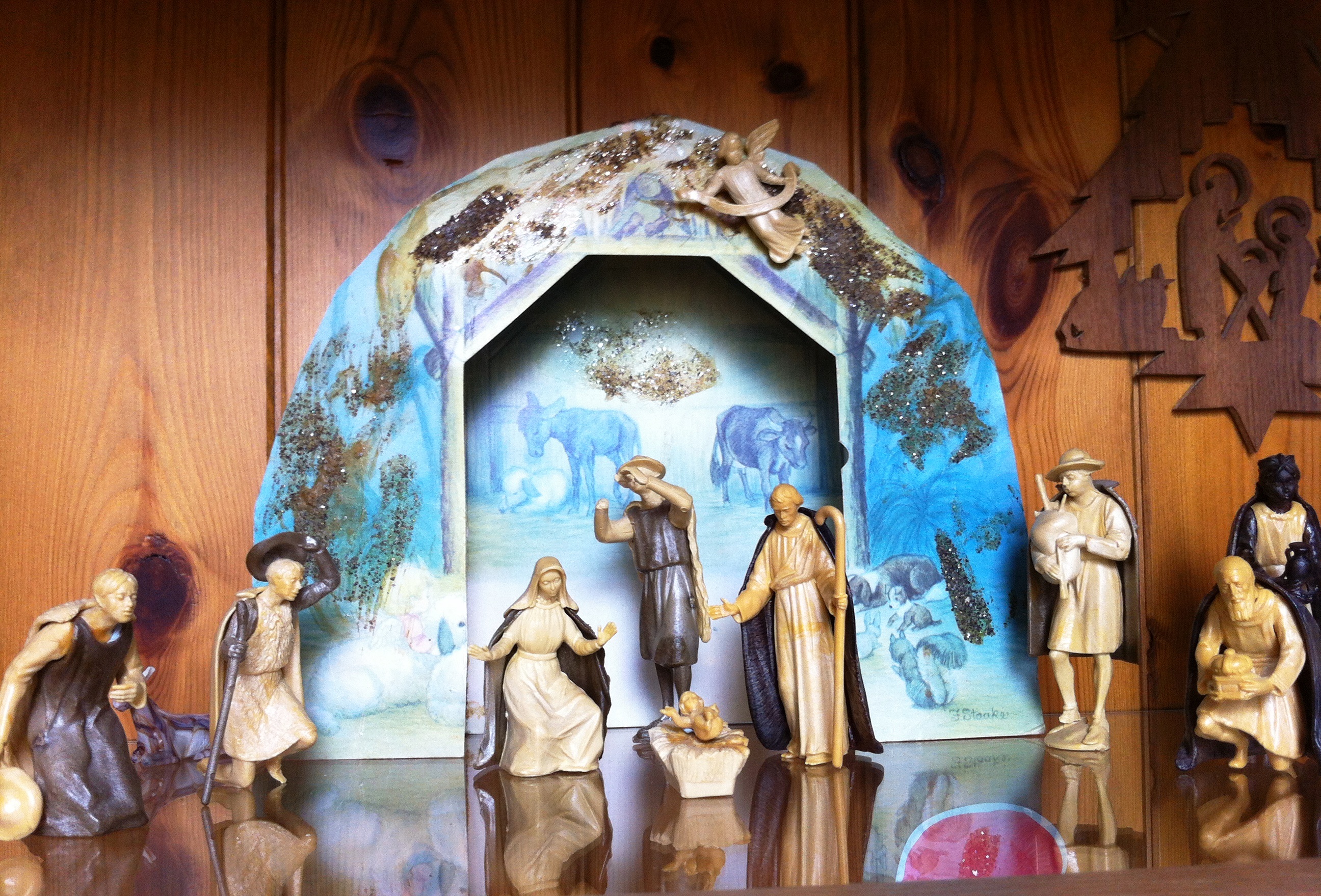
There is a nativity scene with a painted card background and little plastic figures. This is a poignant reminder of the traumatic Christmas of 1952 when I was in the children’s hospital at Rothbury in Northumberland. It was given to me by a kind visitor and has attained a ridiculous level of significance in my life.
Glass cabinet Crib Scene
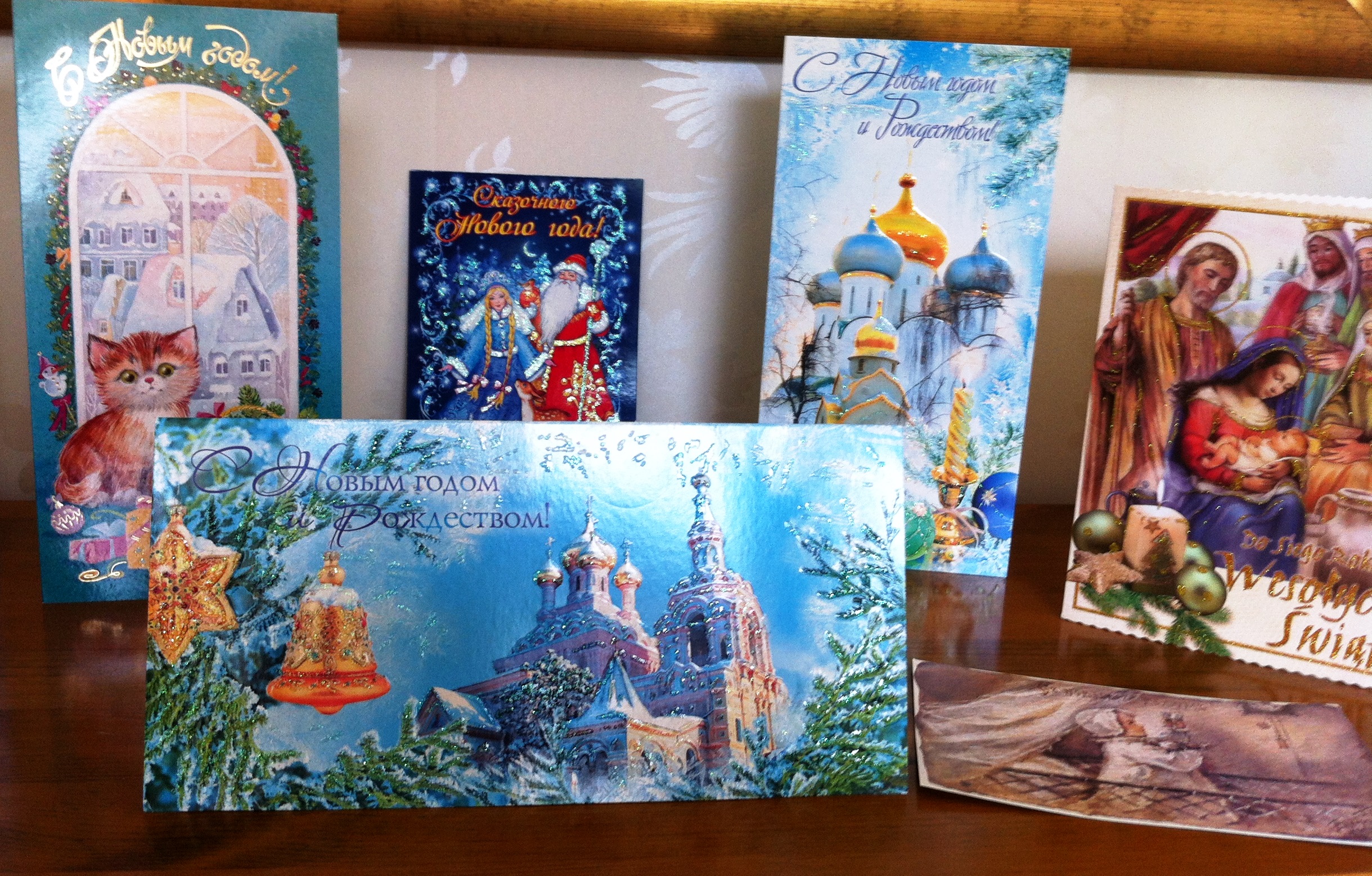
There are treasured Christmas cards from friends as far afield as Africa, Russia and Poland. For many years I was involved in an inter-cultural linking charity called Global Footsteps/Rendezvous.
We organised Conferences where young people could interact, learn from each other, share their cultures, have fun, and generally get to know each other. This led to many close friendships, and a couple of marriages, between people who would otherwise never have met. It is a joy to me that I still receive cards from some of the youth and I treasure them.

Glass cabinet Christmas cards from Russia and Poland Glass cabinet Christmas more cards from Russia
There are little things from my children such as extra items for my Christmas crib scene, glass angels, and maple syrup bottles! One of my daughters lives in Vermont where the maple syrup is tapped right from the trees outside her barn.

Glass from vermont IMG_2530
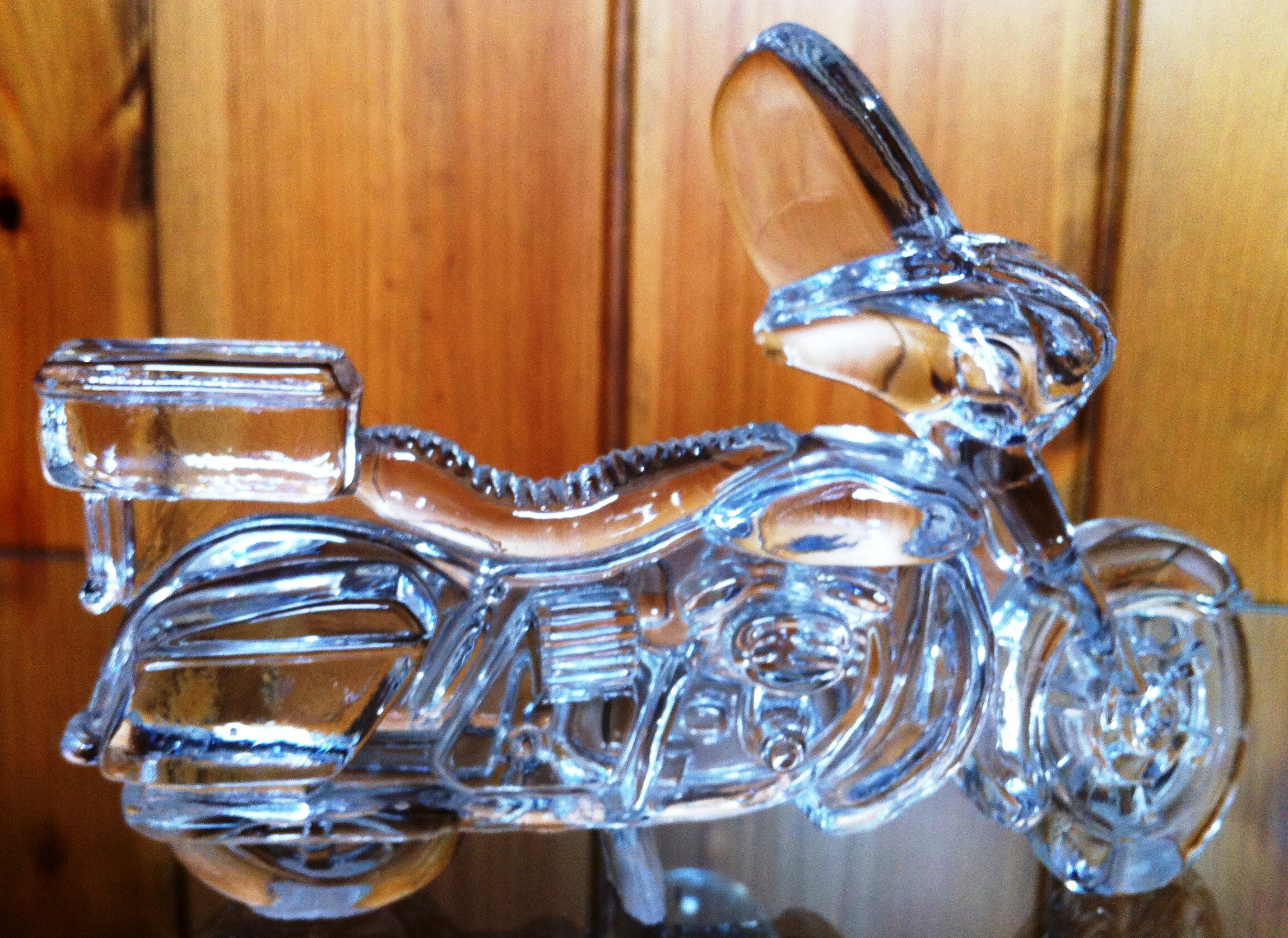
There are paperweights that my husband used to make for me with lovely pictures inside and ornaments we collected from the wonderful places we visited over the years.

Glass from Norway Glass motorbike Glass paperweights

 There are glasses from Anjou and Vezelay, which we collected during a wine tasting holiday in the Loire and Burgundy regions of France.

Glass from Vezelay and Anjou

Glass from Vezelay and Anjou

Crystal Glass from Wales

Crystal Glass from Wales

There is a decanter given to me by a very dear friend when her husband died.  He used to write beautiful poetry and was a very holy man.  So I put a little verse inside the decanter in memory of him:

Life is only for LOVE

Time is only that we may find GOD

Glass Franks decanter 2

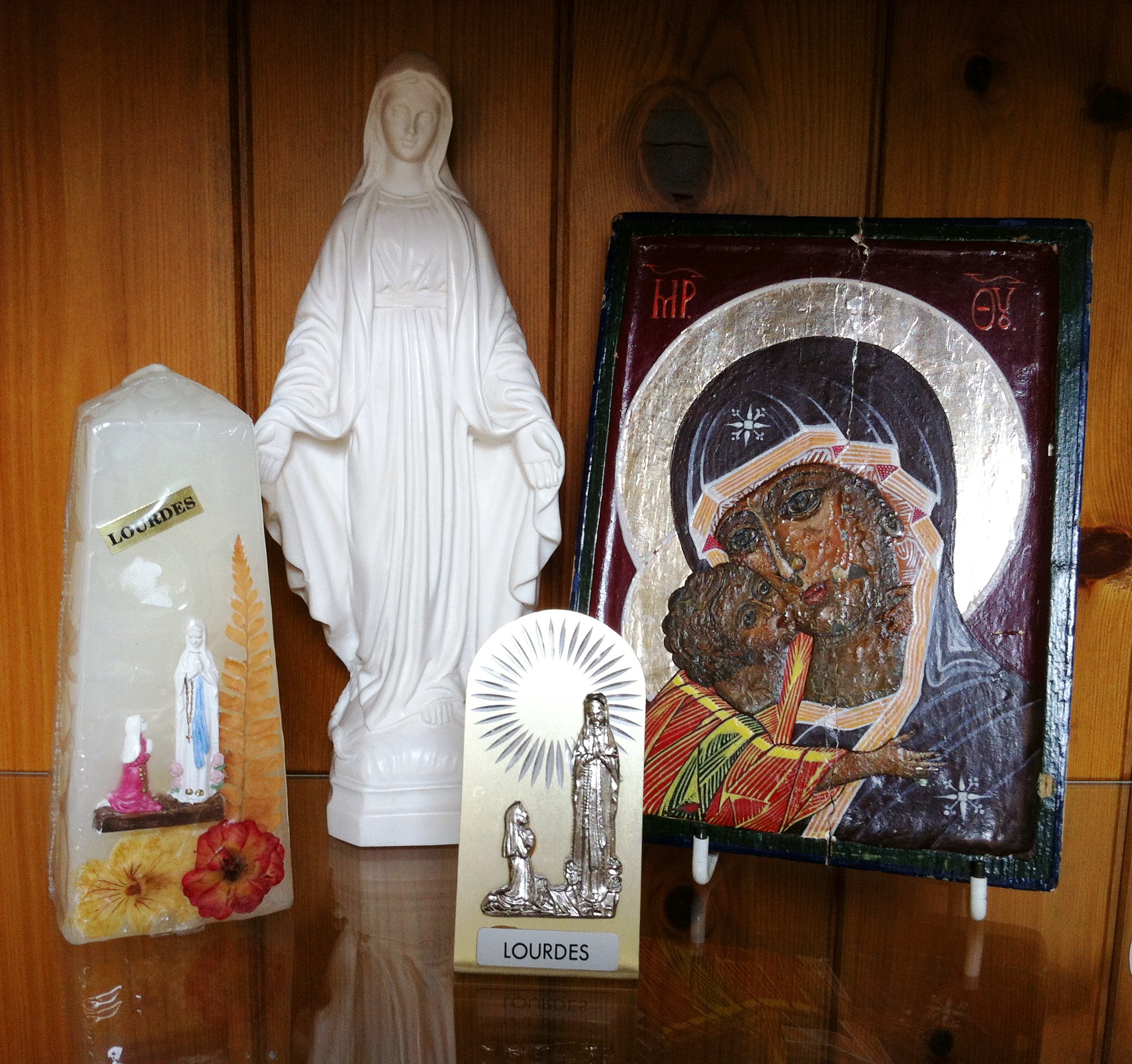
There are lots of mementoes from Lourdes, candles, Icons, Rosary beads, statues, crosses. Some of these were given as gifts, some were my mothers, and some I bought myself. I realise that many of my readers are of different faiths, or none, and I respect that. But today I feel strongly that, although I no longer belong to any particular church community, my faith is very important to me. It has been a constant in my life, a comfort in hard times, my anchor, the rock my life is built on.

Memories of Lourdes

Memories of Lourdes

Then of course there are the assorted glasses that I have gathered from jumble sales, trips to the Welsh Crystal factory, or as gifts.  All have a safe home in my glass cabinet…  

As long as my little grandson Stanley can’t find the key!

Family ~ Weekly Photo Challenge


Many years ago, it seems like another lifetime, I was a busy single mum to 4 wonderful children. I had a full time job that I loved, a nice home that was all my own work, an adorable miniature wire haired dachshund and a stray cat who turned up one day and stayed for 17 years. Over the years I progressed from teacher to deputy head and then Headteacher of a great primary school at the heart of an estate in my adopted home town. Luckily my profession fitted in perfectly with being a single parent as I was usually around in school holidays and always at weekends. But if ever there was a crisis due to illness or something I had the backup of my mum who lived nearby and was always delighted to look after the children or pets!

My school and parish was my community and together with my family, was the source of all the joy, friendship and social life I needed. Although I knew my immediate neighbours, my life was much too busy to get involved in the local community or the people in the wider neighbourhood.

And so life went on and my children became adults and gradually left home. I had always encouraged them to follow their dreams and take any opportunity they could to travel and sample other ways of life and other cultures. I was lucky enough to travel extensively through my job, working with schools in Russia and Africa. I also took great holidays in America, Canada and many parts of Europe. So I think I probably went a bit too far with this advice as now 3 of my children live and work abroad!

As my children grew more independent I filled my spare time travelling to Lourdes at every available opportunity as a volunteer/helper with the sick or disabled whom we called VIPs. This was one of the most rewarding 10 years of my life. It also indirectly brought me my wonderful second husband who was also a volunteer.

I knew that I was very lucky in every way and I worked very hard to try and improve the life chances of the children in my school. But of course life has a way of turning your world upside down sometimes. For me several events occurred to produce the perfect storm that would shatter my well ordered life. I buried my feelings and worked harder and harder until my body refused to do any more and I had to retire.

There then followed 5 very gruelling years which felt like 50 years. I was caring for my mum who was disabled after a heart attack. I only ever went out of the house to shop or for their hospital appointments. I became reclusive, antisocial and anxious. By 2009 my life and social circle was as limited as it could possibly be.

Then in that Autumn my youngest daughter said some women wanted to start a WI in our area. She said she thought it would be good for me so she would go with me to the inaugural meeting. It took all my courage to turn up that night and fortunately there were only a handful of women there. In fact there were so few that almost everyone there ended up on the committee by default! My daughter said I was good on computers so could be the secretary.

Now, almost 4 years on, I know that joining the WI was the best thing I could have done. At first I forced myself to go to all the meetings as I had to take notes. Gradually it became a pleasure to attend the meetings and I looked forward to them. I joined the Book Club and started reading again. I started putting my name down for trips and events. To give me the courage to turn up for them I took my camera to hide behind and became our unofficial photographer. I ventured out to concerts and big events like the AGM in Cardiff. It still takes quite a lot of courage for me to attend these things but I know that if I am struggling I will not be alone. The friendship and support WI members offer each other is very special. I even joined the Public Affairs Committee at our Federation.

Usually I find that the speakers at meetings are so interesting that I completely forget to worry or panic and just enjoy myself!

Now the WI is my community and my family. Through joining, I have rediscovered my creative side, writing a blog at http://www.heavenhappens.wordpress.com I have become outgoing and physically active again and renewed my interest in campaigning.

Best of all, when I walk anywhere in my local area now I seem to know everyone and they all stop for a chat. I feel that I am part of a vibrant and supportive community.

The WI offers all kinds of opportunities to all kinds of women. I would advise any woman of any age to join and get involved to whatever extent you feel able.

The WI is all about inspiring women. It is a rich source of experiences, knowledge and skills passed down through generation ~ and updated every day!

WI even enriches my now rare holidays, as I try to pop in to a local meeting while I am away. It is fascinating to see how different WIs conduct their meetings. But I can honestly say that whichever WI I go to, I know a warm welcome is guaranteed.

I am so happy with my life now and I thank God every day for my wonderful family, friends and community.

Pop, Poets and Plays

Community Choir at Tuckwell Community Choir at Tuckwell

It’s been quite a cultural summer so far for me in the Cotswolds. I sang in a super concert at the local open air theatre, which was amazing. There were 150 of us aged from 5 to 90 singing together in the community choir. Sometimes we split up and sang in individual choirs, and we sang such a variety of songs. It was great to listen to the other choirs, especially the children. The setting was magical. We were in a dell surrounded on 3 sides by trees and with a stream running behind. On the fourth side was a tiered seating area. All the trees were sparkling with lights and there were candles along the paths and down the steps. The theme for dress was ‘festival’ so there were flowers in our hair and lots of pretty dresses. It took me back to my teenage years in the 1960s. I loved every minute of it. Sitting in the audience were two ladies who are direct descendants of a Gloucestershire poet who coincidentally is the subject of the rest of this post, Will Harvey.

There have been all sorts of commemorative events going on to mark the centenary of the start of World War One. Here in Gloucestershire I was involved in a production of a brand new play called Will Harvey’s War at our local theatre, playing the part of a singing farmworker! The play was based on a previously unpublished manuscript written by Will and only recently discovered. It has now been published as a book entitled The Lost Novel of F W Harvey

Will Harvey, better known as Frederick William Harvey DCM (26 March 1888~13 Feb 1957), was a local man, born in a small village called Hartpury in Gloucestershire. I have very fond memories of Hartpury, as my daughter did her degree in Equine Studies there at the college. The setting was perfect. There used to be a great village pub called the Canning Arms where live Jazz was played every Monday night. My husband and I used to go regularly to enjoy the music, the food, and to chat with the great licensees, John and Jean. Sadly, like many country pubs, after Black Wednesday the Canning Arms suffered in the economic downturn and closed. It is now a private house.

Will Harvey moved to Minsterworth and went to the King’s School in Gloucester, where he met Ivor Gurney, a chorister, who went on to become a noted Gloucestershire poet and composer. Along with Herbert Howells they became lifelong friends. Kings school, being a Cathedral school, has a strong music and arts tradition, but it was listening to Elgar’s, Dream of Gerontius that informed Will’s ideas on beauty and creativity. Coincidentally, I worked at King’s School for a time in the 1990’s and have written about it before http://wp.me/p2gGsd-Gp

After school Will trained as a solicitor, but at the age of 26, the First World War intervened in his life. Within days of the war starting in August 1914, Will joined the 5th Battalion of the Gloucestershire Regiment as a private. After a few months training, the battalion was posted to France where Will proved to be quite a hero. He was awarded the DCM or Distinguished Conduct Medal for his bravery. Will was later trained as an officer then sent back to France. Unfortunately, during another brave venture into enemy trenches, he was captured and spent the rest of the war in various prisoner of war camps. Although he made several unsuccessful escape attempts, it was in the camps that Will developed his poetry and writing skills. His most famous poem is Ducks, which he wrote after seeing a picture of ducks on the ceiling of his prison hut, drawn by another prisoner

It is often thought that The Wipers Times was the first trench newspaper, but actually the Fifth Gloucester Gazette came first and Will Harvey was a contributor. It was fortunate that Will was allowed to send his poems home for publication. His first volume was, A Gloucestershire Lad At Home and Abroad, which was soon followed by, Gloucestershire Friends, poems from a German Prison Camp. https://archive.org/details/gloucestershiref00harv

He also wrote about his wartime experiences in Comrades in Captivity. Altogether Will had about 400 poems published. He wrote of war and nature and animals as well as poetry for children.

After WW1 ended, Will came back to Gloucestershire and settled in the Forest of Dean. His poetry was so popular that he was known as “the Laureate of Gloucestershire“. But, now married to a nurse called Anne Kane, Will went back to his career as a solicitor in order to earn a living. To his credit he became known as “the poor man’s solicitor”. Indeed, Will was so compassionate to those facing prison that he often gave his services free. This was great for his reputation but not for his business and eventually it had to be sold. After that, Will joined the BBC and spent years promoting the people of the Forest of Dean, its arts’ scene, culture and heritage. Will’s friends, Ivor Gurney and Howells both set some of Will Harvey’s poems to music. Even today his poetry is set to music by local folk musicians such as Johnny Coppin. He sings of Gloucestershire, its traditions, its people and its culture.

Will Harvey is remembered on a memorial stone at Gloucester Cathedral and a new biography is being published this year.

The whole cast on set at the end of the show The whole cast on set at the end of the show

Frozen in Norway

Sculpture by Gustav Vigeland in Oslo park

Sculpture by Gustav Vigeland in Oslo park

One of the many joys associated with having grandchildren is that you get to watch the most beautiful films at the Cinema, or enjoy Disney videos at home, without feeling silly.
Recently I have been captivated by Frozen which I watched with Ben and Rosie. In the film Elsa the Snow Queen sings ‘Let it Go’, which is one of the songs our choir sings. It really is a most beautiful song, but when the children and their parents sing along together it is truly moving. This weekend we are performing it in a concert at the Tuckwell Open Air Theatre.

The film, Frozen, is based on Hans Christian Anderson’s tale of the Snow Queen.  When my daughter, Anna,  was young she played a part in a local production of the fairytale so it has a special place in my heart.  Also, the dramatic landscape of Norway was the inspiration for the setting apparently and I had a wonderful holiday in Norway some years ago.

If you have never been to Norway, I hope this film will inspire you to go. In July 1999 I flew to Oslo then travelled by train across Norway. Trains and boats are really the best way to travel for seeing scenery I find, and in Norway there is so much to see. The countryside was truly spectacular and very rugged with snow-covered mountains, icy glaciers, breathtakingly beautiful fjords and waterfalls, wildflower covered meadows and lakes so still that it was hard to tell what was real and what was a reflection.

Reflections in a still lake

Reflections in a still lake

There is a real port called Arendal in the South of Norway which becomes Arendelle in the film, Frozen. But it is in Bergen that you find the exquisitely preserved old buildings of Bryggen which feature in the film. There is a fish market in Bergen just opposite these ancient timber buildings. I was a bit shocked to find whale meat for sale alongside fabulous salmon.

Shopping for Salmon in Bergen Market

Shopping for Salmon in Bergen Market

Also in the film you will see Stave churches. There are many of these beautifully preserved churches in Norway. They were built mostly of wood during the middle ages. The largest is Heddal near Notodde. It is a beautiful fairytale church which dates back to the 12th century. There are several of these Stave churches around Bergen and we decided to visit the Fantoft Stavkirk on St Olav’s day. I caught a bus with my husband from Bergen and we had a very pleasant journey to the church. As we went to enter the church my husband realised he had left his wallet with all our money, tickets and passports on the bus! Fortunately I had a mobile phone with me and I managed to find the telephone number of the bus company. I rang them and sadly explained our situation. Imagine my delight when they said the driver had found the wallet and was finishing work for the day soon. He offered to drive back to where he had dropped us on his way home and return the wallet to us! He would not take any tip and seemed surprised that we were so overwhelmed with gratitude. Call me an old cynic but I just can’t imagine this happening in the UK.

Stavkirk

Stavkirk

My husband and I intended visiting the church on the way to the house at Troldhaugen where Edvard Grieg lived. I say the house but actually it was like an estate with a very impressive villa which is now a living museum. There was an island where visitors can enjoy free lunchtime concerts of Grieg’s music in the summer months. There is also the cabin where he worked. By the time we got there we had missed the concert and only had time for a rushed visit.

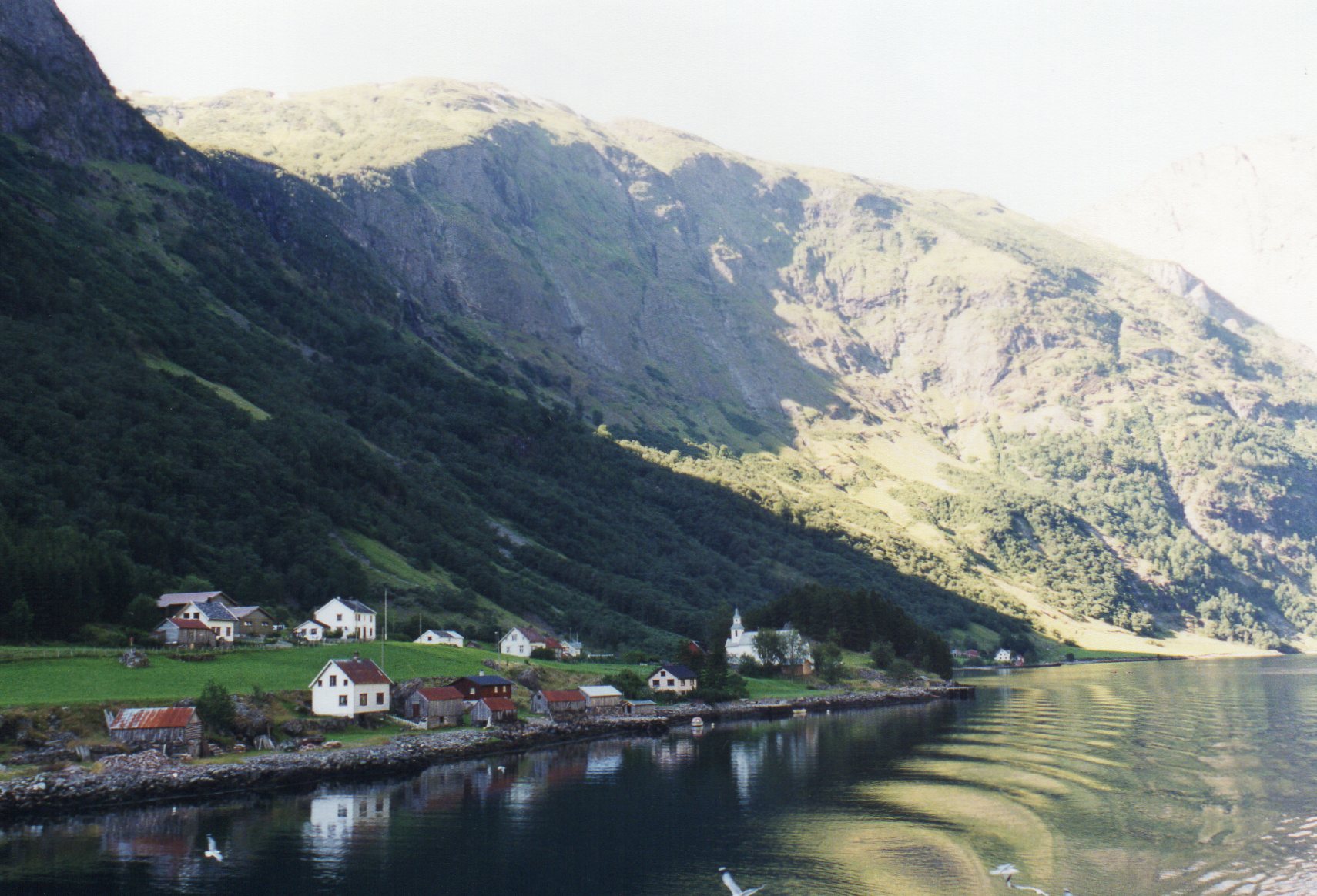
There are several fjords which could be the setting for Arendelle but it is claimed that it is Nærøyfjord, an arm of the Unesco-listed Sognefjord. I can believe that as it is so spectacularly beautiful. We travelled on the famous Flam railway passing huge waterfalls to reach the fjord. Along the way we could hear beautiful operatic singing and we could not work out where it was coming from. The train stopped under a waterfall and from there we could see a woman standing on the very top of the mountain. She was producing that magnificent sound which echoed around the fjord. From there we travelled by boat to one of many little villages dotted around the fjord.

Village along the fjord

Village along the fjord

Also in the film, Frozen, Elsa flees across a glacial landscape which resembles the Folgefonna glacier. It could equally have been the Hardanger Glacier, which we saw, and flew over. It certainly is a bleak and barren place when viewed from the air.

Frozen Norway Norway from the air Hardanger glacier seen from plane

Watching Frozen brought all this back to me so I fished out my photos. Enjoy!


My Japanese Maple

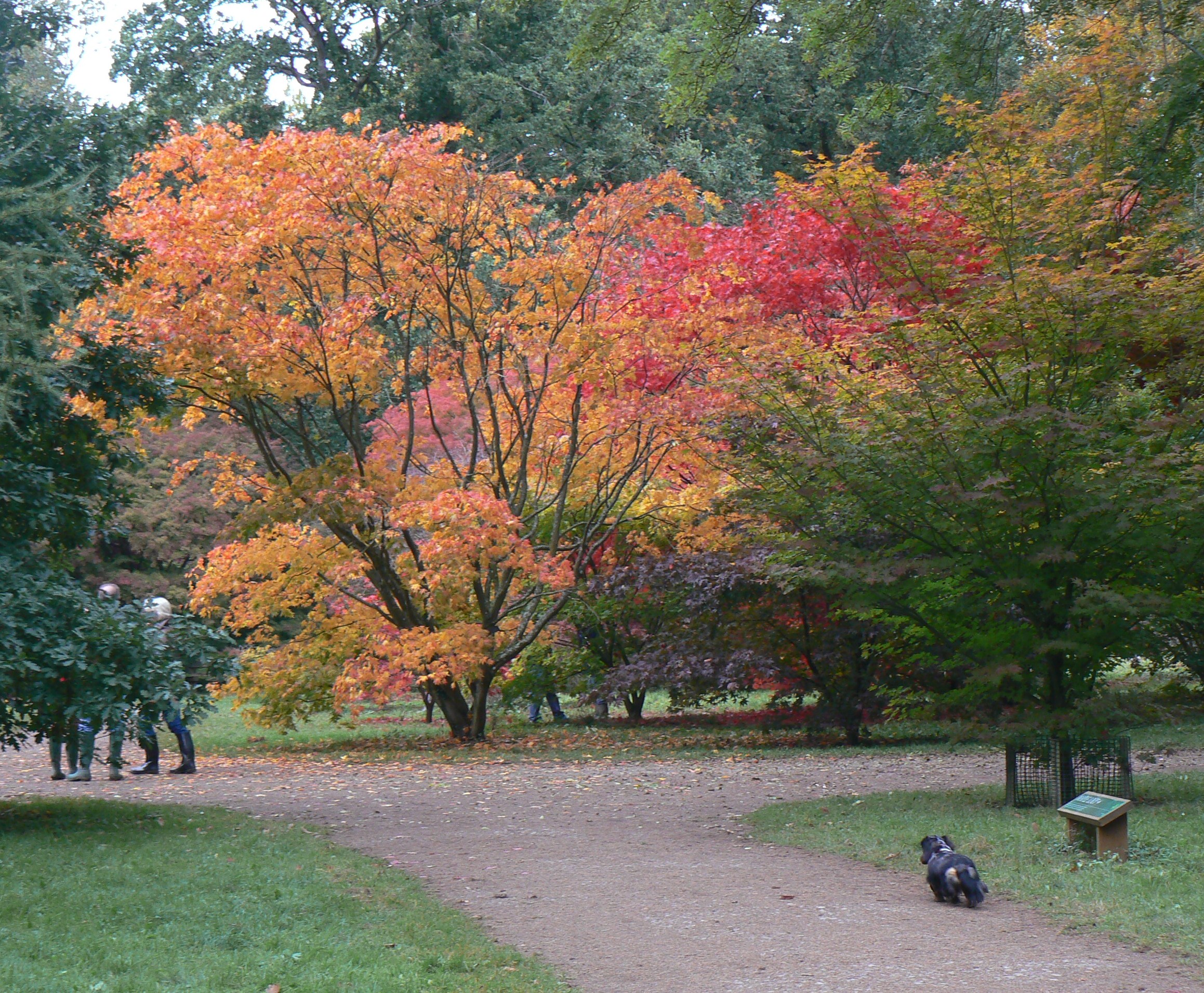
My little dachsund walking amongst the Acers at Westonbirt My little dachsund walking amongst the Acers at Westonbirt

Drained and sitting weakly by the window, I hear the drone of aircraft returning to their bases from the Fairford Airshow. Too high to see, yet they fascinate me with their power and the skill of their crew. The washing machine is rattling in the background, an unbalanced load of sheets and towels, detritus from my weekend sickness.
I feel the cleansing warm breeze waft through the open door, cooling me down and I hear the maple tree shiver to the chinking of delicate chimes. That tree is my pride and joy, a foliate friend, a deciduous delight. At 12 feet tall it is unbridled and bushy. Grown from first generation seed gathered at Westonbirt, it’s not like those at garden centres. This is a thoroughbred tree, the debutante of the Acer world, a Palmatum in its prime. I’ve nurtured it for 8 years since it started to grow in a humble yoghurt pot in the dark. It progressed to a plant pot on the windowsill then a tub on the patio. At three, petite and pretty, it seemed perfectly happy in its miniature world.
By the time we moved house some years ago I was so attached to it that it had to move with us. I felt it was ready for its own space in the earth. I was careful to plant it in a sheltered spot as Acers hate wind on their leaves. And judging by how it has thrived, it seems to have found its niche. At the moment it has seeds on it, like miniature sycamore wings, and masses of new branches which form arches and tunnels. My grandson, Stanley, loves to hide among the branches. I know he’s there of course as I can see his little truck sticking out but I still have to call out in a worried voice,
“Stanley where are you…?”
He instantly appears giggling every time. It’s adorable.
I’ve had to sacrifice a conservatory for my maple tree as I couldn’t bear to risk damaging the roots by digging foundations So my maple and I will just have to sit together in our shady spot growing old together. But it is worth it just to look forward to autumn when it will be glowing red and gold. Stunning
If you want to see some beautiful Acers at Westonbirt just click on this link to a previous post


That’s the way to do it!

Professor Collywobbles 1
Can you guess what links the English Civil Wars (1642–1651) between Oliver Cromwell’s ‘Roundheads’ and King Charles’s ‘Cavaliers’, Samuel Pepys’ Diary, Charles Dickens’ ‘Old Curiosity Shop’, the famous Geordie inventor Robert Stephenson, a pub in London’s Covent Garden, and the Italian clown Joe Grimaldi?
Well, last night at WI we were enlightened and entertained by Professor Collywobbles, who managed to squeeze them all in to his talk on the history of Punch and Judy!
To be honest I was not keen to go. Having never been that keen on this traditional seaside entertainment, I was going to give it a miss. But I am so glad I went.
Now Punch and Judy shows would seem to be as British as fish and chips, but in fact we learned that they hark back to Italy’s commedia dell’arte, a type of improvised comedy based on stock characters. Punch is probably based on the character of Pulcinella, a nasty, aggressive fellow with a long, beaky nose.
We were told that the first reported show was seen on May 9th 1662, and was immortalized by no less than Samuel Pepys in his diary when he wrote about seeing, “an Italian puppet play…the best that ever I saw” in Covent Garden. It was performed by an Italian puppet showman, Pietro Gimonde, known as “Signor Bologna.” But they may well have started even earlier because of Oliver Cromwell. He closed all the theatres during the Civil War apparently, so sketches with puppets or Marionettes were put on at street corners and public places. These anarchic early shows were aimed at adults but children did gather to watch them with their family.
Before long, Punch and Judy shows had sprung up all over London. Judy was at that point known as Joan.
We heard how, by the 19th century, thanks in part to Robert Stephenson, the railways were taking off, and people were travelling to the seaside for days out or holidays. ‘Professors’ saw the opportunity to make money from the crowds and so they began tailoring their shows for children while still retaining some adult jokes. Thus began the tradition of Punch and Judy shows at the seaside.
Professor Collywobbles told us that early Punch plays would have been performed with marionettes, but as the show developed glove puppets were used. They were cheaper to make and easier to carry. Soon mobile booths were designed to carry everything in, and, covered in red and white cloth, these became the stage with the addition of a decorative proscenium arch. The man who operated the puppets was called a ‘professor’ and he often had an assistant who was called a ‘bottler’. The bottler would usually play a musical instrument, warm up the crowds, and collect money in a bottle. Sometimes a live dog, called Toby was used alongside the puppets.
Punch’s screeching voice was, and still is, created with the aid of a swazzle, which sits at the back of the mouth and is pushed to the side when other characters are ‘speaking’. It is quite difficult to understand all the words Punch says so the bottler or other puppet characters often repeat his lines.
I discovered that other countries have long had their own shows with the Pulcinella character. It was very popular in France. In America, George Washington is recorded as buying tickets for a puppet play featuring Punch in Pennsylvania in 1742.
I read that across Europe shows might star Punch himself, or St George and the Dragon, the Spanish Don Cristobal, the German Kasper, the Turkish and Greek shadow puppet star Karagoz, the elaborately costumed French icon Polichinelle, or the pleasant-faced comic, Guignol. Nowadays, In the USA The contemporary fan can see the Sid & Nancy Punk Punch & Judy Show in Brooklyn, or on the West Coast, catch a performance of Punch & Jimmy, which is Punch “with a Gay twist”.
The professor told us that in the UK, the storyline of a Punch and Judy show can be different in every performance, with stock characters ranging from crocodiles to policemen. Changing public taste and social awareness of issues like child abuse however, means that the traditional nature of the show is being adapted. ‘Unsuitable’ characters like the Devil or Pretty Polly, Punch’s mistress, are now less common, while Punch’s unacceptable habit of beating his wife and baby is often left out.
There is an annual gathering of Punch showmen in the grounds of St Paul’s Church, Covent Garden. In 2012 the TV reported that Punch and Judy professors from all over the world gathered at Covent Garden for “the Big Grin”, a celebration of Punch and Judy’s 350th anniversary. They performed in front of the Punch and Judy Pub. Built in 1787, this pub was thought to be named after the puppet show performances that took place in the nearby piazza for the children of flower-sellers – Covent Garden originally being a flower market.
A typical Punch and Judy show today will probably include traditional characters such as:
Mr Punch ~ a violent, rude and not at all politically correct, character who solves his problems by using a ‘slapstick’ which is where the phrase ‘slapstick comedy’ comes from, plus Judy ~ his long suffering wife and the Baby. There may also be a Policeman, a Crocodile, a Skeleton and a Doctor. Often there are props like sausages.
Joey ~ the clown, based on the real life Joseph Grimaldi (1778-1837) who was a tragic character and the world’s most famous clown, is a traditional character.
Other characters, which used to be regular but are now only seen occasionally, include Toby the dog, Hector the horse, Pretty Polly ~ Mr Punch’s mistress; the Devil, the Beadle, the Hangman ~ known as Jack Ketch, and Mr. Scaramouch.
Some characters are now only seen in historical re-enactment performances including the Servant or Minstrel, and the Blind Man.
My Collywobbles told us that he rarely uses other characters including Boxers, Chinese Plate Spinners, topical figures, a trick puppet with an extending neck (the “Courtier”) and a monkey.

Mr. Collywobbles certainly taught me to appreciate this art form and inspired me to go off and search the internet for more information. There is a basic plot or storyline in Punch and Judy which was actually printed in 1828. Prior to that the storylines were handed down and developed orally. But, like most good showmen, Mr. Collywobbles adapted his performance brilliantly to the audience, and kept the humour topical.
And as for Charles Dickens? Well he was a great fan of Joe Grimaldi and he loved Punch and Judy shows. In 1849 he wrote,

In my opinion the street Punch is one of those extravagant reliefs from the realities of life which would lose its hold upon the people if it were made moral and instructive. I regard it as quite harmless in its influence, and as an outrageous joke which no one in existence would think of regarding as an incentive to any kind of action or as a model for any kind of conduct. It is possible, I think, that one secret source of pleasure very generally derived from this performance… is the satisfaction the spectator feels in the circumstance that likenesses of men and women can be so knocked about, without any pain or suffering.

—Charles Dickens, Letter to Mary Tyler, 6 November 1849, from The Letters of Charles Dickens Vol V, 1847–1849
Charles Dickens referred to Punch and Judy shows in several of his books to make a point or draw an analogy. Indeed in the Old Curiosity Shop he introduces a Punch puppeteer and his Bottler in the characters of Short and Codlin. They meet and travel with Little Nell and her grandfather throughout rural England revealing a lot about life on the road.

All in all it was a great evening. True to the WI ethos it was inspiring and educational while being a lot of fun.

The Joys of Cornwall

Derelict mine building at Wheal Coates3

Old tin mines stand tall

Telling stories of the past

On Cornish coastline

I recently spent another lovely week in Cornwall. I wanted to be near the sea while still being near Truro for my hubby’s regular dialysis sessions, so I opted for a cottage in St Agnes. St Agnes is a beautiful, unspoilt little town on the North Cornwall coast. It is full of fascinating relics from the days when tin and copper mining was the main industry. It seemed strange to me to see derelict tin mines visible from behind houses and forming the boundary walls of gardens. In fact tin is still produced in St Agnes at the Blue Hills Mine, the only place in the UK that still produces it. St Agnes is an area of outstanding natural beauty and it has been designated a World Heritage Site. I can certainly see why. I just loved the rugged land and seascapes. Even in our state of unfitness we were able to walk some of the coastal path. This leads to sights that can never be appreciated from the road. One of these is Wheal Coates Mine. It is truly amazing when seen from a distance with its three shafts and its spectacular position on the side of the cliffs. In fact the mine goes all the way down to the sea and at high tide you can hear the waves crashing against rocks through a grid in the ruins. It was possible to get into this mine via a large cave at a nearby beach. There is a local legend that says Wheal Coates is haunted by the spirits of the miners who died there. I expect the eerie sounds of the sea account for the legends.
I’ve always been interested in industrial buildings. I guess this is mainly due to my father’s influence as he was a steel man from the age of 13 and he developed in me a passion for ships, bridges and buildings. The other reason could be because of where I grew up. I lived in the Felling, a shipbuilding and mining area in the North of England. I skipped past the railway station and shipyard every day on my way to school and there was a derelict engine house complete with winding gear at the end of our street of 2 up and 2 down back to back miners’ cottages. These were our adventure playgrounds. Children were never allowed to play on the grass or ride bikes in the municipal parks in those days! Parks were for floral displays and grown-ups to walk in and the park warden was fierce.
Being a traditional and romantic sort of person I regret that industrialisation almost destroyed the crafts of blacksmiths, weavers, spinners, millers and grinders. But I find there is great beauty to be found in the derelict buildings, in the machinery that drove the mines and the mills, and in the engines that turned their wheels and moved their goods

Around St Agnes there are beaches, bays and coves with caves where wreckers and smugglers, no doubt, once hid their treasures. We visited a pub reminiscent of Jamaica Inn. The pub is called the Driftwood and it has a fascinating history. It is a 17th century building which in its time has been a warehouse for the tin mines, a ships’ chandlery, and a sail maker’s loft, before becoming a characterful old pub. It is built of Cornish stone and slate and ship’s timbers and spares. Behind one of the fireplaces in the pub there is a tunnel which was uncovered during restoration. It is said that this was the secret escape route for the wreckers and smugglers of the area as it leads all the way to the beach.

The cottage we stayed in was perfect and my joy was complete when my daughter came to stay for a couple of days with my adorable grandson. He just loved the sea and sand, the horses in the paddock and the trampoline in the garden. We took him to Lappa Valley Railway, which is kiddie heaven in my book. Built on the site of yet another ruined mine, there are castles and treehouses and adventure equipment to satisfy any age. There are also 12 steam engines giving rides on trains which Stanley really loved. There is also a boating lake, café, shop and everything you could want for a fun day out. I loved it.

Home


Sadly it will be another year before I can go away again due to the shortage of holiday dialysis spaces around the country. But until then I have my photos to remind me of the fun we had and the beauty of Cornwall. Enjoy!

All of a Flutter with Real Confetti

confetti fields 17

We took a drive out on Friday to a lovely part of the Cotswolds, the village of Wick near Pershore. I was keen to see the fields of Delphiniums at Wick while the weather was good.
Acres of delphiniums are grown by Charles Hudson on the Wyke manor Estate, which are dried and sold as natural confetti for the Real Confetti Company. Apparently delphiniums, apart from growing in a range of vibrant colours, keep their colour indefinitely once they are dried, while rose petals go brown, carnations go black and marigolds shrivel up. This makes delphiniums perfect for confetti. Being totally natural, they biodegrade and don’t litter up churchyards and wedding venues, many of which have banned paper confetti for this reason.  I was told that when Prince Charles and Camilla came out from their wedding the young royals, William, Harry, Zara and others threw real confetti from Wick over the happy couple.
The village of Wick is a delight to behold. It is really ancient and retains every bit of its character. It must be the quintessential English village with its old church, thatched cottages and beautiful manor house.
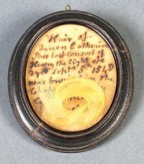
The original manor was called Wyke Manor, using the ancient spelling, and it had a very long and illustrious history. It was owned by John Nevill, 3rd Lord Latimer, involved in the Pilgrimage of Grace in 1538. Upon his death in 1543, he willed the manor to his widow Catherine Parr. Catherine later married King Henry VIII (28 June 1491 – 28 January 1547) as his sixth and last wife in July of 1543. She was 31 years old and he was 52. The marriage didn’t last long as Henry died in 1547 so Catherine outlived him. A small piece of Catherine has returned to the Manor recently as a lock of her hair came up for auction. The hair is mounted in an oval frame on ink-inscribed paper which states “Hair of Queen Catherine Parr, Last Consort of Henry, the night she died September 5th 1548 was in the Chapel of Sudeley Castle”. The current owner of the manor, Charles Hudson, paid £2,160 for the hair, in order to return it to the manor.
Catherine Parr's Hair
After Catherine died, the estate passed to Anthony Babington, who was later executed for treason after plotting to kill Queen Elizabeth I! It then passed to Sir Walter Raleigh, who was also executed.
The Hudson family have owned the Wyke manor Estate since the 1760s and the current owner is Charles Hudson and his wife, the writer Cressida Connolly. I was fascinated to learn that Cressida is an authority on Ladybird Books, which I have always rated highly.

I have recently been told that the house which is now on the Wyke Manor Estate was partially rebuilt in the 1920s in the Elizabethan style.  I am grateful to Paul, a resident of Wick, for this update.

The people of Wick that I met were absolutely lovely and pointed me in the direction of the shop at the back of the manor house. This is not like any shop I have ever seen before. It is literally a part of the stable block and there are children’s bikes scattered all over the yard. Inside the ‘shop’ a lovely young lady, who must have the best job and workplace in the world, was boxing up exquisite dried petals into pretty boxes. Along one wall is a vast array of open boxes each containing different coloured dried petals. The smell and colour and atmosphere is hypnotic. I felt as if I had walked into a fairytale. Honestly, if you get the chance you just have to go along and experience it.
Well I spent so long soaking up the atmosphere that it was getting decidedly overcast by the time I headed off to the actual confetti fields. But I rushed to get as many photos as I could before the light failed, the heavens opened and I got soaked! It was definitely worth it though. Enjoy my photos.

A timely boost to my morale

mostibaward
I am delighted and reinspired to have been nominated for the Influential Blogger Award by Obscured Dreamer. In fact Cat has done me a great favour as I have been somewhat overloaded by life recently, which has stopped me posting. I am often inspired to write and there have been many beautiful photo opportunities I would have loved to share. But I have been too overwhelmed to focus. So,” thank you Cat”, for the boost to my morale and the renewed drive to write.
Here are the guidelines for acceptance – really very straightforward.
To accept this award, the awardees must do the following:
1. Display the Award on your Blog.
2. Announce your win with a blog post and thank the Blogger who awarded you. Do not lump this award with any other award in a “basket”, “bouquet” or “collection” etc., I would rather you didn’t accept the award.
3. Present 10 deserving Bloggers with the Award.
4. Link your awardees in the post and let them know of their being awarded with a comment (or a pingback).
5. Include an embedded video of your current favorite song (YouTube has almost everything, just copy and paste the link into your WordPress editor). If a video is not possible you can embed a SoundCloud track

At the moment I am busy rehearsing for two shows and a concert to commemorate the centenary of the first world war so my choice of songs is influenced by that. On Saturday I took part in the Armed Forces Day at a nearby military museum. It was a scorching hot day in the Cotswolds and young lads from all the armed forces were turned out beautifully in full uniform. They must have been so uncomfortable. There were even some international servicemen and women there as part of the Allied Rapid Reaction Corps (ARRC). The ARRC Headquarters are nearby. There was a flypast by Spitfires and a Hurricane which was very impressive. The song we sang as part of our mini show was written in 1915 as young men were marching off to fight, leaving their sweethearts at home.

My own grandfather joined up at the age of 14 years 8 months and was sent to WW1 as a bugler. Thankfully he survived. One of the plays we are rehearsing is called Will Harvey’s War. This will be the subject of a blogpost soon as Will Harvey was a first world war poet from Gloucestershire who deserves to be better known. He wrote a poem called the Bugler

GOD dreamed a man;
Then, having firmly shut
Life like a precious metal in his fist
Withdrew, His labour done. Thus did begin
Our various divinity and sin.
For some to ploughshares did the metal twist,
And others—dreaming empires—straightway cut
Crowns for their aching foreheads. Others beat
Long nails and heavy hammers for the feet
Of their forgotten Lord. (Who dares to boast
That he is guiltless?) Others coined it: most
Did with it—simply nothing. (Here again
Who cries his innocence?) Yet doth remain
Metal unmarred, to each man more or less,
Whereof to fashion perfect loveliness.
For me, I do but bear within my hand
(For sake of him, Our Lord, so long forsaken)
A simple bugle such as may awaken
With one high morning note a drowsing man
That whereso’er within my motherland
That sound may come, ’twill echo far and wide
Like pipes of battle calling up a clan
Trumpeting men, through beauty to God’s side.

The other play we are rehearsing is called Carried on the Wind. It does not glorify war. It just shows how it affected the ordinary people in Gloucestershire.

There are many blogs that I follow regularly for their joy, wisdom and beauty. Many expand my horizons by taking me to places I will never get a chance to visit. Others introduce me to art, poetry, music, films or books that I know nothing about. In short they enrich my life. Some of them I have mentioned below.

Leaf and Twig ~ a simply beautiful blog I have been following right from the start

Campari and Sofa ~ this shared blog is just so stylish, quirky and different. I love it.

Plain Talk and Ordinary Wisdom ~ the title says it all really ~ “kitchen table stories to inspire and warm your heart” Pat writes a terrific blog

A View from my Summerhouse is Sherri Matthews’ blog and it is just a joy to read.

Easter Ellen, Overcoming to becoming ~ a gentle, sensitive and sometimes painful blog that I love

On Dragonfly Wings with Buttercup Tea ~ Becca is a prolific blogger who is so gifted. She always finds a beautiful photo to accompany her posts and poems.

Celebrating Sunshine ~ just beautiful thoughts and images that lift me up.

Source of Inspiration ~ Pat has found her place in the world and has acquired so much knowledge which in her wisdom she is gracious enough to share.

Derwent Valley Photographers ~ I love photography and I love the North East of England so this site is a pure joy.

The Inscrutable Paths of the Spirit ~ such purity of thought and expression is found in this blog, it brings peace and comfort into our troubled world.

Positive Boomer ~ it’s hard to argue with the sound advice on this blog!

Espirational ~ this blog I found recently aims to provide “a 10 minute vacation for the soul” ~ it succeeds for me

Do pop by and enjoy these inspirational, influential and just plain enjoyable Blogs!

A Saint~Me?

writing-101-june-2014-class-badge-2
There is nothing more pitiful than a defenceless child at the mercy of cruel, heartless, ignorant and selfish people. Such children are so vulnerable, easily hurt physically, traumatised mentally, and damaged emotionally.
The lucky ones can take a lifetime to recover. The unlucky ones cut short their lives, unable to live with their wretchedness.
So in response to today’s DPChallenge, If in 300 years time I were to be known as a saint for anything, it would be for being a defender of the defenceless child.

The lion and the lamb

The lion and the rabbit

A Pastoral Post

Pastoral Symphony

Kimbolton in Herefordshire

Kimbolton in Herefordshire

The English countryside has inspired poets and artists since time immemorial. Today we can add bloggers and photographers to that list. I was fortunate enough to spend a couple of days in the delightful Herefordshire village of Kimbolton this weekend and it reminded me of one of Robert Herrick’s short pastoral poems from his Hesperides (1648)

I sing of brooks, of blossoms, birds, and bowers:
April, May, of June, and July flowers.
I sing of Maypoles, Hock-carts, wassails, wakes,
Of bridegrooms, brides, and of their bridal cakes.

The Herefordshire area is famous for its orchards and beef cattle. But I discovered a wealth of superb castles and gardens too. There are miles of public footpaths, many of which I walked with my little dachshund, Dayna. One delightful walk at Croft Court led through a bluebell wood which was just magical, the ground a sea of bluebells. I stayed on a farm which grows 80 tons of apples a year, all of which goes to Bulmers, the famous cider makers.
I would love to write a poem to paint you a picture of this beautiful area and I will, but for now just enjoy some of my photos and the beautiful music.

Grandma’s Angels

P1070488

She’s 5 going on 25 with long red hair that gets tangled in the shower. She has a smiley face and the loveliest nature. She lives with her brother who’s 8. He has the same red hair but short. He’s cool with a cheeky grin and a mischievous nature. They live in a small market town in Wiltshire with mum, dad, 2 guinea pigs and a whippet-cross dog from the rescue centre.
She loves to copy her mum; her hair, her makeup, her clothes, and especially her jewellery!
She would love to go horse riding, but it costs too much, so she goes trampolining instead. I watch open mouthed as she bounces; doing front drops, swivel hips, back somersaults, straddles and turns. She is fearless.
He loves to copy his dad; playing football, tennis and golf; soaking up anything sporty. 2012 will be his best year yet, Olympics in Great Britain, what a dream! He is already collecting commemorative 50 pence pieces. He knows every design and every sport. He has collected 15 so far with 14 to go. I could order him a complete set but there’s no fun in that. It is far better to search in pockets, purses and change.
I love it when they come to stay for the weekend to give mum and dad a break. All thoughts of housework fly out of the window as our home is transformed into a tiny version of Disneyland. We do beading and baking, chalk patterns on the patio, create fairyland in the shed, tie imaginary horses to the gazebo and sail pirate ships on a gravel ocean.
He wanders off to find grandad. She sits on my knee and we chat. Tugging at my gold cross and chain she asks,
“Grandma, why do you always wear that?”
“My mummy wears pretty necklaces. She changes them all of the time. She has lots.”
I’ve heard this question before and I usually say,
“I wear it to remind me of my dad because he bought it for me a long time ago.” And that’s true, but today I will tell her the whole story.
A long time ago before your mummy and daddy met, your daddy lived by the seaside in Somerset in a fisherman’s cottage. The cottage was 200 years old and it was a wreck when he bought it. It had pine panelling all over the kitchen and lounge. When he took the panelling down he found 57 types of mould growing on the inside walls. It was very colourful mould, some of it quite pretty, but not healthy to live with, so he had to pay someone to come and treat it. The cottage roof leaked, the windows didn’t open, and the walls were damp. But bit by bit he repaired it and made it beautiful. He put on a new roof, damp-proofed the walls, sealed the floors, replaced the windows and doors, and put in a new white bathroom. He did all this quite cheaply because he searched through scrap yards for things he could use. One day he found an old church window in a scrap yard and he bought it for his bathroom. He knocked down part of the wall and put in the beautiful stained glass window. It was full of colour, rich red and blue, and it had angels on it. When the sun shone into the bathroom it glowed with a heavenly light.
Now he was happy with his cottage and he decided to invite the whole family down for the weekend to celebrate the end of the work. Grandma and Grandad went of course, and your daddy’s three sisters. They were teenagers then and they had a little mini car which they shared.
It was a perfect weekend, sunny and warm. We scrambled on the beach and hunted for bits of pink quartz washed out of the rocks by the tide. I still have them in the garden.
I had my cross and chain on then too, it wasn’t long after my dad died. I felt that when I wore it he was close to me and he would watch over me and keep me safe.
It was a long and tiring day so we all went to bed early. I took my cross and chain off and put it on the cabinet beside the bed. We slept really well then got up early to go home. I had a shower in the bathroom and I was fascinated by the coloured lights shining through the stained glass window. It was so beautiful that I said a little prayer before we left. I said thank you for my beautiful family and thank you for a lovely weekend. Then off we set for home.
On the way back home I realised that I had forgotten to pick up my cross and chain. I was a bit cross with myself for forgetting it, but I wasn’t worried because I knew it would be safe. The girls were staying for another day so I guessed they would bring it home for me when they came. There were no mobile phones in those days so I couldn’t call them!
The next day was Sunday and the girls were sharing the driving home after a lovely weekend. They had found my cross and chain and remembered to pop it on the dashboard before they set off. They were very happy driving along, listening to their music and singing. They reached a sharp bend in the road just as another driver was speeding along. He misjudged the corner and crashed right into the little mini. The car was dreadfully smashed up and my 3 precious girls were taken off to hospital in ambulances.
The policeman who came to the crash shook his head sadly thinking the girls would be badly hurt. But at the hospital they were absolutely fine, just a few bruises and a bit shocked. The girls did not want to tell me about the crash as they knew I would be really worried and upset, so they phoned their brother to come and collect them. He got into his car and drove along the same country roads that his sisters had travelled. When he reached the bend in the road he saw the mini being towed onto a breakdown lorry. He got out to watch and was shocked to see the damage to the car. Just then he noticed something glinting in the road. It was my cross and chain. He picked it up and put it in his pocket, then drove on to the hospital to pick up his sisters and bring them home.
When I saw them and heard the whole story I knew that my dad and the angels had been watching over my girls as they travelled in their car that day. They protected them from harm. That is why I always wear my cross and chain. It reminds me how blessed I am.
One day I will give my cross and chain to her, my angel.

P1100279

Creative writing from the bottom of my memory

I am quite excited today because this evening I am going to the inaugural meeting of our new Creative Writing Group. A couple of months ago I was asked to come along to an Artists Way meeting to chat about my blog and how I got it started.
I was a little daunted but very pleased to be asked as I still consider myself a learner in the blogosphere. In fact, the more I delve into it and the more wonderful bloggers I discover, the humbler I get!
But I went along and found the group to be made up of lovely, enthusiastic and creative people. All of them have a story they want to tell and they were full of stimulating questions. I tried my best to encourage a lively discussion but the evening went far too quickly. So, we agreed that what we need is a writing group. There are some well established groups in our area but they didn’t fit our bill. So we decided to start our own. There is no leader or teacher, just a group of us who will hopefully be encouraging while reading, writing and discussing each others work.

Now if any of my blogging community can give me guidelines or tips that I can pass on I would be very grateful. Perhaps you have been part of a group and found a particular session really useful, I would love to know.

Of course one of the things I had to do before meeting the group is decide what makes my blog tick. I have my lovely quote from Tom Stoppard after my header and I truly believe that. However
the essence of my blog can be expressed in a quote from The Way of the World by Nicolas Bouvier,

“I dropped this wonderful moment into the bottom of my memory, like a sheet-anchor that one day I could draw up again. The bedrock of existence is not made up of the family, or work, or what others say and think of you, but of moments like this when you are exalted by a transcendent power that is more serene than love.”

This is how and why I write, I treasure memories and moments when I felt like heaven happens. I will again reblog something I wrote right at the start when not many people were reading my blog. You have to read right to the end for the little bit of transcendent power though!!
I hope you enjoy it.


Prayer

I thought I would re blog some of my very early posts from when I started blogging. At that time I had very few readers and I think it is a shame that some of the posts I loved were not seen. Now that I have a few readers whom I really appreciate I thought I would push my luck and see if I can get you to read my earlier haiku and ramblings. Hope you enjoy them x

heavenhappens's avatarHeavenhappens

This post is inspired by the Carpe Diem Haiku prompt for today, “Prayer”

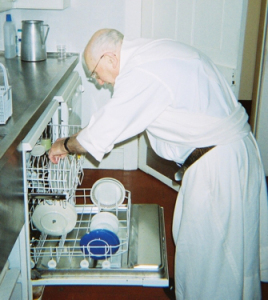
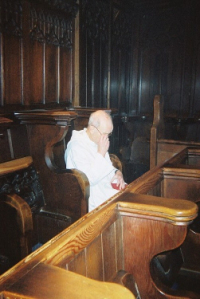
When I first retired from my work in education, I went to work as a housekeeper at Prinknash Abbey This was a labour of love and I learned a great deal about the prayerful life from the Benedictine monks who live and work there.  I learned from Fr Alphedge that every single thing you do can be a prayer if it is done with reverence and joy.

Fr Alphedge at work and prayer

Peaceful and prayerful

monks, masters of mindfulness

sacramental lives

Fr Adhelm in the chapel at prinknash

Meaningful moments

Of quiet contemplation

simple and sincere.

Incense is made at Prinknash

Alone with your thoughts

humbly open your heart, and

Let healing begin

Stained glass window from Gloucester cathedral

Drowning in despair

from the core of your being

you cry to the Lord

Peace dove made…

View original post 42 more words

St George’s Day

Fascinating information about the mysterious St George

Faith Unlocked's avatarFaith Unlocked

Today is St George’s Day!

St George is the patron saint of England (and many other places). He wasn’t English and almost certainly did not slay a dragon.

It is likely that Saint George was born to a Greek Christian noble family in Lydda in Palestine, during the late third century between about 275 AD and 285 AD. He died in the Greek city of Nicomedia in Asia Minor. His father, Gerontios, was a Greek from Cappadocia, an officer in the Roman army; and his mother, Polychronia, was a Greek native of Lydda. They were both Christians from noble families of the Anici, so their child was raised with Christian beliefs. They decided to call him Georgios (Greek), meaning “worker of the land” (i.e., farmer). At the age of fourteen, George lost his father; a few years later, George’s mother, Polychronia, died.

Then George decided to go to Nicomedia, the…

View original post 452 more words

Fireworks for Shakespeare’s 450th Birthday

shakespeare1

Tonight there will be the start of the celebrations in honour of William Shakespeare’s 450th Birthday. The celebrations will be spectacular in Stratford on Avon, his birthplace and the home of the Royal Shakespeare Theatre. Resurrecting an old tradition, there will be a massive firework display over the River Avon behind the theatre. The display starts at 10.40 so it will be a late night for me but I am hoping to get a good view from the bridge in the Bancroft Gardens. I used to walk this way to school every day when I was a teenager so it will bring back lots of memories.

In addition to traditional pyrotechnics, the special birthday display will feature an 8 metre high frame (note this is smaller than the 1830 one!) depicting Shakespeare’s face, which will light up in ‘stars’ made of fireworks. It will be based on the Droeshout engraving of Shakespeare from the First Folio, and reminiscent of Juliet’s lines about Romeo~

Take him and cut him out in little stars,
And he will make the face of heaven so fine
That all the world will be in love with night
And pay no worship to the garish sun.

If you haven’t read my blog about the 400th Birthday celebrations you can find it at this link~ http://wp.me/p2gGsd-5c

There is also a wonderful Shakespeare blog here ~ http://theshakespeareblog.com/2014/04/fireworks-for-shakespeare/