Desert

Sahara Marathon ~ ultra long distance race in the desert’.

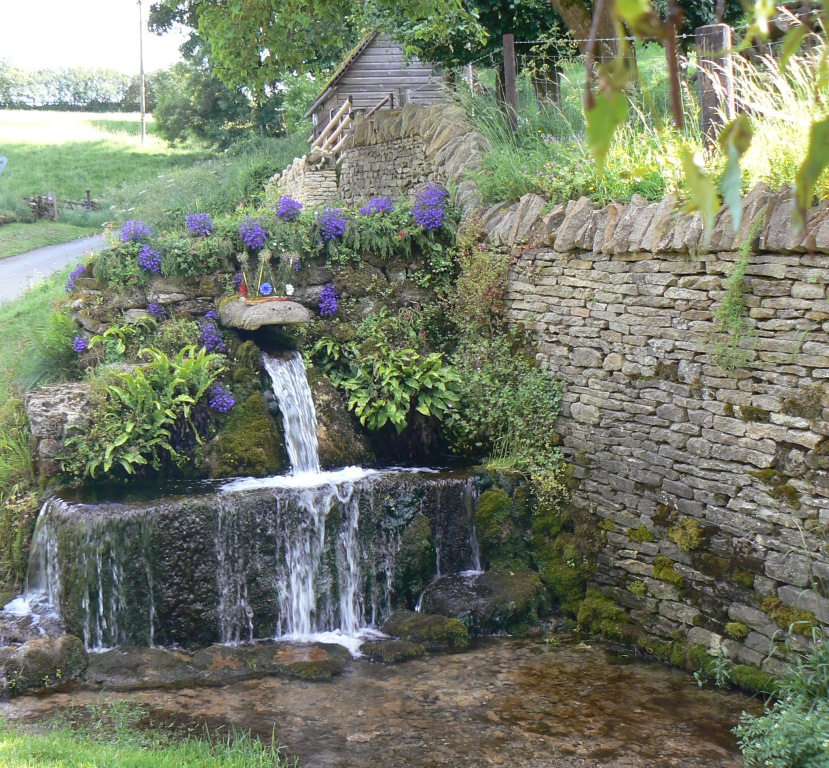
We had a great speaker at WI who fits in beautifully with our Haiku Heights prompt word for this week, Desert.

Tortuous terrain,

Melancholy Marathon,

Desert of Despair

Celia Hargrave, talked about her experience of running in The Marathon Des Sables.  No British woman had ever taken part in the race and it was advertised as “The Toughest Footrace on Earth”.  Both of these factors were a challenge to Celia so she decided to sign up!
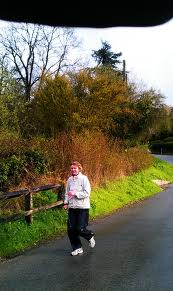
Celia running near her home

Celia is quite an amazing woman.  She is over 60, a former head teacher of a large Birmingham school, and a member of Sheepscombe WI.  Like many WI members, Celia contributes hugely to her community.  She is a magistrate, a fundraising co-ordinator for Sheepscombe Village Hall, and she and her husband open their garden for the National Garden Scheme.  Her garden is about 3 acres set in small woodland with panoramic views.  She has a variety of herbaceous and mixed borders, a rose garden, extensive vegetable plots, and wild flower areas, plantings of spring bulbs with thousands of snowdrops and hellebores, a woodland walk, 2 small ponds, a waterfall and a larger conservation pond.  There are also wooden sculptures in the garden, which is all grown on organic principles.
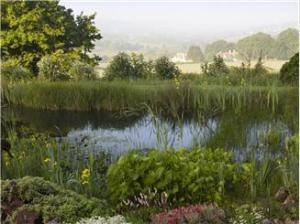
Panoramic View from Celia’s garden ~ Trench Hill

And, as if that were not enough, Celia co-ordinates a club for the elderly and housebound in her area!

Celia had run before competitively in the Stone Masters Marathon, The Chelmsley Wood 24 hour track Race, the London Marathon in 2 hours 46 minutes, London to Brighton Race and Lands End to John O’Groats so she was no novice!  Her longest distance was over 120 miles for which she was ranked sixth in the world. However the Sahara Marathon or MDS is a 6 day 243 km or 151 mile endurance race in which all competitors have to carry everything they need for their survival.  So this was to be an enormous challenge.

Celia sought medical advice and drew up a training programme which involved running every day.  She did some 50 mile races for charity and started to raise money for her challenge.  Fortunately Celia’s own WI at Sheepscombe organised her fundraising and got TV, radio and press coverage for her.  In order to adapt to running in extreme dry heat conditions, Celia started running in her local sauna!  This caused some consternation among other spa users but helped Celia get used to taking in fluids while running.

Eventually Celia took off for Casablanca in Morocco and travelled to Ouarzazate to meet the other competitors.  The majority seemed to be French that year but there were 20+ from the UK.  Other competitors came from all over the world.  They spent one wonderful night in a 5 star luxury Moorish hotel before setting off on a coach out into the desert.  After several hours they had to get off the coach and walk the rest of the way to their campsite.  Two things that impressed Celia there were the desert orchids and a woman in red high heeled shoes both of which seemed incongruous!

The campsite seemed to be in two halves: one for the competitors, which was very basic; and one for the non-competitors, which was comparatively luxurious.  Celia was sharing a ‘tent’ with 12 to 14 men and women competitors and they had very little space.  In the tent they had to store everything they had brought and carry it on their backs in a rucksack daily.  The rucksack was to be no more than 7 kilos in weight when filled.  Celia had reduced her packing to a minimum but still had to carry her map, day book, compass, medical kit, sleeping bag and food.  Each competitor was allowed 9 litres of water a day which was rationed and given out at each checkpoint along the way.  The 9 litres was for everything ~ drinking, washing clothes and self!

When at last the first day of the race proper arrived, the tent was removed at 6.30am ready to be transported to the next stopping point 15 miles away.  As the temperature can quickly reach 120°F Celia was hoping for an early start, and was not happy to be kept hanging around for hours in the heat.

The Marathon Des Sables is run in sections over 6 days, or 7 for some slower runners.  This is the equivalent of 5½marathons.  That is a speed of between 3 and 14km an hour.  Competitiors can be aged between 16 and 78 years old.

Day 1 ~ 25 km, Day 2 ~ 34km, Day 3 ~ 38km, Day 4 ~ 82km, Day 5 ~ 42km, Day 6 ~ 22km

Celia described the terrain on the first day as ‘dunettes’ and the second day as much higher dunes.  Over the course of the race she would run on sand, rock, dried river beds, oases and dunes. She remembered the wind as well as the heat; but her abiding memory was of the horizon which never seemed to get any closer, and the breathtaking vision of a huge sky where every star was visible because of the total darkness.

By the third day Celia had developed a blister which was treated with iodine in the medical tent.  This was so painful that she determined not to go back there again.  The heat and rubbing really takes its toll on the feet.  Some competitors lost nails or got infections in blisters which can put them out of the race.

Day 4 was a rest day. Then day 5 was the toughest day.  It took Celia 13 hours of non stop running/walking to cover the 50 miles of barren wilderness.  Some competitors had to run right through the night, some taking 32 hours altogether to cover the 50 miles.  Celia had the deepest admiration for these slower runners for their self discipline, determination and sheer perseverance.  Those who know reckon that, while physical fitness is really important,  mental stamina constitutes at least 50% of whether competitors finish the race or not.

By this time Celia was on a high and pleased to be coping so well.  She was way ahead of some competitors, male and female.  But on day 6 all that changed.  Instead of relying on her compass, Celia took a route that others seemed to be following.  This led her to high rocky ground and a precipice which she fell over.  Amazingly her rucksack got wedged in the rocks.  Celia became disorientated, being in pain and in shock.  She began hallucinating.  However she managed to release her bag and carried on a further 11 miles to the end of the stage.  All the time she was worried and anxious in case she could not finish.  But at last she arrived on the tarmac road which marked the last kilometre leading to the finish at the small town of Tazzarine.  Here Celia kissed everybody she met with sheer relief.  She was then taken by jeep to a mud house with a fireplace in the wall and a wellspring of hot water.  This she played in, delighting in being clean for the first time in a week.  She then had some food and was taken by coach back to a hotel for a celebratory Gala Dinner.  It turned out that Celia was 1st among the UK entrants, beating all the men as well as the women.

It was later discovered that the fork in Celia’s rucksack had stuck in her back during her fall over the precipice causing the injury which was causing her so much pain.

Celia has done two other desert events since then, one being the Trans 333, a 208 mile race which she did in 86 hours with only two lots of two hours sleep.86 hours!

She truly is inspirational.
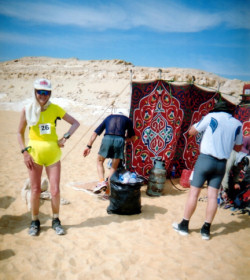
Celia at a checkpoint in the desert
Trees Haiku

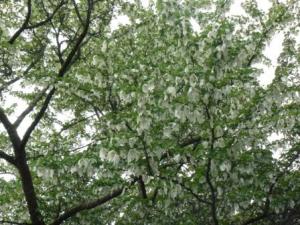
A Handkerchief tree at Minterne Gardens in Dorset

I am fascinated by trees, not only for their beauty, but for the stories they could tell.  Some trees have lived through amazing times and been part of the lives of such interesting people.  If only they could talk!

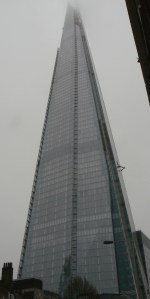
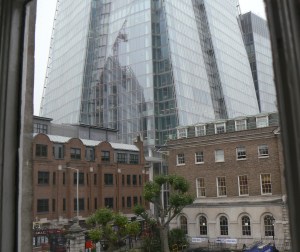
This week I went to the city with a couple of friends. We visited two wonderful museums and wandered along the streets of London where the trees are at their glorious Autumn best.  We strolled along the Embankment beside the River Thames and marvelled at the changing skyline.  I was struck by the juxtaposition of old buildings and new, especially the magnificent Shard which is so close to the old St Thomas’s.  It is a breathtaking sight and a brilliant feat of engineering.  Yet even in front of this awesome glass building my eyes were drawn to a row of trees nearby.

Consumed by the clouds

Engineered to perfection

A giant in glass

The Shard with trees in the foreground

The enormous Shard disappearing into the clouds

Sheer face of the Shard

Glass monument to mammon

Shatters the skyline

View of the Shard from St Thomas’s

One amazing tree I have seen is an ancient olive tree at the site of St Francis of Assissi’s remote hermitage, the Eremo delle Carceri on Mount Subasio.   Olive trees are the longest living trees.  Indeed in good conditions some live to a thousand years old.  This tree is one of them.  It is protected and propped up by poles.  I find it breathtaking to think that St Francis actually touched this tree, walked by the stream and slept in the cave, all of which can still be seen.  I found it very moving when I visited in 2000 and I have to admit to picking some leaves from the tree.  I have pressed them and kept them in my travel journal from Rome and Assissi.  St Francis lived a simple life and slept in the cave on a bed of stone and a pillow of wood.  Some of his followers lived there as hermits too in prayer and meditation.  The warren of caves still exists in a clearing with a stream and lots of trees.

The ancient Olive Tree that St Francis would have seen

Birds stopped to listen

As the humble hermit preached

At one with the trees.

Leaves from the Olive Tree on Mount Subasio

An early picture of St Francis of Assissi

St Francis’s cell in the cave at Mount Subasio

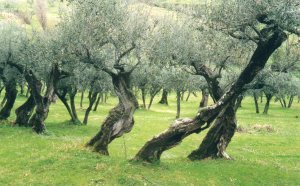
Olive Trees in Italy

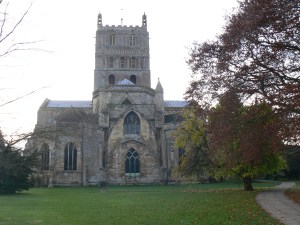
Another tree that inspires me is the Mulberry tree which was in the garden of St Thomas More’s home when he was Lord Chancellor in the time of King Henry V111.  Sir Thomas More, as he was then, bought some land in Chelsea and Kensington in 1524 in order to build his Great House.  Sadly his house is long gone, but the Mulberry tree he planted is still there.  On the site today is Allen Hall, the Seminary of the Roman Catholic Archdiocese of Westminster.  Visitors can visit the seminary by appointment and walk to the secluded walled garden where Thomas More’s Mulberry Tree still stands.  Outside and nearby is a beautiful statue of St Thomas More in a garden facing the river Thames.  In the grounds of Tewkesbury Abbey near where I live there is a Mulberry tree grown from a seed from St Thomas More’s tree.  I often visit this tree and sometimes pick the delicious fruit.

Mulberry Tree at Tewkesbury Abbey

Tewkesbury Abbey and Trees

Portrait of St Thomas More

He planted his tree

And dreamed of Utopia

In turbulent times

The Yew trees in the beautiful village of Painswick in the Cotswolds are also very interesting.  There are 99 of them in the grounds of St Mary’s Church and many of them are hundreds of years old.   They lived through the English Civil War (1642-1645).  There is evidence of Royalist cannonballs high up on the walls of the church to this day.  At times people have tried to establish more Yew Trees in the churchyard but a hundredth will never grow.  It seems as if 99 is the maximum for some reason.  There is an old story that if a hundredth tree ever grows, the devil would pull it out.  It is one of our old Cotswold mysteries!

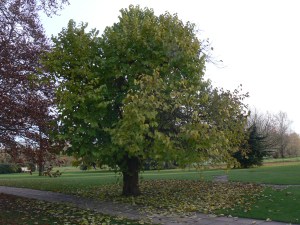
Last but by no means least, is a historic small-leaved Lime tree at Westonbirt which is unbelievably ancient.  It is reputedly 2000 years old!  It is so big that it seems as if it is many trees.  However, it is actually a clump of around 60 trees all growing from one original.  This was the result of coppicing which was a way of managing woodland for fuel established in Anglo-Saxon times.  Over hundreds of years of repeated cutting, the stump gradually spreads outwards in a ring until it reaches enormous proportions.  My photo does not do it justice!

Ancient Lime tree at Westonbirt

Remembrance Sunday

Poppy Day in UK

Remembrance Day falls on the same day as Armistice Day this year, Sunday 11th November.  This will not happen again until 2018.  Somehow as I get older it seems more special.  I listened to the BBC Radio 4 Remembrance Service at the Cenotaph in London today.  It was very moving.  There were 2 veterans of the Battle of El Alamein speaking.  They were only 21 in 1942 when the battle occurred.  It is recognised as a turning point in the war.   After this victory at El Alamein, Winston Churchill would write in “The Hinge of Fate”, his famous verdict: “Before Alamein we never had a victory. After Alamein, we never had a defeat.”

Field Marshal Montgomery and Rommel

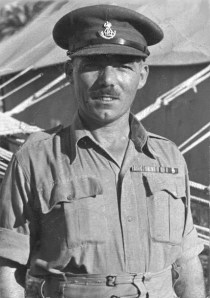
Grandad
With Durham Light Infantry in the Western Desert

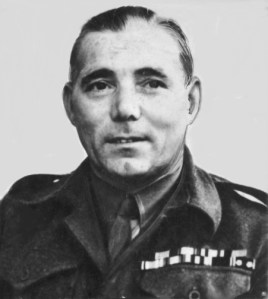
My grandfather, Frederick Charles McCluskey was in the Durham Light Infantry with the Eighth Army and fought in this battle.  He was one of the lucky ones, he survived.   But he had a tough time in this war and it left him with Malaria, which recurred throughout his life, and dreadful foot problems from his long trek through the desert.  He was part of the long march through the Western desert and told me that he wore out the soles of his shoes, then the soles of his feet on this trek.  His friends wrote an obituary in the local newspaper after he died in 1988:-

“Tyneside war hero, Major Frederick Charles McCluskey who played a leading role in a legendary desert trek to freedom, has died at the age of 88.  In June 1942, he and 200 men from The Durham Light Infantry’s 9th Battalion evaded fierce enemy fire to escape after being surrounded by a division of Rommel’s desert army at Gazzala, North Africa.  They travelled 350 gruelling miles to safety.   Major McCluskey, who lived in Newcastle fought in both world wars.”

Grandad
Major F C McCluskey

I also found out that my grandfather who was born in 1900 enlisted in the army for the First World War.  He was just 14 years 8 months when he joined as a Bugler with the Yorkshire Regiment.  He served right through the First World War.  After the war he joined the Durham Light Infantry and was with them throughout his career, ending it as a Major with a commendation for the MBE.  He only left the army in 1952 when my much loved grandmother, his wife, was dying of stomach cancer.

Grandad as a young bugler in the First World War

In 1952 he bought a general store in Newcastle where I spent many happy childhood hours sitting by the fire in the back of the shop, or helping myself to sweeties.

I am very proud of my granddad and it is lovely to remember him today and all he did for our country.

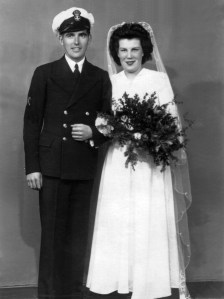
I also remember my dad who was in the Royal Navy.  My mum and he were married during the war in 1945

Mum and Dad’s Wedding 1945

Tears

Today’s haiku is inspired by carpe Diem prompt word “tears”.  It reminded me of the magnificent waterfalls in the Caucasus mountains where hundreds of prisoners lost their lives hacking a way through the mountain to build a road.  One of the waterfalls is called “Lady’s Tears”

From steep mountainside

The Lady’s tears waterfall

Weeps for past sorrows

Image

Autumn haiku

These haiku are inspired by Haiku Heights prompt ~ Conscious

Conscious commitment

Finding fulfilment

Committed to following

A creative path


Conscious of time passing

Dog days are over

Awesome autumn has arrived

Attracting the crowds

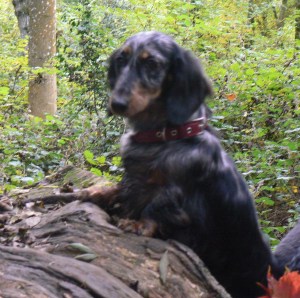
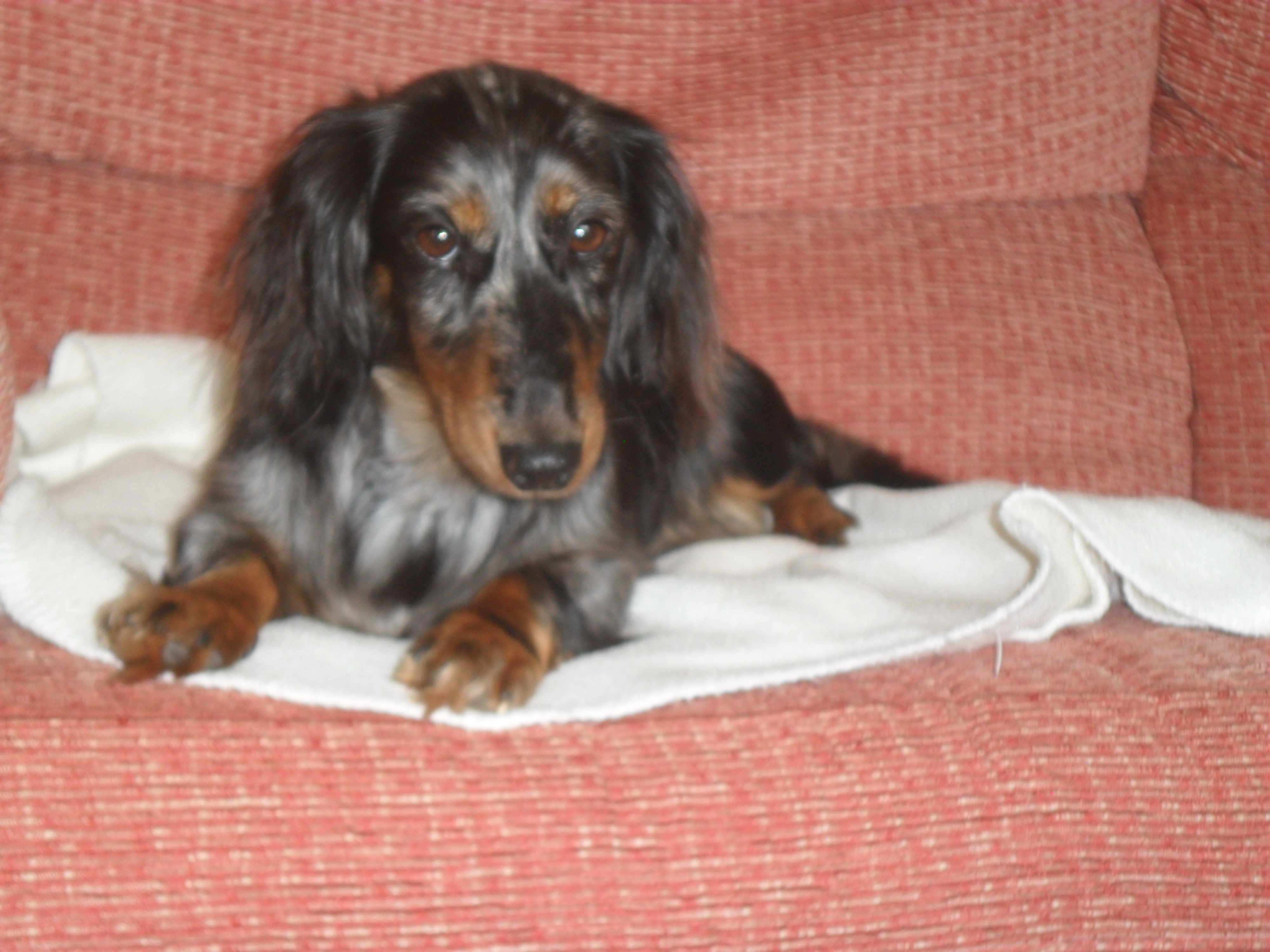
Dayna ther dachsund

Conscious of colours

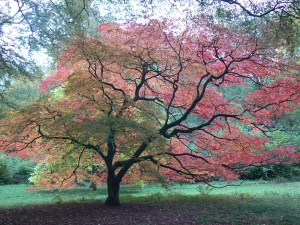
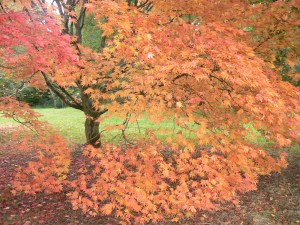
Japanese jewels

Seasonal spectacular

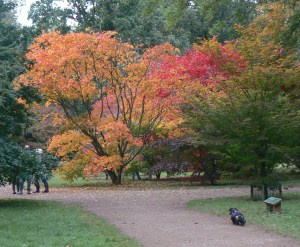
Autumnal Acers


Conscious of nature

Conscious of nature

Arboretum in autumn’s

cascading colours


Russian Odyssey Part 3 ~ October 1995

This is the day we had been waiting for; the chance to go into our partner schools.  Natalya’s husband arrived to pick me up.  He is a sculptor and artist.  He was obviously very successful ‘pre-perestroika’ as he has a car.  All the vehicles we saw in Sochi seem incredibly old, and made a dreadful noise.  They gave off clouds of smelly blue smoke.  However, the Lada got us to our destination.  The school was in the middle of a dense urban development of high-rise flats.  The area was quite run down with pot-holed roads and rusted metal lying around.

In Russia at that time, the schools were not named but numbered according to how close to the centre of the town or city they were situated.  So school number 1 would be very close to the centre.  Our school was School Number 15 as it was some way out.  Some of my colleagues had much further to travel with schools numbered in 30s and 40s.

School No. 15 was an experimental school.  The Director (Headteacher) and staff were ‘Methodists’ educationally speaking.  They followed the Leonid Zankov (1901-1977) model and were influenced by sociologist, Tarasov.  These were progressive approaches involving the integration of subjects and the development of the whole child.  My interest was stimulated by the fact that Zankov was a colleague of Lev Vygotsky who studied the relationship between teaching, learning and child development.  Vygotsky’s theory on the ‘zone of proximal development’ was to be the basis of the 4 year study I would work on with Natalya in our two schools.  As Zankov was the first to test Vygotsky’s theories in the Russian classrooms in the 1970’s and 80’s, this was very exciting for me.

The method was based on the development of the 3 aspects of a child’s psyche, Intellect, Will and Emotions.

Intellect ~ development involves not only the acquisition of knowledge, but also various kinds of cognitive activities, such as logical thinking, observation, memory, and imagination.

Will ~ is described as the ability to set goals and motivate oneself to achieve them. Will grows out of wishes and desires, and develops as the child achieves his or her goals.

Emotions ~ enable learning where children feel safe and cared for.  In the classroom situation, good teacher/pupil relationships were essential.

In the classroom Zankov’s theories required teachers to focus on:~

  • Teaching at an optimal level of difficulty
  • Emphasizing theoretical knowledge
  • Proceeding at a rapid pace
  • Developing students’ awareness of the learning process
  • The purposeful, systematic development of each student

On the surface the classes reminded me of the “Montessori” classrooms of the sixties in Britain.  However, I was soon to learn that it was far more radical than this.

Inside the school I was welcomed by a student of the ‘method’ from the university, and a lecturer who trained the student teachers in the ‘method’.  We were joined by Valentina, an incredibly dignified lady who had adapted Zankov’s theories and devised the ‘method’ for the schools in this area.

I was taken to the Director’s office to be faced with a table, beautifully set and groaning under the weight of a feast.  I ate pancakes with yoghurt and drank very strong coffee.  After this I was taken on a tour of the school.

The first stop was the medical room which reminded me of a Chinese Chemist’s!  I wasn’t far off the mark as I was greeted by a meditating acupuncturist in what looked like transparent pyjamas and bare feet.  This charming man stopped meditating as soon as I walked in and offered to fix my ‘aura’.  I accepted gratefully and was led to a bed where everyone watched as he manipulated the bones in my arms, hands, legs, and spine.  He was horrified by the tension in my neck and treated this very efficiently, just like my chiropractor at home.  He then taught me how to relax by pressing on various pressure points.  As he pressed on one in my thigh, he looked worried and said I had a problem with my liver.  This could have been due to all the vodka I had consumed to get me through our welcome meal, or it could be long term damage from my gallstone operation.  Either way I was impressed.

By this time the doctor had a queue of children waiting outside his room.  He allowed me to watch as he treated children for all manner of problems with aromatherapy, massage and chiropractic.  This was definitely alternative medicine with a capital A and would lead to court cases for assault in Britain.  But the most alarming thing was that the doctor mixed up his own medicines and even injections, which he gave to children, “to help them leave their parents and settle into school without any problem”.  I could not help but worry that these children are being sedated from the age of 2.

There were 273 children at the school aged between 2 and 10.  The school is open from 7am and most children stay until 7pm.  However, they can stay until 9pm if their parents work unusual shifts; or they can leave early if parents are at home.  The young children slept for 2 or 3 hours in the afternoon.  All of the children were given 4 meals a day of very nutritious food from a detailed menu plan.  All of this was free as the government was very concerned about the poor health of the population generally at this time, and the children particularly.

The children had a wide variety of opportunities in the school.  There was a qualified gymnast to develop the children physically.  I watched two of his lessons which reminded me of drill at the Victorian school in Blists Hill.  There was a trained musician who taught the children to listen and speak through song, dance and drama.  And there were students from the University on teaching practice working with classes.  During the day I saw an integrated curriculum that was intended to develop art, language, music, and nature study.

Some lessons were heavily teacher led.  For example The Butterfly lesson:

The teacher started by demonstrating how to “splatter paint” on a folded piece of paper.  She then allowed the children to choose their own colours and do the same.  She then demonstrated how to cut out a butterfly shape.  The children had a stencil in front of them which they drew round.  They then cut out the shape.  Finally they drew around the butterfly shape and cut it out of their painted paper.  The finished object was very professional.  All the children finished at the same time and placed their butterfly on a perfect paper flower they had made earlier.  They then sat on the carpet and the teacher talked about the life cycle of butterflies.  She showed them photographs of butterflies and told them their names.  The children then sang a song about a butterfly and acted out a little play.

During all this time the ‘nurse’ sat and watched every move the children made.  She clearly had a different role to our nursery nurses as she did not help the children with their work, or take any active part in the lesson.  I assumed that she did the setting up of materials and she may have done the clearing away.

The children all produced an attractive finished butterfly but I was alarmed to be told that these pictures would now be given to a psychologist to analyse for any mental health problems.  One butterfly was shown to me and the Head said, “you can see this child has psychological problems because of the colours she has used.”  It looked perfectly ok to me and I did wonder if they were being over-analytical.

The children did not take their artwork home until the end of the year, which runs from January to December.  Much of their work is stuck into an individual record book.  I looked through many of these books and they were all exactly the same, lots of Origami, scraps of material made into pictures, and cut out ducks, trees and animals.  There was no evidence of children expressing their own imagination or creativity

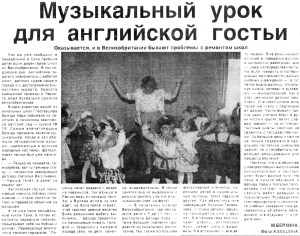
Newspaper photograph of me joining in a dance class at School number 15

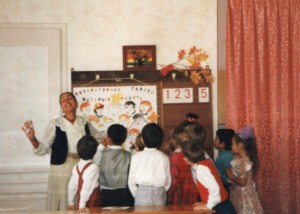
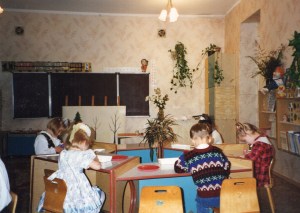
Typical classroom in the kindergarten

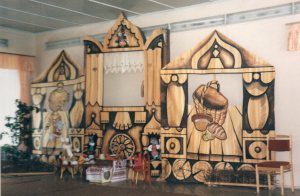
Exquisite scenery painted by Head’s husband for a play in school hall

Wonderfully painted little wooden chairs every child had one.

A wonderful interactive maths lesson

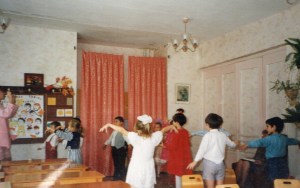
Children stop lessons to do physical exercises every so often.

Small group hard at work

Relaxed children working on a collaborative project

Russian Odyssey Part 2 ~ October 1995

Sochi sign in Russian

The departure lounge at Sheremetova 1 set the tone for our trip to Sochi.  It was packed.  There were babushkas who had been on major shopping trips and had huge parcels wrapped in brown paper and tied with string.  There were business men returning from wheeling and dealing, looking very smart and slightly sinister, carrying impenetrable briefcases.  There were older men who looked like farmers carrying crates of chickens.  All were dressed in dark colours except our group.  We stood out like sore thumbs as foreigners because of our brightly coloured clothes.

We walked to the Aeroflot (Аэрофлот—Российские авиалинии) plane blissfully unaware that this would be a flight like no other we had been on.  The plane was a very old Boeing 737, and unusual.  Getting into the plane was fine but it seemed to be 2 storeys high.  Most of the baggage was left loose below and the seating was accessed by climbing up a wooden ladder.  At the back of the plane was what can only be described as a huge wooden wardrobe.  Here people hung their coats and left their hand luggage, including the chickens.  There was free seating so we were scattered around but settled down quickly, fastening our seat belts.  A rather severe looking air stewardess came round immediately and gave everyone a plastic cup ~ empty.  The engine roared and the plane started taxiing.  Another severe and very blonde stewardess came round and filled all our plastic cups with Coca Cola.  Just then the plane lifted off steeply, the cups tipped over, and we were all soaked in said Coca Cola!  Not the ideal way to start a 4 hour journey.

When we reached the correct altitude the plane levelled out sharply causing the ‘wardrobe’ and its contents to topple forwards.  Fortunately the rear seats stopped it from falling on the passengers and the chickens survived too.

The rest of the journey was uneventful and we arrived safely at our destination, the Riviera of the Black Sea, Sochi.  It was cold and raining but the warmth of our welcome party made up for everything.  A couple of minibuses soon whisked us along the coast road to the town of Sochi.  We were all booked into single rooms on the fourth floor at the Hotel Moskva.

The rooms looked like those in Moscow, very basic, but the bathroom was much worse.  There was a sink, a toilet, a shower, and a cockroach running across the floor.  The drain for the shower was just a hole in the floor.  This hole served to allow everything emptied from the sink, which had no plug, to overflow onto the bathroom floor.  But at least the toilet flushed, but constantly!

Managing to get washed after a fashion, I dressed in my best clothes for our formal welcome dinner.  The meal consisted of two courses, firstly, raw fish from Georgia which is a local delicacy.  Unfortunately I don’t eat fish, as it brings me out in a rash,  so I waited for the main course of Chicken Kiev.  There were lots of toasts and speeches in Russian which were translated for us.  After dinner we met our hosts, the Headteachers from the schools we had been partnered with.  My host was Natalya who spoke no English.  As Head of a kindergarten, she is responsible for 270 pupils aged 2 to 10.  We got on very well from the start and soon found out a lot about each other and our families.  The evening was a great success and we went back to the hotel feeling very positive.

Our welcome meal in Sochi

I decided to skip the shower and went to bed fully covered and with a light on to keep the cockroaches at bay.

I slept quite well and woke to find that Sochi’s famous ‘Mediterranean’ climate had turned quite cold and it looked like rain.  Unfortunately, at our briefing back in Gloucestershire, we had been told it would be quite sub-tropical, so we only brought light summer clothes!  Feeling a bit despondent I went down to breakfast to find everyone else shivering too.  The raw fish was having another outing so I skipped breakfast altogether as did my friend Liz, a vegetarian.

Things looked up when we were picked up by minibuses and taken to the Education offices.  Here we met the Chief Education Officer and his Assistant CEO, Irina.  There were also some Education advisors and all of the Headteachers from our partner schools.  There were interesting and informative talks for 4 hours and we learned a great deal at this meeting about the education philosophy and practice in Sochi.  We returned to our hotel for lunch which was very lavish, and very familiar, consisting of fish soup, raw fish, and Chicken Kiev, after which we went for a guided tour of Sochi.

This was wonderful as we got to see the sea (complete with lighthouse and huge model dinosaurs), the parks, the gardens, the street market, and the Outdoor Education Centre.  This facility was most impressive.  We were shown slide shows and video of field study trips undertaken by children as young as 10.  They travel enormous distances to go hiking, mountain climbing, orienteering, and white-water rafting.  It all looked very exciting but hair-raisingly dangerous.

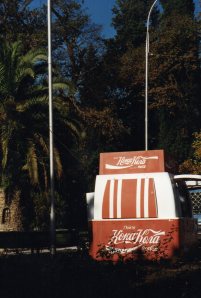
Coca Cola stalls in the park
Bus at the bus stop
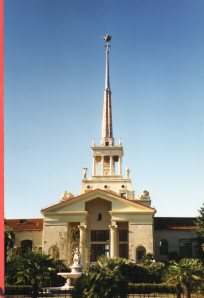
Customs building in Sochi on the Black sea
memorial in the park reflecting the fact that Sochi is a Sanatorium town or Health Spa
Museums, theatres and art gallery in Sochi ~ 1995
Our hotel Moskva, the shopping mall, statue of Lenin and a writer and the theatre in Sochi ~ 1995
Sochi’s Catholic Church
Sochi’s old buildings

Sunset over the Black sea

Haiku ~ Shroud and Home

I am following Haiku Heights’ weekly prompts in October.  Last week’s word was Home and this week’s word is Shroud.  As I was in London last week I thought I would combine the two and put my musings here with a few photographs.

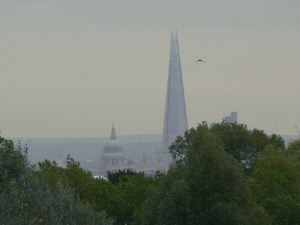
The first photos are from Hampstead Heath in London.  In the distance is the ancient St Paul’s Cathedral, once the most illustrious feature of the skyline, but now overshadowed by the Shard.

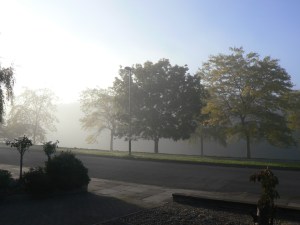
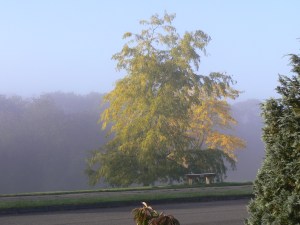
Next are some very misty views from my bedroom window at home.  When I woke up this morning the field opposite my home was shrouded in mist.  The beauty of the trees is enhanced by the Autumn colours and the mist just makes them more beautiful in my opinion.

I also squeezed in a photo of Dayna, my little Dachsund lying at my feet in the front bedroom.  She is never far away and I am happy to say she has settled into her new home beautifully.

So here are my Shroud Haiku:~

High on Hampstead Heath

Misty miles mellow the view

of a city spoiled.

The Shard overwhelming St paul’s Cathedral

St Paul’s stands subsumed

Skyline shattered by the Shard

Crystal Colossus.

The Gherkin shrouded in mist seen from Hampstead Heath

And here are my rather sombre Home Haiku:~

Hopeless the homeless

their troubles unrelenting

as winter approaches.

~

Despairing.  In debt.

Brow-beaten by bankers.

Deprived of their home.

And a much more cheerful one:~

Dayna at rest in the sun

She wallows in warmth

with the sun on her body.

It’s heaven at home

Misty view from my bedroom window today

Heaven is outside my home

Russian Odyssey ~ Part 1 ~ October 1995

My first Russian Trip ~ October 1995

Gloucestershire has always had strong links with Russia thanks to a very active Twinning Committee on the County and Borough Councils.  So after Perestroika, when Russia’s Education Departments wanted to link with those in other countries, it was natural for them to contact the GCC.  At this time I was a Headteacher in a Gloucestershire Primary school and I was very keen to travel.  I was also fascinated by different schools and their pedagogy.  I had already linked with a school in Kenya and found that experience life enhancing.  So, when the opportunity was offered to go to Moscow and link with schools in Sochi, I signed up straight away.

We had a crash course in Russian with a wonderful lady called Sheila who had previously worked at GCHQ.  She assured us that this would help us to ‘get by’ once we went into schools.  Fortunately she was coming with us and would be our guide for the first part of the visit, and she made all the travel arrangements.

So it was that I finished school on the Friday afternoon and headed straight for Heathrow for a very early flight to Moscow on the Saturday morning of half term.  After a delay the plane took off, flying over Denmark and the Baltic Sea.  I sat next to a Mongolian man who was very quiet for the whole 41/2 hour journey!

When we finally arrived in Moscow’s rather dismal airport, it was desperately cold.  Fortunately we were met by a guide with a nice warm car and we were whisked into the city.  The route between the airport and the city in 1995 was very drab with grey trees (silver birch), grey blocks of flats (hardly any private houses then), trolley buses grey with grime, and a few old Ladas.  Very few Russian people could afford cars at that time so the roads were very quiet.  Trolley buses were the main form of transport along with the fabulous Metro system.  We did see some quaint old dachas along the airport road.  Like wooden summer houses, or grand garden sheds, these all had a piece of land around them.  A left over from Soviet times, the dacha was where the Russian people could grow their own fruit and vegetables, and keep chickens to supplement their diet.

We were staying at the infamous Hotel Russia (Россия ) which was situated in what must be one of the world’s most exclusive building plots – overlooking Red Square.  The hotel was huge, built in the 60’s, indeed at the time it was the largest hotel in the world according to the Guiness Book of Records!  The hotel had 21-storeys, 3,200 rooms, 245 half suites, a post office, a health club, a nightclub, a movie theater and a barber shop as well as the 2500-seat State Central Concert Hall.  It held a maximum 6000 people!  It was almost the only hotel that foreigners were allowed to stay in then.  The hotel was still run on Soviet principals in that there was a corridor attendant (дежурная) on every floor.  These were terrifying, large ladies with no sense of humour and no social skills.  They made us feel very uncomfortable as they demanded our passports and travel papers every time we left our room.  They kept them under lock and key until we returned and always wanted to know where we were going and when we would be back.  Inside, the hotel was a strange mixture of austere, tatty corridors and very basic rooms, complete with bed bugs and whole families of cockroaches; but the dining room was totally over the top with flashing lights and lots of gold paint, like a 1950’s ballroom.  The dining room was huge but almost deserted except for a small group of very inebriated ‘businessmen’ with a ‘lady’.  The hotel was demolished in 2007 to be replaced by an entertainment complex.  Overseen by British architect, Sir Norman Foster, the new plans include a new, two thousand room hotel with apartments and secure parking.[

Our evening meal reminded me of a convent I used to go to.  There was no choice or menu, just a salad starter then rissoles with cabbage.  This was followed by tea without milk.  Afterwards we congregated in the room with the most spectacular view over Moscow’s old onion domed churches, and drank lovely Russian Champagne, which at £2 a bottle was half the price of a bottle of water!  I shared a room with a colleague and being very tired we slept really well hardly noticing the cockroaches.

We woke early to see snow falling lightly on Red Square.  I will never forget that sight.  It was truly magical.  On one side there was the Kremlin, opposite that there was the Main Universal Store (Государственный универсальный магазин), abbreviated to Gum (ГУМ), at one end there was the world famous , St Basil’s Cathedral, and at the opposite end the state historical museum.  So after a breakfast of Salami, cucumber and rye bread we set off to see as much of the city as we could in one day.

The best way to get around Moscow was, and still is, by Metro.  It is very fast and very efficient.  The stations are very deep under the city and the old escalators are incredibly long and steep, and move very quickly.  They seemed to be made of walnut and formica and were lit by gas light which emitted a dim glow and a distinctive smell, reminding me of the lighting in my childhood home.  Each station is different and they are all very beautiful.  We got on at the Kremlin station which is decorated with sculptures and frescoes depicting characters from the Bolshoi Ballets.  The ceiling was white porcelain with gold decorations; the walls, white and grey marble.  The station was absolutely spotless with no adverts, no graffiti, not a speck of litter ~ just beautiful.  A token to go anywhere on the Metro at that time cost 1000 roubles which was about 15p at that time.

We travelled around the city stopping at various stations just to see them.  One was a 1920’s art deco style.  The walls were made of Onyx and there were alcoves with fabulous standard lamps made of bronze.  Chandeliers hung from beautiful ceilings.  The Metro stations were used as air raid shelters during the war as were our own in London.  One of the Moscow stations has scenes from the war painted in huge cameos on the ceiling like modern day icons, in deep rich colours and sparkling gold.  Eventually we returned via the Bolshoi station and walked to the Kremlin.

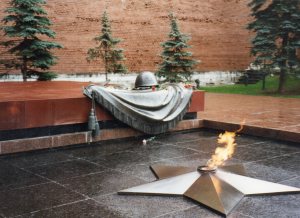
The word Kremlin means fortress and it is actually a walled city.  There are 20 watchtowers on the walls, one with a famous clock.  The Kremlin dates back to the 14th century, and the walls to the 16th; it was home to the Czars.  On the way we passed the monument to the Unknown Soldier.  This is a very beautiful and moving tribute sculpted in bronze.  There is a cloak, sword and helmet, and an everlasting flame.

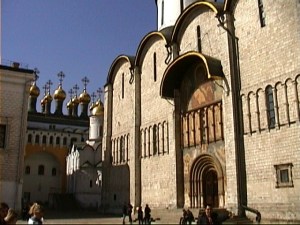
Once inside the Kremlin we were in awe.  At that time we were not allowed to take photos so those that I have of the spectacular buildings are from a later visit.  There are so many churches all topped with gold domes and icon painted walls inside and out.  We went into the Church of the Assumption, which, like most of the churches had been turned into a museum, but services were held 5 or 6 times a year.  Every inch of the walls, ceiling and pillars was covered in exquisite icons.  The old icons were painted on prepared wood using paints made from natural materials including crushed gemstones.  The finished icons were covered in olive oil to preserve it.  Unfortunately, over the centuries, the olive oil darkens and the icons get very dull.  Many have been restored.  Centuries ago, icons were the only Russian art and they all had a religious theme.

Leaving the Kremlin we walked back into Red Square and visited Lenin’s tomb.  Lenin died in 1954 and for a long time he was revered.  However the cost of keeping his body in good enough condition to be on display to the public is enormous and, while we were there, people in Moscow were questioning whether it should continue.  The body was almost luminous and we were rushed through by the guards.

After a fleeting visit to the fabulously luxurious department store that is GUM, we were rushed to Sheremetova 1 airport for our domestic flights to Sochi by the infamous Aeroflot airline!

I will write about that tomorrow.

Travel was free on buses in Moscow for Russians in 1995
Church of the Assumption in the Kremlin
Churches in the Kremlin
Statues of workers in the underground in Moscow
Metro station in Moscow 1995
Steep and fast moving gas lit escalator in Moscow underground 1995
Memorial to the Unknown Soldier behind the Kremlin. Moscow’s Brides leave their wedding bouquets there as a mark of respect
A typical dacha
Cathedral inside Kremlin
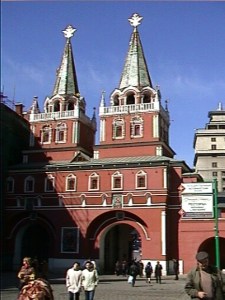
Gate at the end of Red Square
St Basil’s Cathedral
Red Square by Kremlin Walls. Lenin’s mausoleum in the background
Inside the Kremlin

Russian Odyssey Part 4 ~ The Everlasting Snows ~ October 1995

img003

When I wrote my Haiku, entitled ‘Sleep’, about a 36 hour trip on a sleeper train from Moscow to Sochi, I said that I would write more about my Russian adventures.  This is the first instalment!

It was October 1995 when my colleague, Liz and I got up very early at the Hotel Moscow in Sochi.  We were being taken on a trip to the Caucasian Mountains for the day.  We skipped breakfast and went out to meet Igor, his young daughter Anna, the 2 Natalya’s, both Headteachers, Irena, our interpreter, and another couple.  We were driven out of Sochi along the airport road in two Ladas.  We followed the Black Sea coastline until we reached the ‘new’ airport which was being built by construction workers from Yugoslavia, as it was then.  Apparently they never have enough money for materials so the job is taking years to complete.  However, what they have built looked very modern, even futuristic, and very impressive.

At this point we turned inland towards the mountains.  We could not go straight on as this was the road to Georgia and there were still Russian tanks along the border to stop refugees from the Abkhazia/Georgia conflict from coming into Russia.

From here on, the journey took two or three hours, passing some of the most spectacular scenery I have ever seen.  It reminded me of the best of the Pyrenees with shades of Canada.  The colours of the ancient forests of broadleaf trees were indescribably beautiful: Reds, yellows, oranges and all shades of green glinted in the glorious early morning sunshine.  Above these trees were the alpine forests of evergreen trees, and beyond those, the everlasting snows.  This is the home of the Russian bear, the mountain cat, the black Ousel, the wolf and much more.

All the time we were driving along the course of the ‘wild river’, as its name translates.  This river is icy cold, deep and treacherous, coming straight from the snow-capped mountains.  I was told that there are 1 metre long red fish (presumably salmon) in this river.  The road got steeper, and narrower, and more winding as it climbed higher into the mountains.  There were many interesting stops; the Men’s Tears Waterfall, the Ladies’ Tears Waterfall, the ancient cave where Neolithic tools have been found, the memorial to the Red Army soldiers from Krasnapolyana who were butchered and thrown into the ravine in 1927 during the civil war, to name just a few.  The road was so dangerous that we could not get out and take many photographs unfortunately.

Eventually we arrived at the village of Krasnapolyana where Igor was born.  It was like going back to medieval times in England.  There were very few cars, and ours had to drive dead slow to avoid the pigs, hens, cows and dogs wandering at will through the main (and only) street of the village.  There were very few people around but one or two slowly plodded by.  The pace of life in this village is so slow that it seems as if at some point time stopped, stood still, and then started to go slowly backwards.  All around there were little Hansel and Gretel cottages with tiny barns packed to the rafters with the harvest produce.  Not a shop or  a pub to be seen ~ just little old people living on whatever they could grow or rear, in little houses with little gardens.

We were told that the air and water is so pure here that people have been known to live to 130 or even 140 years old.  Some years ago the world’s top biologists got together to stop a bid to hold the winter Olympics in the area.  They considered Krasnapolyana to have the purest and cleanest environment in the whole world.  I can believe it and I am so thrilled that I got to see it in this unspoilt state.  It looked and smelled like Paradise to me.

At last we drove the last few bumpy metres through the forest to a clearing by the river.  Here we stooped and got out of the cars.  The sun was very hot by now and the air was soft, warm, and full of sweet perfume.  It was explained to me that much of the greenery growing in the forest could be used for herbal remedies.  Every bit of ‘grass’ I picked seemed to have an exotic smell and curative properties according to Natalya.  As Liz and I wandered round in raptures at the scenery, the women in our group set about laying out a picnic area.

They emptied the two Ladas and laid out blankets, mattresses, sheets of cardboard, dishes, bowls, cups and saucepans.  Then, out came flasks of tea and coffee, bottles of Russian Vodka and an amazing array of green salad, huge tomatoes, freshly made Georgian Lava bread and homemade cheese.  Meanwhile the men returned from the forest with twigs, sticks and small branches.  They set about building a fire with great precision.  Apparently building a fire for cooking food is an exact science, and Russian men take great pride in it.  Once the fire was lit, it was fussed over like a new baby until it was ready to put the meat over.  Igor skewered three whole chickens which had travelled with us in a huge pan marinating in a batter flavoured with herbs and spices.  The men collected water from the river and splashed the fire and the chickens regularly.  They told me that this helps stop the chicken’s skin from burning and keeps it moist as it cooks right through.  The smell coming from this outdoor barbecue was mouth-watering and I couldn’t wait to eat the food.  Liz, being vegetarian, had been horrified by the whole process, but was glad to see a vegetarian selection cooking on a skewer at the edge of the fire.

As the men cooked, animals wandered by to take a look: a family of wild pigs complete with babies, cows of all sizes and shades, dogs and butterflies.  It really was quite primitive and biblical and I was totally relaxed just watching and anticipating.  When we did sit down on the ground to eat, the meal was superb.  Every sense was alive with the sight, the feel, the smell and the taste of the food was complemented by the sounds of the fire spitting and the river rushing by.  It was an amazing experience.  At the end of the meal we wandered round with 10 year old Anna, writing our names on stones with stones, and drawing the animals we could see, rather as Neolithic man must have done in those caves we had seen.  Finishing up, we cleared everything away and set off again to go further along the mountain track.

Liz and I were told that we were going to touch the everlasting snows.   I had a dreadful feeling that we were going up the mountain on horseback.  But then to our amazement we saw an old ski lift!  Before we had time to panic we were sitting on this thing which climbed as far as the eye could see up into the snow-capped mountains.

I was not in the slightest bit bothered by it.  I thought this totally untypical relaxed state might have been due to the environment, but Liz reckoned it was due to all the vodkas I had consumed at lunchtime!  Either way I loved the splendid views from the top of the ski lift.

After this we set off on the homeward journey.  We took detours to give messages to grandmothers, to buy curative honey from the bee farm, to drink coffee, and to see the hydro-electric station and reservoir that supplies these remote and fortunate people with their power.  They seem to have everything they need in abundance and all naturally produced.  It was a most unusual, thought provoking, pleasurable, and satisfying day.  I was very sad to leave Krasnapolyana.

The views on the way down the mountain were even more spectacular than on the way up.  The setting sun gave the already beautifully coloured autumn leaves a shimmering golden glow.  The only hiccup occurred when I dropped my jar of medicinal honey from this wonderful place.  The beekeeper had gone to so much trouble to find me a small jar and filled it for me to take home.  But, it smashed to bits right outside our hotel.  It seemed almost as if I was not supposed to take anything away from Krasnapolyana.

I have been back to Krasnapolyana several times since then and it has changed out of all recognition.  There are new roads, helicopter pads, tourist hotels, new ski lifts and lots of palatial new houses.  Mr Putin has a beautiful summer home there and skis regularly on the mountain.  And, I am sad to say that the 2014 Winter Olympics will be held in Krasnapolyana, which will bring masses of people and vehicles to this fragile but still beautiful area.  I fear that the environment will be ruined.  But I feel privileged to have seen it when it was still in pristine condition.

Battlefield ~ Haiku

Todays Haiku Heights word is Battlefield.  This stirred up lots of poems in my head ~

My father in law was in the Arctic Convoys.  He served on the destroyer HMS Liverpool guarding merchant navy vessels taking supplies to the beleaguered Russians via Murmansk.  His ship was torpedoed twice in the Mediterranean but he survived the war.

Foes in the fjords

Death lurks in depth for Allied

Atlantic convoys.

My uncle Robert fought and died in Burma as part of the “forgotten army”.  Because they had no supplies and no radios they didn’t even know that the war was over so kept on fighting.  Uncle Robert was killed after the official end of the war so his widow did not get a war pension!

Forgotten fighters

in the jungles of Burma

fought and died in vain.

Of course people at home in the UK fought their own battles and lived through countless air raids.  The things they feared most were the doodle bugs which made a dreadful whining noise overhead.  But the most worrying time was when the whining stopped, as that meant the bombs were falling! 

Air raid warning as

Doodle Bugs whine overhead.

Silence brings despair.

Many young children were evacuated from cities to relative safety in the countryside which brought its own terrors.

Evacuated!

Human fish out of water

blitzed from city homes.

Sleep ~ Haiku

Today’s post is inspired by September challenge on haiku heights.  The word today is SLEEP and it reminded me of a wonderful journey I took by train from Moscow to Sochi on the Black Sea coast.  I will write a series of blogs about my many visits to Russia and the amazing experiences I had there.  But for now I can say that 36 hours on a Russian sleeper train is an experience I will never forget for many reasons!

Night train to Sochi

A cultural odyssey

Vast Russia unfolds

The entrance to Sochi, town name in Russian

Island and Lights haiku

Oops I missed a day yesterday in the haiku Heights challenge as I had a dreadful migraine and could not face the computer.  However all well today so am sneaking both in together!

Island Haiku

In Ladoga Sea

Russia’s rejected lived, on

Old Valaam Island

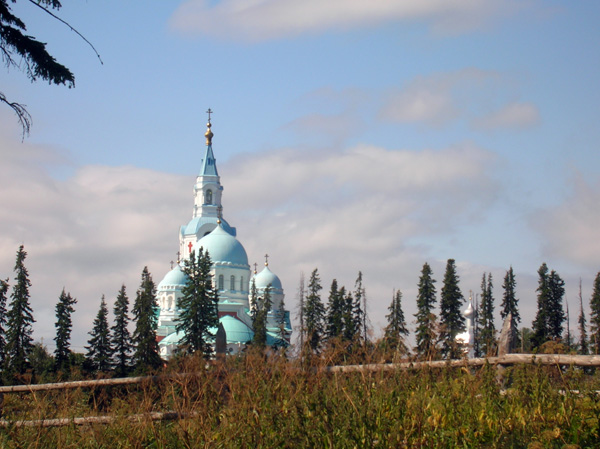
Valaam Monastery

Blind residents on the island

The new Valaam Monastery

Across Lake Ladoga

I visited Russian Karelia and Finland in 2001 on a tour of Monasteries and Orthodox Churches when I was studying Icons.  It was a totally wonderul trip and I saw some magnificent sights.  We stayed at the new Valaam monastery where there is a brilliant iconographer.  I learned a lot from him.  We also visited the Old Valaam Monastery which is on an island in lake Ladoga.  In 2001 the island was a sad and menacing place.  The monastery and cathedral were badly damage; with lots of deliberate damage from its troubled past and natural damage from the severe weather.  In times past Russia’s disabled soldiers and rejected people, many suffering awful physical and mental problems were sent to this island.  They were virtually abandoned there, isolated from the rest of the world and had to fend for themselves as best they could.   They had no love for the buildings or the faith of the few monks left there and lived in abject poverty and squalor.

I am thrilled to say that the monastic community is now thriving and the buildings are restored.  The website http://valaam.ru is just wonderful and will tell you all about the history of this special ancient place.  There is also a wonderful picture gallery so do look at it if you have time.

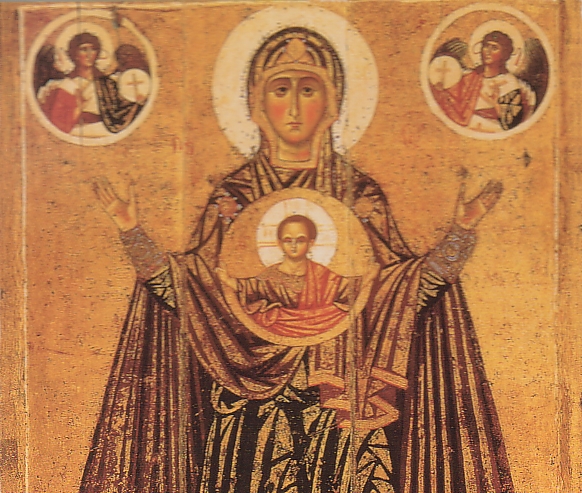
As I mentioned I am very interested in Icons and I loved to travel and take photographs or collect pictures of old icons.  My favourites are the Marian or Theotokos (Bearer of God) ones, and I have a collection from all over the world.  It fascinates me that every culture has their own take on the Mother of God and I have black ones, Chinese ones, and even an Indian squaw one from a reservation in NW Canada.  There seems to be a deep need in every culture to revere a mother figure so that is what my next Haiku reflects:~

Lights haiku

She lights up my life

Motherhood epitomised,

My icon, my rock.

Haiku ~ Revelation

Olympic revelation,

Inspiring and excelling,

Heroic athletes.

The Olympic pennant we made at WI to present to an Olympic AthleteCheltenham_coat_of_arms

Benhall Women’s Institute was formed in October 2009 on the outskirts of Cheltenham Spa in the Cotswolds.

Our Olympic Pennant displays 5 cameos representing local features:

  •  Pittville Pump Room ~ a Regency Spa building officially opened in 1830
  •  Cheltenham Gold Cup, which is a prestigious award presented annually at the National Hunt Race meeting at Cheltenham racecourse
  •  The Devil’s Chimney at Leckhampton ~ a rocky pinnacle which is a prominent local landmark on the Cotswold Way
  •  The “Doughnut”, an iconic building in Benhall, home of GCHQ ~ the Government Communications Headquarters and part of our WI logo
  •  The Olympic Torch is at the centre of our pennant.  The slim UK 2012 design is very distinctive.  It will be coming through Cheltenham on its way from lands End to London on Wednesday 23rd May 2012.

The pennant’s background depicts the honey colour of Cotswold stone and is bound with the Olympic colours of blue, black, red, yellow and green.

On the back of the pennant is this message:~

“The members of Benhall WI would like to congratulate you for participating in the 2012 Olympics.  We hope you enjoy your visit to London 2012.  We present this pennant as a souvenir”.

The pennant was designed and created by a group of Benhall WI members

Haiku inspired by September Challenge at Haiku Heights.


The Spirit of Our School

Rest not! Life is sweeping by; go and dare before you die. Something mighty and sublime, leave behind to conquer time. — Goethe

St Thomas More School was a huge part of my life.  In the early 1970’s I watched the new school building rise in the middle of an open field that had once been farmland and an orchard.  There was an ancient hedgerow all around the site and just one magnificent old oak tree in what would be the playing field.  When it was opened in 1975, I was having my third child so was not available for teaching.  But, as I drove past the school every day, I vowed that one day I would work there.

I got my wish in 1984 when my youngest child was ready to start school.  I was offered a job and jumped at the chance.   The next decade was a time of great blessing as I worked in virtually every class, teaching all age groups, then became deputy Head.  In 1994 the original Headteacher was due to retire and, to my surprise, I was offered his job.  He had been such an inspirational Head that the school was a joy to work in.  Taking on his role, I tried to emulate him while making my own mark and bringing my own vision for the school into being.

Due mainly to the quality of the staff and their outstanding teamwork, the school became a strong and successful community, ‘an oasis of excellence’, appreciated by staff, pupils and parents alike.

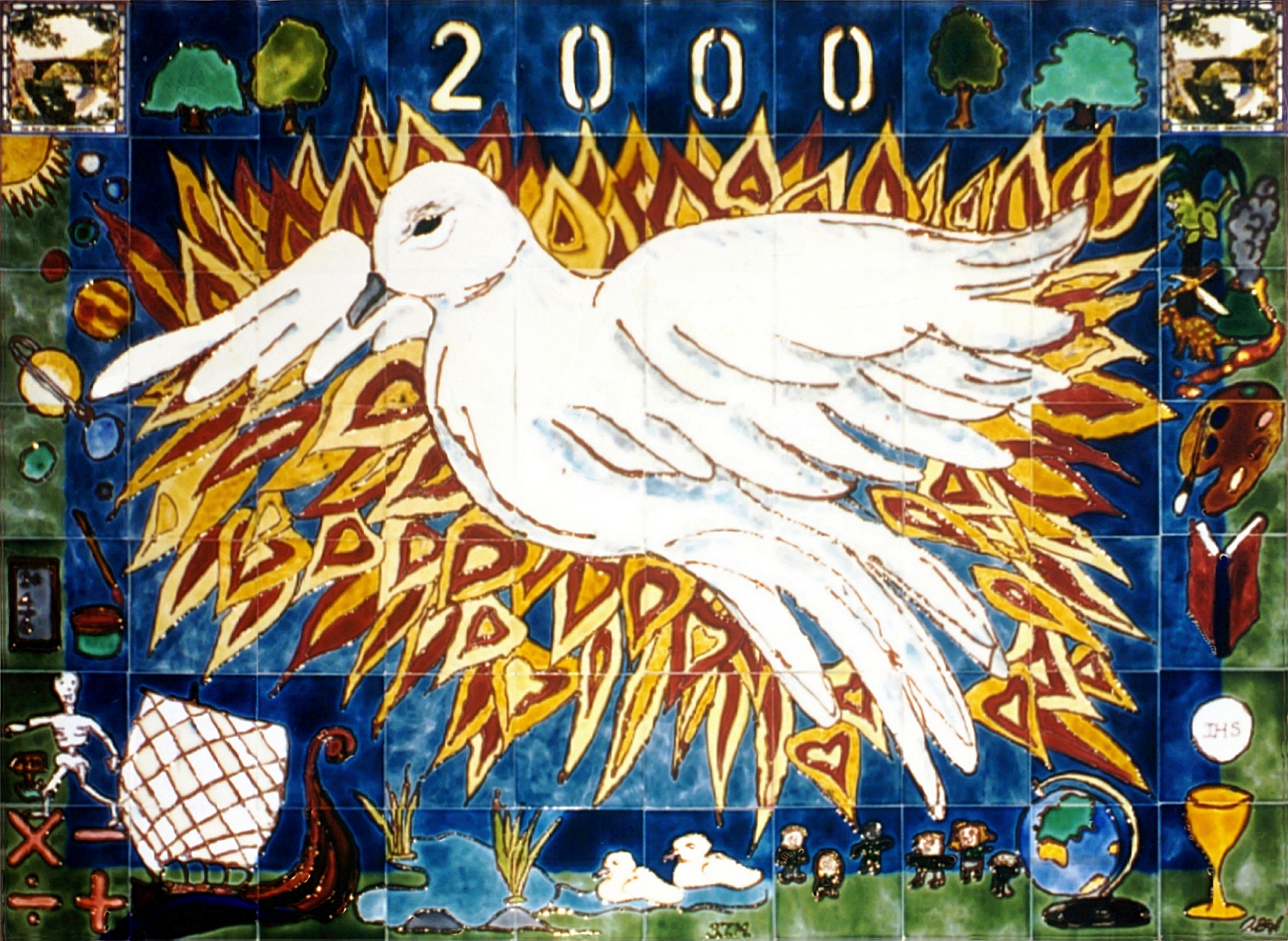
In 1999, as the new millennium approached, the staff wanted to mark the year 2000 with a special feature.  We wanted the whole school community to be involved in creating something totally unique and meaningful.  We came up with the idea of making a large tile frieze.  Each year group was asked to brainstorm their favourite lessons, subjects, or topics, and represent their ideas on paper.

Reception class, the youngest children were just 4 or 5 years old and had only just started school.  They had their photographs taken in their shiny new uniforms, so that was their contribution.

The Year 1 class had helped to build a pond and were raising ducklings which they had hatched from eggs in an incubator, so they drew pictures of that.  I have a wonderful memory of the day the ducklings hatched out ~ the local policeman had called up to the school on a social visit and he watched as the first duckling struggled to crack open the shell.  When it finally succeeded and out popped this beautiful and perfect little bundle of yellow feathers, he was overwhelmed by emotion and had tears in his eyes.

In Year 2 the 7 year olds made their first Holy Communion as it was a Catholic school so they drew a chalice and host.  Being the most significant event in the year, that was their contribution.

Year 3 was the first year of juniors and the children enjoyed learning about Vikings and the Human Body, so they drew lovely longboats and skeletons.

In Year 4 things got much more subject focussed so Maths was represented by a calculator and mathematical symbols.

In Year 5, Music, Dance and Art were the main features, so a pot of paint and a brush was drawn.  Science too was represented by the planets.

By Year 6 the children were getting ready to move on to secondary school.  In order to give them a taste of independence and adventure, it was our tradition to take the class away to Shropshire for a week to stay in a Youth Hostel.  Here, in the Ironbridge Gorge, birthplace of the Industrial Revolution, we had a wonderful time.  We visited the Iron Museum, The Jackfield Tile Museum, Blist’s Hill Reconstructed Village, River Severn Museum and of course the first Iron Bridge ever built.  We also had amazing night hikes, midnight feasts and parties.  Altogether it was an incredible opportunity for fun and learning.  So naturally the Ironbridge at Coalbrookdale was the emblem of Year 6.

The staff gathered all these pictures and images together and chose the ones that would be painted on to the tiles.  The Year 5 teacher, ABW, a wonderfully creative artist and teacher, took on the challenge of putting all the ideas together and creating a design on tracing paper which could be transferred onto numbered ‘green’ tiles.  It was agreed that we would go to Jackfield Tile Museum to create the finished work.

A representative group of staff, parents and children spent a weekend at the Youth Hostel and were each given a small area of the tile frieze to paint.  ABW had done a magnificent job scaling all the children’s artwork up or down so that the frieze would reflect the life of the school.  It was agreed that the year 2000 would go at the top, as well as the 4 trees, oak, ash, poplar and beech, which were the school emblem.  In the top corners would be tiles depicting the Ironbridge itself. The children’s artwork would go around the edge, and at the centre would be the Holy Spirit in the form of a dove surrounded by flames.

We painted the tiles in coloured glaze.  I will never forget the atmosphere in that studio at Jackfield as we worked on the frieze.  There was a stillness and peace in the room which was truly sacramental.  While we worked, the Spirit moved in that place and heaven happened.

When we finished, the tiles were left at the Jackfield tile Museum to be fired.  A couple of weeks later they were collected and set into a frame made by the reception class teacher’s husband.

Bishop Mervyn Alexander of Clifton RIP came in the year 2000 to celebrate the school’s 25th anniversary and he blessed the tile frieze.

Although most of the staff who worked at the school have retired or moved on now, the frieze is still there in the school hall.  And with it is a little piece of all of us who made it.

The power of powerlessness

One of my favourite blogs is “writingyourdestiny.com” and a phrase struck me in one of her posts, “I’m finding that even within chaos of a big move, we can create a sacred space by our attitude”.

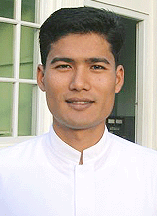
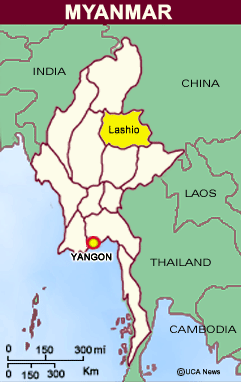
This got me thinking and remembering one of the most significant and memorable meetings I have ever had.  It was with a young catholic priest called Tino from Lashio in Myanmar (Burma).

I met Tino while he visited the UK in 2010.  He was staying with my friends C&D.  At the time Burma was still in turmoil.  The 2010 elections were considered neither free nor fair as the people were too afraid to vote for any of the opposition parties, and the popular choice, Aung Sang Sui Kyi, had been sidelined.  The majority of people in Burma were living in abject poverty with few mod cons, and even the basics were difficult to get.

Tino himself grew up in poverty, repressed by the state, and trying to live his faith with all the odds stacked against him.  He lived 36 miles from the nearest Mass centre and would often walk for hours to get there.  As a child he had sometimes been carried there on the shoulders of the local priest who is now the Bishop of Lashio, Philip Lasap Za Hawng D.D.

Tino depended on C&D who sponsored him, for long term practical, financial and emotional support and along with aid from the church, for his continuing education and training to become a Priest.

When I was in the garden of their home I was overwhelmed by the aura of peace, contentment and holiness that Tino exudes.  He has the gentlest countenance I have ever seen on a man, yet strong, unafraid and self-assured; filled with compassion and love.

Tino was feeling unwell that day due to the unfamiliar and rich food he had been eating, but he showed no sign of irritation with visitors.  He just made himself quietly available to bring the love of God and his own peace to all who came near.

It was a wonderful experience and a great privilege to meet such an inspirational man.  Who would have thought that in the last few months things have changed so much in Burma.  Aung Sang Sui Kyi is now a free woman.  She and her party won a landslide vistory in the April 2012 elections.  She was able to travel to Oxford to be reunited with her family, friends and colleagues.  Tino is able to continue his studies in Rome.  And I am able to write this post knowing that Burma has just ended censorship of the press:

 http://www.guardian.co.uk/world/2012/aug/20/burma-ends-advance-press-censorship

Tino and Aung Sang Sui Kyi have a serenity common to many Burmese which seems to come from a place deep within.  They have the ability to keep a still heart and a quiet mind regardless of what goes on around them.  It is impressive and reminds me of Meister Eckhart‘s words:

“The most powerful prayer, one well nigh omnipotent, and the worthiest work of all is the outcome of a quiet mind.  To the quiet mind all things are possible.  A quiet mind is one which nothing weighs on, nothing worries…”


Getting to know Dayna

My little Dachsund, Dayna, is settling in quite well after a few minor hiccups!  As soon as I picked her up from her previous home last Thursday, I popped into the Pets At Home Store.  There I rashly bought 3 very large bags of a good quality dog food, one chicken, one beef and one vegetable variety, which she flatly refuses to eat.  I also bought a canvas cage for her to sleep in ~ which she absolutely refuses to get into.  I bought a lovely red extending lead to match her very sparkly red collar, which she chewed through during her first walk.

My wonderful dog-loving daughter in Vermont had sent me 3 books packed full of guidance on training your dog:

How to Raise the Perfect Dog by Cesar Millan

How to be your dogs Best Friend by The Monks of New Skete

Dog Stories ~ Everyman Pocket Classics.

I found these books insightful and very helpful, but obviously Dayna has previously read one called How to Get your Owner to Do Whatever You Want, so she wins hands down.  One week and three leads later we have got to know each other a little better and Dayna has got me trained.

Dayna loves pouches of lamb and rice with vegetables or tins of expensive dog food ~ not dry food ~ 3 large bags of which will now be donated to the local animal rescue centre.

Dayna will walk for miles very happily with a short chain metal lead.  She has no interest in being on a long extension but prefers to be within a couple of inches of my feet ~ preferably between them so I am in danger of tripping.

Dayna has no intention of ever sleeping in a cage, however sofly padded or confortably den-like, whatever the Monks of New Skete say!  She prefers to sleep within licking distance of my foot in a soft bed with a fluffy cushion.

Today has been wonderful for both of us.  She has been with me for every minute.  First, we went back to the Pets at Home store and bought a supply of the food Dayna loves;  We drove to Pershore for the Plum Festival and sat outside a cafe in the sun; We took Gerry to the dialysis centre and went for a walk; We cut all the Lavender bushes and bundled up the fabulous smelling lavender to hang up and dry, then went for another long walk;  Lastly we drove back to the dialysis centre, where Dayna scrutinised every man who came out as she waited for the one she has designated the ‘leader of our pack’.

How can something so tiny have so much control?  I don’t know but she gives me everything I wanted from a dog:

Loyalty, trust, companionship, healthy walks, fun, and bucket-loads of love.  I think she is worth her weight in gold.


Crocodile Water Spout

I mentioned the crocodile water spout in my last blog but forgot to attach my photos so they are below.  I love the fact that a respected cotswold stone builder from the nearby village of Hazleton built this feature in the 19th Century.  Presumably some local landowner paid for it.  The spring water has been gushing out of the crocodile’s mouth ever since.  Some days, like yesterday, after lots of heavy rain, it is a truly spectacular sight.

Yesterday, as I took photos of the crocodile from every angle, a  young boy was walking with his father to St Oswald’s Church, which is set on the hill right above the crocodile.  He is clearly used to jumping the stream to save walking all the way along the road.  I don’t know whether it was his desire to show off or his amazement at seeing a ‘mature’ lady photographing water coming out of a spring, but whatever distracted him he landed right in the fast flowing water.  I had to smile as he walked up the hill to church with soaking wet shoes and very soggy trouser bottoms!

I wish I could capture the sound of the pure rushing water for you but my photos will have to do.  I marvel at the fact that nature produces a constant supply of fresh water for us here.  Would that other parts of the world were so lucky.