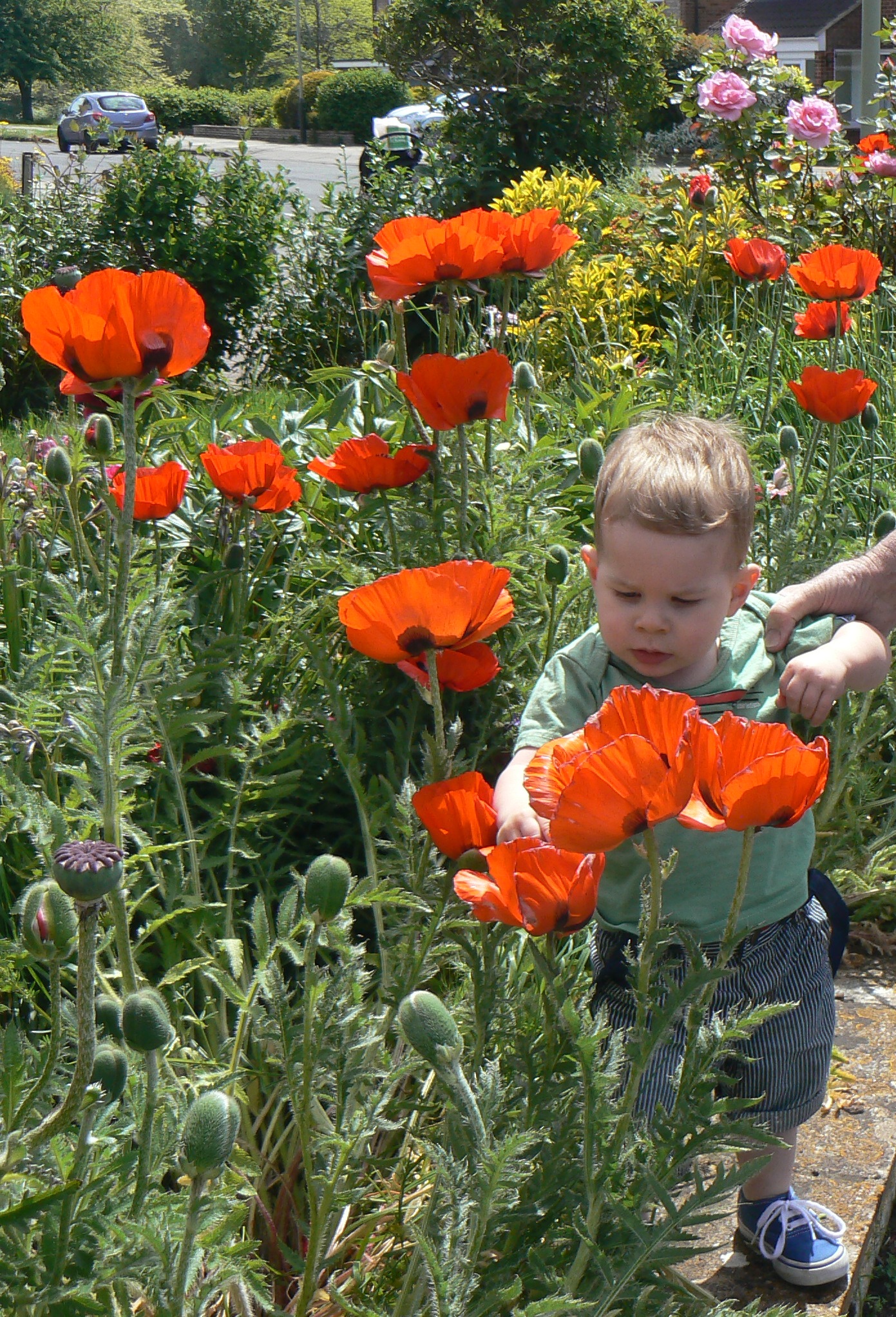
Symmetry

Weekly Photo Challenge Symmetry

Happy Valentine Day

Happy Valentine Day

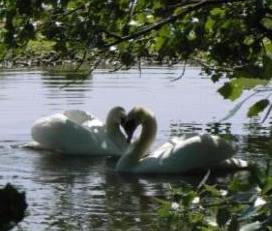
As I am posting this on valentine’s day I decided to use a photo I took in Dorset.  I was at the Abbotsbury Swannery on Chesil Beach and it was a wonderful experience.  The photo is not brilliant but it captures a beautiful moment shared with two swans that have mated for life.  Ahh x x x

I’m also quite partial to a few other photos taken a while ago showing symmetry of sorts

Scale

Fascinated by the photos on the Weekly Photo Challenge, I thought I would join in this week.  The prompt is ‘scale’ and I just had to post a photo of scale model of a hare.

In recent years there has been a spate of large scale ceramic or stone objects appearing in towns and cities of the UK. Having mentioned it to my daughter last night I know that they have been seen in the USA too. The first time I came across it was when my grandchildren, Ben and Rosie went to London and were photographed alongside large colourful elephants. Wallace and Gromit were in Bristol recently too.
Next I heard of a Gorilla festival in Torbay and Exeter. There was also a festival of decorated horses in Cheltenham in honour of the races. Then it was 5 foot tall hares in Cirencester.
Why hares you might wonder?
Well Cirencester was a very important place in Roman times. It was called Corinium and had very good road links to the rest of the UK, such as Ermin Way and the Fosse Way. In 1971 during an archeological dig in Beeches Road near to the River Churn, a Roman mosaic was discovered depicting a hare. The original is now on show in the Corinium Museum.  Hence the theme of hares for the festival. There were about 50 hares around the town. Most of them were 5 foot tall and decorated by local people including schoolchildren, members of the public, celebrities and artists. All of the large hares were named to reflect their sponsors.  One of the most beautiful hares, named Tess, was on display in the Corinium.

Here are some of the others for you to enjoy ~

Blenheim Palace

P1100963

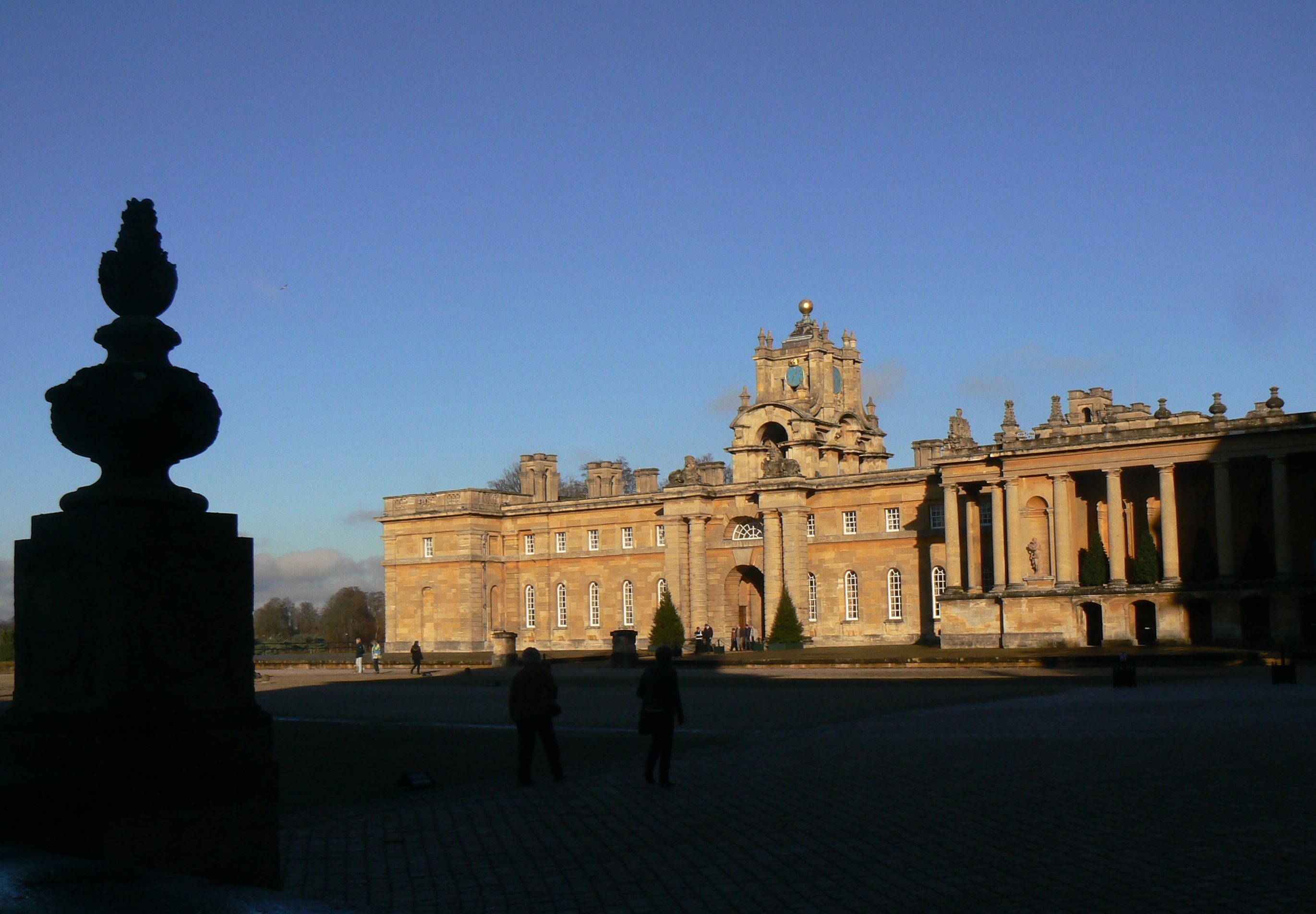
It wasn’t an auspicious start when we met the coach to travel to Woodstock on 27th November 2014.  It was a misty morning, dismal and damp with drizzle.  However as always the mood on the coach was sunny and light hearted; WI ladies are such good company.  We were heading off to Blenheim Palace in Oxfordshire to see the house decorated in “Glitter and Gold” for Christmas.  On the way we travelled through the lovely village of Bladon where most of the Spencer Churchill’s are buried at St Martin’s Church.

Blenheim palace is a Baroque masterpiece designed by Nicholas Hawksmoor and Sir John Vanbrugh, which took 17 years to complete.  On our tour we were told that the house was so perfect that it has never been extended or redesigned.  It was begun in 1704 thanks to Queen Anne who had just come to the throne.  John Churchill had been given the title, Duke of Marlborough by the previous monarch, William of Orange.  It was a particularly turbulent time in Europe and the Duke was recognised by most as a man of courage, stamina and will-power, as well as a brilliant military man.  He was leading the allied forces in Europe when there was a bloody and decisive battle at Blindheim, in Bavaria.  On August 13 1704, Marlborough and his men held back King Louis XIV’s troops and saved Vienna from a French attack.  This changed the course of history in Europe, protecting British interests.  The Queen was so pleased that she granted Marlborough the Manor and Honour of Woodstock and acres of gorgeous countryside as well as the promise of money to build a house as a fitting monument to his great victory.  The name Blindheim was then anglicised and became Blenheim.

This is an extract from the famous poem called The Battle of Blenheim by Robert Southey;

“It was the English,” Kaspar cried,
“Who put the French to rout;
But what they killed each other for
I could not well make out.
But everybody said,” quoth he,
“That ’twas a famous victory!

By the time we reached Blenheim via the long sweeping drive, the sun was shining and it was a perfect day to take in the impressive views of the grounds, the lakes, the bridge, and the breathtaking beauty and symmetry of the house itself.

P1100987

We were doubly fortunate because, not only was the house decked out for Christmas, but there was a spectacular art exhibition by the Chinese conceptual artist, Ai Weihei.  Being an outspoken social activist, Ai Weihei brings politics into his work and some of it was quite controversial.  However there were some really beautiful and thought provoking pieces.  I particularly liked the ‘Chandelier 2002’, which was made of glass crystals, lights, metal and scaffolding.  Being over 5 metres tall it hung glittering from the ceiling in the grand entrance.  I was not so keen on the piece called ‘He Xie, 2012’, in the red drawing room, which consisted of masses of porcelain crabs on the exquisite carpet.

IMG_5154   IMG_5160

We managed to see almost every room in the public parts of the house learning snippets as we dipped in and out of fascinating guided tours.  Every room was different and had objects of beauty to see, sculptures, furniture, china, silverware, paintings and spectacular tapestries.  We were amazed to see huge cases filled with small model soldiers complete with arms and vehicles displayed in battle formation from many wars.  It seems that Blenheim holds the National Collection of the British Model Soldier Society.

P1100959

On the first floor of the house we took a fascinating, if rather unnerving tour, called “Blenheim~the Untold Story”.  This was narrated by the ‘ghost’ of Grace Ridley who was the favoured servant of the first duchess, Sarah.  The voice of Grace led us from room to room mysteriously as she rattled through over 300 years of history and 11 Dukes of Marlborough.  It was certainly entertaining and informative.

On a very sad note, we learned that the 11th Duke had died just a few weeks ago on the 16th October this year at the age of 88.  He was a cousin of the wartime Prime Minister Winston Churchill, who was also his godfather, and he was also distantly related to the late Princess Diana.  He inherited Blenheim in 1972 and devoted his life to preserving the Palace for the benefit of future generations.  His titles will now pass to his eldest son James, Marquess of Blandford, who was born in 1955.  It is an enormous responsibility which I certainly would not relish.  However there is a strong board of trustees to help him.

The late 11th Duke of Marlborough The late 11th Duke of Marlborough

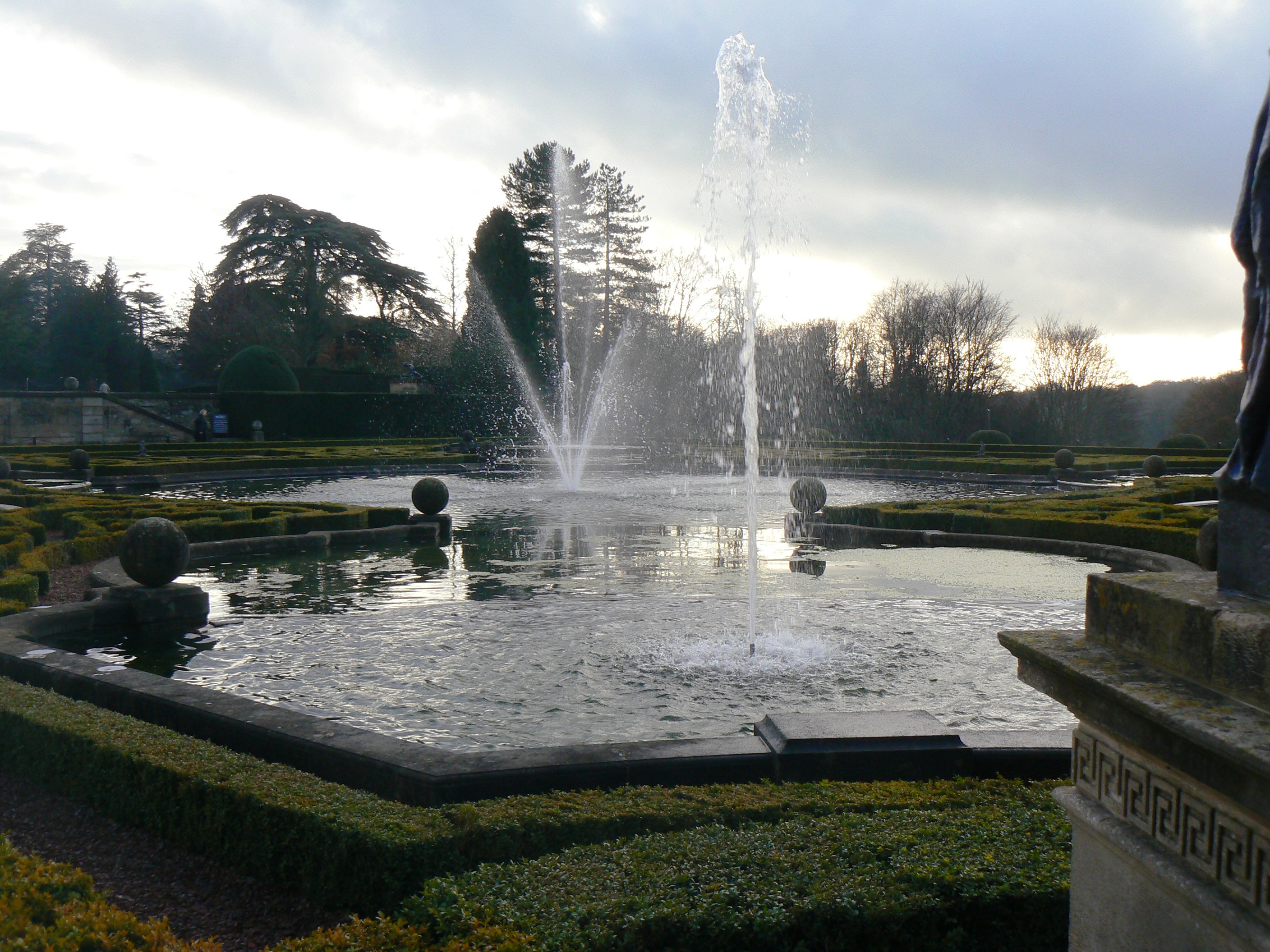
After exhausting the beauty of the house and enjoying a lovely lunch in the Water Terrace Café, one of several eating places at Blenheim, we ventured out into the open air to enjoy just some of the many formal gardens.  We saw the water terraces, the Italian garden and the secret garden which were beautiful.  We didn’t manage to visit the park with its cascades and the Temple of Diana, where Winston Churchill proposed to Clemmie.  Nor did we walk to the huge Column of Victory or Vanbrugh’s Grand Bridge.  However we saw them in the distance and were thrilled by all we did see.  We all agreed we would be going back in the Spring.  And, we were amazed to learn that we could convert our day tickets into an annual pass which gives free entry for the next 12 months!

P1100966

2015 marks many important anniversaries linked to Sir Winston Churchill, including the 50th Anniversary of his death, and the 75th Anniversary of the Battle of Britain ~ ‘his finest hour’.  There will be a special exhibition focussing on his life, from his birth at Blenheim Palace on 30th November 1874 to his days as our Prime Minister.  The room where he was born has been preserved just as it was and there is a case with his baby vest in it.  There are also 2 of his paintings and a lock of his hair.  Winston Churchill was the son of a younger brother of the 8thDuke.

There are many reasons I would like to revisit Blenheim Palace.  I would love to explore the gardens, lakes and the park.  I would also like to see the Column of Victory up close.  But I think we were very lucky to see the house decorated for Christmas with glitter and gold.  It was a very special day out.

“Blood Swept Lands and Seas of Red”

 P1100839

The weather was atrocious when I finally managed to visit the Tower of London with a friend.  After an unseasonably warm October, November has arrived with a splash.  It rained non-stop while we were at the Tower.  Not gentle rain, or refreshing rain, but relentless, heavy, pounding rain, that ran in waves down the sloping entrance, soaking my shoes and the bottom of my trousers.  My daughter has this theory that if it is raining in Barcelona where she lives, it will be dry in London and vice versa.  She happened to ring me just as I was leaving the house clad in wellies and mac.  But as there was a thunderstorm and heavy rain in Barcelona, she said I wouldn’t need them so I changed.  She was wrong.  I got soaked!

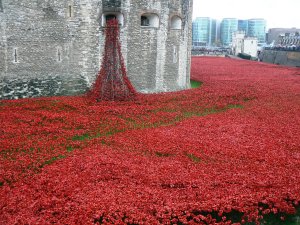
Despite the rain, the Tower was packed with visitors and I was impressed by how cheerful and friendly they were.  Most of the people I spoke to in the extremely long queues were from London or nearby counties of Kent and Essex.  Some said they hadn’t been to the Tower since they were children on a school visit.  Others, like me, had made a day trip involving hours on public transport- coaches, trains, buses and the underground.  Travelling, walking, and queuing all in torrential rain.  All had made the effort because they were keen to see the installation officially called, “Blood Swept Lands and Seas of Red”, but generally known by the people as ~ The Poppies!

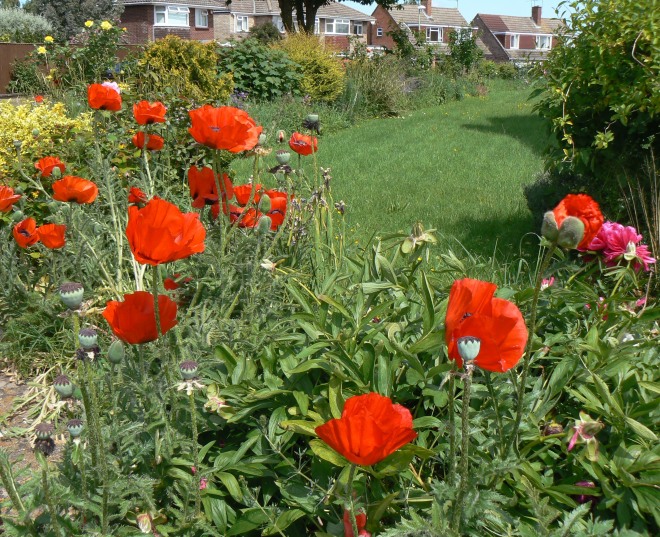
Poppies of course are an emotive symbol, used since the 1920s by the Royal British Legion to raise funds for their charitable work, ‘to the memory of the fallen and the future of the living’.   Although they are controversial, most people in the UK seem to wear them to show respect for those who fought and died in previous conflicts, and solidarity with those serving in the armed forces today.  The tradition was inspired by the poem, In Flanders Fields, by John McCrae. The story goes that when his friend, Alexis Helmer was killed at Ypres in 1915, the Canadian doctor, Major John McCrae, conducted the burial.  In his grief he was moved by the beauty of the wild red poppies growing amongst the horror of the graves.  The sight inspired McCrae to write this famous poem.

In Flanders fields the poppies blow
Between the crosses, row on row,
That mark our place; and in the sky
The larks, still bravely singing, fly
Scarce heard amid the guns below.

We are the Dead. Short days ago
We lived, felt dawn, saw sunset glow,
Loved and were loved, and now we lie
In Flanders fields.

Take up our quarrel with the foe:
To you from failing hands we throw
The torch; be yours to hold it high.
If ye break faith with us who die
We shall not sleep, though poppies grow
In Flanders fields.

The poppies forming the installation at the Tower, all 888,246 of them, were handmade under the direction of the ceramic artist Paul Cummins to commemorate the centenary of the outbreak of World War One.  The artist reportedly said that he took his inspiration from the words of an unknown soldier from Derby who wrote that all his friends, indeed everyone he cared about, had been killed in that dreadful war.   He described, “Blood swept lands and seas of red, where angels dare to tread”.   The ceramic poppies, each representing a British or Commonwealth fatality in WW1, were ‘planted’ by volunteers in the moat around the Tower of London; not haphazardly, but artistically arranged by the stage designer, Tom Piper.   Now complete, they spill over battlements, around walls and out of windows, covering the grassy moat with a red river of biblical proportions.  There is a very appropriate poem which reflects not only the poppies but how I feel about the whole experience:

London by William Blake

I wandered through each chartered street,
Near where the chartered Thames does flow,
A mark in every face I meet,
Marks of weakness, marks of woe.

In every cry of every man,
In every infant’s cry of fear,
In every voice, in every ban,
The mind-forged manacles I hear:

How the chimney-sweeper’s cry
Every blackening church appals,
And the hapless soldier’s sigh
Runs in blood down palace-walls
.

The Journalist, Jonathan Jones has been criticised in some quarters of the media for his opinion that the poppies at the Tower of London are “fake, trite and inward-looking – a UKIP-style memorial”, theguardian.com, 28 October). I found his comments shocking, but thought provoking.

 My impression was of a river of blood flowing around the tower, but outside of the establishment in every sense of the word.  Inside, the building protects and reflects power, treasures, pomp, ceremony, privilege, and a dark side to our history ~ cruelty, torture, imprisonment and murder.

Significantly, many of the people, probably the majority, who came to see the poppies, stayed outside the Tower.  It costs quite a lot for an ordinary family to go inside!  (Happily almost the whole installation can be seen freely from outside.)  I think this is as it should be.  The ordinary people came, not to see the grandeur of the Tower, but to be a part of something spectacular yet stunning in its simplicity.  They stood good-humoured, all ages and nationalities, helping each other in the pouring rain, humanity at its best, honouring those who died.  It was beautiful.

I did go into the Tower but it felt alien, as if it had nothing to do with the poppies – except for the Beefeaters.  These men have all served at least 22 years in the forces, and must have attained at least the rank of Sergeant Major.  They were larger than life characters who wore their immaculate, gorgeous, yet slightly ridiculous uniforms with evident pride and aplomb.  Their uniforms were drenched.  The rain dripped off them like the tears shed by countless families of the fallen we were there to remember.  Somehow this fitted the mood and made it all real.  Did those young men stand firm and wear their rain-sodden, mud-soaked uniforms with pride on those dreadful battlefields?

There is some talk this week of leaving the poppies in situ for longer.  While I don’t agree with this I think it could be very moving to see them standing through the biting winds, mist, murk and mud of a British November.  They could then represent the poor, the homeless, the jobless and all the disadvantaged in this very unequal world.  If they stayed longer, through the cold, frost and snow of a harsh December, they could represent, the lonely, the sick, the disabled, and the elderly so often at the mercy of exhausted relatives or poorly paid and overworked “carers” in homes and hospitals.   Too many of them look forward to death as an escape from suffering, as so many of those young men must have done during WW1.

The juxtaposition of the simple poppies outside, and the Crown Jewels inside the Tower was revealing.  Considered precious, these ‘priceless’ treasures are displayed in glass cases watched over by security.   With soft lighting and controlled temperatures they are guarded in secure rooms sealed by impenetrable metal doors.  They reminded me of seeing the embalmed body of Lenin in his mausoleum in Red Square!  Would that our young soldiers had been so well cared for on the WW1 battlefields!

Unfortunately we seem to have learned little after a hundred years.  The most incongruous thing I saw during my visit was a sign, which said you could avoid the queues by paying for membership of something or other.  This is exactly what is wrong with our world.  Money can buy advantage in every sphere of life.  Those with money, power and influence can get the best seats in theatres, tables in restaurants, food, education, housing, healthcare, medical treatment, etc. etc.  You name it and you can have it if you have money.

The world is still run by a strange elite, a brotherhood, for they are mostly men, who make and adjust the rules to protect and promote their own interests and to feather their own nests.  The few prosper at the expense of the many who struggle daily to get and keep a home in which to live and raise their family, to feed, clothe and educate them, and try desperately to stay well enough to not need help in their old age.  Only when laws, rules and decisions are made, and actions taken to promote the common good, will the war have been worth it.  We are a long way from that yet.

 There may be no-one living now who actually fought in WW1, but there are countless families who treasure the memory of a relative who did, and this installation has given them an opportunity to remember them and to pass on their history to the next generation.   My own grandfather joined up at the start of the war aged just 14 years 8 months and was sent to France as a bugler in 1917, aged 17.  Thankfully he survived.  But, like many others, he never talked about his wartime experiences.  We found out about them when he died many years later and his comrades spoke at his funeral.  Since then I have researched his war record and it is astonishing what he went through.   To me he was always my lovely granddad who ran a corner shop and let me sit by the fire in the back of the shop eating out of date sweeties and chatting to my much loved granny.  I always respected and loved him, but now I admire him for his strength of character and I am proud to be descended from him.

I will finish by posting some photos taken by myself and friends and by quoting a comment sent in to the Guardian, which I agree with wholeheartedly:

“So perhaps the sea of poppies is not about the war of 1914-18, but about a very different conflict, which is still raging in 2014. I mean, of course, the conflict between those who want us to believe that everything is all right (even if some bad things happen) – that everything that was done in the last 100 years turned out okay in the end, and will continue to do so; and those who know in their hearts and minds that things are not okay – that the events of the past decade, whether about banking, climate change, poverty or war, are signals to us that we need to do things differently. Perhaps a dried-up castle moat full of enormously expensive fake flowers is a very potent symbol after all – just not the one the artist intended.”
Nick Moseley
Chesham, Buckinghamshire

http://www.dailymail.co.uk/news/article-2817086/How-make-888-246-china-poppies-fired-glaze-Meet-unsung-heroes-glorious-artwork-captivating-Britain-Tower-tribute-WWI-fallen.html#v-3868841266001

http://www.youtube.com/watch?v=zc5ijfpXwK0


A Place of Great Beauty

cemetery 19

Today is the anniversary of my mum’s death.  I have written before about her last week and my memory of it is still fresh.  It was three years ago on the stroke of midnight that she peacefully stopped living and went to her rest after a brief but very distressing illness.

I went to the local cemetery where she is buried.  I was inspired to write this blog post about my visit because, far from being a sad event, it was a place of such beauty that it brought me great comfort.

The cemetery is very old, actually 150 years old!  And it is huge, about 65 acres I read, and it includes a garden of remembrance for ashes.  There is also a crematorium and a beautiful old building which houses two small chapels and waiting rooms.  The building has Grade 11 Listed status because of its architectural and historical interest.  The garden is so beautifully kept by the dedicated gardeners that at any time of year there is something colourful to see.  It has ponds and a variety of shrubs and flower beds.  There are also magnificent mature trees dotted around the cemetery which are home to squirrels and all sorts of birds including woodpeckers.  The setting for the cemetery is exquisite with a magnificent view of the Cleeve Hills as a backdrop.  A stream flows down from the hills and runs through the grounds, with Cotswold stone footbridges over it.  Today the cemetery is especially beautiful as autumn is in full swing and the trees are a delight to behold.

So it is a great worry to hear on the news and read in the papers that there are financial problems at the cemetery and crematorium caused by ‘unforeseen issues’ with the reasonably new machinery at the crematorium.  These issues have left the council who run the facility about a quarter of a million pounds short of their target.

As I tidied my mum’s grave I was struck by the sheer beauty of the setting and the peace and tranquillity of her final resting place.  I would hope that these financial issues do not mean standards will be lowered or the workforce will be cut.  They do such a magnificent job in what must be a very difficult environment.  For me they manage to provide a little piece of heaven here on earth and I want to thank them and let them to know that it is a great comfort.  Thank you.

I have attached some photos I took to this post but even better I found a video of the site here on YouTube.

Stained Glass Window in memory of Ivor Gurney, WW1 Composer and Poet of Gloucestershire

Stained Glass Window in memory of Ivor Gurney, WW1 Composer and Poet of Gloucestershire


Ivor Gurney Window by Denny 3Ivor Gurney Window by Denny 10

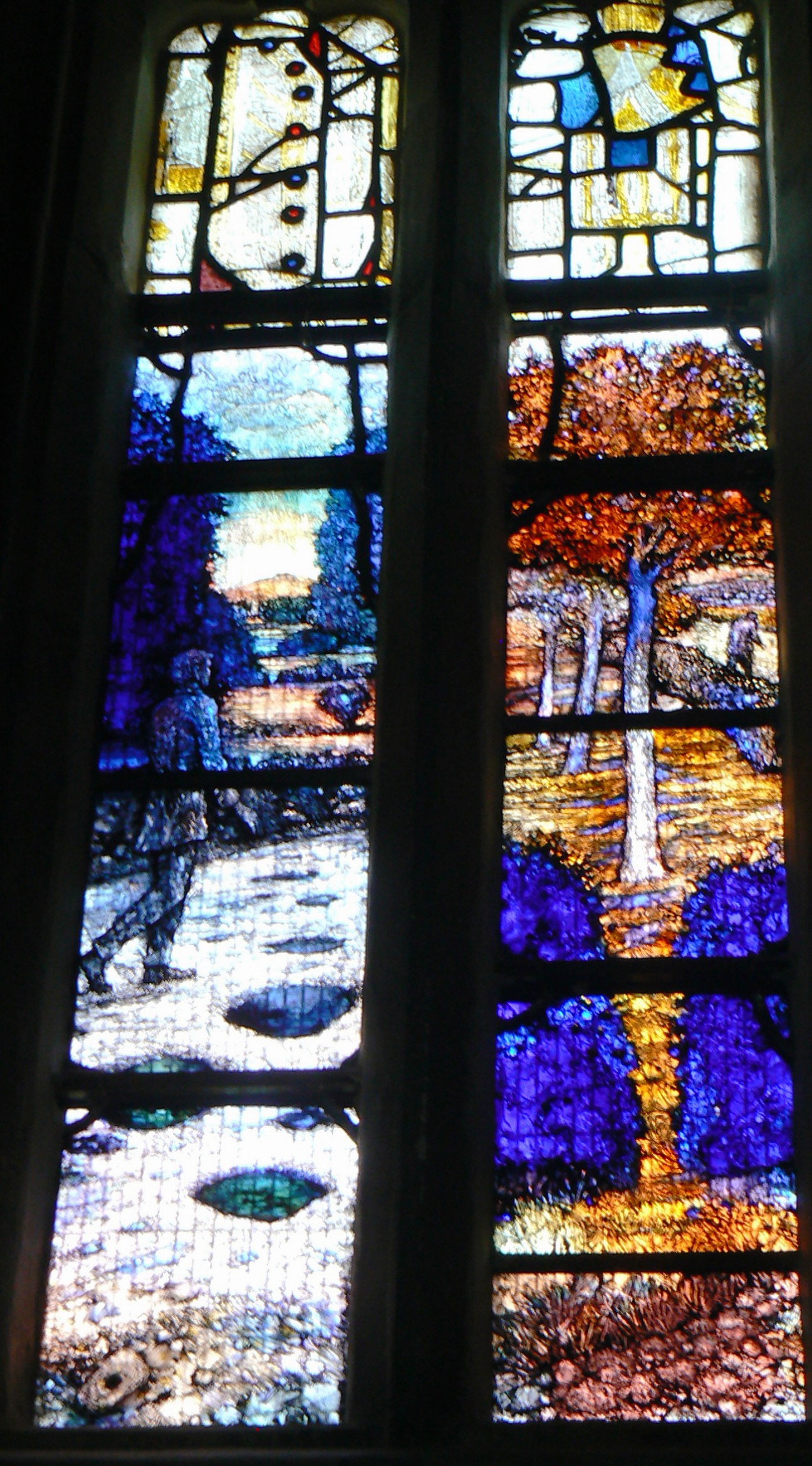
In Gloucester Cathedral there is a new stained glass window created by Tom Denny, which is a memorial to the Gloucestershire poet, Ivor Gurney.  Like Will Harvey, whom I have written about before, he was a pupil and chorister at the Cathedral school before joining the Gloucestershire Regiment to serve in the First World War.  Indeed, they were great friends.  Gurney was a talented musician firstly, but in the thick of war, poetry became his creative outlet.   Like Will Harvey  he survived the war but was drastically changed by it.  So much so that his fragile mental health was totally destroyed, and he spent many years in a mental asylum where he eventually died before he was 50.  Gurney is buried at Twigworth, where his gravestone commemorates him as ‘poet composer of the Severn and Somme’.

Gurney’s poetry is beautiful and reflects his love for the Cotswolds, the countryside and the beauty of nature.  I’d like to share 2 of them with you that touch me deeply for different reasons.

Firstly, To His Love which is a poem thought to be written by Ivor Gurney when he thought his friend Will Harvey had been killed.

To His Love’

He’s gone, and all our plans
Are useless indeed.
We’ll walk no more on Cotswolds
Where the sheep feed
Quietly and take no heed.

His body that was so quick
Is not as you
Knew it, on Severn River
Under the blue
Driving our small boat through.

You would not know him now…
But still he died
Nobly, so cover him over
With violets of pride
Purple from Severn side.

Cover him, cover him soon!
And with thick-set
Masses of memoried flowers-
Hide that red wet
Thing I must somehow forget.

The second is The Bugle, written after Gurney returned from the war, a sadder and wiser man.  I include it as my grandfather was a bugler in WW1, and also because it speaks to me loudly of how ordinary life and commerce still goes on while soldiers suffer and die ‘out of sight, and out of mind.’ 

The Bugle

High over London
Victory floats
And high, high, high,
Harsh bugle notes
Rend and embronze the air.
Triumph is there
With sombre sunbeams mixed of Autumn rare.
Over and over the loud brass makes its cry,
Summons to exultancy
Of past in Victory.
Yet in the grey street women void of grace
Chatter of trifles,
Hurry to barter, wander aimlessly
The heedless town,
Men lose their souls in care of business,
As men had not been mown
Like corn swathes East of Ypres or the Somme
Never again home
Or beauty most beloved to see, for that
London Town might still be busy at
Its sordid cares
Traffic of wares.
O Town, O Town
In soldiers’ faces one might see the fear
That once again they should be called to bear
Arms, and to save England from her own.

There are many learned websites with information about Ivor Gurney, but my wish today is simply to share the beauty and poignancy of the new window and explain a little of its background.

Ivor Gurney Window by Denny 2

There are 8 lights or panes overall and each reflects something from the life and writing of Ivor Gurney.  The notes are a precis of those that appear in the Cathedral by the window.

Light 1 ~ Glimmering Dusk ~ a figure walks at dusk in a Vale landscape.  there are dark pools of rain on the white road and May Hill can be seen in the distance.

Windows 1 & 2

Light 2 ~ The Stone Breaker ~ In Flanders a chance encounter with some road menders reminds Gurney of a much earlier meeting (“Oh years ago and near forgot”), in the fresh beauty of a summer’s early morning, in a landscape of Vale orchards.

Light 3 ~ Brimscombe ~ Gurney remembers a night-time walk through the fir trees of the steep-sided Brimscombe valley near Stroud.  The “pure clemency” of the moment enables him to forget the “blackness and pain” of France.

Windows 3 & 4

Light 4 ~ Severn Meadows ~This was written in March 1917 at Caulaincourt.  As the sun sets over Severn meadows, a figure, in the shadow of a willow, looks back at the river and the willows.

Light 5 ~ Pain ~ Gurney recalls the grey-white Somme battlefield.

“Pain, pain continual; pain unending;….

Grey monotony lending

Weight to the grey skies, grey mud where goes

An army of grey bedraggled scarecrows in rows

Careless at last of cruellest Fate-sending.

Seeing pitiful eyes of men foredone,

Or horses shot, too tired to merely stir,

Dying in shell-holes both, slain by the mud.

…………………………………….

The amazed heart cries out to God.

Windows 5 & 6

Light 6 ~ To His Love ~ Probably drafted on the Somme battlefield, Gurney reacts to the news (false as it turns out) that his great friend, the poet Will Harvey, is presumed killed.  A couple walk on the Cotswold hills as their dead friend lies among the violets.

Light 7 ~ To God ~ In the intense suffering from mental illness, surely aggravated by his experiences on the battlefields, Gurney cries out for death, “I am praying for death, death, death”.

Windows 7 & 8

Light 8 ~ Song and Pain ~ A more optimistic end to the window as a figure emerges from an understanding of pain to enter “The House of Joy”.

As I stood and gazed at these incredibly beautiful but harrowing windows, there were people around me moved to tears by what Gurney had seen and suffered.  Tom Denny is a wonderful artist. He has captured and honoured Gurney’s genius, his love of Gloucestershire, and his suffering in that dreadful war and in his mental distress.

Meditating on a window

https://wordpress.com/post/heavenhappens.me/4977

http://www.ivorgurney.org.uk/biography.htm

http://movehimintothesun.wordpress.com/2011/04/22/to-his-love-ivor-gurney/

Crucible 2 Sculpture Exhibition at Gloucester cathedral

IMG_4321

Today I went to Gloucester with a dear friend, the artist Anne Bate Williams.

We went to see the newly opened Crucible 2 exhibition of sculptures, which is set in and around this beautiful medieval Cathedral.  It was a warm, sunny day which made the experience even more enjoyable.

There were small groups of people around the Cathedral enjoying their lunchbreak.  Some were eating, some taking photographs and some rebellious types sitting on the sculptures!

The first sculpture we saw was a huge arm with a giant hand stretched upwards in a grassy space behind the Cathedral.  This is “Reach for the Stars” by K Armitage.  At the front there were some of confusing sculptures called Battersea 11 and 111.  But the huge “Sitting Couple on bench” by Chadwick was beautiful.

Cleverly placed in the beautiful grounds around the cathedral where children and passers-by can see them, are wonderful lifelike sculptures of animals including a giant bull, a beautiful hippo and its baby,  “Siberian Tiger” by Bugatti, as well as “Tortoise” and “Snail” by Cooper.  It was wonderful to see little children climbing onto the sculptures and I wondered if they expected them to move.

We were already impressed and excited before we even entered the Cathedral.  But once in the entrance, we were greeted by an arresting sculpture called “Pilgrim”, by D Backhouse.  The body is shrouded in white but the face is stunning in its beauty.

I won’t bore you by describing every one of the 100 sculptures, but I will add a link so that you can see some of them yourself. 

If you do live close enough to get to the exhibition, which is free, I would encourage you to come along.  It is on until 31st October and it will be worth the journey.  There are over 60 artists represented here.  Some are world famous like the local Damien Hirst, Henry Moore, Lynn Chadwick, Antony Gormley and Kenneth Armitage.  But there are lots of less well known artists too.

Enjoy my gallery of photos from the exhibition…

Pop, Poets and Plays

Community Choir at Tuckwell Community Choir at Tuckwell

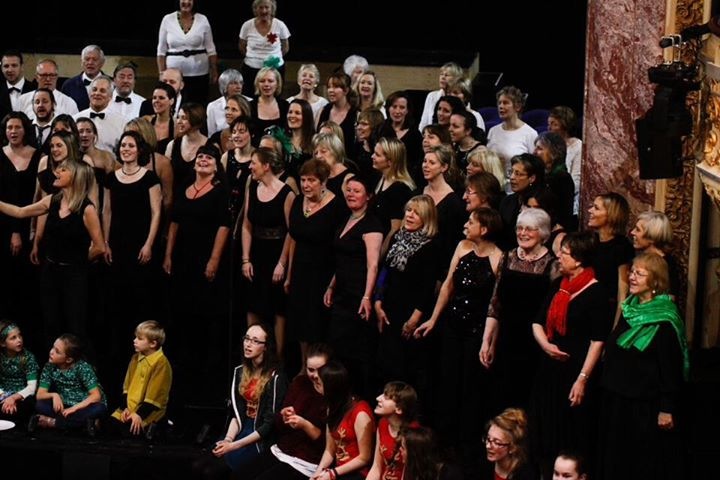
It’s been quite a cultural summer so far for me in the Cotswolds. I sang in a super concert at the local open air theatre, which was amazing. There were 150 of us aged from 5 to 90 singing together in the community choir. Sometimes we split up and sang in individual choirs, and we sang such a variety of songs. It was great to listen to the other choirs, especially the children. The setting was magical. We were in a dell surrounded on 3 sides by trees and with a stream running behind. On the fourth side was a tiered seating area. All the trees were sparkling with lights and there were candles along the paths and down the steps. The theme for dress was ‘festival’ so there were flowers in our hair and lots of pretty dresses. It took me back to my teenage years in the 1960s. I loved every minute of it. Sitting in the audience were two ladies who are direct descendants of a Gloucestershire poet who coincidentally is the subject of the rest of this post, Will Harvey.

There have been all sorts of commemorative events going on to mark the centenary of the start of World War One. Here in Gloucestershire I was involved in a production of a brand new play called Will Harvey’s War at our local theatre, playing the part of a singing farmworker! The play was based on a previously unpublished manuscript written by Will and only recently discovered. It has now been published as a book entitled The Lost Novel of F W Harvey

Will Harvey, better known as Frederick William Harvey DCM (26 March 1888~13 Feb 1957), was a local man, born in a small village called Hartpury in Gloucestershire. I have very fond memories of Hartpury, as my daughter did her degree in Equine Studies there at the college. The setting was perfect. There used to be a great village pub called the Canning Arms where live Jazz was played every Monday night. My husband and I used to go regularly to enjoy the music, the food, and to chat with the great licensees, John and Jean. Sadly, like many country pubs, after Black Wednesday the Canning Arms suffered in the economic downturn and closed. It is now a private house.

Will Harvey moved to Minsterworth and went to the King’s School in Gloucester, where he met Ivor Gurney, a chorister, who went on to become a noted Gloucestershire poet and composer. Along with Herbert Howells they became lifelong friends. Kings school, being a Cathedral school, has a strong music and arts tradition, but it was listening to Elgar’s, Dream of Gerontius that informed Will’s ideas on beauty and creativity. Coincidentally, I worked at King’s School for a time in the 1990’s and have written about it before http://wp.me/p2gGsd-Gp

After school Will trained as a solicitor, but at the age of 26, the First World War intervened in his life. Within days of the war starting in August 1914, Will joined the 5th Battalion of the Gloucestershire Regiment as a private. After a few months training, the battalion was posted to France where Will proved to be quite a hero. He was awarded the DCM or Distinguished Conduct Medal for his bravery. Will was later trained as an officer then sent back to France. Unfortunately, during another brave venture into enemy trenches, he was captured and spent the rest of the war in various prisoner of war camps. Although he made several unsuccessful escape attempts, it was in the camps that Will developed his poetry and writing skills. His most famous poem is Ducks, which he wrote after seeing a picture of ducks on the ceiling of his prison hut, drawn by another prisoner

It is often thought that The Wipers Times was the first trench newspaper, but actually the Fifth Gloucester Gazette came first and Will Harvey was a contributor. It was fortunate that Will was allowed to send his poems home for publication. His first volume was, A Gloucestershire Lad At Home and Abroad, which was soon followed by, Gloucestershire Friends, poems from a German Prison Camp. https://archive.org/details/gloucestershiref00harv

He also wrote about his wartime experiences in Comrades in Captivity. Altogether Will had about 400 poems published. He wrote of war and nature and animals as well as poetry for children.

After WW1 ended, Will came back to Gloucestershire and settled in the Forest of Dean. His poetry was so popular that he was known as “the Laureate of Gloucestershire“. But, now married to a nurse called Anne Kane, Will went back to his career as a solicitor in order to earn a living. To his credit he became known as “the poor man’s solicitor”. Indeed, Will was so compassionate to those facing prison that he often gave his services free. This was great for his reputation but not for his business and eventually it had to be sold. After that, Will joined the BBC and spent years promoting the people of the Forest of Dean, its arts’ scene, culture and heritage. Will’s friends, Ivor Gurney and Howells both set some of Will Harvey’s poems to music. Even today his poetry is set to music by local folk musicians such as Johnny Coppin. He sings of Gloucestershire, its traditions, its people and its culture.

Will Harvey is remembered on a memorial stone at Gloucester Cathedral and a new biography is being published this year.

The whole cast on set at the end of the show The whole cast on set at the end of the show

Frozen in Norway

Sculpture by Gustav Vigeland in Oslo park

Sculpture by Gustav Vigeland in Oslo park

One of the many joys associated with having grandchildren is that you get to watch the most beautiful films at the Cinema, or enjoy Disney videos at home, without feeling silly.
Recently I have been captivated by Frozen which I watched with Ben and Rosie. In the film Elsa the Snow Queen sings ‘Let it Go’, which is one of the songs our choir sings. It really is a most beautiful song, but when the children and their parents sing along together it is truly moving. This weekend we are performing it in a concert at the Tuckwell Open Air Theatre.

The film, Frozen, is based on Hans Christian Anderson’s tale of the Snow Queen.  When my daughter, Anna,  was young she played a part in a local production of the fairytale so it has a special place in my heart.  Also, the dramatic landscape of Norway was the inspiration for the setting apparently and I had a wonderful holiday in Norway some years ago.

If you have never been to Norway, I hope this film will inspire you to go. In July 1999 I flew to Oslo then travelled by train across Norway. Trains and boats are really the best way to travel for seeing scenery I find, and in Norway there is so much to see. The countryside was truly spectacular and very rugged with snow-covered mountains, icy glaciers, breathtakingly beautiful fjords and waterfalls, wildflower covered meadows and lakes so still that it was hard to tell what was real and what was a reflection.

Reflections in a still lake

Reflections in a still lake

There is a real port called Arendal in the South of Norway which becomes Arendelle in the film, Frozen. But it is in Bergen that you find the exquisitely preserved old buildings of Bryggen which feature in the film. There is a fish market in Bergen just opposite these ancient timber buildings. I was a bit shocked to find whale meat for sale alongside fabulous salmon.

Shopping for Salmon in Bergen Market

Shopping for Salmon in Bergen Market

Also in the film you will see Stave churches. There are many of these beautifully preserved churches in Norway. They were built mostly of wood during the middle ages. The largest is Heddal near Notodde. It is a beautiful fairytale church which dates back to the 12th century. There are several of these Stave churches around Bergen and we decided to visit the Fantoft Stavkirk on St Olav’s day. I caught a bus with my husband from Bergen and we had a very pleasant journey to the church. As we went to enter the church my husband realised he had left his wallet with all our money, tickets and passports on the bus! Fortunately I had a mobile phone with me and I managed to find the telephone number of the bus company. I rang them and sadly explained our situation. Imagine my delight when they said the driver had found the wallet and was finishing work for the day soon. He offered to drive back to where he had dropped us on his way home and return the wallet to us! He would not take any tip and seemed surprised that we were so overwhelmed with gratitude. Call me an old cynic but I just can’t imagine this happening in the UK.

Stavkirk

Stavkirk

My husband and I intended visiting the church on the way to the house at Troldhaugen where Edvard Grieg lived. I say the house but actually it was like an estate with a very impressive villa which is now a living museum. There was an island where visitors can enjoy free lunchtime concerts of Grieg’s music in the summer months. There is also the cabin where he worked. By the time we got there we had missed the concert and only had time for a rushed visit.

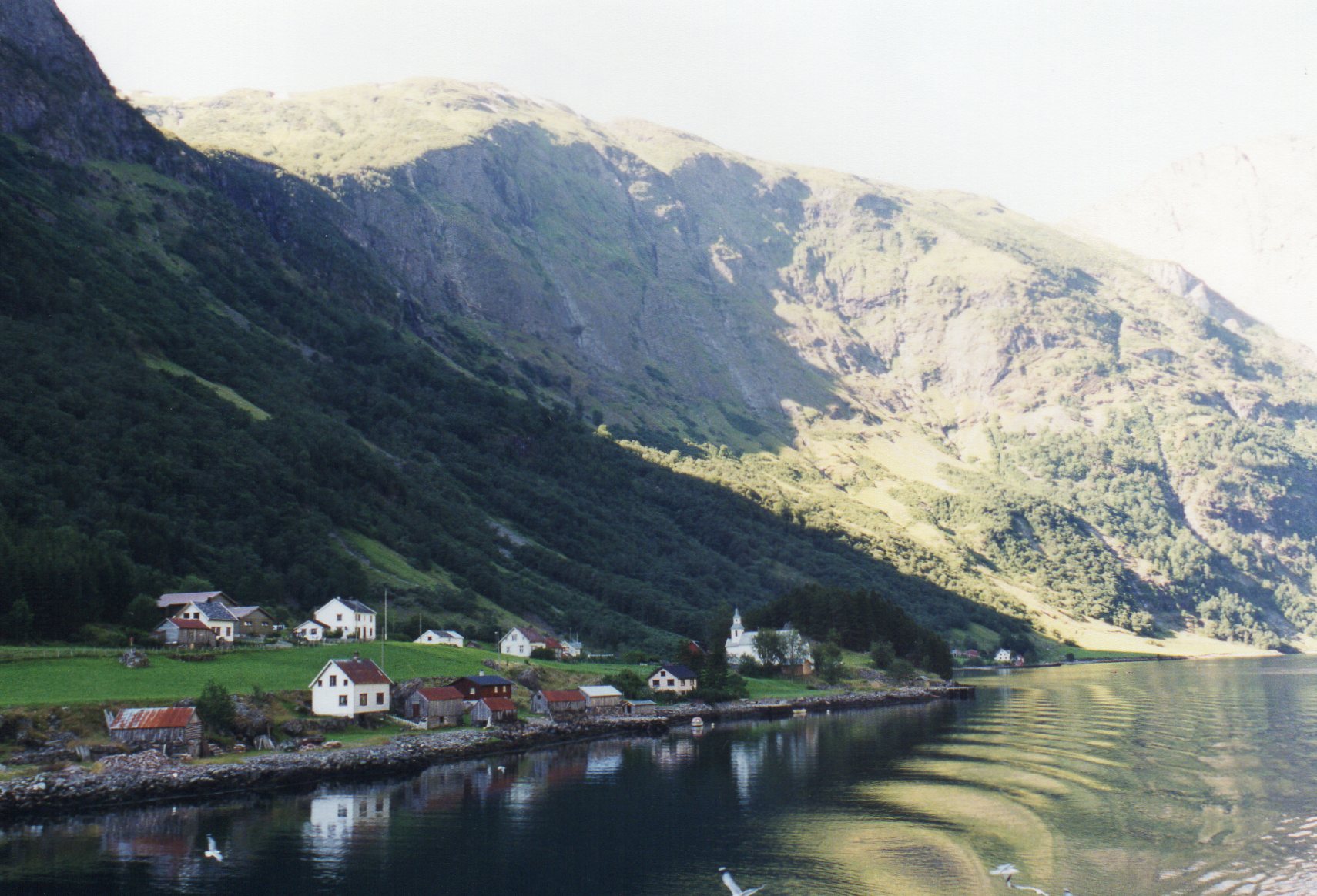
There are several fjords which could be the setting for Arendelle but it is claimed that it is Nærøyfjord, an arm of the Unesco-listed Sognefjord. I can believe that as it is so spectacularly beautiful. We travelled on the famous Flam railway passing huge waterfalls to reach the fjord. Along the way we could hear beautiful operatic singing and we could not work out where it was coming from. The train stopped under a waterfall and from there we could see a woman standing on the very top of the mountain. She was producing that magnificent sound which echoed around the fjord. From there we travelled by boat to one of many little villages dotted around the fjord.

Village along the fjord

Village along the fjord

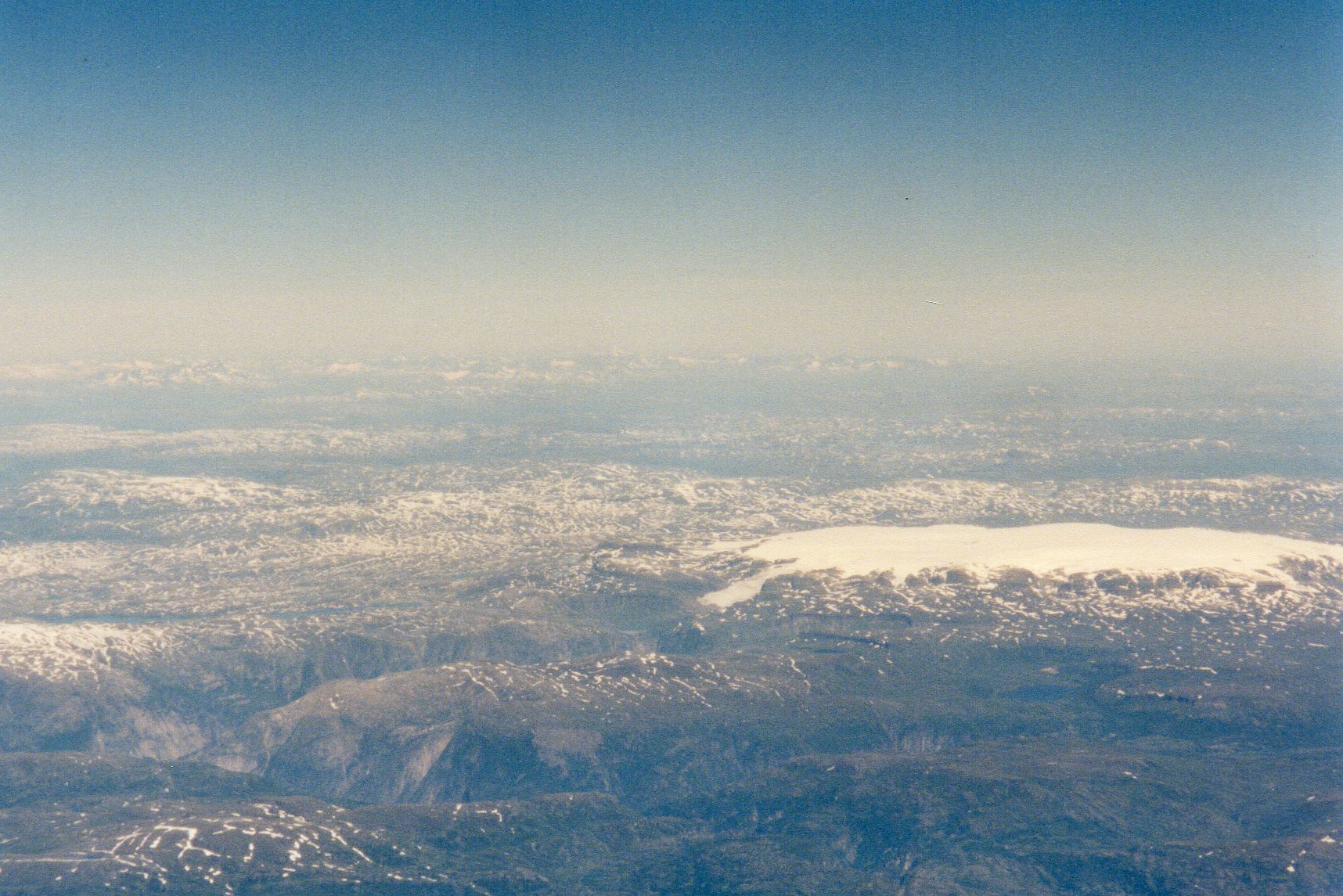
Also in the film, Frozen, Elsa flees across a glacial landscape which resembles the Folgefonna glacier. It could equally have been the Hardanger Glacier, which we saw, and flew over. It certainly is a bleak and barren place when viewed from the air.

Frozen Norway Norway from the air Hardanger glacier seen from plane

Watching Frozen brought all this back to me so I fished out my photos. Enjoy!


The Joys of Cornwall

Derelict mine building at Wheal Coates3

Old tin mines stand tall

Telling stories of the past

On Cornish coastline

I recently spent another lovely week in Cornwall. I wanted to be near the sea while still being near Truro for my hubby’s regular dialysis sessions, so I opted for a cottage in St Agnes. St Agnes is a beautiful, unspoilt little town on the North Cornwall coast. It is full of fascinating relics from the days when tin and copper mining was the main industry. It seemed strange to me to see derelict tin mines visible from behind houses and forming the boundary walls of gardens. In fact tin is still produced in St Agnes at the Blue Hills Mine, the only place in the UK that still produces it. St Agnes is an area of outstanding natural beauty and it has been designated a World Heritage Site. I can certainly see why. I just loved the rugged land and seascapes. Even in our state of unfitness we were able to walk some of the coastal path. This leads to sights that can never be appreciated from the road. One of these is Wheal Coates Mine. It is truly amazing when seen from a distance with its three shafts and its spectacular position on the side of the cliffs. In fact the mine goes all the way down to the sea and at high tide you can hear the waves crashing against rocks through a grid in the ruins. It was possible to get into this mine via a large cave at a nearby beach. There is a local legend that says Wheal Coates is haunted by the spirits of the miners who died there. I expect the eerie sounds of the sea account for the legends.
I’ve always been interested in industrial buildings. I guess this is mainly due to my father’s influence as he was a steel man from the age of 13 and he developed in me a passion for ships, bridges and buildings. The other reason could be because of where I grew up. I lived in the Felling, a shipbuilding and mining area in the North of England. I skipped past the railway station and shipyard every day on my way to school and there was a derelict engine house complete with winding gear at the end of our street of 2 up and 2 down back to back miners’ cottages. These were our adventure playgrounds. Children were never allowed to play on the grass or ride bikes in the municipal parks in those days! Parks were for floral displays and grown-ups to walk in and the park warden was fierce.
Being a traditional and romantic sort of person I regret that industrialisation almost destroyed the crafts of blacksmiths, weavers, spinners, millers and grinders. But I find there is great beauty to be found in the derelict buildings, in the machinery that drove the mines and the mills, and in the engines that turned their wheels and moved their goods

Around St Agnes there are beaches, bays and coves with caves where wreckers and smugglers, no doubt, once hid their treasures. We visited a pub reminiscent of Jamaica Inn. The pub is called the Driftwood and it has a fascinating history. It is a 17th century building which in its time has been a warehouse for the tin mines, a ships’ chandlery, and a sail maker’s loft, before becoming a characterful old pub. It is built of Cornish stone and slate and ship’s timbers and spares. Behind one of the fireplaces in the pub there is a tunnel which was uncovered during restoration. It is said that this was the secret escape route for the wreckers and smugglers of the area as it leads all the way to the beach.

The cottage we stayed in was perfect and my joy was complete when my daughter came to stay for a couple of days with my adorable grandson. He just loved the sea and sand, the horses in the paddock and the trampoline in the garden. We took him to Lappa Valley Railway, which is kiddie heaven in my book. Built on the site of yet another ruined mine, there are castles and treehouses and adventure equipment to satisfy any age. There are also 12 steam engines giving rides on trains which Stanley really loved. There is also a boating lake, café, shop and everything you could want for a fun day out. I loved it.

Home


Sadly it will be another year before I can go away again due to the shortage of holiday dialysis spaces around the country. But until then I have my photos to remind me of the fun we had and the beauty of Cornwall. Enjoy!

All of a Flutter with Real Confetti

confetti fields 17

We took a drive out on Friday to a lovely part of the Cotswolds, the village of Wick near Pershore. I was keen to see the fields of Delphiniums at Wick while the weather was good.
Acres of delphiniums are grown by Charles Hudson on the Wyke manor Estate, which are dried and sold as natural confetti for the Real Confetti Company. Apparently delphiniums, apart from growing in a range of vibrant colours, keep their colour indefinitely once they are dried, while rose petals go brown, carnations go black and marigolds shrivel up. This makes delphiniums perfect for confetti. Being totally natural, they biodegrade and don’t litter up churchyards and wedding venues, many of which have banned paper confetti for this reason.  I was told that when Prince Charles and Camilla came out from their wedding the young royals, William, Harry, Zara and others threw real confetti from Wick over the happy couple.
The village of Wick is a delight to behold. It is really ancient and retains every bit of its character. It must be the quintessential English village with its old church, thatched cottages and beautiful manor house.
The original manor was called Wyke Manor, using the ancient spelling, and it had a very long and illustrious history. It was owned by John Nevill, 3rd Lord Latimer, involved in the Pilgrimage of Grace in 1538. Upon his death in 1543, he willed the manor to his widow Catherine Parr. Catherine later married King Henry VIII (28 June 1491 – 28 January 1547) as his sixth and last wife in July of 1543. She was 31 years old and he was 52. The marriage didn’t last long as Henry died in 1547 so Catherine outlived him. A small piece of Catherine has returned to the Manor recently as a lock of her hair came up for auction. The hair is mounted in an oval frame on ink-inscribed paper which states “Hair of Queen Catherine Parr, Last Consort of Henry, the night she died September 5th 1548 was in the Chapel of Sudeley Castle”. The current owner of the manor, Charles Hudson, paid £2,160 for the hair, in order to return it to the manor.
Catherine Parr's Hair
After Catherine died, the estate passed to Anthony Babington, who was later executed for treason after plotting to kill Queen Elizabeth I! It then passed to Sir Walter Raleigh, who was also executed.
The Hudson family have owned the Wyke manor Estate since the 1760s and the current owner is Charles Hudson and his wife, the writer Cressida Connolly. I was fascinated to learn that Cressida is an authority on Ladybird Books, which I have always rated highly.

I have recently been told that the house which is now on the Wyke Manor Estate was partially rebuilt in the 1920s in the Elizabethan style.  I am grateful to Paul, a resident of Wick, for this update.

The people of Wick that I met were absolutely lovely and pointed me in the direction of the shop at the back of the manor house. This is not like any shop I have ever seen before. It is literally a part of the stable block and there are children’s bikes scattered all over the yard. Inside the ‘shop’ a lovely young lady, who must have the best job and workplace in the world, was boxing up exquisite dried petals into pretty boxes. Along one wall is a vast array of open boxes each containing different coloured dried petals. The smell and colour and atmosphere is hypnotic. I felt as if I had walked into a fairytale. Honestly, if you get the chance you just have to go along and experience it.
Well I spent so long soaking up the atmosphere that it was getting decidedly overcast by the time I headed off to the actual confetti fields. But I rushed to get as many photos as I could before the light failed, the heavens opened and I got soaked! It was definitely worth it though. Enjoy my photos.

It’s The Simple Things

IMG_1352

Reflecting on the week ahead of me I am delighted but a little daunted by the prospect of amusing 3 children under 10 while their parents work. These are my adored grandchildren and I love them to bits, but will I have the energy to keep them all amused?
Chekhov considered the work of an artist/writer, to be “the proper presentation of the problem”, so I tried to analyse the root of my anxiety. It became clear that I feel bound to stimulate and educate the grandchildren, while feeding them nutritious meals, sticking to their proper sleep patterns, keeping them clean and safe, and ensuring that they are happy and having fun at all times.  When I consider these goals, I see that they are idealistic and possibly unrealistic given a) the British weather and b) my age and situation.

So I cast my mind back to the things they have really enjoyed in the past and I realise that it is the simple things that bring the most pleasure.  So we can put away the Ipads, Xboxes, Dvds and electronic games and instead get out the wellies and walk!

Dodging the raindrops dressed in wellies and macs,

Jumping in puddles to make a big splash

Picking up pebbles to throw in the stream,

Peeping through fences, who knows what you’ll see

Goats, cows, pigs and hens abound

Sheep in the fields with their lambs all around

Watch a man in a red tractor cut grass in the park

Ring grandma’s doorbell and hear her dog bark.

In the sky there are seagulls,  helicopters and planes

As we walk past the airport along country lanes.

The roads are too busy with vehicles galore

Lorries, trucks, buses, police cars and more.

Popping into the pet shop to see what is new

Stanley climbs up a ladder to get a good view

Of fish, bearded dragons, geckos, rabbits, snakes too.

Reaching the playground we ride the model train

Taking trips to the seaside and then back again

Eating our picnic in the playhouse was fun

The day passed too quickly but now it is done

Walking back was an adventure, we walked on the walls

Spotting birds, trees and flowers, ladybirds and snails

I can’t wait for tomorrow to do it all again.

A Pastoral Post

Pastoral Symphony

Kimbolton in Herefordshire

Kimbolton in Herefordshire

The English countryside has inspired poets and artists since time immemorial. Today we can add bloggers and photographers to that list. I was fortunate enough to spend a couple of days in the delightful Herefordshire village of Kimbolton this weekend and it reminded me of one of Robert Herrick’s short pastoral poems from his Hesperides (1648)

I sing of brooks, of blossoms, birds, and bowers:
April, May, of June, and July flowers.
I sing of Maypoles, Hock-carts, wassails, wakes,
Of bridegrooms, brides, and of their bridal cakes.

The Herefordshire area is famous for its orchards and beef cattle. But I discovered a wealth of superb castles and gardens too. There are miles of public footpaths, many of which I walked with my little dachshund, Dayna. One delightful walk at Croft Court led through a bluebell wood which was just magical, the ground a sea of bluebells. I stayed on a farm which grows 80 tons of apples a year, all of which goes to Bulmers, the famous cider makers.
I would love to write a poem to paint you a picture of this beautiful area and I will, but for now just enjoy some of my photos and the beautiful music.

Its a Perfect day

Stanley finds pegs fascinating

Stanley finds pegs fascinating


One of the songs sung by the choir I belong to at our recent concert is Perfect Day.
Laughter and Lyrics Choir

Laughter and Lyrics Choir

Today has been just perfect. It is usually called Grandma day as I look after Stanley on Wednesdays and Thursdays. But today it was Turtle Day as I had bought a turtle shaped sand pit for him to play in.
Stanley really is a delight in every way and just spending time with him makes me feel wonderful.
It was especially good today for two reasons
1. We have both been feeling very unwell until today, with chest infections followed by throat infections
2. The sun was shining in a clear blue sky and it was lovely and warm.
Stanley usually arrives at 8am to be greeted by my little dachshund, Dayna who races out of the front door to greet him. They both then race in to get to the best armchair ~ Dayna, and the Chuggington corner ~ Stanley. Now when my children were little it was all Thomas the Tank engine and I do feel a bit disloyal saying this but Chuggington is just so much more exciting! I have collected all the trains ~ wooden and die-cast, some track, two carrying cases, a hard back story book and a floor layout for imaginative play. Now Stanley is only 16 months old but he plays with Chuggington things for hours. He ‘rides the rails’ around, across and under furniture whether or not the dog is sitting on it, he builds tunnels with mega bricks (or grandma’s legs), and he drives the trains in and out of their sheds in the carrying cases endlessly. He just never seems to tire of it. At lunchtime as a special treat he gets to watch an episode of Chuggington which I have pre-recorded while he eats what I have prepared. I have 78 episodes recorded now so that pretty much guarantees peaceful lunchtimes until he starts school!
I jokingly say to my daughter that if I were to go on Mastermind, the BBC high brow quiz show, my specialist subject would be Chuggington ~ I know so much about it I have started creating new storylines as I watch. I also make pictures for Stanley by cutting out the card trains which come with each new toy and building a scene around them with the train names written on. I then laminate them. Stanley loves these and it is how we both learned all the names.
But today, even Chuggington came second to the TURTLE sandpit. I sited it on the patio near a gazebo so that Stanley would have some shade and Grandma would have somewhere to sit. Having forgotten to buy buckets and spades etc., I gathered old plastic containers, a colander and a jug, spatulas and wooden spoons, which worked almost as well. And then the fun started.
When Stanley had enough of that exercise he thoroughly inspected the garden. Being his first Spring at an age where he could make sense of his surroundings it was a joy just to follow him watching and listening. But the highlight for me was sharing the discovery that two of the birdhouses my daughter made for me are occupied by nesting blue tits. Stanley adores watching birds in the trees and bushes, in the sky or on the ground, at the water table or on the feeders. So to show him where they are nesting was a joy.
After that he toddled up to my shed. Now anyone who has read my post “Windows” will know that my sheds are very special places for relaxation and meditation and usually no-one else ventures in there. However, today Stanley looked at the shed, pushed at the locked door and said, “Open, Yea?” in a voice that would totally melt the polar ice cap. Of course I said yes and in no time at all the nicknacks in my sanctuary were all rearranged. There was a moment when I looked at him, ancient toy car in one hand and orange wooden rosary prayer beads in the other and the happiness I felt took my breath away. And I realised that at that moment Stanley and I were both in that place where ‘heaven happens’.

NaPoWriMo 6 ~ A Good hare Day

napo2014button1
For NaPoWriMo on day 6 there was a simpler challenge than Saturday’s thank goodness. We were asked to look out of a window and write a poem using what we observed. Having to be always contrary I decided to look into windows instead.
This is because I went to Cirencester to see the March Hare Festival.

A dreary day in the Cotswolds,
Wind blows and cold rain drizzles down
Stone cottages are looking weathered and worn,
Daunted daffodils and bluebells bend low
Agitated pheasants scurry, flapping over Ermin Way,
Committed we continue, to Cirencester for the day.

Like Brigadoon this market town appears out of the mist,
One of those magic moments, a place by angels kissed.
A colourful celebration reflecting local life is underway;
A Festival of March Hares, some dazzling some restrained,
In windows, doorways, churches and shops creatively displayed

Cultured, cosmopolitan and colourful vignettes,
Cameos of ancient times are captured in mosaic,
Homages to industry, hospitality, trade and faith
Veterans of two world wars amusingly portrayed
Childhoods caught in acrylic, nature, myths and legends true
Captured by artistic celebrities, dignitaries and ordinary people too

Visitors and residents alike, excited and involved
Chat, sharing what they have found, advise, inspire, enthuse
Pubs overflow with merriment, cafes are buzzing too
Music pours from the Brewery Arts, crafters’ skills on show
Working in glass and gold and silver, in wood and pottery and silk,
Local artists interpret the world in paint and pen and ink.

In recent years there has been a spate of large ceramic or stone objects appearing in towns and cities of the UK. Having mentioned it to my daughter last night I know that they have been seen in the USA too. The first time I came across it was when my grandchildren, Ben and Rosie went to London and were photographed alongside large colourful elephants. Wallace and Gromit were in Bristol recently too.
Next I heard of a Gorilla festival in Torbay and Exeter. There was also a festival of decorated horses in Cheltenham in honour of the races. Now there are 5 foot tall hares in Cirencester.
Why hares you might wonder?
Well Cirencester was a very important place in Roman times. It was called Corinium and had very good road links to the rest of the UK, such as Ermin Way and the Fosse Way. In 1971 during an archeological dig in Beeches Road near to the River Churn, a Roman mosaic was discovered depicting a hare. The original is now on show in the Corinium Museum. Hence the theme of hares for this festival. There will be about 50 hares around the town eventually. Most of them will be 5 foot tall and decorated by local people including schoolchildren, members of the public, celebrities and artists. All of the large hares are named to reflect their sponsors. One of the most beautiful hares is on display in the Corinium and it is named Tess.
Apart from the large hares there are lots of smaller hares dotted around the town and there are prizes for discovering and photographing them. I think I will have to go back as I only found 10 large ones! I did however find the solid chocolate one which weighs 10kg in a lovely little chocolatiers called ‘Lick the Spoon’.
The festival does have a serious purpose which is to boost trade and tourism in the town. Judging by how much money I spent yesterday they are going to be very successful!
They are also aiming to raise the £50,000 needed for Gloucestershire Wildlife Trust to begin to develop the Green Hare Churn Walkway around the River Churn in Cirencester. This new trail project will involve schools and community groups and will have lasting benefits for residents and visitors alike. The hares will be auctioned off at the end of the festival to raise the funds.
I hope they do well as we had a wonderful day, and we will certainly be going back. The Festival of Hares is on until 14th September and is well worth a visit at any age. To give you a helping hand I have listed the names of the hares that are on display at the moment and where you can find them. Tomorrow there will be more as phase two will be hidden around the town! Some of them are in schools which won’t be open now til after the holidays.

Bare Hare at the Agricultural College
Harry, King of the Hill at Kingshill School
Mr Harebushes at Organic farm Shop, Burford Road
Via Albatine at Whiteway Workshops
Harebelle at the Twelve Bells
Flame, The Phoenix Wayfarer at Phoenix Way
Hareoh the Phareoh at St John Baptist Church
Whare’s Davey in Davey Law Offices
Haretherop in Waterstones Bookshop
Harriet in Mistral Clothes Shop
Harold O’Hare in Zippy Pix Photo Shop
Hartley in 51 Dyer Street
Harrison in Hampton’s Estate Agents
Daniel George in Bishop’s Walk
Hopportunity Hare in Cirencester opportunity Group
Corina at the Corinium Hotel
Tess at the Corinium Museum
General Lievre at Gardiner Haskins
Harelequin at Beeches House
Miles, the Millionhare at Limes hair Company
Wooly Jumper outside the Fleece
Madame Butterfly at McGill’s Chartered Accountant
Hicarus at Cotswold Airport
Eostra at Rendcomb College
Sign the Hare at Bingham House

Weekly Photo Challenge ~ Threshold

On the threshold of the new millennium On the threshold of the new millennium

Rest not! Life is sweeping by; go and dare before you die. Something mighty and sublime, leave behind to conquer time. — Goethe

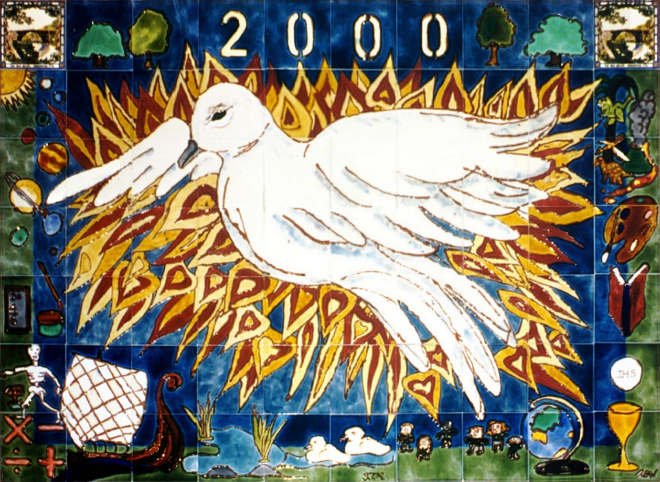
The prompt in the Weekly Photo Challenge this week is the word ‘threshold’. Looking through my photos this one of the tile frieze made at the end of 1999 for the year 2000 leapt out at me. It is hard to imagine today just what a big deal it was being on the threshold of a new millennium. There were all sorts of apocalyptic warnings about power failures, planes falling out of the sky, systems not being able to cope etc. No-one really new what would happen at midnight on 31st December 1999 and what the new millennium would mean for civilisation. So I wanted to mark the occasion with something very special and permanent for my school.

St Thomas More School was a huge part of my life. In the early 1970’s I watched the new school building rise in the middle of an open field that had once been farmland and an orchard. There was an ancient hedgerow all around the site and just one magnificent old oak tree in what would be the playing field. When it was opened in 1975, I was having my third child so was not available for teaching. But, as I drove past the school every day, I vowed that one day I would work there.

I got my wish in 1984 when my youngest child was ready to start school. I was offered a job and jumped at the chance. The next decade was a time of great blessing as I worked in virtually every class, teaching all age groups, then became deputy Head. In 1994 the original Headteacher was due to retire and, to my surprise, I was offered his job. He had been such an inspirational Head that the school was a joy to work in. Taking on his role, I tried to emulate him while making my own mark and bringing my own vision for the school into being.

Due mainly to the quality of the staff and their outstanding teamwork, the school became a strong and successful community, ‘an oasis of excellence’, appreciated by staff, pupils and parents alike.

In 1999, as the new millennium approached, the staff wanted to mark the year 2000 with a special feature. We wanted the whole school community to be involved in creating something totally unique and meaningful. We came up with the idea of making a large tile frieze. Each year group was asked to brainstorm their favourite lessons, subjects, or topics, and represent their ideas on paper.

Reception class, the youngest children were just 4 or 5 years old and had only just started school. They had their photographs taken in their shiny new uniforms, so that was their contribution.

The Year 1 class had helped to build a pond and were raising ducklings which they had hatched from eggs in an incubator, so they drew pictures of that. I have a wonderful memory of the day the ducklings hatched out ~ the local policeman had called up to the school on a social visit and he watched as the first duckling struggled to crack open the shell. When it finally succeeded and out popped this beautiful and perfect little bundle of yellow feathers, he was overwhelmed by emotion and had tears in his eyes.

In Year 2 the 7 year olds made their first Holy Communion as it was a Catholic school so they drew a chalice and host. Being the most significant event in the year, that was their contribution.

Year 3 was the first year of juniors and the children enjoyed learning about Vikings and the Human Body, so they drew lovely longboats and skeletons.

In Year 4 things got much more subject focussed so Maths was represented by a calculator and mathematical symbols.

In Year 5, Music, Dance and Art were the main features, so a pot of paint and a brush was drawn. Science too was represented by the planets.

By Year 6 the children were getting ready to move on to secondary school. In order to give them a taste of independence and adventure, it was our tradition to take the class away to Shropshire for a week to stay in a Youth Hostel. Here, in the Ironbridge Gorge, birthplace of the Industrial Revolution, we had a wonderful time. We visited the Iron Museum, The Jackfield Tile Museum, Blist’s Hill Reconstructed Village, River Severn Museum and of course the first Iron Bridge ever built. We also had amazing night hikes, midnight feasts and parties. Altogether it was an incredible opportunity for fun and learning. So naturally the Ironbridge at Coalbrookdale was the emblem of Year 6.

The staff gathered all these pictures and images together and chose the ones that would be painted on to the tiles. The Year 5 teacher, ABW, a wonderfully creative artist and teacher, took on the challenge of putting all the ideas together and creating a design on tracing paper which could be transferred onto numbered ‘green’ tiles. It was agreed that we would go to Jackfield Tile Museum to create the finished work.

A representative group of staff, parents and children spent a weekend at the Youth Hostel and were each given a small area of the tile frieze to paint. ABW had done a magnificent job scaling all the children’s artwork up or down so that the frieze would reflect the life of the school. It was agreed that the year 2000 would go at the top, as well as the 4 trees, oak, ash, poplar and beech, which were the school emblem. In the top corners would be tiles depicting the Ironbridge itself. The children’s artwork would go around the edge, and at the centre would be the Holy Spirit in the form of a dove surrounded by flames.

We painted the tiles in coloured glaze. I will never forget the atmosphere in that studio at Jackfield as we worked on the frieze. There was a stillness and peace in the room which was truly sacramental. While we worked, the Spirit moved in that place and heaven happened.

When we finished, the tiles were left at the Jackfield tile Museum to be fired. A couple of weeks later they were collected and set into a frame made by the reception class teacher’s husband.

Bishop Mervyn Alexander of Clifton RIP came in the year 2000 to celebrate the school’s 25th anniversary and he blessed the tile frieze.

NaPoWriMo 2 ~ Shishi ~ The paired lion-dogs that guard the entrances of temples

napo2014button1
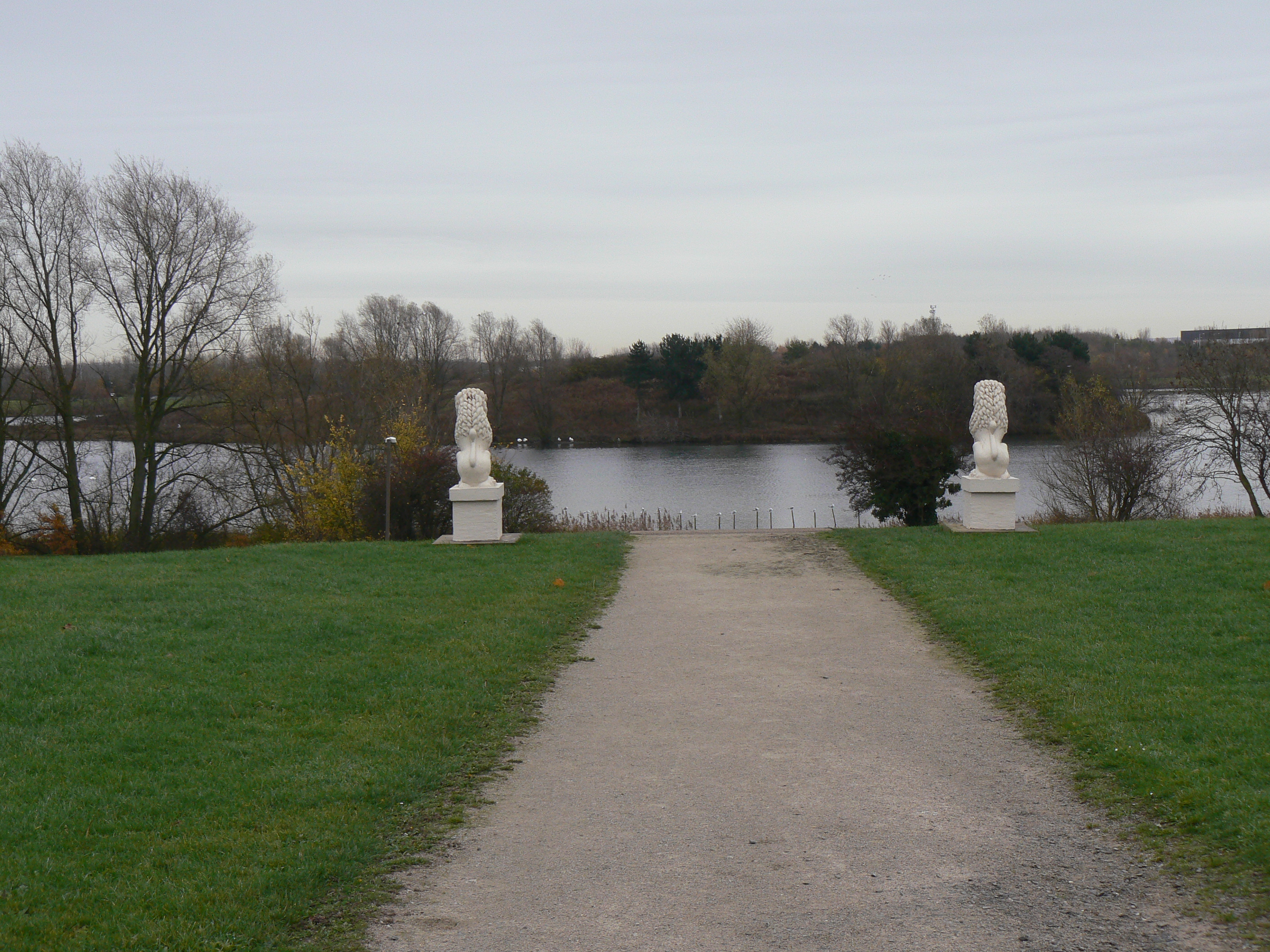
This haiku is inspired by one of the creatures from from Japanese legend. Shishi is the paired lion-dogs, one male and one female, that guard the entrances to Shinto shrines and Buddhist temples. The Shishi have magical powers to repel evil.
Jp. = Shishi 獅子 or Kara Shishi 唐獅子, Chn. = Shíshī
Also known as Koma-inu 狛犬 (lion dog) in Japan

I chose this topic for two reasons. Firstly I have a cast iron garden chair which is very decorative and it has a lion head at the end of each arm rest. Secondly, one of my daughters used to be a dancer and she worked in Japan for a year when she left LIPA (Liverpool Institute of Performing Arts). She loved Japan and the people she worked for who were so kind to her. One day she went for a trip to see a newly built temple. In order to raise money to complete the temple roof tiles were being sold with a dedication on them. Knowing that my interests are spiritual she Paid for a tile to have my name and a blessing carved on it. I think it is probably one of the most unusual, the most thoughtful, and the most wonderful thing anyone has ever done for me.

Serene and smiling

Weathered guardians of childhood

Casting out evil

Buddhist temple in Willan, UK

Buddhist temple in Willan, UK

P1030050

Weekly Photo Challenge ~ Street Life

pothole protestjpeg

pothole protest2jpeg
I woke up very early one morning to the sound of a pickaxe pounding the pavement opposite my house. Being naturally curious as well as a member of the Neighbourhood Watch scheme I got up to see what was going on. And there they were, two men, one ‘little’ and one ‘large’, digging holes in the pavement right opposite my front window! On the back of their white flatbed truck they had an assortment of tools and what looked suspiciously like a bus shelter. Since no-one had contacted us to inform us that this might be happening I rushed out in my pyjamas to find out what authority they had for the work. They told me that we should have been contacted, but their orders were to put up a bus shelter right there.

Now as you can just see from the photo my house is right opposite a lovely park with a stream and a small wood which is a delight throughout the year. I simply could not allow an ugly bus shelter to block my view. Yes I am a NIMBY!

‘Large’, who clearly underestimated the power of a woman in pyjamas, said there was nothing I could do about it as they had their orders. I said well you can’t carry your orders out if I am sitting in the hole, which I promptly did ~ yes …. in my pyjamas. At this point ‘little’ got into the van to have a smoke and ‘large’ very gallantly offered me his fluorescent yellow jacket as it was starting to rain.

Knowing me well and realising I would not be backing down any time soon my long suffering husband brought me out a cup of tea and a telephone to ring the council. Pah! The same council who had not even bothered to inform, never mind consult, the residents, I would not be wasting my time phoning them – anyway it was far too early. I would phone my MP direct. Fortunately I had his number as this is not the first protest I have been involved in. Poor ‘large’ was completely thrown when my call was put straight through to the MP’s mobile as he was at the House …. of Commons that is!

By now ‘little’ had started to get edgy and asked how long I was planning on sitting in the hole. I informed him that I could stay there as long as it took to get the decision reversed, so he called his boss. At this point passers by on their way to work had started to notice and one even took photos. I began to realise I was causing a bit of a stir – and so did ‘little’ and ‘large’. They reported this to their boss along with the fact that I was on the phone to my MP. ’The Boss’ immediately ordered them to fill in the hole and abandon the site.

Quite bewildered but in very good humour the two men did as told and tarmacked over the holes. They never did come back and to this day there is no bus stop opposite the house, just beautiful views.

As a postscript to this I will just say that the next day I was taking my elderly mother to the cemetery to put flowers on dad’s grave when we passed the local newsagents. Mum looked at the display of newspapers in the window and said – “you’re in the papers!” To my horror on the front page was the not very fetching photo of me sitting in a hole wearing my pj’s and a yellow fluorescent jacket!

The world and his brother have seen it and that is how I came to be known as “bus stop brenda”.

To read more about life in my street do read my post about ‘Comings and Goings’ at http://wp.me/p2gGsd-191