Blenheim Palace

P1100963

It wasn’t an auspicious start when we met the coach to travel to Woodstock on 27th November 2014.  It was a misty morning, dismal and damp with drizzle.  However as always the mood on the coach was sunny and light hearted; WI ladies are such good company.  We were heading off to Blenheim Palace in Oxfordshire to see the house decorated in “Glitter and Gold” for Christmas.  On the way we travelled through the lovely village of Bladon where most of the Spencer Churchill’s are buried at St Martin’s Church.

Blenheim palace is a Baroque masterpiece designed by Nicholas Hawksmoor and Sir John Vanbrugh, which took 17 years to complete.  On our tour we were told that the house was so perfect that it has never been extended or redesigned.  It was begun in 1704 thanks to Queen Anne who had just come to the throne.  John Churchill had been given the title, Duke of Marlborough by the previous monarch, William of Orange.  It was a particularly turbulent time in Europe and the Duke was recognised by most as a man of courage, stamina and will-power, as well as a brilliant military man.  He was leading the allied forces in Europe when there was a bloody and decisive battle at Blindheim, in Bavaria.  On August 13 1704, Marlborough and his men held back King Louis XIV’s troops and saved Vienna from a French attack.  This changed the course of history in Europe, protecting British interests.  The Queen was so pleased that she granted Marlborough the Manor and Honour of Woodstock and acres of gorgeous countryside as well as the promise of money to build a house as a fitting monument to his great victory.  The name Blindheim was then anglicised and became Blenheim.

This is an extract from the famous poem called The Battle of Blenheim by Robert Southey;

“It was the English,” Kaspar cried,
“Who put the French to rout;
But what they killed each other for
I could not well make out.
But everybody said,” quoth he,
“That ’twas a famous victory!

By the time we reached Blenheim via the long sweeping drive, the sun was shining and it was a perfect day to take in the impressive views of the grounds, the lakes, the bridge, and the breathtaking beauty and symmetry of the house itself.

P1100987

We were doubly fortunate because, not only was the house decked out for Christmas, but there was a spectacular art exhibition by the Chinese conceptual artist, Ai Weihei.  Being an outspoken social activist, Ai Weihei brings politics into his work and some of it was quite controversial.  However there were some really beautiful and thought provoking pieces.  I particularly liked the ‘Chandelier 2002’, which was made of glass crystals, lights, metal and scaffolding.  Being over 5 metres tall it hung glittering from the ceiling in the grand entrance.  I was not so keen on the piece called ‘He Xie, 2012’, in the red drawing room, which consisted of masses of porcelain crabs on the exquisite carpet.

IMG_5154   IMG_5160

We managed to see almost every room in the public parts of the house learning snippets as we dipped in and out of fascinating guided tours.  Every room was different and had objects of beauty to see, sculptures, furniture, china, silverware, paintings and spectacular tapestries.  We were amazed to see huge cases filled with small model soldiers complete with arms and vehicles displayed in battle formation from many wars.  It seems that Blenheim holds the National Collection of the British Model Soldier Society.

P1100959

On the first floor of the house we took a fascinating, if rather unnerving tour, called “Blenheim~the Untold Story”.  This was narrated by the ‘ghost’ of Grace Ridley who was the favoured servant of the first duchess, Sarah.  The voice of Grace led us from room to room mysteriously as she rattled through over 300 years of history and 11 Dukes of Marlborough.  It was certainly entertaining and informative.

On a very sad note, we learned that the 11th Duke had died just a few weeks ago on the 16th October this year at the age of 88.  He was a cousin of the wartime Prime Minister Winston Churchill, who was also his godfather, and he was also distantly related to the late Princess Diana.  He inherited Blenheim in 1972 and devoted his life to preserving the Palace for the benefit of future generations.  His titles will now pass to his eldest son James, Marquess of Blandford, who was born in 1955.  It is an enormous responsibility which I certainly would not relish.  However there is a strong board of trustees to help him.

The late 11th Duke of Marlborough The late 11th Duke of Marlborough

After exhausting the beauty of the house and enjoying a lovely lunch in the Water Terrace Café, one of several eating places at Blenheim, we ventured out into the open air to enjoy just some of the many formal gardens.  We saw the water terraces, the Italian garden and the secret garden which were beautiful.  We didn’t manage to visit the park with its cascades and the Temple of Diana, where Winston Churchill proposed to Clemmie.  Nor did we walk to the huge Column of Victory or Vanbrugh’s Grand Bridge.  However we saw them in the distance and were thrilled by all we did see.  We all agreed we would be going back in the Spring.  And, we were amazed to learn that we could convert our day tickets into an annual pass which gives free entry for the next 12 months!

P1100966

2015 marks many important anniversaries linked to Sir Winston Churchill, including the 50th Anniversary of his death, and the 75th Anniversary of the Battle of Britain ~ ‘his finest hour’.  There will be a special exhibition focussing on his life, from his birth at Blenheim Palace on 30th November 1874 to his days as our Prime Minister.  The room where he was born has been preserved just as it was and there is a case with his baby vest in it.  There are also 2 of his paintings and a lock of his hair.  Winston Churchill was the son of a younger brother of the 8thDuke.

There are many reasons I would like to revisit Blenheim Palace.  I would love to explore the gardens, lakes and the park.  I would also like to see the Column of Victory up close.  But I think we were very lucky to see the house decorated for Christmas with glitter and gold.  It was a very special day out.

Life Choices by Danielle Jordan

An inspirational blogpost from a thoroughly modern woman!

theworldoutsidethewindow's avatarThe World Outside the Window

Welcome to my latest guest contributor, the fantastically talented Danielle Jordan. Danielle is a self-employed theatre practitioner and so are all of her family including baby Scarlett. She has agreed to share the unique challenges she faces as a first time mother working as a self-employed person in the arts.

image An actor’s life for me (and baby)

Life Choices byDanielle Jordan

“Umm…I think she might have been a bit sick?”

“No no she’s just dribbling in her sleep, anyway, before you learn how to strangle each other, let’s go through that last scene…”

View original post 1,280 more words

Pain

stellas wooden statue 1

Pain is messy

A rebellious teenager, appearing

Defiant, disruptive

Causing chaos

Pain is invisible

A malevolent spirit haunting

Nagging, gnawing

Stealing sleep

Pain is antisocial

An angry mob descending

Erratic, uncaring,

Restricting movement

Pain is cunning

A bully stalking

Defeating doctors, confounding consultants,

Making fools of pharmacists,

Pain is relentless

A silent enemy

Heartless, challenging

Limiting life

It’s the middle of the night and as i can’t sleep my default mode is to get up and write.

I can’t sleep because of the relentless pain in my shoulder which is the result of an injury to my rotator cuff.  I’d never heard of this unseen but essential part of my anatomy until it was injured.  According to Wikipedia, the rotator cuff is a group of muscles and their tendons that act to stabilize the shoulder.  Like me, you have probably never given them a thought; but, if they are inflamed, torn or damaged like mine, you will certainly know about it!  The pain in my shoulder is excruciating, especially if I try to lift or lower my arm or twist it behind my back.  It is worse at night because I tend to turn over and lie on the right side and it is my right shoulder that is injured.  I guess it will improve over time and with some simple exercise, but at the moment the pain is hard to manage.  The hospital doctor gave me Co-codamol but they made me sick and most over the counter analgesics don’t even dull the pain.  So I guess I will just have to live with it.

On the bright side, it does not affect me much when my arm is by my side so I can still write ~ YIPPEE!  I think if I was unable to write I would go crazy.

“Blood Swept Lands and Seas of Red”

 P1100839

The weather was atrocious when I finally managed to visit the Tower of London with a friend.  After an unseasonably warm October, November has arrived with a splash.  It rained non-stop while we were at the Tower.  Not gentle rain, or refreshing rain, but relentless, heavy, pounding rain, that ran in waves down the sloping entrance, soaking my shoes and the bottom of my trousers.  My daughter has this theory that if it is raining in Barcelona where she lives, it will be dry in London and vice versa.  She happened to ring me just as I was leaving the house clad in wellies and mac.  But as there was a thunderstorm and heavy rain in Barcelona, she said I wouldn’t need them so I changed.  She was wrong.  I got soaked!

Despite the rain, the Tower was packed with visitors and I was impressed by how cheerful and friendly they were.  Most of the people I spoke to in the extremely long queues were from London or nearby counties of Kent and Essex.  Some said they hadn’t been to the Tower since they were children on a school visit.  Others, like me, had made a day trip involving hours on public transport- coaches, trains, buses and the underground.  Travelling, walking, and queuing all in torrential rain.  All had made the effort because they were keen to see the installation officially called, “Blood Swept Lands and Seas of Red”, but generally known by the people as ~ The Poppies!

Poppies of course are an emotive symbol, used since the 1920s by the Royal British Legion to raise funds for their charitable work, ‘to the memory of the fallen and the future of the living’.   Although they are controversial, most people in the UK seem to wear them to show respect for those who fought and died in previous conflicts, and solidarity with those serving in the armed forces today.  The tradition was inspired by the poem, In Flanders Fields, by John McCrae. The story goes that when his friend, Alexis Helmer was killed at Ypres in 1915, the Canadian doctor, Major John McCrae, conducted the burial.  In his grief he was moved by the beauty of the wild red poppies growing amongst the horror of the graves.  The sight inspired McCrae to write this famous poem.

In Flanders fields the poppies blow
Between the crosses, row on row,
That mark our place; and in the sky
The larks, still bravely singing, fly
Scarce heard amid the guns below.

We are the Dead. Short days ago
We lived, felt dawn, saw sunset glow,
Loved and were loved, and now we lie
In Flanders fields.

Take up our quarrel with the foe:
To you from failing hands we throw
The torch; be yours to hold it high.
If ye break faith with us who die
We shall not sleep, though poppies grow
In Flanders fields.

The poppies forming the installation at the Tower, all 888,246 of them, were handmade under the direction of the ceramic artist Paul Cummins to commemorate the centenary of the outbreak of World War One.  The artist reportedly said that he took his inspiration from the words of an unknown soldier from Derby who wrote that all his friends, indeed everyone he cared about, had been killed in that dreadful war.   He described, “Blood swept lands and seas of red, where angels dare to tread”.   The ceramic poppies, each representing a British or Commonwealth fatality in WW1, were ‘planted’ by volunteers in the moat around the Tower of London; not haphazardly, but artistically arranged by the stage designer, Tom Piper.   Now complete, they spill over battlements, around walls and out of windows, covering the grassy moat with a red river of biblical proportions.  There is a very appropriate poem which reflects not only the poppies but how I feel about the whole experience:

London by William Blake

I wandered through each chartered street,
Near where the chartered Thames does flow,
A mark in every face I meet,
Marks of weakness, marks of woe.

In every cry of every man,
In every infant’s cry of fear,
In every voice, in every ban,
The mind-forged manacles I hear:

How the chimney-sweeper’s cry
Every blackening church appals,
And the hapless soldier’s sigh
Runs in blood down palace-walls
.

The Journalist, Jonathan Jones has been criticised in some quarters of the media for his opinion that the poppies at the Tower of London are “fake, trite and inward-looking – a UKIP-style memorial”, theguardian.com, 28 October). I found his comments shocking, but thought provoking.

 My impression was of a river of blood flowing around the tower, but outside of the establishment in every sense of the word.  Inside, the building protects and reflects power, treasures, pomp, ceremony, privilege, and a dark side to our history ~ cruelty, torture, imprisonment and murder.

Significantly, many of the people, probably the majority, who came to see the poppies, stayed outside the Tower.  It costs quite a lot for an ordinary family to go inside!  (Happily almost the whole installation can be seen freely from outside.)  I think this is as it should be.  The ordinary people came, not to see the grandeur of the Tower, but to be a part of something spectacular yet stunning in its simplicity.  They stood good-humoured, all ages and nationalities, helping each other in the pouring rain, humanity at its best, honouring those who died.  It was beautiful.

I did go into the Tower but it felt alien, as if it had nothing to do with the poppies – except for the Beefeaters.  These men have all served at least 22 years in the forces, and must have attained at least the rank of Sergeant Major.  They were larger than life characters who wore their immaculate, gorgeous, yet slightly ridiculous uniforms with evident pride and aplomb.  Their uniforms were drenched.  The rain dripped off them like the tears shed by countless families of the fallen we were there to remember.  Somehow this fitted the mood and made it all real.  Did those young men stand firm and wear their rain-sodden, mud-soaked uniforms with pride on those dreadful battlefields?

There is some talk this week of leaving the poppies in situ for longer.  While I don’t agree with this I think it could be very moving to see them standing through the biting winds, mist, murk and mud of a British November.  They could then represent the poor, the homeless, the jobless and all the disadvantaged in this very unequal world.  If they stayed longer, through the cold, frost and snow of a harsh December, they could represent, the lonely, the sick, the disabled, and the elderly so often at the mercy of exhausted relatives or poorly paid and overworked “carers” in homes and hospitals.   Too many of them look forward to death as an escape from suffering, as so many of those young men must have done during WW1.

The juxtaposition of the simple poppies outside, and the Crown Jewels inside the Tower was revealing.  Considered precious, these ‘priceless’ treasures are displayed in glass cases watched over by security.   With soft lighting and controlled temperatures they are guarded in secure rooms sealed by impenetrable metal doors.  They reminded me of seeing the embalmed body of Lenin in his mausoleum in Red Square!  Would that our young soldiers had been so well cared for on the WW1 battlefields!

Unfortunately we seem to have learned little after a hundred years.  The most incongruous thing I saw during my visit was a sign, which said you could avoid the queues by paying for membership of something or other.  This is exactly what is wrong with our world.  Money can buy advantage in every sphere of life.  Those with money, power and influence can get the best seats in theatres, tables in restaurants, food, education, housing, healthcare, medical treatment, etc. etc.  You name it and you can have it if you have money.

The world is still run by a strange elite, a brotherhood, for they are mostly men, who make and adjust the rules to protect and promote their own interests and to feather their own nests.  The few prosper at the expense of the many who struggle daily to get and keep a home in which to live and raise their family, to feed, clothe and educate them, and try desperately to stay well enough to not need help in their old age.  Only when laws, rules and decisions are made, and actions taken to promote the common good, will the war have been worth it.  We are a long way from that yet.

 There may be no-one living now who actually fought in WW1, but there are countless families who treasure the memory of a relative who did, and this installation has given them an opportunity to remember them and to pass on their history to the next generation.   My own grandfather joined up at the start of the war aged just 14 years 8 months and was sent to France as a bugler in 1917, aged 17.  Thankfully he survived.  But, like many others, he never talked about his wartime experiences.  We found out about them when he died many years later and his comrades spoke at his funeral.  Since then I have researched his war record and it is astonishing what he went through.   To me he was always my lovely granddad who ran a corner shop and let me sit by the fire in the back of the shop eating out of date sweeties and chatting to my much loved granny.  I always respected and loved him, but now I admire him for his strength of character and I am proud to be descended from him.

I will finish by posting some photos taken by myself and friends and by quoting a comment sent in to the Guardian, which I agree with wholeheartedly:

“So perhaps the sea of poppies is not about the war of 1914-18, but about a very different conflict, which is still raging in 2014. I mean, of course, the conflict between those who want us to believe that everything is all right (even if some bad things happen) – that everything that was done in the last 100 years turned out okay in the end, and will continue to do so; and those who know in their hearts and minds that things are not okay – that the events of the past decade, whether about banking, climate change, poverty or war, are signals to us that we need to do things differently. Perhaps a dried-up castle moat full of enormously expensive fake flowers is a very potent symbol after all – just not the one the artist intended.”
Nick Moseley
Chesham, Buckinghamshire

http://www.dailymail.co.uk/news/article-2817086/How-make-888-246-china-poppies-fired-glaze-Meet-unsung-heroes-glorious-artwork-captivating-Britain-Tower-tribute-WWI-fallen.html#v-3868841266001

http://www.youtube.com/watch?v=zc5ijfpXwK0


Oh What a Year! 1963

Shottery Manor

I sing in a lovely choir every Friday morning and I love it.  The songs we sing are varied but there is always one that catches our mood, gets us laughing, crying or dancing, and lights up our voices.  This week it was the old Frankie Valli and the 4 Seasons number, Oh What a Night!  It was released in December 1975, but the words recall “late December back in ‘63”.  I bet you didn’t know that the song was originally going to be about December 1933 and Prohibition?  However thank goodness Valli persuaded them to change it to a song about first love in ’63.  You can play the song as you read my blog by clicking on the icon on the sidebar.

Oh, what a night, late December back in ’63
What a very special time for me
As I remember what a night!

I made a passing comment that I was sweet 16 in 1963 to the amusement of some of the older choir members and horror of the younger ones.  But as so often happens with music it then brought up all sorts of memories.

1963/64 was a very special year for me.    I was in my final year at Stratford Grammar school for Girls learning in the most beautiful setting imaginable.  I was studying English literature at ‘A level’.  My main text was King Lear.  I’ve mentioned before that in those days it was possible to pay 4 shillings in pre-decimal money, which is 20 pence now, and stand at the back of the theatre to watch Shakespeare’s plays.  I took full advantage of this and I was there in 1962 when Paul Schofield played King Lear in what is recognised as the greatest performance of the role of all time.  It left an indelible impression on me which stays with me even now.   The main themes of the play have universal and timeless significance,

  • Appearance versus reality
  • Justice
  • Compassion and reconciliation
  • The natural order

Our English teacher, Miss Southall, was an inspiration too.  All black hair, flowing gown and long legs, which she bared to the sun during summer term.  This meant English classes were held on the lawn in the beautiful walled garden with its Dovecote, in front of the magnificent Shottery Manor which was the setting for the sixth form.  The school was, and still is, just a stone’s throw from Anne Hathaway’s cottage in Shottery.  It oozed history with its old oak floors, wood panelling and not so secret passages which could have been priest holes.  We were convinced that there was a tunnel leading from the Manor into town but no-one ever ventured in far enough to find out because it was pitch dark.

According to school history, the oldest part of the Manor was 14th century when it was owned by Evesham Abbey.  In 1402 the Bishop of Worcester granted a licence to John Harewell of Wootten Wawen for a priest to celebrate Mass in the Oratory of the Manor.  This room became our sixth form study.   The house stayed in the Harewell family for centuries but in 1919 the manor was bought by Mr A D Flower on behalf of the trustees of the late Edgar Flower.  The Flower family were very significant to Stratford on Avon.  Edward Flower started Flower’s Brewery there in 1831 and his sons, Charles and Edgar continued the business making rather a lot of money.  Fortunately the Flowers had that wonderful Victorian ethic of using their money to benefit the community, (I wonder what happened to that in Britain?), and they used it to develop the Shakespeare Memorial Theatre.  Charles donated the land by the River Avon and in 1875 launched a campaign to build the theatre.  He also donated the money to build the theatre (about £1 million in today’s money), which opened in 1879 with a performance of Much Ado About Nothing.  Charles also gave the cottages opposite so that the rents could be used to maintain the theatre.

The last members of the Flower family to live in the Manor left in 1951 and it was empty for a few years.  But thank goodness Warwickshire County Council bought it and it was turned into the first Girl’s Grammar School in the area.  It opened in 1958 just in time for me to arrive.  I was very lucky to get in at all as I had moved from the north of England where my education record was patchy to say the least.

I started school in a converted Chemical Works by the shipyards on the River Tyne.  I remember there was a huge room which was partitioned off for different age groups.  My delight, and my downfall, was to peep round the partition to see what was going on in other areas.  The grass is always greener etc….

I was not in infants for very long as I was what they called in those days, ‘a sickly child’.  I was underweight (hard to imagine I know!), undernourished, with Rheumatic Fever and a heart condition.  I eventually got back to school in the juniors but was so far behind that the teachers didn’t even try to educate me.  They gave me all the little jobs to do, which was great by me!

On Monday mornings my job was to fill up all the inkwells.  I went to the office to mix up black ink powder and water in a jug with a long spout.  I then went from desk to desk.  Each wooden desk had a hole with a ceramic pot in it.  I poured the ink into the pot until it reached the rim.  We used ‘dip pens’ in the juniors in those days, just a wooden handle with a metal nib on the end which you dipped in the ink then scraped on the edge to take off the excess.  The youngest infants still used chalk and individual slates.   I had to be very careful with the ink as washable ink was unheard of.  This stuff would stain permanently!

As you can imagine this job could take all morning if necessary; however there was also free milk to give out and wafers to sell.  In those days children didn’t bring fancy cool bags or plastic lunch boxes filled with snacks to school.  If they were very lucky they would have a ha’penny (1/2d) to buy some wafers.  These wafers were the sort you get on an ice cream ‘sandwich’.  They came in big boxes and were sold 2 for 1/2d.

Many children were undernourished in those days as it was just after the war and there was still some rationing.  The recently formed NHS did a wonderful job of providing supplements for children.  We got little bottles of orange juice, cod liver oil by the spoonful not capsules, Virol malt extract and I got a tonic too.

I can honestly say I don’t remember learning a thing at primary school except to sing, ‘Flow Gently sweet Afton’ and to make an advent calendar out of matchboxes for Christmas.  It was my inspirational, well-read and self-taught father who taught me what I needed to know: how to read, write, do maths, to identify constellations, wonder, dream, question, listen, love.  He had an open mind and an open heart.  It was he who convinced Miss Williams, the original head teacher of Stratford grammar School for Girls, that I was a suitable candidate for her school.  I am so glad that he did.  Because, since 1963, thanks to that education, I have been able to plough my own furrow.

St John's School, Felling

St John’s School, Felling

Upper Sixth Shottery Manor

Upper Sixth Shottery Manor

My Stratford Blog  http://wp.me/p2gGsd-5c

So what else was on at the Shakespeare Memorial Theatre in 1963 that I watched for 4s (shillings)?

The Tempest, Julius Caesar, Comedy of Errors, Edward 1V, Henry V1, Richard 111, and the newly adapted history plays under the title of the Wars of the Roses.

In 1963 the director was Peter Hall with John Barton, designer John Bury, and music was by Guy Woolfenden

And the actors in these plays had names that have graced theatre, television and film for decades:

Paul Schofield, Vanessa Redgrave, Dorothy Tutin, John Gielgud, Peggy Ashcroft, Judy Dench, Roy Dotrice, Ian Holm (a fabulous Richard 111), David Warner ( a dreamy Henry V1), Janet Suzman, Clifford Rose, Penelope Keith, etc….

And what else was happening at home and abroad in 1963?

Major William Hicks Beach (Conservative) was MP for Cheltenham and Harold Macmillan was Prime Minister in UK until Sir Alec Douglas Hume succeeded him in October.

The Beatles released their first album, Please Please Me and rapidly rose to fame.

Britain had the worst winter since 1946/47 when I was born.  The snow lasted until April.

The Great Train Robbery took place in Buckinghamshire with millions of pounds stolen.

In June 1963 the first woman to travel into Space was a Soviet Cosmonaut, Valentina Tereshkova.  She orbited Earth 48 times, spending 71 hours in Space.  She parachuted to earth after ejecting at 20,000 feet.

Tens of thousands of protestors came from all over the world to join the CND march from Aldermarston to London to protest about the Hydrogen Bomb which threatened world peace.

Thousands of African Americans were arrested in Birmingham, Alabama for protesting against segregation.

Martin Luther King gave his ‘I Have a Dream’ speech during a march on Washington for jobs and freedom

President John F Kennedy made a historic Civil Rights Address in which he promised a Civil Rights Bill

The first Sindy Doll was marketed by Pedigree.

In October the Rolling Stones played at the Odeon in Cheltenham. The Beatles played there on 1st November.

Pope Paul VI succeeds Pope John XXIII as the 262nd Pope.

The second James Bond Film ‘From Russia with Love’ opened in London.

22nd November 1963 was a terrible day.  Not only did authors CS Lewis and Aldous Huxley die, but President John F Kennedy was assassinated in Dallas.  Lyndon B Johnson was sworn in as president.

The first episode of Dr Who was aired on television in November 1963.  During the 60s the series was in black and white.

Carpe Diem ~ Corn

LOGO SEPT 14

I went to Taize one summer when it was so hot and dry that the magnificent River Loire had almost dried up in places.  Too hot to stay in the car I decided to walk for a while across the fields and I had an amazing experience.    At the foot of the hill were fields of sunflowers, corn and poppies.  I stood alone in a field full of sunflowers, looking up towards the church, as a gentle breeze blew.  The wind caused the flowers to bend and the sound they made was so strange.   I experienced what I can only describe as the spirit moving.

Today’s Haiku prompt at Carpe Diem reminded me of that moment.

Soft wind whispering

Spirit moving through the corn

Speaking to my soul

It reminded me strongly of the beautiful words of one of my favourite hymns:
 Be still for the presence of the Lord
Be still for the presence of the Lord  The holy one is here
Come bow before him now  With reverence and fear
In him no sin is found  We stand on holy ground
Be still for the presence of the Lord  The holy one is here
Be still for the power of the Lord  Is moving in this place
He comes to cleanse and heal  To minister his grace
No work too hard for him  In faith receive from him
Be still for the power of the Lord  Is moving in this place
Icon at Taize

Icon at Taize

Banksy ~ A rebel with a cause?

I recently wrote about our concert at the Tuckwell Open Air Theatre.  For several weeks before the concert we rehearsed in a room above a pub in one of the older parts of Cheltenham.  Right opposite the pub, on the corner of Hewlett Road and Fairview Road, was an ugly modern telephone box.    I will never understand why the powers that be got rid of our lovely red telephone boxes and replaced them with these ugly grey plastic things.  But I guess beauty is in the eye of the beholder!

red telephone box modern telephone booth

However, I digress.  The telephone box was attached to the side wall of a very insignificant rented house.  Insignificant that is until one Saturday night in April this year when a van turned up and a man covered the wall of the house with tarpaulin.  He then proceeded to paint a mural around the phone box which showed three men apparently using listening devices to hear and record the conversations of people using the phone box.   The trenchcoat-wearing men were obviously meant to be spies.  Now this was clearly a reference to the fact that GCHQ, the Government Communications Headquarters, is based in the town.  GCHQ had been controversially in the news because of Edward Snowdon’s revelation that they listen in to private telephone calls, though quite why anyone is surprised by that I fail to see.  I may be missing something, but if this is done in the quest to prevent terrorism and serious crime ~ isn’t that their job?

When the tarpaulin, the man and the van left, there appeared an amazing piece of very professional street art or graffiti, depending on your point of view.

It was quickly established that the art was the work of the world famous elusive Bristol based artist known as Banksy, which made it extremely valuable to whoever owned that wall.  Banksy owned up to the work, which is now known as Spy Booth

People came from miles around to have their photograph taken inside the Spy Booth including my daughter and my grandson!

Jenny and Stanley in the Spy Booth

Of course all of this attention had negative consequences too.  The painting was very soon badly vandalised, which is tragic, but also rather ironic as it was originally an act of vandalism itself.

Banksy vandalised

The debacle which has rumbled on ever since verges on the ridiculous with the owner, the tenants, the council, local business people, millionaire prospective buyers and art experts all proclaiming their views loudly in the local newspaper.   But most residents agree that it livens up a rather dull area, is a tourist attraction and definitely belongs in Cheltenham.  It would be irrelevant as a political statement if it were not linked to the phone box and the home of the Government communications Headquarters.

Banksy himself has said, “As a kid I always dreamed of growing up to be a character in Robin Hood”.  It seems now his street art is so valuable that he doesn’t need to steal from the rich.  They are queuing up to buy his work!   Today I heard that another of his paintings, Mobile Lovers, attached to the side of a community building in Bristol has been sold for a six figure sum and all the money is going to secure the future running of the premises as a Youth Club.

Mobile Lovers appeared in April on a doorway by Broad Plain Working With Young People

Miss Margaret’s New House

When I was a student in the 1960’s I started collecting nursery rhymes and poetry which I could use once I started teaching.  I built up quite a collection in a folder.  I also got into the habit of cutting poems out of the daily newspaper if they appealed to me.  One poem impressed me so much I have treasured it for the last 50 years.  I still have the original cutting.  Brown with age, I’ve now laminated it so that it doesn’t get damaged.  It is called Miss Margaret’s New House and it chimed with me really strongly.

As regular readers of my blog will know, my much loved mum died in 2012.  She lived just a couple of doors away from me, which was really handy when I was caring for her.  But once she had died, the house being so close was a constant source of sadness which I could not escape.

The house was empty and forlorn for months but now new people have bought the house to ‘do up’ and live in.  It seems to me that there will be nothing left of the original house soon.  It now has a huge extension on the back, the lovely hardwood window frames have been replaced with white plastic and the leaded lights are gone.  The kitchen has been ripped out and a new one built in the extension.  The wall between the bathroom and toilet has been knocked through and all the fittings have been replaced.  The climbing roses have been cut down and the rambling hedgerow tamed and trimmed.  All the carpets are gone and modern wooden flooring installed and the walls have all be painted in neutral tones.

I’m sure it will all be lovely by the time they move in, but no longer will it be ‘my mum’s house’.  This is a blessing in a way as I will no longer feel those pangs of sadness as I pass by on my walks with the dog or my grandson.  Every trace of my mum’s taste and personality has gone from the house now, along with her fixtures and fittings, into the skip.

Her style was plain and simple.  She loved the soft pink on the walls, pale green on the floors ~ always Wilton, always 80/20 wool.  She loved roses in the garden, flowers in the house, and dark oak Ercol furniture.  She loved soft cushions and silver ornaments.  Her door, like her heart, was always open to visitors, especially her family.  She never forgot a birthday and was generous to a fault.  Not a day goes by when I don’t miss her.

Now to get back to the poem!  I hope you enjoy it as much as I do.


 She never liked The Firs.  She said

‘Give me simplicity.

Pretentious roofs and leaded panes…

Lord, how they sicken me!


I’ll have an honest house one day.

Clean-shaped outside and in.

Where need shall take its dues, and oust

The merely finikin.


A downright house, a compact house;

A small house – I am small;

The lone pea in its vasty pod

Is not my role at all.


Nor yet for me pert painted doors,

Flame yellow, scarlet bright;

A low house with white window sills,

And trees to left and right.


A quiet house, a peaceful house…

Cool in the August heat,

But snug and safe when parching winds

Drive brown leaves down the street…


This will I have’, she said and let

It cost me what it may

I shall not grudge that dwelling’s price…

She moved in yesterday.


It took the sum of all she had,

But well content she seemed;

She has them all-the sheltering trees,

The quiet that she dreamed;


The low pitched roof, the straight bare walls-

All hers, and perfect, save

For the white window sills.  There are

No windows in a grave.

By Ana Jackson

Miss Margaret's House? No, its mine!

My mum painting in Painswick Rococo Gardens

My mum painting in Painswick Rococo Gardens

My Life in the Glass Cabinet

Preserved Rose from Lourdes

Preserved Rose from Lourdes

August has been challenging to say the least. We needed a new gas boiler ~ expensive but not a disaster you would think. However…one thing leads to another … a burst water pipe in the loft filled up the loft space and soaked the insulation; water came through the ceiling and the loft door soaking all the carpets in the hall, bathroom and airing cupboard. Water then came through all the electric light fittings and the alarms. The gas fitters trying to stop the water managed to put their foot through the ceiling and made a hole in the bathroom wall. We then had a gas leak where the pipes were connected to the meter!
Result ~ 2 regular gas fitters to fit the new boiler, 2 emergency gas fitters to fix the gas leak, 2 emergency electricians to change all the fittings and make it safe, 2 plumbers to change the pipes, 1 handyman to fix the hole in the wall, 2 builders to take down the ceiling and build a new one, 2 decorators to repaint the ceilings and walls in the hall and kitchen, 2 carpet fitters to lay new carpets to hall and bathroom, 1 carpenter to make new loft door, 1 man to replace loft insulation, several insurance assessors and surveyors and a very frazzled housewife!
As if all this weren’t enough my husband then had a nasty fall and injured his leg. It will take some weeks to recover and he is in a wheelchair until it does. Undaunted we decided to go away for a couple of days as it was my birthday on Monday. Not being used to worrying about access I booked a hotel which involved getting said husband and wheelchair up and down several stairs countless times daily. Finding this rather awkward I managed to jam my little finger causing a deep gash, and losing copious amounts of blood in the beautifully tiled reception.
And so dear reader as August draws to a close I am busy getting my little bungalow back in some kind of order. I had to empty the glass cabinet so I could move it for the carpet fitters and today’s job was to clean it and put everything back.
Glass Cabinet
I realised as I put things back that this glass cabinet is a treasure trove, preserving significant moments and key memories spanning almost my whole life.
There are the two little pixies that I bought in Woolworth’s on Felling High Street in 1952 for my mother with my sixpence pocket money. When she died and the house was cleared they turned up amongst her possessions. She had kept them for 60 years and I will keep them now.
Glass cabinet ceramics

Felling High Street when i was a girl

Felling High Street when i was a girl

There is a nativity scene with a painted card background and little plastic figures. This is a poignant reminder of the traumatic Christmas of 1952 when I was in the children’s hospital at Rothbury in Northumberland. It was given to me by a kind visitor and has attained a ridiculous level of significance in my life.
Glass cabinet Crib Scene
There are treasured Christmas cards from friends as far afield as Africa, Russia and Poland. For many years I was involved in an inter-cultural linking charity called Global Footsteps/Rendezvous.
We organised Conferences where young people could interact, learn from each other, share their cultures, have fun, and generally get to know each other. This led to many close friendships, and a couple of marriages, between people who would otherwise never have met. It is a joy to me that I still receive cards from some of the youth and I treasure them.

Glass cabinet Christmas cards from Russia and Poland Glass cabinet Christmas more cards from Russia
There are little things from my children such as extra items for my Christmas crib scene, glass angels, and maple syrup bottles! One of my daughters lives in Vermont where the maple syrup is tapped right from the trees outside her barn.

Glass from vermont IMG_2530
There are paperweights that my husband used to make for me with lovely pictures inside and ornaments we collected from the wonderful places we visited over the years.

Glass from Norway Glass motorbike Glass paperweights

 There are glasses from Anjou and Vezelay, which we collected during a wine tasting holiday in the Loire and Burgundy regions of France.

Glass from Vezelay and Anjou

Glass from Vezelay and Anjou

Crystal Glass from Wales

Crystal Glass from Wales

There is a decanter given to me by a very dear friend when her husband died.  He used to write beautiful poetry and was a very holy man.  So I put a little verse inside the decanter in memory of him:

Life is only for LOVE

Time is only that we may find GOD

Glass Franks decanter 2

There are lots of mementoes from Lourdes, candles, Icons, Rosary beads, statues, crosses. Some of these were given as gifts, some were my mothers, and some I bought myself. I realise that many of my readers are of different faiths, or none, and I respect that. But today I feel strongly that, although I no longer belong to any particular church community, my faith is very important to me. It has been a constant in my life, a comfort in hard times, my anchor, the rock my life is built on.

Memories of Lourdes

Memories of Lourdes

Then of course there are the assorted glasses that I have gathered from jumble sales, trips to the Welsh Crystal factory, or as gifts.  All have a safe home in my glass cabinet…  

As long as my little grandson Stanley can’t find the key!

Frozen in Norway

Sculpture by Gustav Vigeland in Oslo park

Sculpture by Gustav Vigeland in Oslo park

One of the many joys associated with having grandchildren is that you get to watch the most beautiful films at the Cinema, or enjoy Disney videos at home, without feeling silly.
Recently I have been captivated by Frozen which I watched with Ben and Rosie. In the film Elsa the Snow Queen sings ‘Let it Go’, which is one of the songs our choir sings. It really is a most beautiful song, but when the children and their parents sing along together it is truly moving. This weekend we are performing it in a concert at the Tuckwell Open Air Theatre.

The film, Frozen, is based on Hans Christian Anderson’s tale of the Snow Queen.  When my daughter, Anna,  was young she played a part in a local production of the fairytale so it has a special place in my heart.  Also, the dramatic landscape of Norway was the inspiration for the setting apparently and I had a wonderful holiday in Norway some years ago.

If you have never been to Norway, I hope this film will inspire you to go. In July 1999 I flew to Oslo then travelled by train across Norway. Trains and boats are really the best way to travel for seeing scenery I find, and in Norway there is so much to see. The countryside was truly spectacular and very rugged with snow-covered mountains, icy glaciers, breathtakingly beautiful fjords and waterfalls, wildflower covered meadows and lakes so still that it was hard to tell what was real and what was a reflection.

Reflections in a still lake

Reflections in a still lake

There is a real port called Arendal in the South of Norway which becomes Arendelle in the film, Frozen. But it is in Bergen that you find the exquisitely preserved old buildings of Bryggen which feature in the film. There is a fish market in Bergen just opposite these ancient timber buildings. I was a bit shocked to find whale meat for sale alongside fabulous salmon.

Shopping for Salmon in Bergen Market

Shopping for Salmon in Bergen Market

Also in the film you will see Stave churches. There are many of these beautifully preserved churches in Norway. They were built mostly of wood during the middle ages. The largest is Heddal near Notodde. It is a beautiful fairytale church which dates back to the 12th century. There are several of these Stave churches around Bergen and we decided to visit the Fantoft Stavkirk on St Olav’s day. I caught a bus with my husband from Bergen and we had a very pleasant journey to the church. As we went to enter the church my husband realised he had left his wallet with all our money, tickets and passports on the bus! Fortunately I had a mobile phone with me and I managed to find the telephone number of the bus company. I rang them and sadly explained our situation. Imagine my delight when they said the driver had found the wallet and was finishing work for the day soon. He offered to drive back to where he had dropped us on his way home and return the wallet to us! He would not take any tip and seemed surprised that we were so overwhelmed with gratitude. Call me an old cynic but I just can’t imagine this happening in the UK.

Stavkirk

Stavkirk

My husband and I intended visiting the church on the way to the house at Troldhaugen where Edvard Grieg lived. I say the house but actually it was like an estate with a very impressive villa which is now a living museum. There was an island where visitors can enjoy free lunchtime concerts of Grieg’s music in the summer months. There is also the cabin where he worked. By the time we got there we had missed the concert and only had time for a rushed visit.

There are several fjords which could be the setting for Arendelle but it is claimed that it is Nærøyfjord, an arm of the Unesco-listed Sognefjord. I can believe that as it is so spectacularly beautiful. We travelled on the famous Flam railway passing huge waterfalls to reach the fjord. Along the way we could hear beautiful operatic singing and we could not work out where it was coming from. The train stopped under a waterfall and from there we could see a woman standing on the very top of the mountain. She was producing that magnificent sound which echoed around the fjord. From there we travelled by boat to one of many little villages dotted around the fjord.

Village along the fjord

Village along the fjord

Also in the film, Frozen, Elsa flees across a glacial landscape which resembles the Folgefonna glacier. It could equally have been the Hardanger Glacier, which we saw, and flew over. It certainly is a bleak and barren place when viewed from the air.

Frozen Norway Norway from the air Hardanger glacier seen from plane

Watching Frozen brought all this back to me so I fished out my photos. Enjoy!


That’s the way to do it!

Professor Collywobbles 1
Can you guess what links the English Civil Wars (1642–1651) between Oliver Cromwell’s ‘Roundheads’ and King Charles’s ‘Cavaliers’, Samuel Pepys’ Diary, Charles Dickens’ ‘Old Curiosity Shop’, the famous Geordie inventor Robert Stephenson, a pub in London’s Covent Garden, and the Italian clown Joe Grimaldi?
Well, last night at WI we were enlightened and entertained by Professor Collywobbles, who managed to squeeze them all in to his talk on the history of Punch and Judy!
To be honest I was not keen to go. Having never been that keen on this traditional seaside entertainment, I was going to give it a miss. But I am so glad I went.
Now Punch and Judy shows would seem to be as British as fish and chips, but in fact we learned that they hark back to Italy’s commedia dell’arte, a type of improvised comedy based on stock characters. Punch is probably based on the character of Pulcinella, a nasty, aggressive fellow with a long, beaky nose.
We were told that the first reported show was seen on May 9th 1662, and was immortalized by no less than Samuel Pepys in his diary when he wrote about seeing, “an Italian puppet play…the best that ever I saw” in Covent Garden. It was performed by an Italian puppet showman, Pietro Gimonde, known as “Signor Bologna.” But they may well have started even earlier because of Oliver Cromwell. He closed all the theatres during the Civil War apparently, so sketches with puppets or Marionettes were put on at street corners and public places. These anarchic early shows were aimed at adults but children did gather to watch them with their family.
Before long, Punch and Judy shows had sprung up all over London. Judy was at that point known as Joan.
We heard how, by the 19th century, thanks in part to Robert Stephenson, the railways were taking off, and people were travelling to the seaside for days out or holidays. ‘Professors’ saw the opportunity to make money from the crowds and so they began tailoring their shows for children while still retaining some adult jokes. Thus began the tradition of Punch and Judy shows at the seaside.
Professor Collywobbles told us that early Punch plays would have been performed with marionettes, but as the show developed glove puppets were used. They were cheaper to make and easier to carry. Soon mobile booths were designed to carry everything in, and, covered in red and white cloth, these became the stage with the addition of a decorative proscenium arch. The man who operated the puppets was called a ‘professor’ and he often had an assistant who was called a ‘bottler’. The bottler would usually play a musical instrument, warm up the crowds, and collect money in a bottle. Sometimes a live dog, called Toby was used alongside the puppets.
Punch’s screeching voice was, and still is, created with the aid of a swazzle, which sits at the back of the mouth and is pushed to the side when other characters are ‘speaking’. It is quite difficult to understand all the words Punch says so the bottler or other puppet characters often repeat his lines.
I discovered that other countries have long had their own shows with the Pulcinella character. It was very popular in France. In America, George Washington is recorded as buying tickets for a puppet play featuring Punch in Pennsylvania in 1742.
I read that across Europe shows might star Punch himself, or St George and the Dragon, the Spanish Don Cristobal, the German Kasper, the Turkish and Greek shadow puppet star Karagoz, the elaborately costumed French icon Polichinelle, or the pleasant-faced comic, Guignol. Nowadays, In the USA The contemporary fan can see the Sid & Nancy Punk Punch & Judy Show in Brooklyn, or on the West Coast, catch a performance of Punch & Jimmy, which is Punch “with a Gay twist”.
The professor told us that in the UK, the storyline of a Punch and Judy show can be different in every performance, with stock characters ranging from crocodiles to policemen. Changing public taste and social awareness of issues like child abuse however, means that the traditional nature of the show is being adapted. ‘Unsuitable’ characters like the Devil or Pretty Polly, Punch’s mistress, are now less common, while Punch’s unacceptable habit of beating his wife and baby is often left out.
There is an annual gathering of Punch showmen in the grounds of St Paul’s Church, Covent Garden. In 2012 the TV reported that Punch and Judy professors from all over the world gathered at Covent Garden for “the Big Grin”, a celebration of Punch and Judy’s 350th anniversary. They performed in front of the Punch and Judy Pub. Built in 1787, this pub was thought to be named after the puppet show performances that took place in the nearby piazza for the children of flower-sellers – Covent Garden originally being a flower market.
A typical Punch and Judy show today will probably include traditional characters such as:
Mr Punch ~ a violent, rude and not at all politically correct, character who solves his problems by using a ‘slapstick’ which is where the phrase ‘slapstick comedy’ comes from, plus Judy ~ his long suffering wife and the Baby. There may also be a Policeman, a Crocodile, a Skeleton and a Doctor. Often there are props like sausages.
Joey ~ the clown, based on the real life Joseph Grimaldi (1778-1837) who was a tragic character and the world’s most famous clown, is a traditional character.
Other characters, which used to be regular but are now only seen occasionally, include Toby the dog, Hector the horse, Pretty Polly ~ Mr Punch’s mistress; the Devil, the Beadle, the Hangman ~ known as Jack Ketch, and Mr. Scaramouch.
Some characters are now only seen in historical re-enactment performances including the Servant or Minstrel, and the Blind Man.
My Collywobbles told us that he rarely uses other characters including Boxers, Chinese Plate Spinners, topical figures, a trick puppet with an extending neck (the “Courtier”) and a monkey.

Mr. Collywobbles certainly taught me to appreciate this art form and inspired me to go off and search the internet for more information. There is a basic plot or storyline in Punch and Judy which was actually printed in 1828. Prior to that the storylines were handed down and developed orally. But, like most good showmen, Mr. Collywobbles adapted his performance brilliantly to the audience, and kept the humour topical.
And as for Charles Dickens? Well he was a great fan of Joe Grimaldi and he loved Punch and Judy shows. In 1849 he wrote,

In my opinion the street Punch is one of those extravagant reliefs from the realities of life which would lose its hold upon the people if it were made moral and instructive. I regard it as quite harmless in its influence, and as an outrageous joke which no one in existence would think of regarding as an incentive to any kind of action or as a model for any kind of conduct. It is possible, I think, that one secret source of pleasure very generally derived from this performance… is the satisfaction the spectator feels in the circumstance that likenesses of men and women can be so knocked about, without any pain or suffering.

—Charles Dickens, Letter to Mary Tyler, 6 November 1849, from The Letters of Charles Dickens Vol V, 1847–1849
Charles Dickens referred to Punch and Judy shows in several of his books to make a point or draw an analogy. Indeed in the Old Curiosity Shop he introduces a Punch puppeteer and his Bottler in the characters of Short and Codlin. They meet and travel with Little Nell and her grandfather throughout rural England revealing a lot about life on the road.

All in all it was a great evening. True to the WI ethos it was inspiring and educational while being a lot of fun.

The Joys of Cornwall

Derelict mine building at Wheal Coates3

Old tin mines stand tall

Telling stories of the past

On Cornish coastline

I recently spent another lovely week in Cornwall. I wanted to be near the sea while still being near Truro for my hubby’s regular dialysis sessions, so I opted for a cottage in St Agnes. St Agnes is a beautiful, unspoilt little town on the North Cornwall coast. It is full of fascinating relics from the days when tin and copper mining was the main industry. It seemed strange to me to see derelict tin mines visible from behind houses and forming the boundary walls of gardens. In fact tin is still produced in St Agnes at the Blue Hills Mine, the only place in the UK that still produces it. St Agnes is an area of outstanding natural beauty and it has been designated a World Heritage Site. I can certainly see why. I just loved the rugged land and seascapes. Even in our state of unfitness we were able to walk some of the coastal path. This leads to sights that can never be appreciated from the road. One of these is Wheal Coates Mine. It is truly amazing when seen from a distance with its three shafts and its spectacular position on the side of the cliffs. In fact the mine goes all the way down to the sea and at high tide you can hear the waves crashing against rocks through a grid in the ruins. It was possible to get into this mine via a large cave at a nearby beach. There is a local legend that says Wheal Coates is haunted by the spirits of the miners who died there. I expect the eerie sounds of the sea account for the legends.
I’ve always been interested in industrial buildings. I guess this is mainly due to my father’s influence as he was a steel man from the age of 13 and he developed in me a passion for ships, bridges and buildings. The other reason could be because of where I grew up. I lived in the Felling, a shipbuilding and mining area in the North of England. I skipped past the railway station and shipyard every day on my way to school and there was a derelict engine house complete with winding gear at the end of our street of 2 up and 2 down back to back miners’ cottages. These were our adventure playgrounds. Children were never allowed to play on the grass or ride bikes in the municipal parks in those days! Parks were for floral displays and grown-ups to walk in and the park warden was fierce.
Being a traditional and romantic sort of person I regret that industrialisation almost destroyed the crafts of blacksmiths, weavers, spinners, millers and grinders. But I find there is great beauty to be found in the derelict buildings, in the machinery that drove the mines and the mills, and in the engines that turned their wheels and moved their goods

Around St Agnes there are beaches, bays and coves with caves where wreckers and smugglers, no doubt, once hid their treasures. We visited a pub reminiscent of Jamaica Inn. The pub is called the Driftwood and it has a fascinating history. It is a 17th century building which in its time has been a warehouse for the tin mines, a ships’ chandlery, and a sail maker’s loft, before becoming a characterful old pub. It is built of Cornish stone and slate and ship’s timbers and spares. Behind one of the fireplaces in the pub there is a tunnel which was uncovered during restoration. It is said that this was the secret escape route for the wreckers and smugglers of the area as it leads all the way to the beach.
The cottage we stayed in was perfect and my joy was complete when my daughter came to stay for a couple of days with my adorable grandson. He just loved the sea and sand, the horses in the paddock and the trampoline in the garden. We took him to Lappa Valley Railway, which is kiddie heaven in my book. Built on the site of yet another ruined mine, there are castles and treehouses and adventure equipment to satisfy any age. There are also 12 steam engines giving rides on trains which Stanley really loved. There is also a boating lake, café, shop and everything you could want for a fun day out. I loved it.

Home


Sadly it will be another year before I can go away again due to the shortage of holiday dialysis spaces around the country. But until then I have my photos to remind me of the fun we had and the beauty of Cornwall. Enjoy!

All of a Flutter with Real Confetti

confetti fields 17

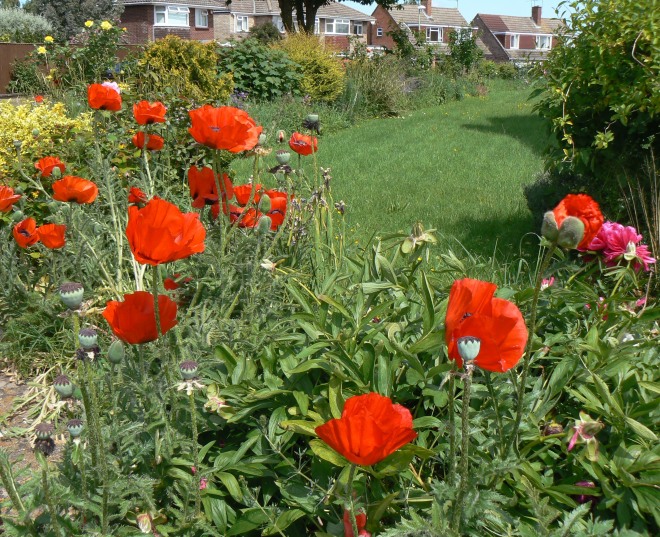
We took a drive out on Friday to a lovely part of the Cotswolds, the village of Wick near Pershore. I was keen to see the fields of Delphiniums at Wick while the weather was good.
Acres of delphiniums are grown by Charles Hudson on the Wyke manor Estate, which are dried and sold as natural confetti for the Real Confetti Company. Apparently delphiniums, apart from growing in a range of vibrant colours, keep their colour indefinitely once they are dried, while rose petals go brown, carnations go black and marigolds shrivel up. This makes delphiniums perfect for confetti. Being totally natural, they biodegrade and don’t litter up churchyards and wedding venues, many of which have banned paper confetti for this reason.  I was told that when Prince Charles and Camilla came out from their wedding the young royals, William, Harry, Zara and others threw real confetti from Wick over the happy couple.
The village of Wick is a delight to behold. It is really ancient and retains every bit of its character. It must be the quintessential English village with its old church, thatched cottages and beautiful manor house.
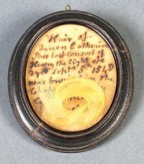
The original manor was called Wyke Manor, using the ancient spelling, and it had a very long and illustrious history. It was owned by John Nevill, 3rd Lord Latimer, involved in the Pilgrimage of Grace in 1538. Upon his death in 1543, he willed the manor to his widow Catherine Parr. Catherine later married King Henry VIII (28 June 1491 – 28 January 1547) as his sixth and last wife in July of 1543. She was 31 years old and he was 52. The marriage didn’t last long as Henry died in 1547 so Catherine outlived him. A small piece of Catherine has returned to the Manor recently as a lock of her hair came up for auction. The hair is mounted in an oval frame on ink-inscribed paper which states “Hair of Queen Catherine Parr, Last Consort of Henry, the night she died September 5th 1548 was in the Chapel of Sudeley Castle”. The current owner of the manor, Charles Hudson, paid £2,160 for the hair, in order to return it to the manor.
Catherine Parr's Hair
After Catherine died, the estate passed to Anthony Babington, who was later executed for treason after plotting to kill Queen Elizabeth I! It then passed to Sir Walter Raleigh, who was also executed.
The Hudson family have owned the Wyke manor Estate since the 1760s and the current owner is Charles Hudson and his wife, the writer Cressida Connolly. I was fascinated to learn that Cressida is an authority on Ladybird Books, which I have always rated highly.

I have recently been told that the house which is now on the Wyke Manor Estate was partially rebuilt in the 1920s in the Elizabethan style.  I am grateful to Paul, a resident of Wick, for this update.

The people of Wick that I met were absolutely lovely and pointed me in the direction of the shop at the back of the manor house. This is not like any shop I have ever seen before. It is literally a part of the stable block and there are children’s bikes scattered all over the yard. Inside the ‘shop’ a lovely young lady, who must have the best job and workplace in the world, was boxing up exquisite dried petals into pretty boxes. Along one wall is a vast array of open boxes each containing different coloured dried petals. The smell and colour and atmosphere is hypnotic. I felt as if I had walked into a fairytale. Honestly, if you get the chance you just have to go along and experience it.
Well I spent so long soaking up the atmosphere that it was getting decidedly overcast by the time I headed off to the actual confetti fields. But I rushed to get as many photos as I could before the light failed, the heavens opened and I got soaked! It was definitely worth it though. Enjoy my photos.

It’s The Simple Things

IMG_1352

Reflecting on the week ahead of me I am delighted but a little daunted by the prospect of amusing 3 children under 10 while their parents work. These are my adored grandchildren and I love them to bits, but will I have the energy to keep them all amused?
Chekhov considered the work of an artist/writer, to be “the proper presentation of the problem”, so I tried to analyse the root of my anxiety. It became clear that I feel bound to stimulate and educate the grandchildren, while feeding them nutritious meals, sticking to their proper sleep patterns, keeping them clean and safe, and ensuring that they are happy and having fun at all times.  When I consider these goals, I see that they are idealistic and possibly unrealistic given a) the British weather and b) my age and situation.

So I cast my mind back to the things they have really enjoyed in the past and I realise that it is the simple things that bring the most pleasure.  So we can put away the Ipads, Xboxes, Dvds and electronic games and instead get out the wellies and walk!

Dodging the raindrops dressed in wellies and macs,

Jumping in puddles to make a big splash

Picking up pebbles to throw in the stream,

Peeping through fences, who knows what you’ll see

Goats, cows, pigs and hens abound

Sheep in the fields with their lambs all around

Watch a man in a red tractor cut grass in the park

Ring grandma’s doorbell and hear her dog bark.

In the sky there are seagulls,  helicopters and planes

As we walk past the airport along country lanes.

The roads are too busy with vehicles galore

Lorries, trucks, buses, police cars and more.

Popping into the pet shop to see what is new

Stanley climbs up a ladder to get a good view

Of fish, bearded dragons, geckos, rabbits, snakes too.

Reaching the playground we ride the model train

Taking trips to the seaside and then back again

Eating our picnic in the playhouse was fun

The day passed too quickly but now it is done

Walking back was an adventure, we walked on the walls

Spotting birds, trees and flowers, ladybirds and snails

I can’t wait for tomorrow to do it all again.

Creative writing from the bottom of my memory

I am quite excited today because this evening I am going to the inaugural meeting of our new Creative Writing Group. A couple of months ago I was asked to come along to an Artists Way meeting to chat about my blog and how I got it started.
I was a little daunted but very pleased to be asked as I still consider myself a learner in the blogosphere. In fact, the more I delve into it and the more wonderful bloggers I discover, the humbler I get!
But I went along and found the group to be made up of lovely, enthusiastic and creative people. All of them have a story they want to tell and they were full of stimulating questions. I tried my best to encourage a lively discussion but the evening went far too quickly. So, we agreed that what we need is a writing group. There are some well established groups in our area but they didn’t fit our bill. So we decided to start our own. There is no leader or teacher, just a group of us who will hopefully be encouraging while reading, writing and discussing each others work.

Now if any of my blogging community can give me guidelines or tips that I can pass on I would be very grateful. Perhaps you have been part of a group and found a particular session really useful, I would love to know.

Of course one of the things I had to do before meeting the group is decide what makes my blog tick. I have my lovely quote from Tom Stoppard after my header and I truly believe that. However
the essence of my blog can be expressed in a quote from The Way of the World by Nicolas Bouvier,

“I dropped this wonderful moment into the bottom of my memory, like a sheet-anchor that one day I could draw up again. The bedrock of existence is not made up of the family, or work, or what others say and think of you, but of moments like this when you are exalted by a transcendent power that is more serene than love.”

This is how and why I write, I treasure memories and moments when I felt like heaven happens. I will again reblog something I wrote right at the start when not many people were reading my blog. You have to read right to the end for the little bit of transcendent power though!!
I hope you enjoy it.


Prayer

I thought I would re blog some of my very early posts from when I started blogging. At that time I had very few readers and I think it is a shame that some of the posts I loved were not seen. Now that I have a few readers whom I really appreciate I thought I would push my luck and see if I can get you to read my earlier haiku and ramblings. Hope you enjoy them x

heavenhappens's avatarHeavenhappens

This post is inspired by the Carpe Diem Haiku prompt for today, “Prayer”

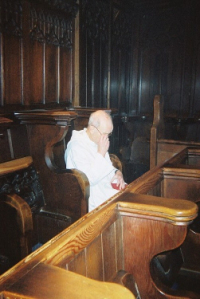
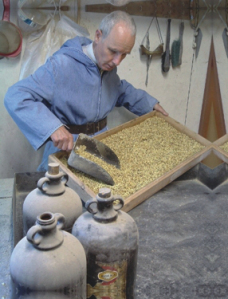
When I first retired from my work in education, I went to work as a housekeeper at Prinknash Abbey This was a labour of love and I learned a great deal about the prayerful life from the Benedictine monks who live and work there.  I learned from Fr Alphedge that every single thing you do can be a prayer if it is done with reverence and joy.

Fr Alphedge at work and prayer

Peaceful and prayerful

monks, masters of mindfulness

sacramental lives

Fr Adhelm in the chapel at prinknash

Meaningful moments

Of quiet contemplation

simple and sincere.

Incense is made at Prinknash

Alone with your thoughts

humbly open your heart, and

Let healing begin

Stained glass window from Gloucester cathedral

Drowning in despair

from the core of your being

you cry to the Lord

Peace dove made…

View original post 42 more words

St George’s Day

Fascinating information about the mysterious St George

Faith Unlocked's avatarFaith Unlocked

Today is St George’s Day!

St George is the patron saint of England (and many other places). He wasn’t English and almost certainly did not slay a dragon.

It is likely that Saint George was born to a Greek Christian noble family in Lydda in Palestine, during the late third century between about 275 AD and 285 AD. He died in the Greek city of Nicomedia in Asia Minor. His father, Gerontios, was a Greek from Cappadocia, an officer in the Roman army; and his mother, Polychronia, was a Greek native of Lydda. They were both Christians from noble families of the Anici, so their child was raised with Christian beliefs. They decided to call him Georgios (Greek), meaning “worker of the land” (i.e., farmer). At the age of fourteen, George lost his father; a few years later, George’s mother, Polychronia, died.

Then George decided to go to Nicomedia, the…

View original post 452 more words