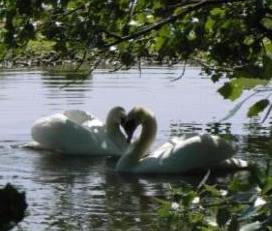
As I am posting this on valentine’s day I decided to use a photo I took in Dorset. I was at the Abbotsbury Swannery on Chesil Beach and it was a wonderful experience. The photo is not brilliant but it captures a beautiful moment shared with two swans that have mated for life. Ahh x x x
I’m also quite partial to a few other photos taken a while ago showing symmetry of sorts
Blenheim palace detail
Blenheim palace
The saddest door of all ~ Traitor’s gate at Tower of london
Fascinated by the photos on the Weekly Photo Challenge, I thought I would join in this week. The prompt is ‘scale’ and I just had to post a photo of scale model of a hare.
Tess covered in Mosaics at the Corinium Museum
Tess covered in Mosaics at the Corinium Museum
Tess before and after she was decorated
In recent years there has been a spate of large scale ceramic or stone objects appearing in towns and cities of the UK. Having mentioned it to my daughter last night I know that they have been seen in the USA too. The first time I came across it was when my grandchildren, Ben and Rosie went to London and were photographed alongside large colourful elephants. Wallace and Gromit were in Bristol recently too.
Next I heard of a Gorilla festival in Torbay and Exeter. There was also a festival of decorated horses in Cheltenham in honour of the races. Then it was 5 foot tall hares in Cirencester.
Why hares you might wonder?
Well Cirencester was a very important place in Roman times. It was called Corinium and had very good road links to the rest of the UK, such as Ermin Way and the Fosse Way. In 1971 during an archeological dig in Beeches Road near to the River Churn, a Roman mosaic was discovered depicting a hare. The original is now on show in the Corinium Museum. Hence the theme of hares for the festival. There were about 50 hares around the town. Most of them were 5 foot tall and decorated by local people including schoolchildren, members of the public, celebrities and artists. All of the large hares were named to reflect their sponsors. One of the most beautiful hares, named Tess, was on display in the Corinium.
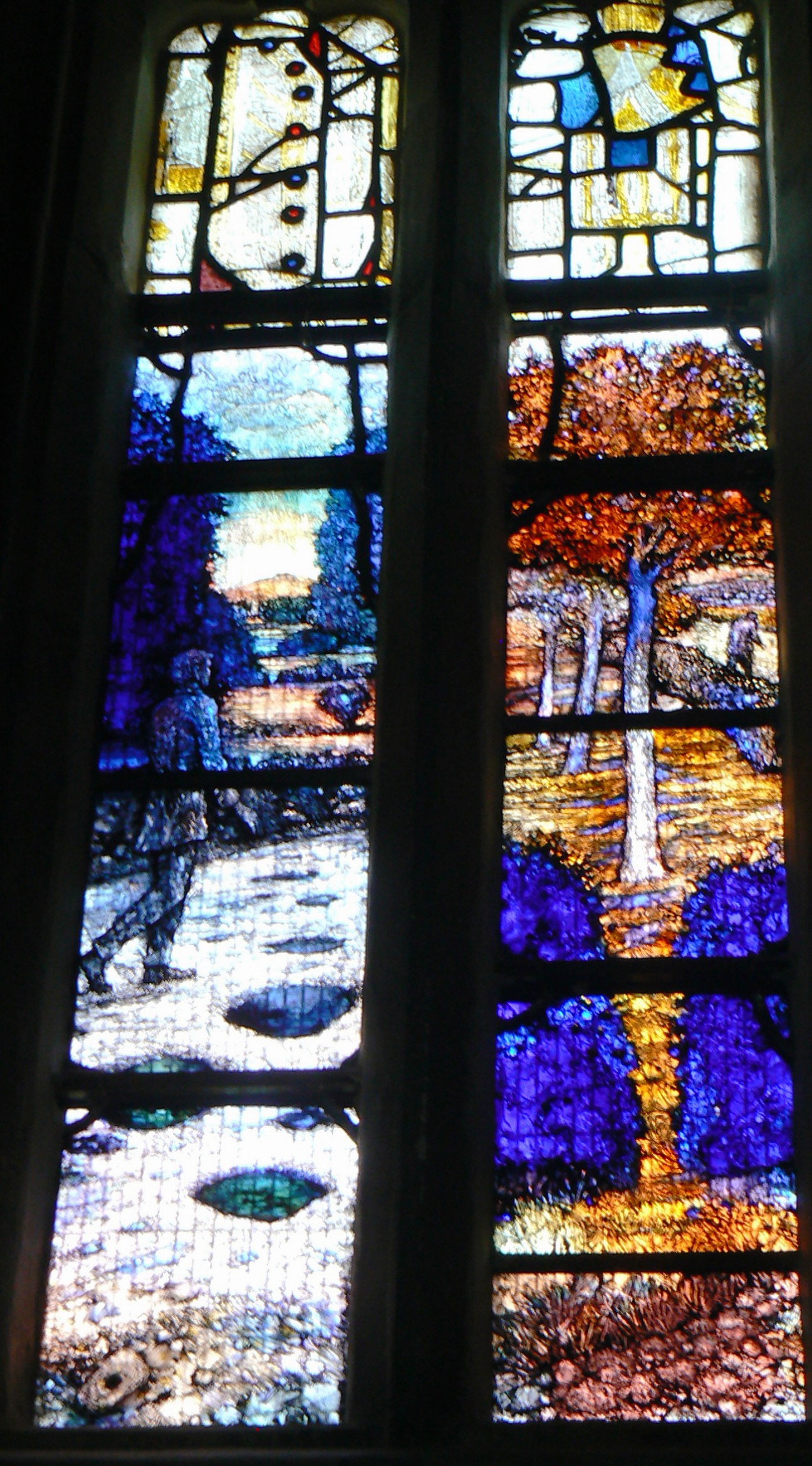
In Gloucester Cathedral there is a new stained glass window created by Tom Denny, which is a memorial to the Gloucestershire poet, Ivor Gurney. Like Will Harvey, whom I have written about before, he was a pupil and chorister at the Cathedral school before joining the Gloucestershire Regiment to serve in the First World War. Indeed, they were great friends. Gurney was a talented musician firstly, but in the thick of war, poetry became his creative outlet. Like Will Harvey he survived the war but was drastically changed by it. So much so that his fragile mental health was totally destroyed, and he spent many years in a mental asylum where he eventually died before he was 50. Gurney is buried at Twigworth, where his gravestone commemorates him as ‘poet composer of the Severn and Somme’.
Gurney’s poetry is beautiful and reflects his love for the Cotswolds, the countryside and the beauty of nature. I’d like to share 2 of them with you that touch me deeply for different reasons.
Firstly, To His Love which is a poem thought to be written by Ivor Gurney when he thought his friend Will Harvey had been killed.
To His Love’
He’s gone, and all our plans
Are useless indeed.
We’ll walk no more on Cotswolds
Where the sheep feed
Quietly and take no heed.
His body that was so quick
Is not as you
Knew it, on Severn River
Under the blue
Driving our small boat through.
You would not know him now…
But still he died
Nobly, so cover him over
With violets of pride
Purple from Severn side.
Cover him, cover him soon!
And with thick-set
Masses of memoried flowers-
Hide that red wet
Thing I must somehow forget.
The second is The Bugle, written after Gurney returned from the war, a sadder and wiser man. I include it as my grandfather was a bugler in WW1, and also because it speaks to me loudly of how ordinary life and commerce still goes on while soldiers suffer and die ‘out of sight, and out of mind.’
The Bugle
High over London
Victory floats
And high, high, high,
Harsh bugle notes
Rend and embronze the air.
Triumph is there
With sombre sunbeams mixed of Autumn rare.
Over and over the loud brass makes its cry,
Summons to exultancy
Of past in Victory.
Yet in the grey street women void of grace
Chatter of trifles,
Hurry to barter, wander aimlessly
The heedless town,
Men lose their souls in care of business,
As men had not been mown
Like corn swathes East of Ypres or the Somme
Never again home
Or beauty most beloved to see, for that
London Town might still be busy at
Its sordid cares
Traffic of wares.
O Town, O Town
In soldiers’ faces one might see the fear
That once again they should be called to bear
Arms, and to save England from her own.
There are many learned websites with information about Ivor Gurney, but my wish today is simply to share the beauty and poignancy of the new window and explain a little of its background.
There are 8 lights or panes overall and each reflects something from the life and writing of Ivor Gurney. The notes are a precis of those that appear in the Cathedral by the window.
Light 1 ~ Glimmering Dusk ~ a figure walks at dusk in a Vale landscape. there are dark pools of rain on the white road and May Hill can be seen in the distance.
Light 2 ~ The Stone Breaker ~ In Flanders a chance encounter with some road menders reminds Gurney of a much earlier meeting (“Oh years ago and near forgot”), in the fresh beauty of a summer’s early morning, in a landscape of Vale orchards.
Light 3 ~ Brimscombe ~ Gurney remembers a night-time walk through the fir trees of the steep-sided Brimscombe valley near Stroud. The “pure clemency” of the moment enables him to forget the “blackness and pain” of France.
Light 4 ~ Severn Meadows ~This was written in March 1917 at Caulaincourt. As the sun sets over Severn meadows, a figure, in the shadow of a willow, looks back at the river and the willows.
Light 5~ Pain ~ Gurney recalls the grey-white Somme battlefield.
“Pain, pain continual; pain unending;….
Grey monotony lending
Weight to the grey skies, grey mud where goes
An army of grey bedraggled scarecrows in rows
Careless at last of cruellest Fate-sending.
Seeing pitiful eyes of men foredone,
Or horses shot, too tired to merely stir,
Dying in shell-holes both, slain by the mud.
…………………………………….
The amazed heart cries out to God.
Light 6 ~ To His Love ~ Probably drafted on the Somme battlefield, Gurney reacts to the news (false as it turns out) that his great friend, the poet Will Harvey, is presumed killed. A couple walk on the Cotswold hills as their dead friend lies among the violets.
Light 7 ~ To God ~ In the intense suffering from mental illness, surely aggravated by his experiences on the battlefields, Gurney cries out for death, “I am praying for death, death, death”.
Light 8 ~ Song and Pain ~ A more optimistic end to the window as a figure emerges from an understanding of pain to enter “The House of Joy”.
As I stood and gazed at these incredibly beautiful but harrowing windows, there were people around me moved to tears by what Gurney had seen and suffered. Tom Denny is a wonderful artist. He has captured and honoured Gurney’s genius, his love of Gloucestershire, and his suffering in that dreadful war and in his mental distress.
Many years ago, it seems like another lifetime, I was a busy single mum to 4 wonderful children. I had a full time job that I loved, a nice home that was all my own work, an adorable miniature wire haired dachshund and a stray cat who turned up one day and stayed for 17 years. Over the years I progressed from teacher to deputy head and then Headteacher of a great primary school at the heart of an estate in my adopted home town. Luckily my profession fitted in perfectly with being a single parent as I was usually around in school holidays and always at weekends. But if ever there was a crisis due to illness or something I had the backup of my mum who lived nearby and was always delighted to look after the children or pets!
My school and parish was my community and together with my family, was the source of all the joy, friendship and social life I needed. Although I knew my immediate neighbours, my life was much too busy to get involved in the local community or the people in the wider neighbourhood.
And so life went on and my children became adults and gradually left home. I had always encouraged them to follow their dreams and take any opportunity they could to travel and sample other ways of life and other cultures. I was lucky enough to travel extensively through my job, working with schools in Russia and Africa. I also took great holidays in America, Canada and many parts of Europe. So I think I probably went a bit too far with this advice as now 3 of my children live and work abroad!
As my children grew more independent I filled my spare time travelling to Lourdes at every available opportunity as a volunteer/helper with the sick or disabled whom we called VIPs. This was one of the most rewarding 10 years of my life. It also indirectly brought me my wonderful second husband who was also a volunteer.
I knew that I was very lucky in every way and I worked very hard to try and improve the life chances of the children in my school. But of course life has a way of turning your world upside down sometimes. For me several events occurred to produce the perfect storm that would shatter my well ordered life. I buried my feelings and worked harder and harder until my body refused to do any more and I had to retire.
There then followed 5 very gruelling years which felt like 50 years. I was caring for my mum who was disabled after a heart attack. I only ever went out of the house to shop or for their hospital appointments. I became reclusive, antisocial and anxious. By 2009 my life and social circle was as limited as it could possibly be.
Then in that Autumn my youngest daughter said some women wanted to start a WI in our area. She said she thought it would be good for me so she would go with me to the inaugural meeting. It took all my courage to turn up that night and fortunately there were only a handful of women there. In fact there were so few that almost everyone there ended up on the committee by default! My daughter said I was good on computers so could be the secretary.
Now, almost 4 years on, I know that joining the WI was the best thing I could have done. At first I forced myself to go to all the meetings as I had to take notes. Gradually it became a pleasure to attend the meetings and I looked forward to them. I joined the Book Club and started reading again. I started putting my name down for trips and events. To give me the courage to turn up for them I took my camera to hide behind and became our unofficial photographer. I ventured out to concerts and big events like the AGM in Cardiff. It still takes quite a lot of courage for me to attend these things but I know that if I am struggling I will not be alone. The friendship and support WI members offer each other is very special. I even joined the Public Affairs Committee at our Federation.
Usually I find that the speakers at meetings are so interesting that I completely forget to worry or panic and just enjoy myself!
Now the WI is my community and my family. Through joining, I have rediscovered my creative side, writing a blog at http://www.heavenhappens.wordpress.com I have become outgoing and physically active again and renewed my interest in campaigning.
Best of all, when I walk anywhere in my local area now I seem to know everyone and they all stop for a chat. I feel that I am part of a vibrant and supportive community.
The WI offers all kinds of opportunities to all kinds of women. I would advise any woman of any age to join and get involved to whatever extent you feel able.
The WI is all about inspiring women. It is a rich source of experiences, knowledge and skills passed down through generation ~ and updated every day!
WI even enriches my now rare holidays, as I try to pop in to a local meeting while I am away. It is fascinating to see how different WIs conduct their meetings. But I can honestly say that whichever WI I go to, I know a warm welcome is guaranteed.
I am so happy with my life now and I thank God every day for my wonderful family, friends and community.
Rest not! Life is sweeping by; go and dare before you die. Something mighty and sublime, leave behind to conquer time. — Goethe
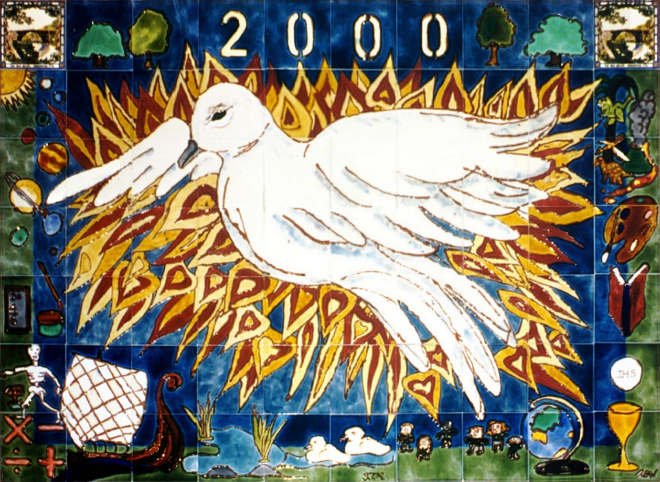
The prompt in the Weekly Photo Challenge this week is the word ‘threshold’. Looking through my photos this one of the tile frieze made at the end of 1999 for the year 2000 leapt out at me. It is hard to imagine today just what a big deal it was being on the threshold of a new millennium. There were all sorts of apocalyptic warnings about power failures, planes falling out of the sky, systems not being able to cope etc. No-one really new what would happen at midnight on 31st December 1999 and what the new millennium would mean for civilisation. So I wanted to mark the occasion with something very special and permanent for my school.
St Thomas More School was a huge part of my life. In the early 1970’s I watched the new school building rise in the middle of an open field that had once been farmland and an orchard. There was an ancient hedgerow all around the site and just one magnificent old oak tree in what would be the playing field. When it was opened in 1975, I was having my third child so was not available for teaching. But, as I drove past the school every day, I vowed that one day I would work there.
I got my wish in 1984 when my youngest child was ready to start school. I was offered a job and jumped at the chance. The next decade was a time of great blessing as I worked in virtually every class, teaching all age groups, then became deputy Head. In 1994 the original Headteacher was due to retire and, to my surprise, I was offered his job. He had been such an inspirational Head that the school was a joy to work in. Taking on his role, I tried to emulate him while making my own mark and bringing my own vision for the school into being.
Due mainly to the quality of the staff and their outstanding teamwork, the school became a strong and successful community, ‘an oasis of excellence’, appreciated by staff, pupils and parents alike.
In 1999, as the new millennium approached, the staff wanted to mark the year 2000 with a special feature. We wanted the whole school community to be involved in creating something totally unique and meaningful. We came up with the idea of making a large tile frieze. Each year group was asked to brainstorm their favourite lessons, subjects, or topics, and represent their ideas on paper.
Reception class, the youngest children were just 4 or 5 years old and had only just started school. They had their photographs taken in their shiny new uniforms, so that was their contribution.
The Year 1 class had helped to build a pond and were raising ducklings which they had hatched from eggs in an incubator, so they drew pictures of that. I have a wonderful memory of the day the ducklings hatched out ~ the local policeman had called up to the school on a social visit and he watched as the first duckling struggled to crack open the shell. When it finally succeeded and out popped this beautiful and perfect little bundle of yellow feathers, he was overwhelmed by emotion and had tears in his eyes.
In Year 2 the 7 year olds made their first Holy Communion as it was a Catholic school so they drew a chalice and host. Being the most significant event in the year, that was their contribution.
Year 3 was the first year of juniors and the children enjoyed learning about Vikings and the Human Body, so they drew lovely longboats and skeletons.
In Year 4 things got much more subject focussed so Maths was represented by a calculator and mathematical symbols.
In Year 5, Music, Dance and Art were the main features, so a pot of paint and a brush was drawn. Science too was represented by the planets.
By Year 6 the children were getting ready to move on to secondary school. In order to give them a taste of independence and adventure, it was our tradition to take the class away to Shropshire for a week to stay in a Youth Hostel. Here, in the Ironbridge Gorge, birthplace of the Industrial Revolution, we had a wonderful time. We visited the Iron Museum, The Jackfield Tile Museum, Blist’s Hill Reconstructed Village, River Severn Museum and of course the first Iron Bridge ever built. We also had amazing night hikes, midnight feasts and parties. Altogether it was an incredible opportunity for fun and learning. So naturally the Ironbridge at Coalbrookdale was the emblem of Year 6.
The staff gathered all these pictures and images together and chose the ones that would be painted on to the tiles. The Year 5 teacher, ABW, a wonderfully creative artist and teacher, took on the challenge of putting all the ideas together and creating a design on tracing paper which could be transferred onto numbered ‘green’ tiles. It was agreed that we would go to Jackfield Tile Museum to create the finished work.
A representative group of staff, parents and children spent a weekend at the Youth Hostel and were each given a small area of the tile frieze to paint. ABW had done a magnificent job scaling all the children’s artwork up or down so that the frieze would reflect the life of the school. It was agreed that the year 2000 would go at the top, as well as the 4 trees, oak, ash, poplar and beech, which were the school emblem. In the top corners would be tiles depicting the Ironbridge itself. The children’s artwork would go around the edge, and at the centre would be the Holy Spirit in the form of a dove surrounded by flames.
We painted the tiles in coloured glaze. I will never forget the atmosphere in that studio at Jackfield as we worked on the frieze. There was a stillness and peace in the room which was truly sacramental. While we worked, the Spirit moved in that place and heaven happened.
When we finished, the tiles were left at the Jackfield tile Museum to be fired. A couple of weeks later they were collected and set into a frame made by the reception class teacher’s husband.
Bishop Mervyn Alexander of Clifton RIP came in the year 2000 to celebrate the school’s 25th anniversary and he blessed the tile frieze.




 Heavenhappens