A Gloucestershire Rhapsody

I have the deepest respect for anyone with mental health issues who manages to keep going in ‘normal’ life.  But for those who do their duty in extremely stressful situations, I have nothing but the greatest admiration.

Such a person was the poet and composer, Ivor Gurney.  I have written about him before so readers may remember that he was a local man, a pupil and chorister at Gloucester Cathedral’s Kings School, and a talented student at the Royal College of Music until the First World War broke out.  Although he was a very sensitive person with mental health issues, his bravery and patriotism led him to enlist with the Gloucestershire Regiment.

In 1916 Ivor was on the Somme where he was wounded.  In 1917 he was transferred and fought in the horrendous Third Battle of Ypres, better known as Passchendale. Here Gurney suffered from a gas attack, eventually returning to hospital in the UK.  He went to recuperate in a little mining village I know well from my childhood, Seaton Delaval, in Northumberland.  Here he wrote poems, including the famous first book of poetry Severn and Somme, which was published in November 1917.

After all he had been through, Gurney became mentally fragile and had to return to the hospital in London where he stayed until he died before he was 50.  Gurney is buried in Gloucestershire where his gravestone commemorates him as ‘poet composer of the Severn and Somme’.  

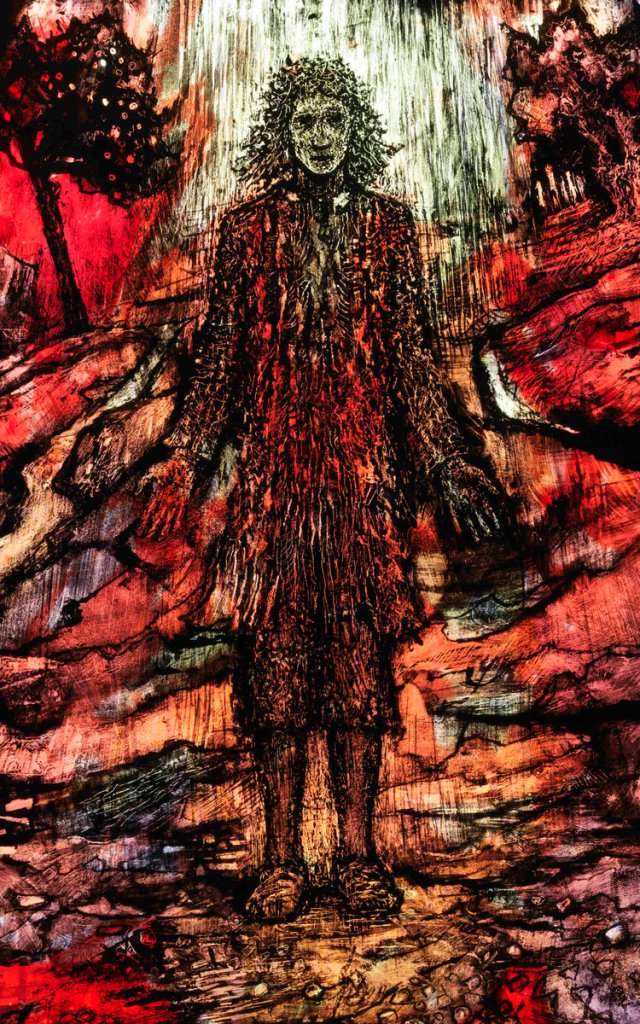
Although Gurney has a loyal following, the marvellous works that he left behind, both poetry and musical compositions were not sufficiently recognised in Gloucestershire until recently, when a magnificent series of stained glass windows were installed in Gloucester Cathedral.  And I have the greatest admiration for the Mezzo Soprano, Sarah Connolly, who worked tirelessly to achieve this.

In her own words she tells the story:

“One day, whilst rifling through the English song drawer marked G in the Royal College of Music library, I came across Ivor Gurney’s song, ‘Sleep’, and after playing and singing all the songs I had selected that session, his was the most startlingly beautiful.
Everyone who discovers ‘Sleep’ for the first time is deeply moved by it, history supports that. I was determined to find out about Ivor Bertie Gurney, since I felt his song expressed such character and depth and pain.

If only I had known that my harmony professor, Jeremy Dale Roberts had once been responsible for the fate of IBG’s entire musical oeuvre, after his friend and mentor Gerald Finzi had died. Finzi had successfully fought to rescue Gurney’s works from his jealous brother Ronald who had threatened to chuck the lot on the fire.
Think of the discussions Jeremy and I could have had! We have them now of course and I invited him, Joy and Kiffer Finzi to attend the fundraising concert, the unveiling and dedication ceremony of Tom Denny’s Gurney window in Gloucester two years ago.

The idea for a Gurney window was mine, and if I am grateful for any influence my career has afforded, it is that I did not even need to persuade the wonderful Gloucester Cathedral staff and Tom Denny, since they were unreservedly enthusiastic about it.
A few months later in a meeting with the wonderful Robin Lunn, who very sadly died recently, Tom Denny showed us his watercolour sketch of the 8 lights. I was moved to tears. I had requested that one light showed how Ivor suffered from what would be described today as Bi-Polar disease throughout his life. Shell-shock and the nightmare on the frontline would have heightened that condition to breaking point.
I also suggested to Tom that the lights be influenced directly by IBG’s poetry, since he was respected enough to be included in Westminster Abbey’s Poets’ Corner and a published poet in his own lifetime. Tom selected several poems to cleverly infuse each subject and the whole tone. At my request, the Cathedral agreed to display the poems next to the window.

To raise the funds to pay Tom and the Cathedral for hosting an all-day/evening event, I needed to raise around 26k minimum. Selling 800 seats for the evening concert was proving difficult. Rupert Christiansen very kindly ran an article in the Daily Telegraph Some local museums helped along with a JustGiving campaign under the aegis of the Cathedral’s charitable status.

The funds were raised from the day’s music making and from generous donations. Artists kind enough to give up time in their busy schedules included Simon Callow, Dame Felicity Lott, James Gilchrist, Neal Davies, Vernon Harwood, Joseph Middleton, the English Chamber Orchestra, Tenebrae Choir, Adrian Partington, Professor Jeremy Dibble, Nigel Short, and composer Judith Bingham who also wrote A Walk with Ivor Gurney for myself and Tenebrae to perform on the occasion and to many others who helped and advised me.

At the dedication ceremony, where I sat next to composer Ian Venables, chairman of the Ivor Gurney Society, (of which I am now a proud patron), we both shed a few tears when the Dean Stephen Lake intoned the official words of welcome to Ivor Gurney who at last had a gorgeous tribute fitting to his status and life devoted to music and the Cathedral.”

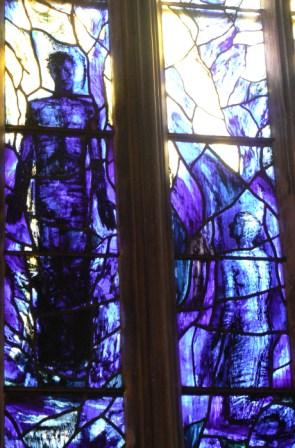
I hope you enjoy my photos of the beautiful Ivor Gurney windows from Gloucester Cathedral.
A Window on my World

Since lockdown eased and I am able to travel again, I have embarked on a very personal pilgrimage.  In the past I have travelled with groups or a few friends on pilgrimages to Lourdes.  And in the Jubilee year, 2000, I went on a pilgrimage with my late husband to Rome.  But this is an entirely different sort of pilgrimage.  My focus is to visit all of the chapels, churches, cathedrals and abbeys for which Tom Denny has created stained-glass windows. 

A pilgrimage is simply a journey to a Holy place. But we often discover our true selves on the journey, and go home refreshed, restored, and with a renewed sense of purpose and meaning in our lives.  So, I guess I am trying subconsciously to find new meaning and purpose for my life since being widowed. 

I’m not going to write a learned piece about stained-glass or compare the merits or otherwise of ancient versus modern, as that has been done elsewhere.  We know that the purpose of the earliest stained-glass windows was to portray the Gospel stories, and lives of the Saints, for people who did not have access to a Bible or religious texts.  They were informative, telling the churchgoing viewer what to believe.  They are undoubtedly exquisite works of art. But I do not find them as mesmerising and deeply spiritual as Tom Denny’s windows.  His seem to be reflective (apologies for the pun) rather than instructive.  They show what is and ask you for your response.

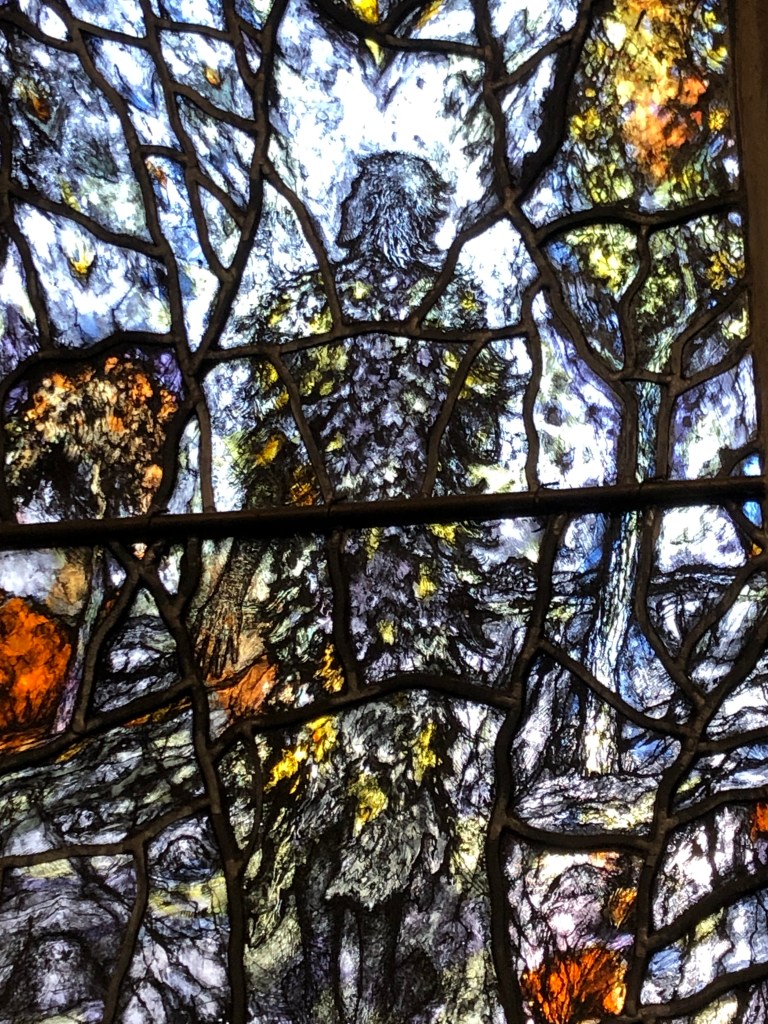
I have loved his work since I first saw his depiction of Jesus showing his wounded hands to doubting Thomas.  The image, created in 1992 in Gloucester Cathedral, is stunning. From a distance there is just a vast area of azure blue glass.  But when you closely study the windows, you begin to see the details.  The sun and moon presiding over the elements; the trees, animals and birds. And then, hidden but in plain sight, Jesus. He is looking out from the window at me with his hands open as if to say, “Here I am. This is me. I have given my all for you and all of humankind.  Now go and do the same!”  That impression will never leave me.

00020768

So, I have embarked on my pilgrimage to see and learn more. I was delighted to discover that there are many more of Tom Denny’s windows within a couple of hours drive of my home.  First, I visited Hereford Cathedral where the windows celebrate the life of Thomas Traherne.  I knew nothing of this 17th century mystic priest and poet.  I have since discovered that Traherne was a brilliant man and a philosopher, way ahead of his time.  His wisdom is poured into his astonishing prose, Centuries of Meditations.  Traherne believed that the presence of God is everywhere and that we are called to sense it every day.  His parish was in Credenhill, a Herefordshire village surrounded by the beauty of the natural world.

I have realised that Tom Denny really gets to the heart of a place or person before he embarks on the creating a window. So, all of this beauty is reflected in the details in Tom Denny’s windows.  There are children, old people, animals, birds, butterflies and insects, trees, hills and fields, as well as the city of Hereford.  All are bathed in the light coming from the cross. 

Traherne called young children ‘moving jewels’ ~ isn’t that just lovely?

I have copied some details from Tom Denny’s book, Glory, Azure & Gold as the windows are quite high and my photos don’t show the detail.

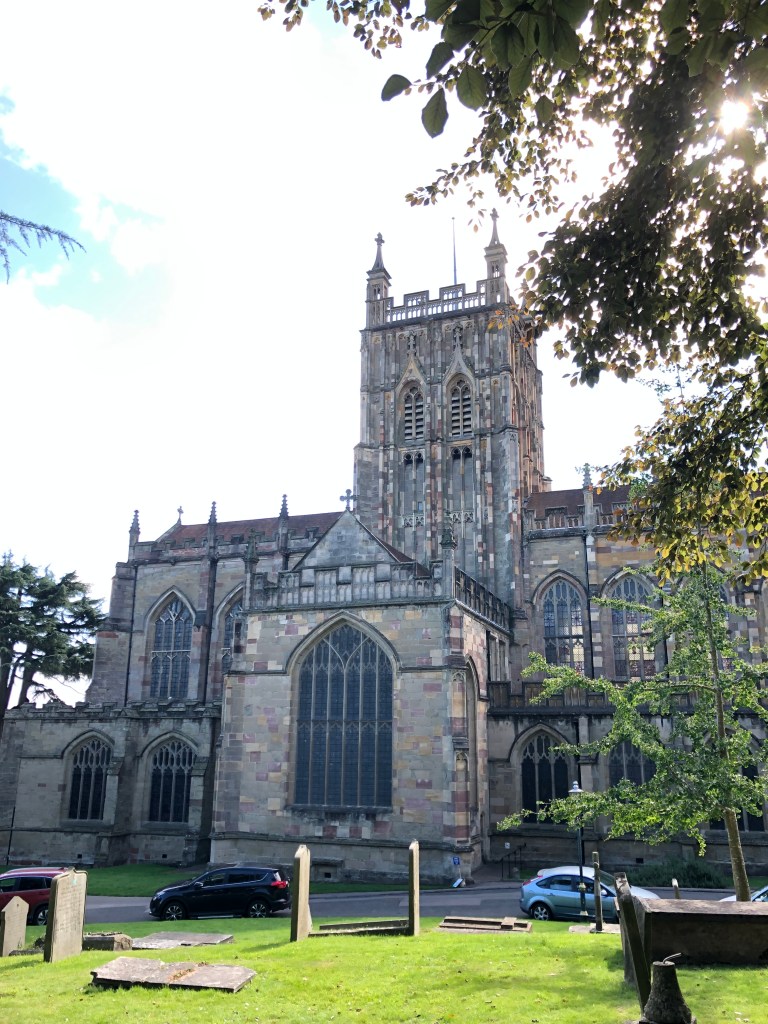
This week I continued my pilgrimage with a trip to the Priory Church in Great Malvern.  This was a revelation again.  Firstly, Malvern is a beautiful town set in glorious lush countryside surrounding the Malvern Hills.  There are gorgeous parks with some truly ancient trees and beautiful lakes and springs.  Indeed the town has been famous for its spring water since 1622.  The town is quite a challenge for me as it is so hilly and I get quite breathless since I had Covid.  But I persevered and am so glad I did.  The priory itself was founded by the Benedictine monk, St Aldwin in 1085.  It was a monastery for 450 years until it was at risk of dissolution.  In 1541 the local people raised £20 to save it for the town. Since then it has been a parish church.  It still has an original stone font from Norman times and the 15th century Nave is built on the original columns from 1085.  It also has a treasured collection of stained glass windows dating back to mediaeval times.  They depict old testament scenes including the Creation, and the lives of Noah, Abraham and Moses.   But of course I came to see the fabulous Denny Millennium windows.  These were installed in 2004.  They were based on Psalm 36 which explores the nature of God.  The windows express the theme through images from nature: including heavens, clouds, mountains, oceans, wings, fountains and light.  There are also people in the windows so typical of those I have seen in other Denny  windows.  They are simple, rustic representations yet with faces and movement full of personality.  There is also a magnificent depiction of a stag, which to me represents the power and glory of God.  Here are some of my photos. But do scroll to the end to see my favourites!

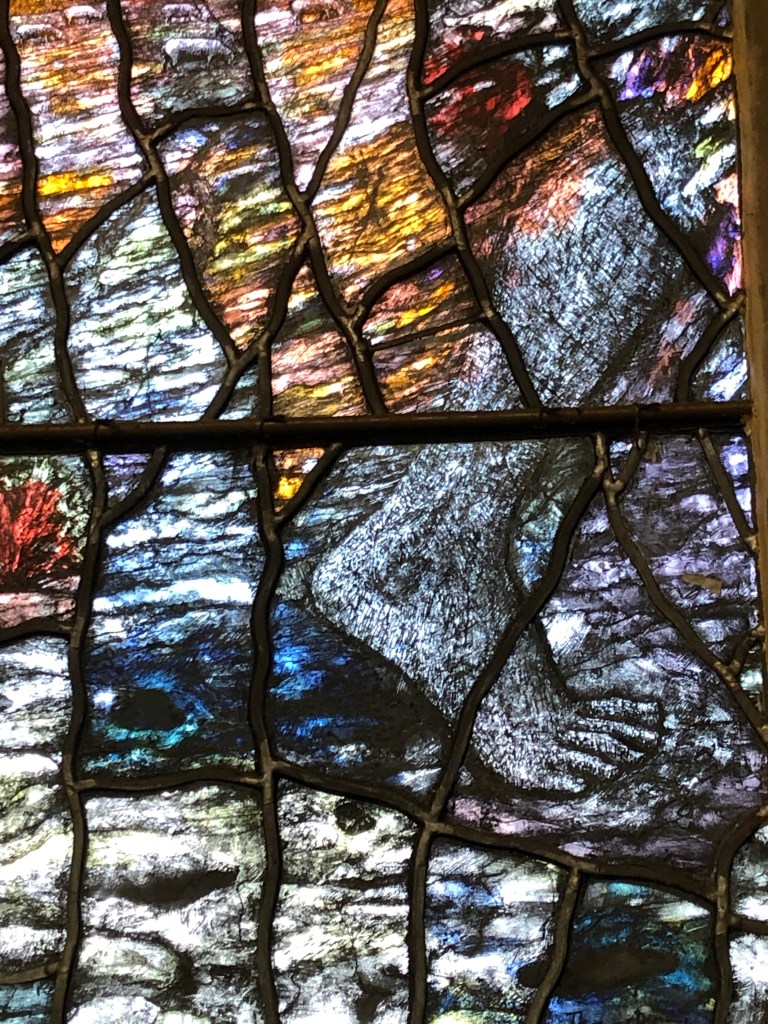
This last image is one that will stay with me. There are countless ways to interpret the foot seemingly walking out of the window. Denny quotes, “Behold upon the mountains the feet of him that bringeth good tidings…” (Nahum 1.15). Being a long time member of the WI it also reminds me of the hymn Jerusalem: “And did those feet in ancient time walk upon England’s mountains green?”

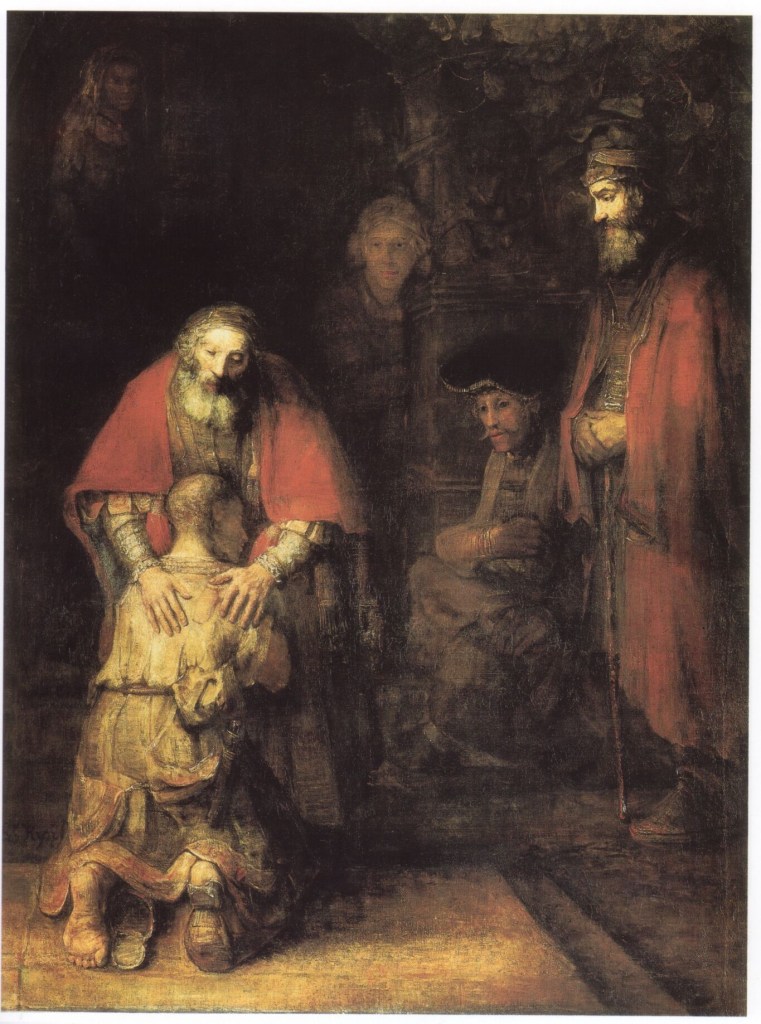
But over all that it reminds me most of the feeling I got when I first saw the original painting by Rembrandt of The Return of the Prodigal Son. I was visiting the State Hermitage Museum in St Petersburg, Russia in 2003. The Hermitage is huge and there are many floors and corridors to explore. On one of the corridors there were 2 enormous panelled doors which were closed. On opening them I was confronted by the painting which was immediately facing the doors and took up the whole wall. The painting is 81/2 feet tall and the figures are life size! The impression I got, which was of course cleverly planned, was that I was stepping into the painting ~ I was the returning prodigal son and the face of the father was lit up with love for me! Rembrandt has brilliantly portrayed the son with one shoe falling off and his bare foot cracked and sore, to represent the journey, hardship and defeat he has suffered. I have to say the painting filled me with such emotion that it made me cry.

The Return of the Prodigal Son by Rembrandt van Rijn (1606-1669)

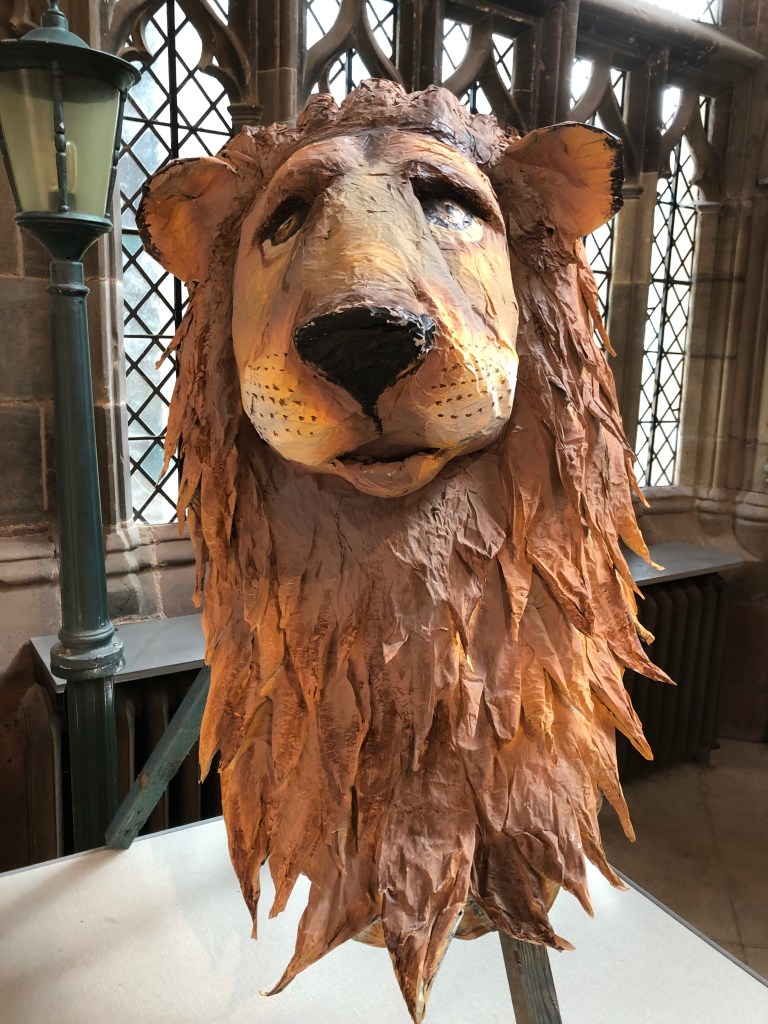
If you are still with me on this exceptionally long blogpost, I apologise but hope it is worth it. At the East end of the priory church was a very unexpected find. There is a display about C S Lewis’s book, The Lion, the Witch and the Wardrobe. Lewis spent much of his childhood in Malvern, not all of it happy apparently, and went to Malvern school. He often attended services at the priory. It is noted that as he left via the East porch he would have seen the light streaming through the great east window as if there was another world beyond. So, the porch is believed to be the inspiration for the wardrobe. I have to say that seeing the porch as I did on a lovely sunny day, this seems highly plausible. So there is a carving of a lion’s head and a replica gas lamp behind the porch. Another minor detail I discovered is that the word Aslan, which is the name of the lion in the 7 books in the Chronicles of Narnia series, is derived from the Turkish word for lion.

To learn more about the work of Tom Denny check out his website https://www.thomasdenny.co.uk