A visit to Krakow in Poland

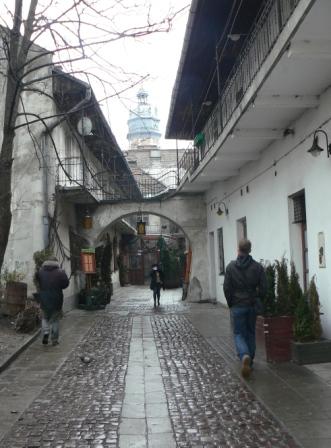
This street was used in the filming of Schindler’s List

Today, 27th January 2025 is Holocaust Memorial Day so I am republishing some of the occasions when the true horror of what happened to the Jewish people was brought forcibly home to me.

The city of Krakow is beautiful, compact, well preserved and a joy to walk around.  I went  some years ago with a dear friend for a few days.  It was a leap of faith for me after my last disastrous attempt at a plane journey.  But this time I just relaxed and enjoyed the whole experience.  I thought it would be really cold but actually it was warmer in Krakow than the UK.
There are some times and some places I find, when all your interests seem to converge, and this was one of those times and places for me.  I once read that the thing of interest to a scientist is ‘everything in the universe’.  I’m no scientist but I do like to make sense of the world and I prefer to find out for myself rather than be told what to believe.  So my visit to the old Jewish quarter in Kazimierz as well as my visit to Schindler’s Enamel factory, which is now a museum, was a revelation.  This is what I learned:
“On great fields something stays.  Forms change and pass; bodies disappear; but spirits linger, to consecrate ground for the vision – place of souls”. 
So said Maj. Gen. Joshua L Chamberlain at Gettysberg and I knew exactly what he meant when I stood on the site of the Jewish ghetto after visiting Oskar Schindler’s enamelware factory in Zablocie, Krakow.  It happened that I was there on 14thMarch 2012, 69 years to the day of the “final purge”.  The fact that this holocaust happened within living memory is horrific.  The fact that slaughter of innocents on this scale may be happening in parts of the world today is unbearable.
There were about 225,000 Jews living in Krakow before the war but only about 15,000 managed to survive it with the help of brave Poles who kept them hidden, and the enigmatic German Oskar Schindler who needed the cheap labour force they provided.
In March 1941 all Krakow Jews who previously lived in areas such as Kazimierz were forced to live in the new ghetto of Podgorze. The area comprised 320 buildings which had been home to the poorest Poles.  Almost 17000 Jews were now crammed into these buildings and the area was surrounded by barbed wire and walls.  By the autumn of 1941 the jobless Jews who did not have the correct paperwork were transported to concentration camps or shot where they stood.
On March 13-14th 1943 the final extermination was begun.  The firsthand accounts of the few who survived these events were recorded and can be heard at the Schindler factory which is now a museum.  I heard that the remaining men were separated from the women and children.  They were marched off to be used as forced labour.  Any who could not walk unaided were shot on the spot.  Then German soldiers went through the buildings clearing out the women and children to be loaded onto transport which would take them to the extermination camps.  Children and babies were just thrown out of the windows onto the waiting carts, not all landed safely.  The sick and elderly were just killed where they lay.
Literally thousands of Jews were loaded onto transport to the Plaszow camp where they gradually died from starvation, beating, disease, hard labour or execution.   Thousands of others were taken to the extermination camp at Auschwitz-Birkenau over the next few months.   The Auschwitz archives record the fate of those transported.  In February 1944 the remaining men arrived, in May the rest of the children and in August the women.  They all died in the gas chambers shortly afterwards.  The final transport of prisoners from Krakow arrived in Auschwitz the day before the camp was liberated by the Soviet army. 
For a harrowing first hand eyewitness account of all the deportations including the final purge there is the memoir The Cracow Ghetto Pharmacy by Tadeusz Pankiewicz.
On a lighter note, (well a bit lighter!), I am fascinated by the process of education, so a visit to the Jagiellonian University where my hosts worked, Copernicus studied, and Pope John Paul 11, as Karol Wojtyla, both studied and taught, was a rare treat for me!  I discovered that Krakow is still a city of real learning and culture.
Karol Wojtyla, actor, poet, playwright, keen sportsman, philosopher and eventually Pope, was born on May 18th 1920 in a small flat with no bathroom and no running water.  The flat was above a shop owned and rented from Jews in Wadowice, which is 30 miles south west of Krakow.His mother died when he was very young and in 1938 he moved with his father to Krakow to the Jagiellonian University and became immersed in Polish Literature.  On September 1st1939 the first German bombs fell on Krakow as Karol prayed in the Cathedral onWawel Hill.  By the 6thSeptember the German army had occupied Krakow and renamed it GG, General Government.  On 17th Sept the Russians entered Eastern Poland.  On 27thSeptember Warsaw surrendered, the Polish Government took refuge in Romania and the swastika flew over Wawel Castle.  By November all 186 professors from the Jagiellonian University had been deported to a concentration camp.   This was the beginning of the German plan to destroy Polish culture.  Secondary schools, Universities and theatres were closed.  Masses were restricted and the celebration of Polish feast days was banned. When the University closed Karol got a job in a stone quarry and later in the office at the quarry.  He was involved in a subversive theatre group and the underground religious movement between 1941 and 1945.  On 17thJanuary 1945 the Russian army entered Krakow and the Germans retreated.  Karol Wojtyla was training for the priesthood in secret, finally being ordained on 1st November 1946 and going to continue his studies in Rome.  When he returned to Poland in 1948 it was under communist rule and it might have stayed that way if Karol Wojtyla had not become Pope John Paul 11 in 1978.  His power and influence on the world stage gave support to the trade unions in Poland which led to the Solidarity movement participating in the elections of 1989. Combined with the reforms led by Mikhail Gorbachev in the Soviet Union,and increased pressure from the West, communism collapsed in Europe and the Berlin wall came down.  In 1990 Lech Walesa became President of a democratic Poland.
Lastly,anyone who knows me well knows that I am a passionate collector of icons ~ of the postcard variety I hasten to add not the priceless originals!  I had thought I would go on a bus trip to Czestochowa to see the Black Madonna, but Our Lady of Czestochowa found me in a chapel in the Royal Cathedral at Wawel Hill.  I was mesmerised by this ancient copy, especially the eyes of the Madonna.  They seemed to look right into my soul.  I was more than happy to miss out on the bus trip and stay and pray here.
 So my short visit provided lots of food for thought.  It reaffirmed my belief in the dignity of the individual; in human rights; and in Christian values.  My gregarious side was thrilled to spend time in the company of our wonderful hosts, Ben, Kasia, Maja and their multi-lingualfriend Adam.  I would love to visit Krakow again one day.
Here are some photos from the displays at the Schindler factory or the Jewish Museum which touched me greatly.  They show families and groups of Jews being taken or led away from the ghetto to the camps.  They had to carry whatever they could and abandon the rest.  The last picture shows the Plaszow Camp between 1943-44 where women are being marched to forced labour.
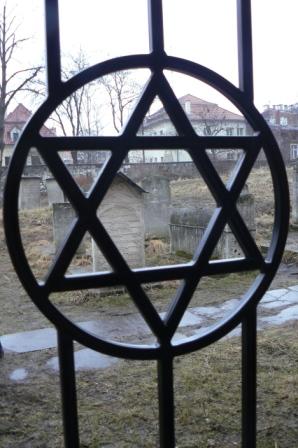
Jewish cemetery

Karol Wojtyla’s parish church


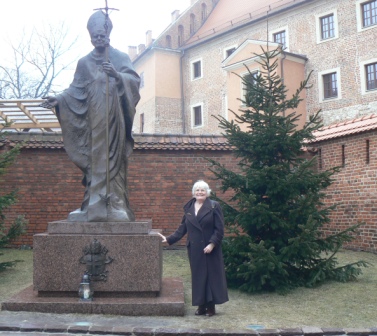
Standing by the statue of Pope John Paul 11

Palm Sunday

The Little Springtime ~ Palm Sunday
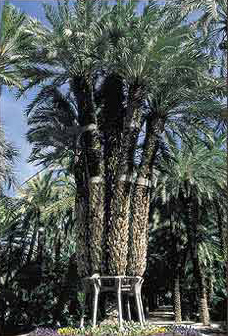
I absolutely love Palm Sunday.  One of the highlights of the school year when I was teaching was making palm crosses for STM parish.  It was a joy to teach successive year sixes how to fold and weave the palms.  We took great pride in making the neatest and tightest crosses so that they would not unfold when held at the Sunday Mass.  At Easter in 1993 I went to the Palm forest in Elche in Spain, where many of the palms which we use in churches all over Europe, are grown.  When the palms start to grow they are tied up and covered so that the sun does not get to them.  This stops them turning green.  When they are fully grown they are cut and wrapped.  They have to be kept moist until they are folded as they dry out quickly. In Spain, where great Palm Sunday processions are held in the streets,palms are folded into amazing intricate and decorative shapes.   But I prefer our simple crosses.  I treasure one that was made for me last year by my husband when I did not manage to get to a church service.  He did not have a proper palm frond so he went out into the garden and picked some long straight leaves which he lovingly weaved into a cross.   That one takes pride of place in my box of treasures.
Between 1970 and 2000 my life as a parent, teacher and then head teacher meant that my trips were always governed by school holidays.  Not being keen on very hot weather my favourite time to travel was always the Easter holidays.  For most of the 80’s and 90’s the Easter holidays meant I could join a Jumbulance trip to Lourdes with ACROSS.  I have written about one special Lourdes trip in a previous blog and I hope to write about my other trips eventually
Other memorable Easter holidays were spent in Kenya, Spain, Taize and Russia. In the Jubilee year of 2000, a very difficult year for me, I travelled between Assisi and Rome.
Travel for me is an opportunity to learn about other people and to share with them; their traditions, communities and lives.  Sometimes we can be of help in some way and make a difference to people’s lives.  That is a privilege and a blessing.
One man who made a real difference was Roger Schutz.  In the 1940s he was appalled by the violence and suffering he saw across Europe.  Throughout the war years, he sheltered political refugees, especially Jews, whom he helped cross the border into Switzerland from the occupied region of France.  He began to develop the idea of a community based on mutual understanding and respect for all.  He found a suitable site at Taize near Cluny in the Burgundy region of France and on Palm Sunday of 1948, seven men took monastic vows.  They dedicated their lives to working and praying for ‘outsiders’ of all kinds; especially those living in extremes of poverty, hunger, or disease.  Taize is now famous for its gentle and powerful worship built on meditation through repetitive chants, a model of worship which has spread around the world.  Brother Roger’s work continues; to bring reconciliation, unity and peace to all the peoples of the world.  www.taize.fr
There is a beautiful icon of Mary in the Church of Reconciliation inTaize.  I would recommend anyone who travels to France to make a detour so that they can spend some time in Taize.  When I went to Taize one summer I had an amazing experience.   I stood alone in a field full of sunflowers, at the foot of the hill looking up towards the church, as a gentle breeze blew.  The wind caused the flowers to bend and the sound they made was so strange.   It reminded me strongly of the beautiful words of one of my favourite hymns:
 Be still for the presence of the Lord
Be still for the presence of the Lord  The holy one is here
Come bow before him now  With reverence and fear
In him no sin is found  We stand on holy ground
Be still for the presence of the Lord  The holy one is here
Be still for the power of the Lord  Is moving in this place
He comes to cleanse and heal  To minister his grace
No work too hard for him  In faith receive from him
Be still for the power of the Lord  Is moving in this place
I wish you all a peaceful and Happy Palm Sunday and the joy of your family around you x
Palm Sunday Crosses
Intricate Palm Sunday sculptures on display
Palm Tree a Elche
Icon of Our Lady at Taize
Brother Roger of Taize

Coronavirus ~ a personal experience of Covid-19

It is ironic that it took a global pandemic caused by a miniscule virus to show how fragile our world really is, and how interdependent we are.

Yet another irony is that, during the pandemic of Covid-19, we have never felt so alone and out of control.  Normally, with good planning, hard-earned resources, a bit of luck and the practical or emotional help of family and friends, most of us can cope with any emergency or unexpected event.  But, with this pandemic none of our personal skills, contacts or experience have been of much help at all.  Many of us have faced situations which we simply could not avoid or cope with.

For myself it all began on Tuesday 24rd March 2020 after the UK government brought in special rules to “Stay home, save lives, protect the NHS”.  Listening to the horrific news reports on TV about how the virus was killing, not hundreds but thousands, of people in China and Italy, the people of the UK were shocked and frightened enough to comply ~ well except for Dominic Cummings!  However, there were many people who could not stay at home.  There were essential workers who had to wear personal protective equipment (PPE) and carry on with their jobs.  Then there were frail people like my husband who had to attend hospital regularly for treatment – in his case, dialysis.  Usually he was picked up by hospital transport at midday and returned home around 7pm every Tuesday, Thursday and Saturday.  But, in order to avoid his being in transport with other people, I was asked to bring him in and pick him up myself.  This I was more than happy to do.

However, once I got to the dialysis unit   it was obvious that the situation was far from safe or controlled.  All of the patients, as well as transport drivers and nurses, were packed into one small waiting area with no PPE at all and no possibility of social distancing!  I was so worried that when I got home, I rang the hospital to complain that they were not observing the safety rules set out by the government. 

Needless to say, within a week we were both feeling unwell. On Tuesday 31st March my husband was getting confused and didn’t want to eat anything. On Wednesday 1st April he stayed in bed all day and again didn’t eat. On Thursday 2nd April the nurses phoned me from dialysis to say that my husband was really unwell. I drove straight there to find him barely conscious and being dreadfully sick. He couldn’t recognise me and was obviously very ill. We decided that he needed to go to the Emergency department at the other end of the hospital. However, the Covid-19 rules meant anyone suspected of having the virus was not allowed into the main hospital. So, to avoid a very long walk around the outside of the hospital, his lovely named nurse rang for an ambulance. This took what felt like an eternity to arrive and the paramedics, seemingly unaware of the rules, were extremely cross that I hadn’t just wheeled him through the hospital in a wheelchair. Eventually they agreed to bring a trolley in and they got him onto the ambulance. I was about to climb in after him when they said I wasn’t allowed to go with him and I wouldn’t be allowed to visit him. At that point I felt sick with fear.

After testing it was found that he did indeed have Covid-19 so he was sent to a special ward.   There followed days of confusion.  I sent in his essentials; pyjamas, phone, drinks, sweets etc., none of which he was well enough to receive or use.  The hospital was becoming overwhelmed with cases of the virus and the staff seemed to be in chaos.  I phoned daily and got very different reports on his condition but never got to talk to my husband himself.  3 times I was told by one doctor that he could go home, only to be told later by a different doctor that he was too ill to go home. 

So, when on Thursday 9th April, a senior doctor phoned me I was delighted to hear that my husband was ‘doing well’.  However, I had misheard and what the doctor actually said was that my husband ‘was not doing well’.  In fact, he was so unwell that this consultant was going to break all the rules and allow me to come into the hospital and sit with him.  For this I will be eternally grateful. 

When I got to the hospital staff were very unwilling to let me in but eventually, they were overruled. From the minute I got in the nurses were wonderful. They gave me full PPE and moved my husband’s bed to a private en-suite room on the 9th floor with a wonderful view of the city skyline as the sun set. I suppose this should have rung alarm bells for me, but it didn’t. My husband looked so peaceful, sleeping. I thought if I just kept talking, he would eventually wake up. I chattered on for 7 hours about all the things he loved; family, fishing, caravanning, holidays and home. But he never did wake up. His breathing, which had been loud, got quieter and slower, and eventually at 1.20am on Good Friday 10th April, it just stopped. There was no drama, he just slipped away quietly and with no fuss.

When I summoned the nurse to tell her, she was exhausted and despondent.  She had seen so many people die of this virus; 5 in the last 24 hours, which was more death than she had ever experienced before.  I felt so sorry for her.  She then carefully put most of my husband’s belongings in special bags as ‘contaminated’ to be safely disposed of.  It was then I realised that we really were in a ‘plague’ situation. 

The PPE combined with my own developing Coronavirus had me dripping in sweat, but with the help of a socially distanced porter, I managed to find my way out to the carpark.  There I sat, alone, in the middle of the night for such a long time, in a state of shock and feeling numb.  I just didn’t know what I was supposed to do next.  And, I realised now that I didn’t feel well at all.  The thing about being a carer is that you are so focussed on the person you care for that you tend to be unaware of how you are yourself.   But I managed to drive home and didn’t see another car on the bypass.  This just added to the strangeness of the situation.  

The days that followed my husband’s death were unbelievably awful.  Nothing was normal as no one was working properly due to the government pandemic rules; not the registrar, the funeral directors, the bereavement office or anyone. Everything was such a struggle, which just compounded my grief.  Then I became seriously ill.  My daughter was checking on me daily from outside my window and she had been concerned that I was suffering from the virus.  On the Sunday evening when she came round, I was in a state of collapse, confused, with a raging temperature and unable to stand.  She called an ambulance and I was taken straight into hospital.  My Coronavirus test was positive so I was transferred to an isolation room on a Covid ward. Anyone who says Covid is just like flu, or not even as bad as flu as Mr Trump said recently, has not experienced the full horror of the virus.  The coughing is relentless and breathing so difficult.  But for me the worst thing was the soaring temperature and unbelievable sweating which soaked through clothes and bedding as fast as they could be changed.  Also, my kidneys were being attacked which has damaged them permanently.  I did often feel like giving up, and some days death would have been welcome.  But, thanks to wonderful doctors, a superb local hospital and the encouragement and prayers of my wonderful family and friends, I recovered.   My lungs don’t appear to be permanently damaged, but I get breathless now just taking the dog for her walk and my arthritis is much more painful.  I’ve actually bought a walking stick and a seat-stick because I feel so weak and tired some days.  But I know how lucky I am to have survived and I am grateful.

Heartfelt floral wreath by Rebel and the Rose

The Aftermath

There was a long delay in having my husband’s body collected from the hospital by the funeral directors and I was not allowed to visit or see his body there.  Funerals were on hold so a whole month passed before he could even be cremated.  And the organisation of the funeral was out of my hands due to Covid-19 restrictions.  Rules stated that only 5 people were allowed to attend his funeral and it had to be held outside the crematorium.  We couldn’t have music or video or live streaming or any means of sharing the funeral with his loving family.  It is unimaginably hard to have to tell sisters, grandchildren and his many good friends, that they could not attend his funeral.  I find it hard even now to express how devastating the ‘funeral’ was.  

Five of us walked behind the hearse towards the crematorium building.  The funeral directors lifted up the rear door of the hearse and they slid the coffin onto a trolley.  No-one was allowed to touch the coffin.  We gathered round for a reading and prayers in the ten-minute service, which was all we were allowed. 

The weather was atrocious with howling wind being funnelled through the car park.  I comfort myself by believing it was the Holy Spirit blowing through. 

Suddenly there came from Heaven a noise like a violent rushing wind, and it filled the whole house where they were sitting…And they were filled with the Holy Spirit

Acts2:2-4

The minister, Seb Cummings from Mariners’ church in Gloucester, was so compassionate but sadly we couldn’t hear the readings we had chosen so carefully because of the wind. Then the funeral directors wheeled the trolley inside and he was gone.  It just didn’t seem real to me, but the oddness and sadness of it will stay with me forever. Now all I have are my memories and my photographs.

On the death of the beloved

Though we need to weep your loss,
You dwell in that safe place in our hearts,
Where no storm or night or pain can reach you.

Your love was like the dawn
Brightening over our lives
Awakening beneath the dark
A further adventure of colour.

The sound of your voice
Found for us
A new music
That brightened everything.

Whatever you enfolded in your gaze
Quickened in the joy of its being;
You placed smiles like flowers
On the altar of the heart.
Your mind always sparkled
With wonder at things.

Though your days here were brief,
Your spirit was live, awake, complete.

We look towards each other no longer
From the old distance of our names;
Now you dwell inside the rhythm of breath,
As close to us as we are to ourselves.

Though we cannot see you with outward eyes,
We know our soul’s gaze is upon your face,
Smiling back at us from within everything
To which we bring our best refinement.

Let us not look for you only in memory,
Where we would grow lonely without you.
You would want us to find you in presence,
Beside us when beauty brightens,
When kindness glows
And music echoes eternal tones.

When orchids brighten the earth,
Darkest winter has turned to spring;
May this dark grief flower with hope
In every heart that loves you.

May you continue to inspire us:

To enter each day with a generous heart.
To serve the call of courage and love
Until we see your beautiful face again
In that land where there is no more separation,
Where all tears will be wiped from our mind,
And where we will never lose you again.

by John O’Donohue

Since all this happened, as restrictions eased a bit, I have been able to lay Gerry to rest with the dignity of his family around him. Our wonderful priest Fr Alan Finley conducted a beautiful short service with prayers and readings that gave the ceremony meaning, and me a great deal of comfort.

I now have a place I can visit which is peaceful and beautiful and a fitting tribute to his life. I grieve every day and every night.

Otherworldly

frosty spiders web

There is nothing quite so exciting as waking up to a fresh snowfall.  The beauty of the spider’s web is out of this world.  This week our landscape has been transformed by the heaviest snowfall the UK has seen in years.  It makes for very exciting dog walks and hair-raising drives!  When I was teaching I used to love a ‘snow day’.  But now that I am a little too old for sledging, sitting at the window watching the younger generation having such fun just makes me wistful.  Then my mind drifts….

It snowed overnight and the roads are a fright,

So the schools are all closed ~ on a Friday!

Mums and dads can’t drive, their cars slip and slide

So its family fun on a school day.

Dogs in bright jackets are leaping for joy

Taken out for a walk, on a school day.

Babies and toddlers peep out of their prams

They’re going to the park, on a school day.

Tiny tots muffled in mittens and hats,

Squeal in delight, on a school day.

Giggling girls, hugging their friends,

Slide down the hill, on a school day.

Teen terrors in hoodies become little boys

Throwing snowballs at girls, on a school day.

Steep slopes draw the daring on sledges and boards,

They hurtle downhill, on a school day.

I sit at the window and, like falling snow,

My thoughts pile up into drifts.

My smiles turn to tears at the sights and sounds

Of my school days, as the frozen scene shifts.

Of ink wells and blotters, of wafers and milk,

Of chalk boards and outside loos;

Of walking to school by the RiverTyne,

Of castles, and coalmines and ships.

And then there are people, who wave as they pass,

Loved aunties and cousins and friends

A younger brother no longer in touch

A mother and father I mourned.

There are icicles hanging near a frozen stream,

The snow covered branches are bending

The field is a snow frosted wonderland

Its beauty my broken heart mending.

I wrote this poem the last time there was heavy snow on a Friday, in 2013.  Here are some of the photos I took then from my window or on my rambles/trudges through the Cotswolds.

These are the days of our lives


snowdrops-and-heelebores (2)

I went to the funeral of a dear man this week who was my next-door neighbour for many years, and, as these occasions are wont to do, it made me rethink the value and purpose of our lives and what we leave behind.

Listening to the heartfelt words of his children and grandchildren I was reminded of the saying, “people may not remember what you did or said, but they will always remember how you made them feel.”

Not one of them mentioned a gift he had bought them or how much pocket money they had received if any.  They didn’t mention his house or his décor, his car or his clothes.  They didn’t mention his looks or his job.  What they all mentioned was that he was kind; always there for them, would do anything for them, and that they had fun with him.

He was an ‘ordinary’ man, one of 9 children in the 1940s, when large families were more common.  He was a happy rascal as a little boy, playing truant from school to hunt for rabbits in the countryside.  He met his wife to be when he was 15 and she was 14.  They married at 19 and have been happy together ever since.

He grew up at a time when it was possible to get a job for life in a large, local company.  He worked hard, enjoyed the job, was on friendly terms with all his fellow workers, and stayed there for 40 years.

Apart from his family, the love of his life was his garden.  We always used to look after and water each other’s gardens whenever either of us was away.   His garden was a delight but his passion was such that he eventually took on 2 allotments as well.  There he grew all the fruit and vegetables you can imagine, for eating, and to brew his home-made beer, wine and cordial.

Gardening was so important to him that this lovely poem was recited at his funeral.

The Glory of the Garden by Rudyard Kipling

Our England is a garden that is full of stately views,
Of borders, beds and shrubberies and lawns and avenues,
With statues on the terraces and peacocks strutting by;
But the Glory of the Garden lies in more than meets the eye.

For where the old thick laurels grow, along the thin red wall,
You will find the tool- and potting-sheds which are the heart of all ;
The cold-frames and the hot-houses, the dungpits and the tanks:
The rollers, carts and drain-pipes, with the barrows and the planks.

And there you’ll see the gardeners, the men and ‘prentice boys
Told off to do as they are bid and do it without noise;
For, except when seeds are planted and we shout to scare the birds,
The Glory of the Garden it abideth not in words.

And some can pot begonias and some can bud a rose,
And some are hardly fit to trust with anything that grows;
But they can roll and trim the lawns and sift the sand and loam,
For the Glory of the Garden occupieth all who come.

Our England is a garden, and such gardens are not made
By singing: – “Oh, how beautiful!” and sitting in the shade,
While better men than we go out and start their working lives
At grubbing weeds from gravel-paths with broken dinner-knives

There’s not a pair of legs so thin, there’s not a head so thick,
There’s not a hand so weak and white, nor yet a heart so sick.
But it can find some needful job that’s crying to be done,
For the Glory of the Garden glorifieth every one.

Then seek your job with thankfulness and work till further orders,
If it’s only netting strawberries or killing slugs on borders;
And when your back stops aching and your hands begin to harden,
You will find yourself a partner in the Glory of the Garden.

Oh, Adam was a gardener, and God who made him sees
That half a proper gardener’s work is done upon his knees,
So when your work is finished, you can wash your hand and pray
For the Glory of the Garden, that it may not pass away!
And the Glory of the Garden it shall never pass away!

And it reaffirmed in me the knowledge that wealth, position and possessions, ultimately mean nothing to the people who truly love you.  They remember your smile, your kindness, and how you made them feel.

Although the funeral made me sad and thoughtful, this poem comforted me.  For, like the glory of the garden, this dear man’s goodness will live on, in his widow, his children and grandchildren.  His life had inestimable value to them and to all who knew him.

In memory of my neighbour I will give you a photographic guided tour of the Rococo Gardens in Painswick which at the moment is aglow with snowdrops and hellebores.


A City in a Forest

Souls entwined at the Peace Pagoda

This weekend I visited relatives who live in Willen, very close to the North Lake.  Willen is one of the dozen or so ancient villages that were absorbed when the new town of Milton Keynes was built 50 years ago.  I remember driving through the area with my father when the town was being built.  I was fascinated by the ‘grid system’ of the roads, horrified by the number of roundabouts and underpasses, and amazed by the number of tree-lined cycle paths.  Driving through the city again this weekend, I was amused by the street names, delighted by the beauty of the trees and parks, and relieved to see that some of the old villages have still retained their individual identity and historic buildings.

My dream house

There are two lakes in Willen, North and South and both are beautiful in very different ways.   South Lake, and the park it is set in, is a hive of activity.  On the lake there are facilities for water sports like canoeing, sailing, windsurfing, and paddle sports, as well as an area for fishing.  In the park there are areas for golfing, cycling, football, table tennis, aerial adventures, jogging and gymnastics; as well as a wonderful children’s adventure playground.

In total contrast, North Lake is set in the most serene park I have ever visited.  It is a designated and protected wildlife and nature reserve and there are waders and waterfowl galore.  There is also a Peace Pagoda, the first ever built in Western Europe.   It was built by monks and nuns of the Nipponzan Myoholi as a symbol of world peace and is meant to promote unity among all the peoples of the world regardless of race, creed, or border.   It opened in September 1980.   In front of the pagoda stand two creatures from Japanese legend.   Shishi, the paired lion-dogs are said to have magical powers that repel evil.

peace-pagoda-with-lions.jpg

Near the pagoda is the Buddhist Temple as well as Japanese and Zen gardens.   There is such an air of serenity around the pagoda and the Temple.  It draws me to it.

Near the temple is a medicine wheel of stones, which looks a bit like the ancient stone circle at Avebury.   It is said that a ley line passes through this area and close by is a single ‘needle’ stone that catches the rising midsummer sun.  There certainly are a lot of mystical and spiritual influences in the area of Willen and Milton Keynes.  If you are interested you can read more at this link.

img_5698.jpg

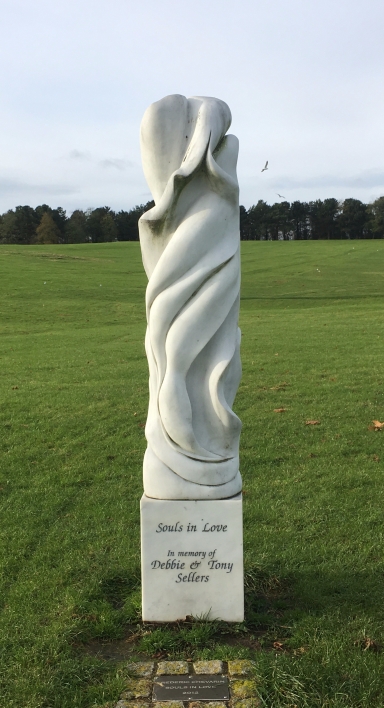
There is so much to see on and around the lake.  I was very impressed by all the artwork.  There is a fascinating Labyrinth and a beautiful pure white memorial statue named ‘Souls in Love’.  The sight of this statue aligned with a pure white swan and the white peace pagoda gleaming in the setting sun was totally stunning.  Of course my photos, taken with my phone, don’t do it justice; but I hope you enjoy them anyway.

souls-entwined-and-souls-flying-free.jpg

While I was at the lakeside I saw waders and waterfowl galore, as well as the most spectacular murmuration of starlings as dusk fell.  A group of ‘twitchers’ with very impressive cameras was gathered at the edge of the lake to watch the amazing aerial display.  There must have been thousands of birds flying so close together that they seem to move as one.  I watched them swoop and soar as they selected just the right spot to roost for the night.  As they got closer and the sky got darker, the sound of their wings was deafening, then silence fell as they all settled.  The whole spectacle was breathtaking, a beautiful ballet.  Do watch this video if you have never witnessed a murmuration or check out these fabulous photos from the Guardian.

All in all a very enjoyable weekend.

Remembrance Sunday

Back of hotel

Following last week’s exciting trip to Spain, I had a marvellously luxurious weekend at the local Tewkesbury Park Hotel to celebrate a family birthday.  All of this travel and excitement is experimental for me as I have been a bit housebound over the last few years for various reasons.

While some of our group played golf and some had spa treatments or relaxed, I went for a stroll around the grounds with my camera.  Being set high on a hill there are amazing views, towards the Malvern Hills, Brecon Beacons, River Severn and Tewkesbury itself.

There is so much to see in Tewkesbury with its medieval buildings and alleys, and two powerful rivers, the Severn and the Avon, that meet there.  There is always lots of activity around the river, whether it be pleasure-boating or fishing.  Occasionally of course the rivers flood the town, but the locals are so used to it that they are very well prepared and cope brilliantly.

At the heart of the town is Tewkesbury Abbey.  There is so much history surrounding this abbey that it is worth visiting over and over again.  I used to take school groups there when I was teaching, or foreign visitors when I was involved in Global Footsteps.

There is also a fascinating history in the hotel site too.  I am one of those people who has to find out as much as I can about everywhere I go, so I started to delve.  I was thrilled to discover that recorded history goes back to when the park was enclosed between 1185 and 1187.  The park covered 200 acres then and was stocked with deer.  By the late 14th century there was a large medieval timber and stone manor house on the site, which was called Tewkesbury Lodge.  By 1540 records taken after the dissolution of the Monasteries showed that the deer park covered 80 acres with the rest being agricultural.  There are no records of deer at the park after that.

The original manor house was at times owned by the crown or by the abbey as well as private individuals including the Clare family who used it as a hunting lodge.

kneeling knight

But, one of the most fascinating owners for me was Edward, Baron Le Despenser, who died in his 30’s in 1375.  He has a beautiful monument known as ‘The Kneeling Knight’, in Tewkesbury Abbey, which I have often admired.  It seems unusual for a knight to be depicted kneeling above a chapel.

At some point the medieval house was demolished, and the present building was built in the 18th century by the Wall family.   The last private owner was Violet Sargeaunt who lived there from 1933 until her death in 1973.  Finally, a superb golf course was developed, which opened in 1976 and the hotel prospered alongside it.

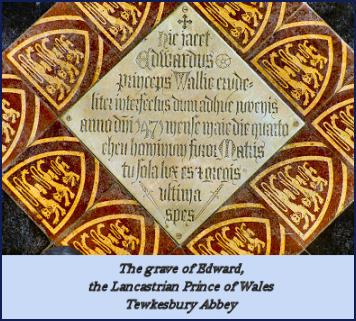
I walked down to the heart-wrenching field that lies at the foot of the hotel’s driveway.  It is called Bloody Meadow and it recalls The Battle of Tewkesbury which brought to an end the Wars of the Roses between the house of York (white rose symbol) and the house of Lancaster (red rose symbol).  The Yorkist King Edward 1V was victorious, while Edward, Prince of Wales, son of Henry V1 and last Lancastrian heir to the throne, was killed, aged just 17.  His burial place lies in Tewkesbury Abbey with a Latin inscription which translates as,

“Here lies Edward, Prince of Wales, cruelly slain whilst but a youth, Anno Domine 1471, May fourth. Alas the savagery of men. Thou art the soul light of thy Mother, and the last hope of thy race.”

Grave of Edward, the Lancastrian Prince of Wales

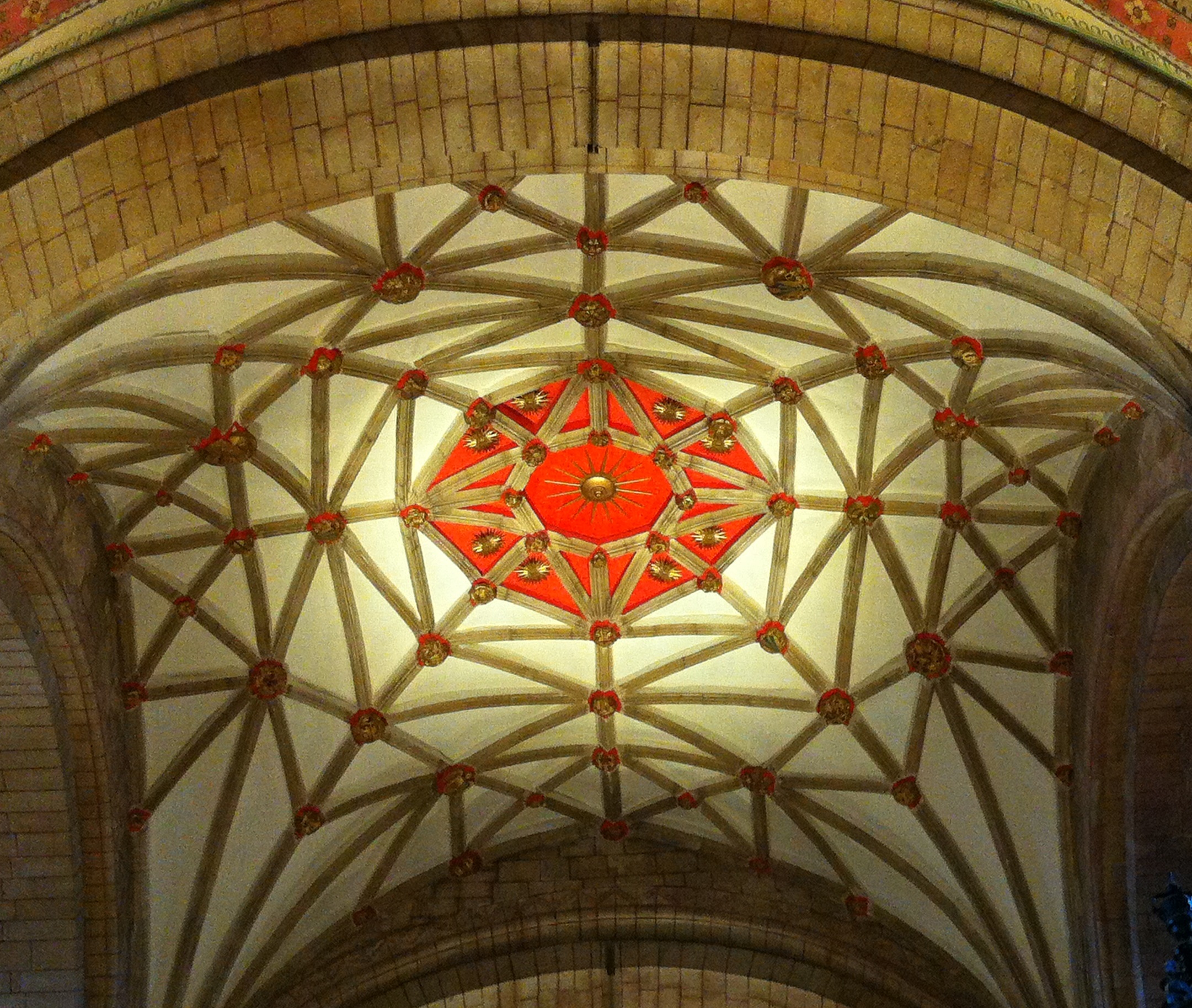
Also in Tewkesbury Abbey high up on the ceiling there is a spectacular carving which shows the badge of Edward 1V, the ‘sunne in splendour’.   It is admirable on the one hand that both winner and loser are remembered in the Abbey, but I find it rather gloating that the massive ‘sunne in splendour’ dominates the roofspace and ‘lords it’ forever over the poor defeated young prince.

medieval sunne in splendour

At the entrance to the ‘Bloody Meadow’, a commemorative plaque on the fence reads,

The field has been called the bloody meadow for more than 500 years, and tradition says that it is the meadow where so many were taken and slain.  This is possibly where Edward, Prince of Wales, met his death.  Other Lancastrians killed in the field almost certainly in the rout, include the Earl of Devonshire, The Marquis of Dorset and Sir William Rous.

The field is long and constricted, a death trap for men who are edging backwards whilst trying to avoid lethal blows.  How many fell is not recorded. Only important people were named.  Those who escaped the Bloody Meadow were faced with crossing the Mill Avon, and many drowned.

I took photos here but felt incredibly sad for the common soldiers who were buried in this meadow in anonymous pits while the nobles were interred in the Abbey and its graveyard.

IMG_5530

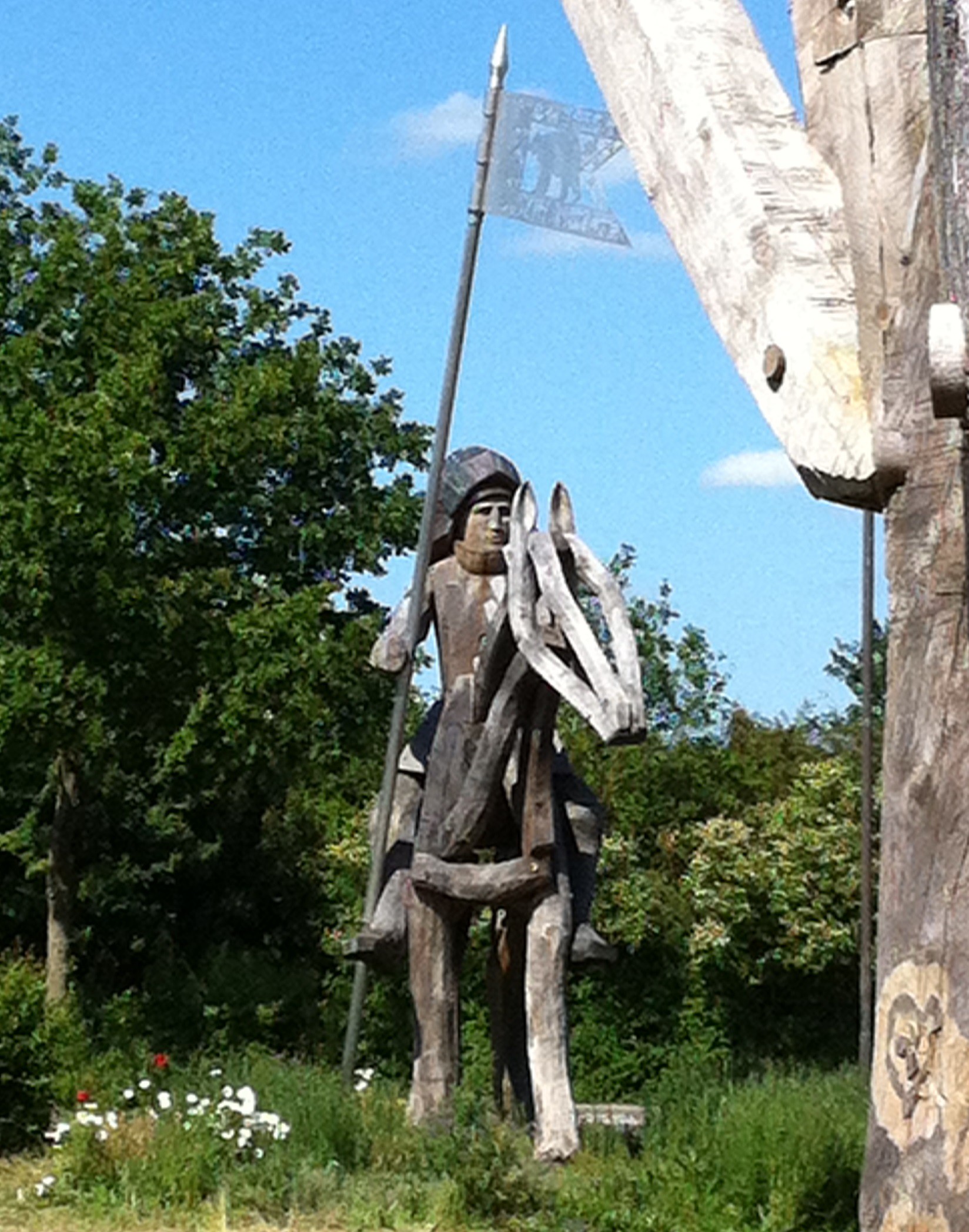
When I left the hotel, I stopped at the roundabout on the outskirts of Tewkesbury to marvel at the commemorative sculptures officially called the Arrivall.  I like to call them Victor and Vanquished.  This is a high vantage point from where the army of King Edward 1V could have seen the Duke of Somerset leading King Henry V1’s ill-fated army.

I have written about this sculpture before but on this day, being Remembrance Sunday, it was embellished with a ‘Lest we forget flag’, which somehow just reinforced the ongoing inevitability, futility, and tragedy of war for me.

IMG_5541

Victor represents the Yorkist army under Edward IV and is located on the roundabout itself. This part of the sculpture shows a horse and rider, the rider has a traditional lance with a pennant on top.

Vanquished, that represents the defeated Lancastrian army. This army was led by the Duke of Somerset, supporting Henry VI. Vanquished is a riderless horse, with its head bowed and a lance leaning on its back.

Here is a link for anyone seriously interested in the history of this fascinating area.

Layers of Love

chiselling the slate

I have always been fascinated by stone because in one form or another it has been around since the world began, and, in one form or another, will still be around when we are all gone!

As a youngster I lived for a few years in the Lake District, where slate has been mined for centuries, and still is.  There were wonderful shades of green and  blue-grey, which you can still get today.  The colours depend on what minerals and organic materials were in the shale when it was laid down. There was even a silvery grey called Coniston Old Man! Geologists reckon it was laid down over the course of 500 million years, from sedimentary rock under low heat and pressure.  This natural slate can withstand the most extreme environments and conditions, which makes it ideal as a building material.

But, when slate is turned on its side, it can be easily split with a hammer and chisel into separate layers of differing thicknesses.  It is these qualities of timelessness, strength and layering that were in my mind this week.

I imagine that inside of each one of us there are layers of love being laid down.  Daily life is the mud between the layers and the surface may be riven by life’s ups and downs.  But, hopefully we will all have layers of love laid down for our parents, siblings, children and extended family, whether natural or adoptive, who form the bedrock of our emotional lives.

There will be other layers formed by people we hardly knew but who made a deep impression on our hearts.  I’m thinking of my grandmother who died when I was just 5 but whom I loved with all my heart because she made me feel safe and loved when I was tiny.  They say children won’t remember what you said or what you did, but they will remember how you made them feel.  That was certainly true in her case.

Special friends will lay down other layers, which will still be there even when the friends have passed away.  I’m thinking here of my dear friend, Pat, who died in a cycling accident some years ago.   I have such fond memories of her as we had such fun together at college and for years after.

But there will be other people we meet during the course of our lives whom we respect and admire so strongly that a love develops that transcends normal feelings and is often inexplicable to others.  And this is the point of my post.

When I retired from decades working in education, I was drained in every way; physically, mentally, spiritually and emotionally.  My well had definitely run dry!  I knew that I needed to be in a peaceful place where I could restore my energy and regain my ‘joie de vivre’.  So, I went to work as a housekeeper at St Peter’s Grange, which at the time was a retreat and conference centre run by the Benedictine monks from Prinknash Abbey

This was a labour of love and I learned a great deal about life from the Benedictine monks I shared the chores with.  Fr Alphedge especially was an inspiration.  He was always so happy, building up the fire, sweeping the floor, even scrubbing out enormous pots and pans.  His philosophy was to treat every moment as a sacrament, and every task as a gift to God, not a chore.  He did each menial job with reverence while radiating joy, peace and stillness for almost 40 years.

FullSizeRender

Fr Alphedge in L’Astazou, Lourdes with our ACROSS pilgrimage 1993

Fr Alphedge left this life last month, and I found myself grieving and reflecting on all I had learned from him during those beautiful moments of quiet contemplation that we shared, over the soapy suds, dusty cobwebs and sooty ashes.

And it boils down to love.  I learned to love myself again, to love life, to love the people I come into contact with, and to love the work in-hand.  This is not a shallow kind of love.  As Fr Alphedge would be the first to admit, some people – monks included – can do irritating things that temporarily annoy one.  But, deep inside, love is laid down like the mudstone that changes over time to riven slate.  The people we meet are like the crystals of quartz embedded in it and the formative experiences we have are like the minerals and organic matter that give the slate its colour.

Many years ago, my parents picked up a large slab of slate in the Lake District and carved letters from their names into it, which they painted gold.  It reads ‘Terstels’ from Terry and Stella, and is still on the front of the house where they lived until they died.  I pass it every day and it reminds me that although they are gone, my love for them is still as strong as ever.  I guess it is the first layer of love I laid down.

Terstels 1

I think we each have a limitless capacity for love- it costs nothing, takes up no space, and it is very precious.

Another monk, a Salesian this time, who was rather irreverently known as Bro. Joe, taught me not to hide love but to spread it, share it, give it freely, and let others know that they are loved.  This poem was printed on his funeral order of service and I think it is very good advice!

If with pleasure you are viewing
Any work that I am doing,
If you like me, or you love me, tell me now.
Don’t withhold your approbation
Till the Father makes oration
And I lie with snowy lilies o’er my brow.
For no matter how you shout it,
I won’t care so much about it,
I won’t see how many tear drops you have shed.
If you think some praise is due me.
Now’s the time to slip it to me,
For I cannot read my tombstone when I’m dead.

More than fame and more than money
Is the comment warm and sunny,
Is the hearty warm approval of a friend.
For it gives to life a savour
And it makes me stronger, braver,
And it gives to me the spirit to the end.
If I earn your praise bestow it,
If you like me, let me know it,
Let the words of true encouragement be said.
Do not wait till life is over
And I’m underneath the clover,
For I cannot read my tombstone when I’m dead.


I need to thank Michelle at Honister Slate Mine for the great photos

A Circular Walk

IMG_4886

Tramway Bridge in Stratford on Avon, now just for pedestrians

I lead quite a pedestrian life these days, but I am very grateful that I am still reasonably fit, and can still enjoy regular walks.  Today I am especially grateful, as this autumn is glorious in the Cotswolds.  The sun is shining through the trees in the woods where I take my little dog for her walks, and the ground is covered with golden leaves.

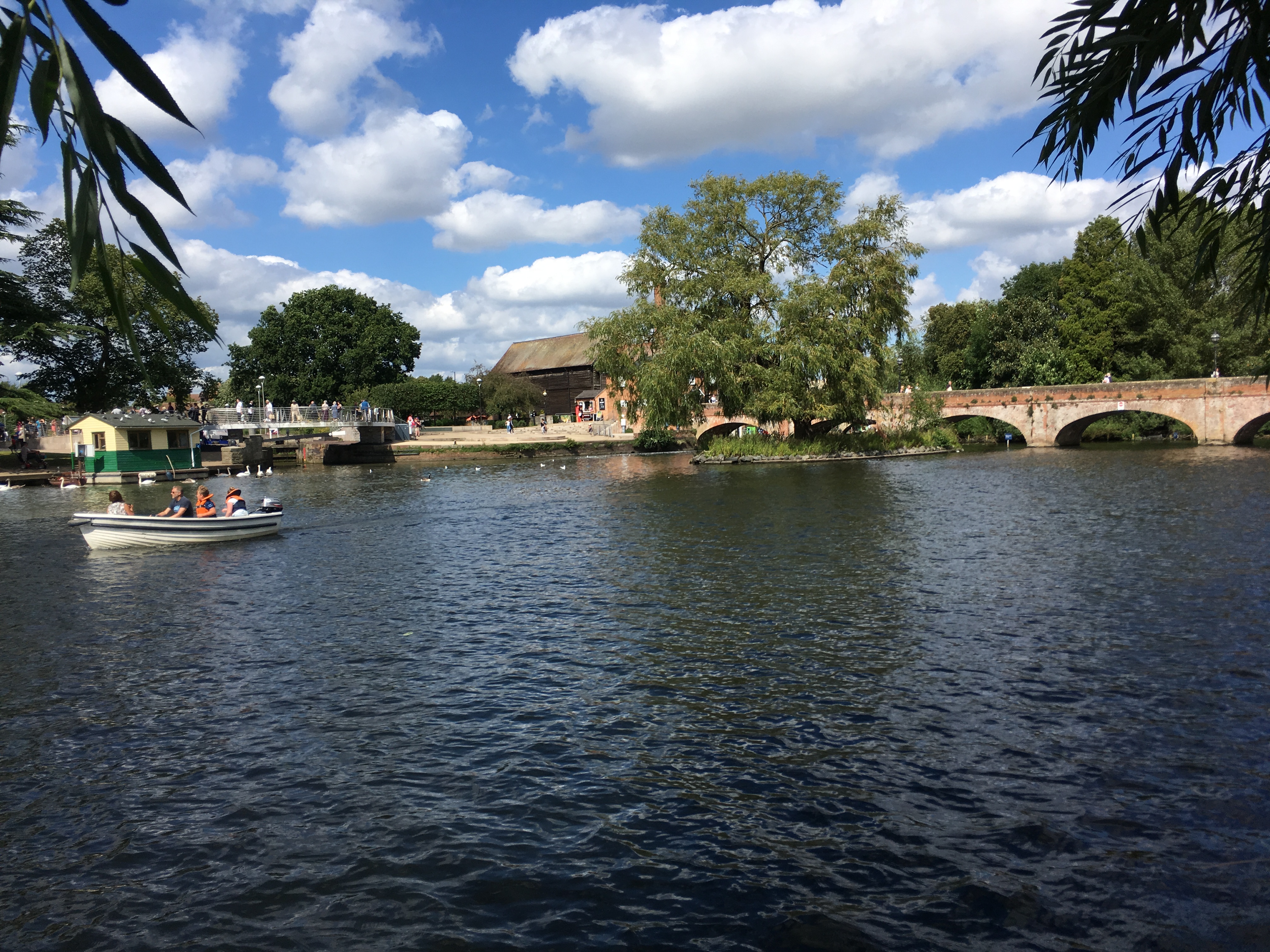
Another walk that I never tire of, and take as often as I can, is the circular walk beside the river Avon in Stratford.  As a teenager I used to walk to school along the old bridge built in 1822 for horse trams.  It is now a pedestrian bridge, which leads to Bancroft gardens and the town.  But if you turn left, instead of crossing the tramway bridge, you can take a beautiful walk alongside the river.  Here you will get the most spectacular views of the Shakespeare Theatre, and Holy Trinity Church, which is the burial place of William Shakespeare.  The path goes on past the ferry, weirs and the old mill, but there is a bridge which you can cross to get into the oldest part of the town.

s on a weir 3

Weir on the Avon at Stratford

Whenever I have visitors, I take them to the Old Town to see some of the most beautiful places in Stratford.  I start at the British Legion memorial garden which is always peaceful and very moving.  There are several plaques on the wall about both World Wars.  There is also one of the most beautiful garden seats I have ever seen.  It is wrought in iron and has a design of soldiers marching amongst poppies.

WW1 memorial garden seat

British Legion memorial garden bench to remember the centenary of WW1

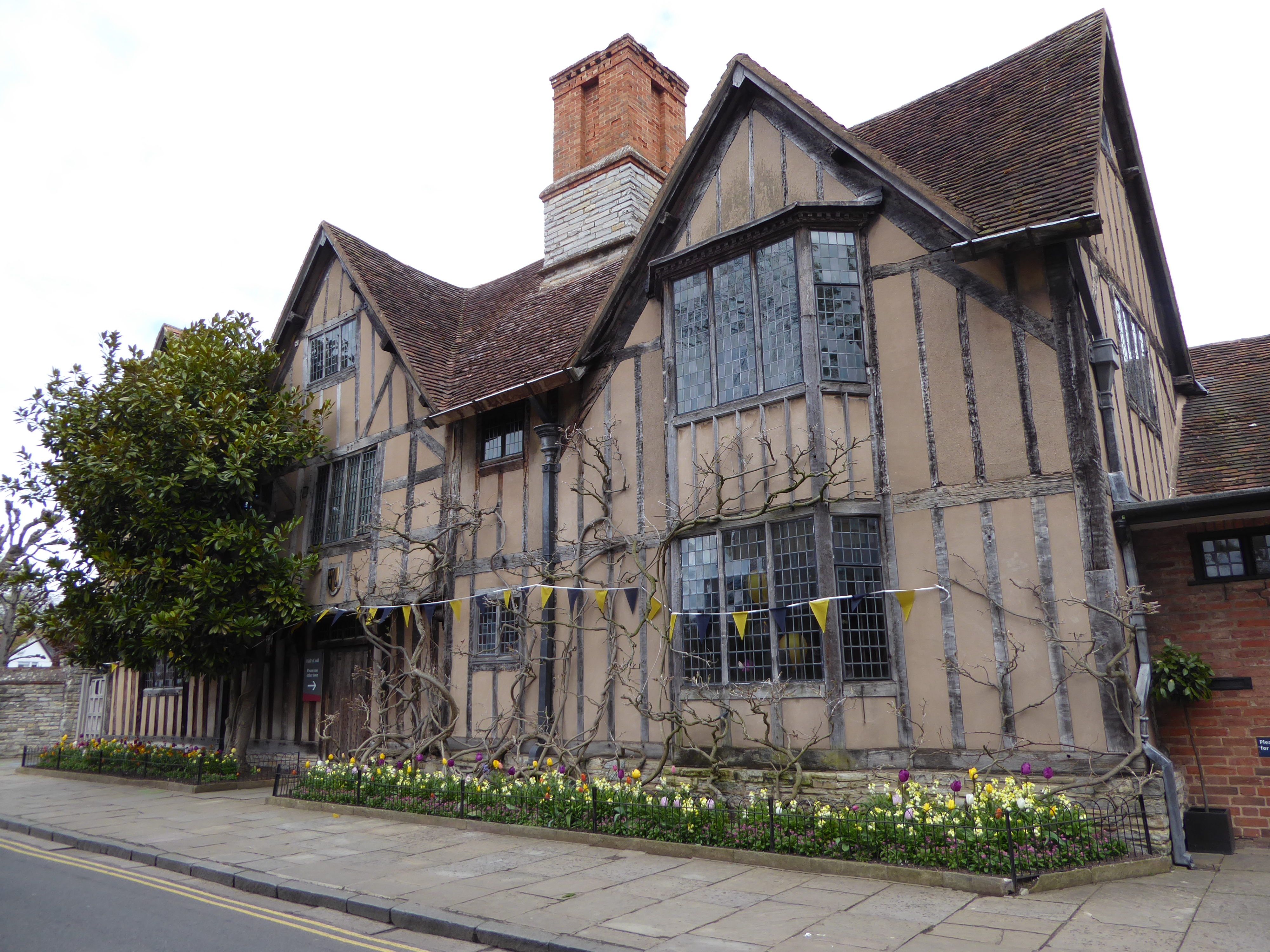
From there I walk past the Jacobean home of Shakespeare’s daughter Susanna and her husband Dr John Hall.  The main part of this beautiful house was built in 1613!

P1000798

Halls Croft

I then turn left into Church Street and walk on to Chapel Lane where there are some of the oldest buildings in the town, which were built for the Guild of the Holy Cross. This guild virtually controlled the town in the middle ages.  First you see a row of almshouses for the poor and needy parishioners.

As a teenager I used to collect shopping for a wonderful old French lady who lived in one of the almshouses.  Inside, the rooms had solid oak floors which creaked, and low timbered ceilings.  I believe they were renovated in the 1980s and brought up to date inside, but the outside is thankfully unchanged.

Next door to the almshouses is the Guild Hall where you can visit Shakespeare’s actual schoolroom.  Then there is the Guild Chapel, with a history dating back to 1269!

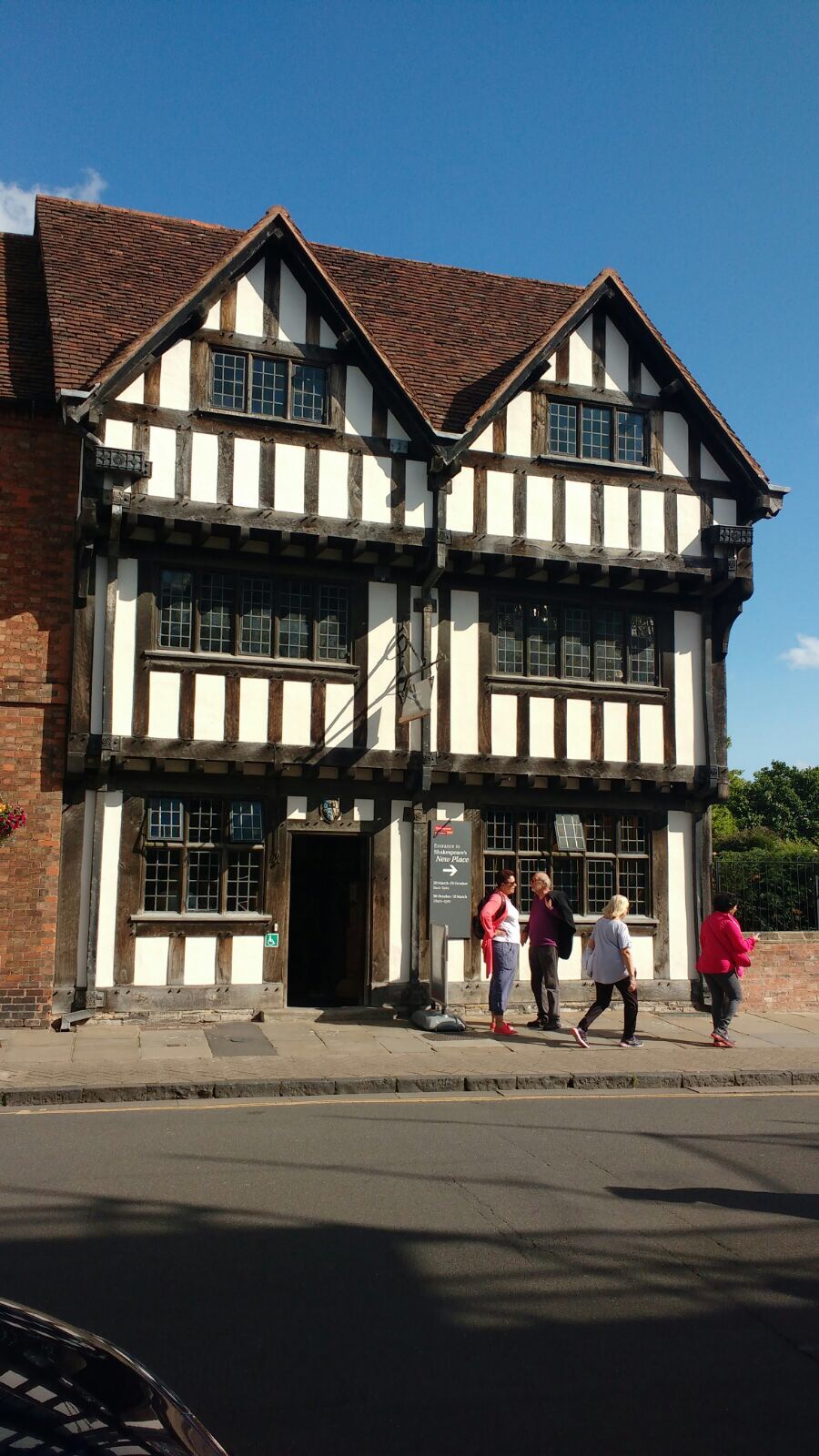
Opposite the Guild Chapel is the site of New Place with its gorgeous gardens.  When Shakespeare bought New Place it was the second biggest house in Stratford.  It was his family’s home from 1597 until he died there in 1616.  Sadly, the house was demolished in the 18th century, but visitors can really connect with Shakespeare in the garden through imaginative artworks reflecting the plays.  It is believed that Shakespeare wrote the Tempest here and this summer there was wonderful artwork on that theme.

Nash's House next to New Place

Nash’s House next to New Place

On the other side of the road, on the High Street, is the oldest pub in the town.  The Garrick Inn, like many buildings in the old town, is a timber framed and dates back to the 1400’s.  It revels in its colourful history of plagues, fires, priest holes, and ghosts!


The Garrick Inn and Harvard House

The Garrick Inn and Harvard House

Next door to the pub is Harvard House, where John Harvard was born in 1607.  He married and emigrated to Massachusetts in America where he was a preacher and teaching elder.  When he died of TB he left 230 books and a very generous legacy to a fund for the founding of a new college.  This was to become Harvard College, the oldest institution of higher education in America.  The house is preserved thanks to the work of Marie Corelli, the writer.  She lived in Stratford at the height of her fame and was passionate about preserving the old buildings in the town.  She bought Harvard House in a dilapidated state and was determined to save it.  In 1905, Marie met an American couple, Mr and Mrs Morris, who agreed to help pay for the restoration as a sign of friendship between UK and USA.   Between them, they donated the house to Harvard University, and, at the grand re-opening in October 1909, the American ambassador, Whitelaw Reid, declared it ‘free to all visiting sons of Harvard, and a rendezvous for all visiting Americans’.

I would probably go on to Shakespeare’s birthplace from here.  It really is worth going into the Birthplace Trust just to find out what Stratford was like in his day.

From there I would go back towards the theatre and the Bancroft Gardens and return to my car via the Tramway, picking up a whippy ice-cream on the way.

I have written other posts about Anne Hathaway’s cottage, the Theatre and Holy Trinity Church, which you can read by clicking the links.  But for now, you can enjoy some of the photos from my last circular walk!


“Whoever saves one life, saves the world entire”

IMG_3577

Beached

For this week’s, WPC theme of ‘danger’, I thought I could post my daughter’s photo of the injured seal that had worn itself out and washed itself up on the beach near Santa Cruz, where she lives.  It was in grave danger until Lisa called Marine Rescue, who turned up quickly and returned to poor creature safely into the ocean.

IMG_3061

There was also a photo of a skunk walking down the garden path between Lisa and her front door!  Skunks are notoriously aggressive, unafraid of humans, carry diseases and smell disgusting.  She was in great danger of being attacked or sprayed as she carried her shopping in from the car.

But then, as I was reading Shakespeare’s Merchant of Venice for my Open University course, I suddenly realised just how much danger some persecuted individuals or groups have faced, over the centuries.

In the Merchant of Venice, it is Shylock who is hated for being Jewish.  Shakespeare explores this brilliantly as only he can.  But it reminded me of places I have visited where evidence of the dangers of being Jewish is still clearly visible, or just below the surface.

Danger 2

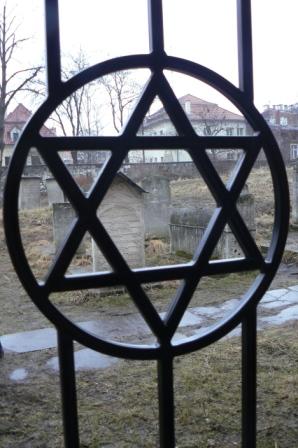
Wrought Iron Star of David on the Cemetery gate in Krakow

Last year I visited a little Catalan town called Empuriabrava.  In the old town, I was horrified by the evidence of past abuse of Jews. There was a cemetery dedicated specifically to those who had been coerced into converting to Christianity.
“On 18th February, 1417 more than 100 people were baptised at the font of the Basilica of Santa Maria, surrounded by their godfathers and authorities.
In 1415, there was the first wave of mass conversions to Christianity as a result of the Perpignan ordinations driven by Benedict X111, known as “Papa Luna”. From that moment on, the converted Jews were buried in a delimited space of the Christian cemetery. The cemetery was attached to the Northern wall of the apse of the basilica. This area has been known for centuries as “the cemetery for the converted Jews”. Nowadays part of the old cemetery is occupied by the Cappella del Santissim, built in 1724, and the other part has been restored as a pedestrian walkway. “
It is a beautiful, peaceful town now but I have to say the references and reminders of those dark times were everywhere, and quite menacing.

IMG_8265

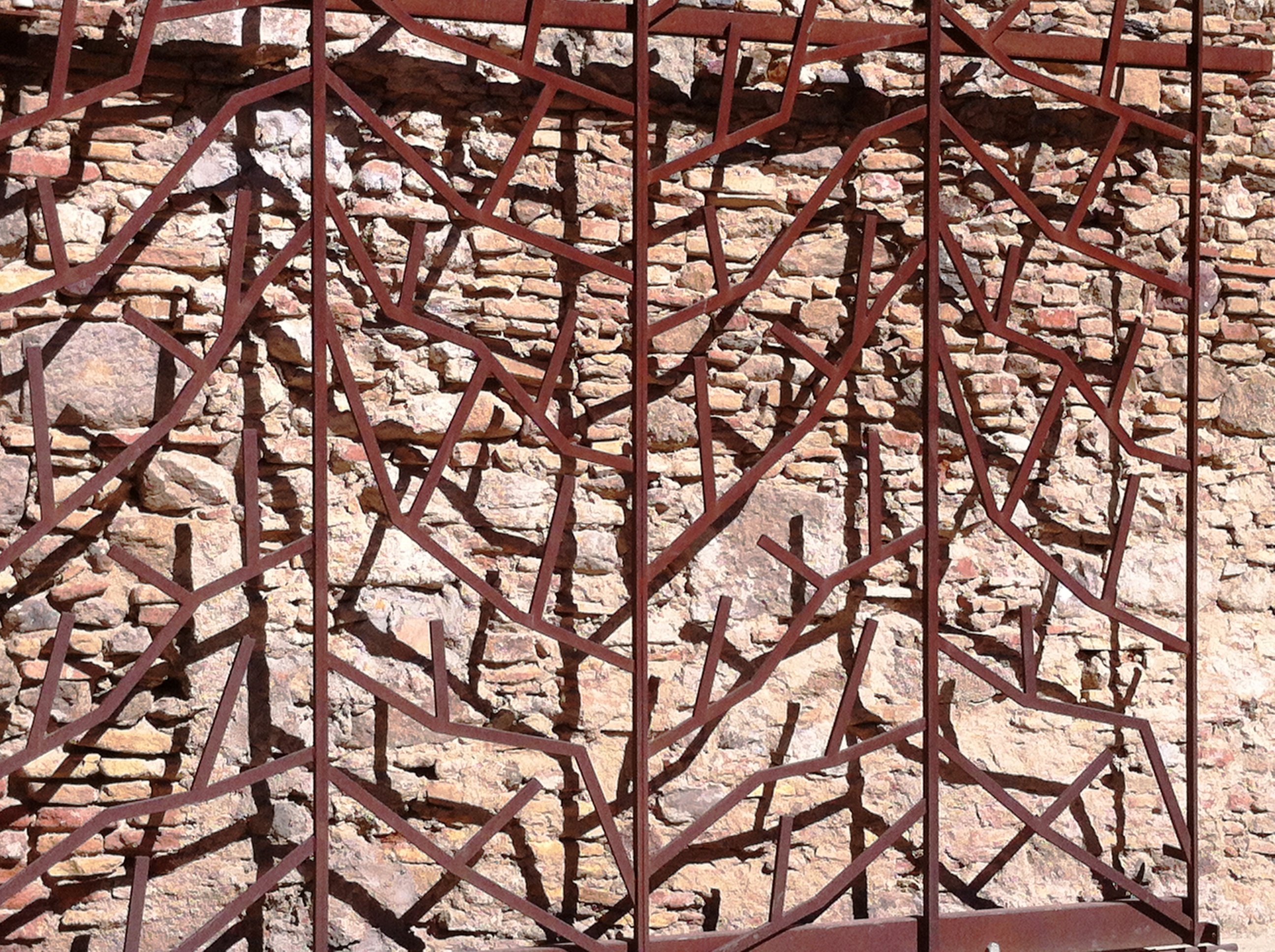
wrought iron representing barbed wire on the cemetery wall

At Gettysberg, Maj. Gen. Joshua L Chamberlain said,

“On great fields, something stays.  Forms change and pass; bodies disappear; but spirits linger, to consecrate ground for the vision – place of souls”.

I knew exactly what he meant when I travelled to Krakow in Poland.

The city of Krakow is beautiful, compact, well preserved and a joy to walk around.  But my visit to the old Jewish quarter in Kazimierz as well as my visit to Schindler’s Enamel factory in Zablocie, which is now a museum, was a revelation.  It happened that I was there on 14thMarch 2012, 69 years to the day of the “final purge”.  The fact that this holocaust happened within living memory is horrific.  The fact that slaughter of innocents on this scale may be happening in parts of the world today is unbearable.

There were about 225,000 Jews living in Krakow before the war but only about 15,000 managed to survive it with the help of brave Poles who kept them hidden, and the enigmatic German Oskar Schindler who needed the cheap labour force they provided.

In March 1941, all Krakow Jews who previously lived in areas such as Kazimierz were forced to live in the new ghetto of Podgorze. The area comprised 320 buildings which had been home to the poorest Poles.  Almost 17000 Jews were now crammed into these buildings and the area was surrounded by barbed wire and walls.  By the autumn of 1941 the jobless Jews who did not have the correct paperwork were transported to concentration camps or shot where they stood.

On March 13-14th 1943 the final extermination was begun.  The first-hand accounts of the few who survived these events were recorded and can be heard at the Schindler factory which is now a museum.  I heard that the remaining men were separated from the women and children.  They were marched off to be used as forced labour.  Any who could not walk unaided were shot on the spot.  Then German soldiers went through the buildings clearing out the women and children to be loaded onto transport which would take them to the extermination camps.  Children and babies were just thrown out of the windows onto the waiting carts, not all landed safely.  The sick and elderly were just killed where they lay.
Literally thousands of Jews were loaded onto transport to the Plaszow camp where they gradually died from starvation, beating, disease, hard labour or execution.   Thousands of others were taken to the extermination camp at Auschwitz-Birkenau over the next few months.   The Auschwitz archives record the fate of those transported.  In February 1944 the remaining men arrived, in May the rest of the children and in August the women.  They all died in the gas chambers shortly afterwards.  The final transport of prisoners from Krakow arrived in Auschwitz the day before the camp was liberated by the Soviet army.
For a harrowing first hand eyewitness account of all the deportations including the final purge there is the memoir, The Cracow Ghetto Pharmacy by Tadeusz Pankiewicz.

Here are some photos from the displays at the Schindler factory or the Jewish Museum which touched me greatly.  They show families and groups of Jews being taken or led away from the ghetto to the camps.  They had to carry whatever they could and abandon the rest.  The last picture shows the Plaszow Camp between 1943-44 where women are being marched to forced labour.


Happy Times Past

Rest not! Life is sweeping by; go and dare before you die. Something mighty and sublime, leave behind to conquer time. — Goethe

tile-spirit-squared-for-abw

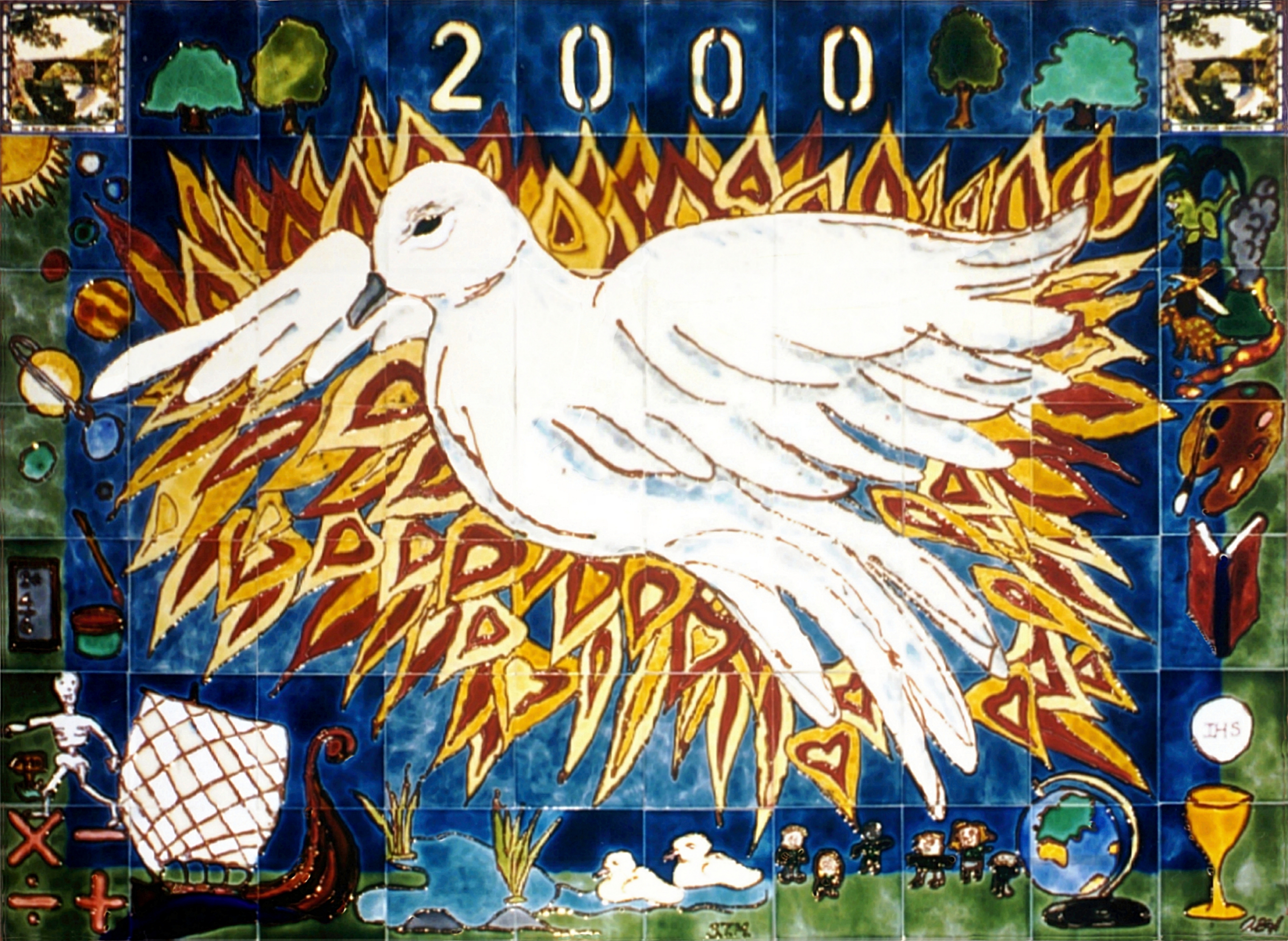
The prompt in the Weekly Photo Challenge this week is the word ‘Nostalgia’ and my friends and I are certainly feeling nostalgic today.  We had some truly upsetting news about our old school. The huge tile frieze that we created in 1999 to mark the new millennium, was destroyed in a fire.

It is hard to imagine today just what a big deal it was being on the threshold of a new millennium.  There were all sorts of apocalyptic warnings about power failures, planes falling out of the sky, computer systems not being able to cope etc. No-one really knew what would happen at midnight on 31st December 1999 or what the new millennium would mean for civilisation.  So, as St Thomas More School was such a huge part of my life, I wanted to mark the occasion with something very special and permanent.

In the early 1970’s I watched the new school building rise in the middle of an open field that had once been farmland and an orchard. There was an ancient hedgerow all around the site and just one magnificent old oak tree in what would be the playing field. When it was opened in 1975, I was having my third child so was not available for teaching. But, as I drove past the school every day, I vowed that one day I would work there.

I got my wish in 1984 when my youngest child was ready to start school. I was offered a job and jumped at the chance. The next decade was a time of great blessing as I worked in virtually every class, teaching all age groups, then became deputy Head.

In 1994 the original Headteacher was due to retire and, to my surprise, I was offered his job. He had been such an inspirational Head that the school was a joy to work in. Taking on his role, I tried to emulate him while making my own mark and bringing my own vision for the school into being.

Due mainly to the quality of the staff and their outstanding teamwork, the school became a strong and successful community, ‘an oasis of excellence’, appreciated by staff, pupils and parents alike.

In 1999, as the new millennium approached, the staff wanted to mark the year 2000 with a special feature. We wanted the whole school community to be involved in creating something totally unique and meaningful. We came up with the idea of making a large tile frieze. Each year group was asked to brainstorm their favourite lessons, subjects, or topics, and represent their ideas on paper.

Reception class, the youngest children were just 4 or 5 years old and had only just started school. They had their photographs taken in their shiny new uniforms, so that was their contribution.

The Year 1 class had helped to build a pond and were raising ducklings which they had hatched from eggs in an incubator, so they drew pictures of that. I have a wonderful memory of the day the ducklings hatched out ~ the local policeman had called up to the school on a social visit and he watched as the first duckling struggled to crack open the shell. When it finally succeeded and out popped this beautiful and perfect little bundle of yellow feathers, he was overwhelmed by emotion and had tears in his eyes.

In Year 2 the 7 year olds made their first Holy Communion as it was a Catholic school so they drew a chalice and host. Being the most significant event in the year ~ yes honestly, not SATs! That was their contribution.

Year 3 was the first year of juniors and the children enjoyed learning about Vikings and the Human Body, so they drew lovely longboats and skeletons.

In Year 4 things got much more subject focused so Maths was represented by a calculator and mathematical symbols.

In Year 5, Creative Arts such as Music, Dance, Drama and painting were the main features, so a pot of paint and a brush was drawn. Science too was represented by the planets.

By Year 6 the children were getting ready to move on to secondary school. In order to give them a taste of independence and adventure, it was our tradition to take the class away to Shropshire for a week to stay in a Youth Hostel. Here, in the Ironbridge Gorge, birthplace of the Industrial Revolution, we had a wonderful time. We visited the Iron Museum, The Jackfield Tile Museum, Blist’s Hill Reconstructed Village, River Severn Museum and of course the first Iron Bridge ever built. We also had amazing night hikes, midnight feasts and parties. Altogether it was an incredible opportunity for fun and learning. So naturally the Ironbridge at Coalbrookdale was the emblem of Year 6.  Yes, again it wasn’t SATs that featured large in their lives.  How times changed!

For our frieze the staff gathered all these pictures and images together and chose the ones that would be painted on to the tiles. The Year 5 teacher, Anne Bate Williams, a wonderfully creative artist and teacher, took on the challenge of putting all the ideas together and creating a design on tracing paper which could be transferred onto numbered ‘green’ tiles. It was agreed that we would go to Jackfield Tile Museum to create the finished work.

A representative group of staff, parents and children spent a weekend at the Youth Hostel and were each given a small area of the tile frieze to paint. Anne had done a magnificent job scaling all the children’s artwork up or down so that the frieze would truly reflect the life of our school.

It was agreed that the year 2000 would go at the top, as well as the 4 trees, oak, ash, poplar and beech, which were the school emblem.  In the top corners would be tiles depicting the Ironbridge itself.  The children’s artwork would go around the edge, and at the centre would be the Holy Spirit in the form of a dove surrounded by flames.

We painted the tiles in coloured glaze.  I will never forget the atmosphere in that studio at Jackfield as we worked on the frieze.  There was a stillness and peace in the room which was truly sacramental.  While we worked, the Spirit moved in that place and heaven happened.

When we finished, the tiles were left at the Jackfield tile Museum to be fired.  A couple of weeks later they were collected and set into a frame made by Tony O’Shea, the reception class teacher’s husband.

Bishop Mervyn Alexander of Clifton RIP came in the year 2000 to celebrate the school’s 25th anniversary and he blessed the tile frieze.

Although most of the staff who worked at the school have retired or moved on now, the frieze stayed proudly in the school hall for the last 16 years and with it, a little piece of all of us who made it.  And now it is no more.

Nostalgia  in my dictionary is defined as ‘a feeling of sadness mixed with pleasure and affection when you think of happy times in the past.’  I think this sums up our feelings today perfectly.

So here I go down Memory Lane…


Partners

Partners

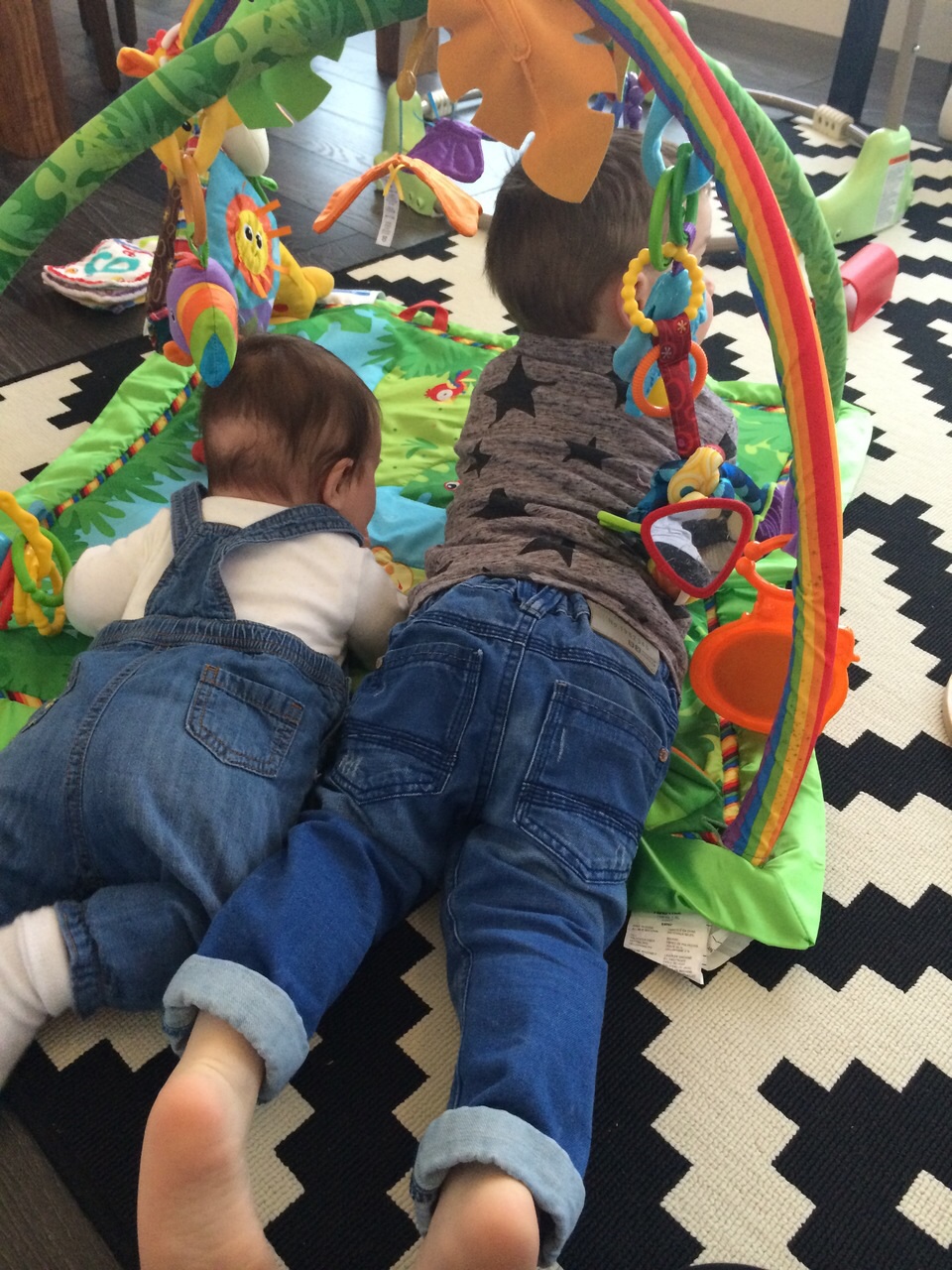
I just have to post photos of my grandchildren to illustrate this week’s photo challenge.  The theme is Partners and these two are definitely partners when it comes to getting up to mischief.  But they adore each other!

Following on from the surprising result of our referendum on membership of the European Union this week, I feel sad that our partnership with the other European countries is coming to an end.  So many people gave so much to bring peace and partnership to Europe during the wars, not least the combined services of army, airforce and navy.  In their honour I am posting some photos I took on Remembrance Day at Westminster Abbey in London.

I can’t resist putting in some of my favourite photos.  Of course my little Dachsund, Dayna, is a wonderful companion for me, but her hero is my husband.  When he is at the hospital for dialysis she often sits beside (or on) his slippers waiting for his return. The pair of ponies share a field near me so I guess they qualify as partners.  And of course the garden birds are my constant delight and we have a partnership.  I feed them regularly and they reward me by coming into my garden and sometimes even into the house like this little one!

And last but not least, partners for life ….literally!

My mum and Dad lived in parallel streets as children and went to the same school.  They were friends from the age of 8 and eventually married in 1945.  They were inseparable until my father died in 1993 and she followed him some years later.

terry & stella wedding

My mum and Dad on their wedding day in 1945


Royal Numbers

P1000988

On 11th June 2016 our Queen will celebrate her official 90th Birthday and her husband, Prince Philip will be 95!  These are wonderful ages to reach and definitely worth celebrating.

London is already awash with flags and the celebrations start tomorrow.  Nobody covers royal events as well as the Daily Mail so do click to see the fabulous images of London bedecked.

I’m sure there are street parties planned for cities, towns and villages throughout the UK and beyond.  On my travels through the Cotswolds I have seen lots of bunting in the streets and flags flying from shops churches, public buildings of every sort, as well as private homes and gardens.

I went to Willersey yesterday which is a gorgeous little village.  It is quintessentially Cotswolds with its duck pond, village pubs, honey coloured stone houses, and beautiful cottage gardens.  It also has a village shop which has got to have the most helpful owner in the world.  My sister in law was desperate to buy some bread to take back to her caravan for tea so she popped into the only shop in the village.  Sadly, they had sold out of bread but the owner said,

 “wait a minute I’ve just used 2 slices out of my loaf, you can have the rest of that”

He then ran upstairs to his flat above the shop and returned with the remainder of his lovely crusty seed-topped brown bread!  Can you imagine getting that level of care and service in a city or town supermarket?

Willersey was like a model village perfectly dressed for a royal themed party.  There was bunting all over the pubs, and flags flying high in the summer breeze.  Several owners had really gone overboard with the decorations in their gardens as you can see from my photos below.  One in particular had a garden table and benches covered in union flags with more flags and bunting in the trees as well as a huge flag on a flagpole.  It looked beautiful against the poppies and colourful flowers in the border.

Willersey is holding a really royal party all afternoon and evening on Saturday 11th.  I do hope the weather stays fine for them.  There will be royal themed fancy dress and hats, races to the next village, themed picnics, and lots of musical entertainment.  There will also be a royal pageant and a whole village photo for the archives.  The day’s events will be rounded off by a Toast to the Queen and everyone writing a message in a giant card for Her Majesty.

It should be lots of fun.

A Tribute

W L Langsbury Printers front

It is quite normal these days to see small shops close down in High Streets up and down the land.  And, after a few weeks or maybe months, the passing shoppers don’t even notice they have gone or forget what was there before.  But just occasionally, a shop is so well loved by its regular customers that its closure is a genuine shock.

This was the case for me recently when I popped to W L Langsbury, the local printers in Suffolk Road.

I arrived to find a simple notice on the door saying, ‘closed due to bereavement’.  My heart missed a beat on reading this.  I hoped that it was not the lovely old printer who was known to me, and all of his regular customers, as Bill Langsbury and to his family as Lionel.

I used to pop in to Bill if I wanted anything special printed for school in my teaching days, before we had computers and photocopiers in the school office.  Then after retirement, when I became the secretary of our WI.  Many of our older members did not have email but they all needed monthly minutes and agendas as well as occasional newsletters.  I produced a master copy on my computer and then Bill printed out enough for everyone.  He did the job to perfection ~ quickly, efficiently and cheaply.  He took great delight in telling me that there is no VAT on newsletters.

It was always a joy to step inside the door of his shop.  The smell of metal, ink, wood and paper is a heady mixture, like a steam train in a timber yard.  It was for all the world like the living museums at Blist’s Hill or Beamish and yet the jobs got done if not immediately, always by the end of the day!  The machinery looked ancient, in fact one of the printing presses was a 1938 Heidelberg and it still worked perfectly.  On the walls there were pictures of Cheltenham in days gone by and posters from the 1940’s warning that ‘careless talk costs lives’! Almost every inch of wall and floor space in the front shop was used to store boxes of paper of all sizes and colours.  There was also a wonderful selection of notepads which Bill made himself from the paper offcuts.  These he sold for pennies and they were great for shopping lists or jotters.  Some were so old they still had the price in pre-decimal currency.

In the back room of the shop where the serious work was done there was a treasure trove of vintage wooden shelves and drawers full of cast metal numbers and lettering of different sizes and fonts.

High up on the walls was the ‘filing system’, which I am sure only Bill or his brother and workmate Ken could understand.  Beyond, there was a narrow hallway with a staircase leading to where Bill lived, above the shop.

I suppose I find all this a delight because my grandad had a general store in the 1950s after he left the army.  He and my grandma lived above the shop and I loved staying there.

But of course the shop would be nothing without the character of the printer himself.  I was full of admiration for him and the life he had lived over 83 years.  It is the living history that fascinates me.

Bill was born in Shepherd’s Bush, London, in December 1932 when King George V was on the throne. He moved to Ealing with his parents where his brother Ken was born in 1938.  There they lived through the short reign of King Edward V111 who abdicated in 1936 to marry Wallis Simpson, a divorcee.    He was a young lad of 7 when the bombs started dropping on London during the Blitz of WW2 in the reign of King George V1.  When a neighbouring house was destroyed by the bombs his parents, Harry and Queenie Langsbury moved the family to Cheltenham for safety.

After a brief stay with in-laws they lived in a cottage behind the King’s Head Pub in the Lower High Street where Queenie worked.  The boys went to church 3 times on a Sundays and went to local schools.  Bill was a keen student and talented artist enjoying cartoon drawing.  So he went on to the art college which is where he learned his printing skills.  By this time our Queen Elizabeth 11 was on the throne.

Leaving college he got a printing job in a pharmaceutical company but he had an entrepreneurial streak.  He managed to save his money, and, with the help of his brother’s paper round money, he bought his own second hand printing press by the time he was 16 and set up business in the family home.

Bill did his National Service in the catering corps with the RAF in the early 1950’s and returned to Cheltenham where his mum had bought the terraced house in what was Andover Road and is now Suffolk Road.

At first Bill, aged just 24, was printing in the front room while the family lived in the rest.  However, Bill got so many orders that he took over the back room too and the family were relegated to upstairs.

Bill’s brother Ken married and moved on to have his own family.  Bill, staying single, lived with his mum until she died aged 93.

Eventually Bill had so much work that his brother Ken came to work with him.  It is wonderful to think that these two brothers got on so well that they worked together for over 40 years.  But you couldn’t not get on with Bill.  He was an eccentric, sweet, kind gentleman.  He loved his work, his shop and his machinery.  He lived a simple life with few mod cons and no visible luxuries, but he was always cheerful.  Printing was his passion.

In 2016 W L Langsbury Printer’s celebrates 60 years in business.  To commemorate this Bill produced a special edition of his letterpress Gloucester bold calendar, containing a selection of proverbs from a collection first published in 1640.

Bill worked a normal day in his printer’s shop on 14th January 2016.  He had a problem with his leg but didn’t bother anyone about it.  This was typical, as according to his brother, Bill had not visited a doctor between 1948 and 2015 and he only went in 1948 because the National Health Service had just started and his father took the boys for a free health check!  He ran a bath and sitting on the edge his kind heart finally and peacefully took its rest.  His brother found him there next morning.

The shop is now closed and the fittings will no doubt go to letterpress collectors or to auction.  I feel sad that this delightful, Dickensian shop with its vintage machinery, which is a feast for the senses, will be open no more.

But mostly I feel sad that Cheltenham has lost a truly irreplaceable character.  I, and many other customers I’m sure will miss him greatly.

Steam train from every angle

Steam train from every angle

Well it is Bank Holiday Monday in the UK so as usual the weather is atrocious.  The rain is pouring down.  I have a sweater on as it is cool to say the least.  I feel so sorry for all the residents of local North Cotswold villages and towns who had planned fetes, festivals, open gardens and the like.  Their long planned for events will all be a washout.

I had planned to go to Childswickham for the ‘retro’ English Village Fete on the village green.  There was to be a flower festival in the church too.  After this I had planned to go to Dumbleton, which is a quintessential English village.  It has a pretty church, a well-used cricket club and a picturesque 19th century Hall which is now a hotel.  There are magnificent trees around beautiful parkland all set off by pretty little cottages and some rather grand houses.  Later I would have gone along the road to my favourite village of Broadway for good food and live music on the green.

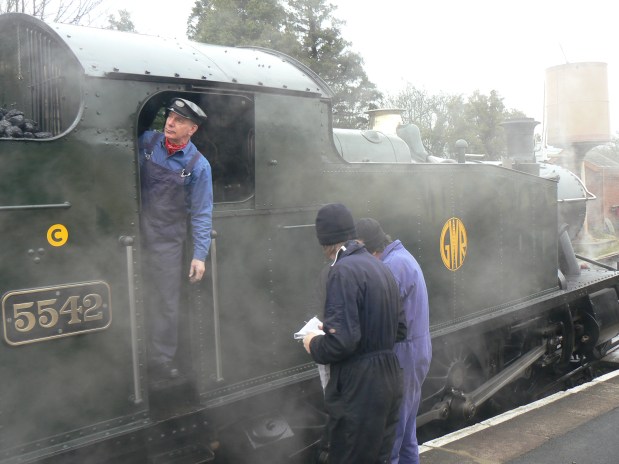
I imagined I would get some good shots with my new digital camera (Panasonic Lumix TZ70) that I could take from every angle for this week’s photo challenge.  But it is not to be.  Instead I will use some shots I took some time ago at Toddington Railway Station.

This wonderful old steam railway takes me back to my childhood when we would take day trips by steam train from the grime of Gateshead to the fresh air and fun of the seaside at Whitley bay or South Shields.   It is beautifully restored, maintained and run by dedicated volunteers of the Gloucestershire Warwickshire Railway.  The route it takes gives wonderful views of the Cotswolds, and the towns and villages it passes through.

It is so beautiful that it is sometimes used as a film set and that is how I got my shots.  Alex Sibo, who was studying at our local university, wrote, directed and produced a short documentary film about his family history.  It follows the story of his grandfather, Bruno Siba, as he managed to escape WW11 Czechoslovakia.  He had to hide his identity and change his name in order to escape.  I played a minor part in his film, which was great fun.  You can watch a bit of the film here.

Here are my rather atmospheric shots of Toddington railway station early on a damp morning.  There are more recent shots on a previous blog.

Victor and Vanquished ~ Symbol of The Battle of Tewkesbury

Victor Victor

This weekend there is a Medieval Festival taking place in the nearby market town of Tewkesbury.  It is an annual event which commemorates the Battle of Tewkesbury which took place here on 4th May 1471.  The main event is a very realistic re-enactment of the battle on the actual site.

The Battle of Tewkesbury brought to an end the Wars of the Roses between the house of York whose symbol was the white rose, and the house of Lancaster, whose symbol was the red rose.  The Yorkist King Edward 1V, was victorious while Edward, Prince of Wales, son of Henry V1 and last Lancastrian heir to the throne, was killed.  His burial place lies in Tewkesbury Abbey with an inscription which reads,

“Here lies Edward, Prince of Wales, cruelly slain whilst but a youth, Anno Domine 1471, May fourth. Alas the savagery of men. Thou art the soul light of thy Mother, and the last hope of thy race.”

Also in Tewkesbury Abbey high up on the ceiling there is a magnificent Red Rose carved, which shows the badge of Edward 1V, the ‘sun in splendour’.

Fittingly, both the victor and the vanquished are remembered in the Abbey.  They are also remembered by an impressive sculpture, which was installed on the Stonehills Roundabout at the Tewkesbury end of the A38 road to Gloucester last year.  The sculpture is called ‘Arrivall’ and consists of two timber framed horses 5m (16ft) tall.   One is a mounted knight, known as Victor, which is a symbol of the victorious Yorkist forces of King Edward IV.  On the opposite side of the roundabout stands the other sculpture, the riderless horse Vanquished, which is a symbol of the beaten Lancastrian forces.  His head is bowed in defeat and exhaustion from the battle.  The sculptures, made by Phil Bews from the Forest of Dean are of green oak, and the work took 2 years to complete.  Local schoolchildren and members of the community were invited to carve poppies on the horses’ legs in remembrance of the centenary of WW1 in 2014.

Both of the horses have lances with pennants which swing in the breeze.  These were made by a local company and donated free.  In fact the local people and business community raised almost all the £65,000 needed for this magnificent sculpture, which rather eerily faces the original battle site.

I took my life in my hands on this busy roundabout to get some photos.  I am looking forward to going back and getting more photos at different times of the year and in different weather conditions, at sunset and in moonlight.  But even in daylight I found the sculptures very impressive and strangely moving.

ROY-G-BIV ~ Rambles and rainbows

Indigo denim jeans on  Jungle playmat

Jungle playmat

The differences between being a child in postwar Britain, a parent in the 1970’s, and a grandparent today are amazing to me.  When I was a child there were still shortages of food which meant essential supplies were rationed while luxuries were just none existent for the ordinary family.  This made for a simpler diet with few choices and little chance of overindulging.  However, undernourishment was such a big issue for children at the time that the government provided orange juice, cod liver oil, malt extract and often a tonic like Minadex for every school age child.  Babies and schoolchildren were given free milk.

Food was basic, grown, fished or farmed, and home cooked.  There was very little processed food and no such thing as ready meals!  Packaging was practical and simple too.  Butter and cheese was cut off a large block and wrapped in greaseproof paper then put in a brown paper bag.  Sugar, flour and dry goods were scooped out from large sacks, weighed and poured into paper bags.  Fresh fish was bought straight from the quayside or from a man who brought it round the houses in a horse and cart.  Bread and pastries were usually baked at home or bought from the local baker, while meat was from the local butcher and chickens were often still alive!  Every town had a High Street which had a selection of specialist shops and there were ‘corner shops’ in most residential areas.  In fact when my grandfather left the army in 1952, he bought a corner shop right next to the hospital off the West Road in Newcastle.  Some shops, like Woolworth’s, were quite large, but nothing like the huge supermarkets of today.

Women, and it was almost always women, had large sensible shopping bags, which were used over and over again.  Plastic bags had not been invented.   Often the shopping was delivered to the housewife in a cardboard box by a lad on a bicycle or a man in a van.  This was essential as working class women, or indeed men, would not have had a car.  We have gone full circle here as so many supermarkets deliver shopping now, but not for the same reason!

But to get back to childhood, babies as far as I remember were dressed and treated as babies until they were about 3 years old. They would be put in a big pram and stuck outside in the garden or yard, or often, on the street outside the front door.  Here the child would sleep or watch the world go by for hours between feeds with a few toys.  My soft toys would have been knitted by my mum while my dad would occasionally make wooden toys.  Toys, being few,  were treasured.  I still have the doll I had when I was 1 and the golly (sorry) my mum knitted when I was 4.  Boys would often have tin cars or lead soldiers, both of which would be considered dangerous now.

Today things are so different.  Babies are socialised and stimulated from the earliest age.  My grandchildren are taken to ‘bounce and rhyme’,  baby gym, play barns, swimming classes, baby massage  etc. etc.  It amazes me to see the speed of their development.  And at home the range of toys is breathtaking.  Everything seems to have movement, music, colour and lights built in.  Even books have appropriate sounds alongside the story.  And, before babies can even crawl they have play mats like the one in my photo.  This 3D mat has all the colours of the rainbow in it.  It is based on a jungle theme so there are animals adorning it.  It is soft, safe, supportive and stimulating.  It plays a variety of music, animal noises, and even waterfall sounds.  It has given my grandchildren hours of pleasure.  I chose this photo for a couple of reasons.  It shows  my two and a half year old grandson teaching his 8 month old sister how to roll over.  It is so cute and the clothes just tickle me.  Denim jeans on a baby I find hilarious and absolutely adorable.

So this week’s photo challenge was to illustrate the colours of the rainbow and I think this photo does that.  The denim jeans qualify as Indigo while all the other colours of the rainbow are in the playmat.  but just in case you want more I have added a little group of colourful shots below.


All Lives Matter

I was very moved this morning by the news that over five thousand people had gathered yesterday for the funeral of the three students who were murdered on Tuesday in a brutal attack at Chapel Hill, North Carolina.  This is on top of the three thousand who attended a candlelit vigil for them on Wednesday night.

I didn’t know these young people, but they were clearly much loved and respected by their community.  The people who did know them best, their friends, relatives and fellow students, describe them as inspirational, happy, caring people.

Deah Barakat, aged just 23, was known for his charitable work and volunteering which inspired others to do the same.  Yusor Mohammad Abu-Salha  was his 21 year old wife and they were described as very much in love and recently married.  Razan Mohammad Abu-Salha was Yusor’s sister and was devoted to the couple.  She was only 19.

A neighbour has admitted killing them apparently.  How and why someone could do such an awful thing is beyond my comprehension.   Maybe he is mentally ill.  Maybe he is evil.  Maybe he was jealous of their youth, happiness and popularity.   Or, maybe he was prejudiced because of their religion, they were Muslims.  Whatever the reason, he is in the minority of wicked people who are destroying our world, and our ability to live together with peace, justice and compassion.  And today the world is a sadder place because of his actions.  As John Donne said in his famous poem

“Each man’s death diminishes me, for I am involved in mankind”

But the crowds of people who gathered to pay their respects and honour their memory are, in my opinion, the normally silent majority who, though usually powerless to make change, are prepared to stand in solidarity when something is clearly wrong.

This is the mark of a caring community and a civilised society.

It is up to each individual of whatever age or background to decide whether they wish to be anti-society, or part of the silent majority who want to make the world a better place for all; not just for the people who look, think, dress and act like themselves.

I would ask today that we think about it.  And, in recognition of the tragedy that has befallen these lovely young people and their families, let us all do something, however small, to make our bit of the world a better place; a place where everyone is respected for their humanity, and is treated with dignity.  Find someone who needs your kindness, a child, a young parent, a teenager, a troubled adult, a carer, a frail, disabled or elderly person, and give them your time and attention.  Listen to what they are saying and make them feel that they are valued.  That their lives, however different matter to someone.


No man is an island,

Entire of itself.
Each is a piece of the continent,
A part of the main.
If a clod be washed away by the sea,
Europe is the less.
As well as if a promontory were.
As well as if a manor of thine own
Or of thine friend’s were.
Each man’s death diminishes me,
For I am involved in mankind.
Therefore, send not to know
For whom the bell tolls,
It tolls for thee.

John Donne

http://gu.com/p/45nm4

http://www.theguardian.com/us-news/2015/feb/13/thousands-funeral-muslim-students-north-carolina-shooting

https://embed.theguardian.com/embed/video/us-news/video/2015/feb/12/chapel-hill-vigil-muslims-north-carolina-university-video


“Blood Swept Lands and Seas of Red”

 P1100839

The weather was atrocious when I finally managed to visit the Tower of London with a friend.  After an unseasonably warm October, November has arrived with a splash.  It rained non-stop while we were at the Tower.  Not gentle rain, or refreshing rain, but relentless, heavy, pounding rain, that ran in waves down the sloping entrance, soaking my shoes and the bottom of my trousers.  My daughter has this theory that if it is raining in Barcelona where she lives, it will be dry in London and vice versa.  She happened to ring me just as I was leaving the house clad in wellies and mac.  But as there was a thunderstorm and heavy rain in Barcelona, she said I wouldn’t need them so I changed.  She was wrong.  I got soaked!

Despite the rain, the Tower was packed with visitors and I was impressed by how cheerful and friendly they were.  Most of the people I spoke to in the extremely long queues were from London or nearby counties of Kent and Essex.  Some said they hadn’t been to the Tower since they were children on a school visit.  Others, like me, had made a day trip involving hours on public transport- coaches, trains, buses and the underground.  Travelling, walking, and queuing all in torrential rain.  All had made the effort because they were keen to see the installation officially called, “Blood Swept Lands and Seas of Red”, but generally known by the people as ~ The Poppies!

Poppies of course are an emotive symbol, used since the 1920s by the Royal British Legion to raise funds for their charitable work, ‘to the memory of the fallen and the future of the living’.   Although they are controversial, most people in the UK seem to wear them to show respect for those who fought and died in previous conflicts, and solidarity with those serving in the armed forces today.  The tradition was inspired by the poem, In Flanders Fields, by John McCrae. The story goes that when his friend, Alexis Helmer was killed at Ypres in 1915, the Canadian doctor, Major John McCrae, conducted the burial.  In his grief he was moved by the beauty of the wild red poppies growing amongst the horror of the graves.  The sight inspired McCrae to write this famous poem.

In Flanders fields the poppies blow
Between the crosses, row on row,
That mark our place; and in the sky
The larks, still bravely singing, fly
Scarce heard amid the guns below.

We are the Dead. Short days ago
We lived, felt dawn, saw sunset glow,
Loved and were loved, and now we lie
In Flanders fields.

Take up our quarrel with the foe:
To you from failing hands we throw
The torch; be yours to hold it high.
If ye break faith with us who die
We shall not sleep, though poppies grow
In Flanders fields.

The poppies forming the installation at the Tower, all 888,246 of them, were handmade under the direction of the ceramic artist Paul Cummins to commemorate the centenary of the outbreak of World War One.  The artist reportedly said that he took his inspiration from the words of an unknown soldier from Derby who wrote that all his friends, indeed everyone he cared about, had been killed in that dreadful war.   He described, “Blood swept lands and seas of red, where angels dare to tread”.   The ceramic poppies, each representing a British or Commonwealth fatality in WW1, were ‘planted’ by volunteers in the moat around the Tower of London; not haphazardly, but artistically arranged by the stage designer, Tom Piper.   Now complete, they spill over battlements, around walls and out of windows, covering the grassy moat with a red river of biblical proportions.  There is a very appropriate poem which reflects not only the poppies but how I feel about the whole experience:

London by William Blake

I wandered through each chartered street,
Near where the chartered Thames does flow,
A mark in every face I meet,
Marks of weakness, marks of woe.

In every cry of every man,
In every infant’s cry of fear,
In every voice, in every ban,
The mind-forged manacles I hear:

How the chimney-sweeper’s cry
Every blackening church appals,
And the hapless soldier’s sigh
Runs in blood down palace-walls
.

The Journalist, Jonathan Jones has been criticised in some quarters of the media for his opinion that the poppies at the Tower of London are “fake, trite and inward-looking – a UKIP-style memorial”, theguardian.com, 28 October). I found his comments shocking, but thought provoking.

 My impression was of a river of blood flowing around the tower, but outside of the establishment in every sense of the word.  Inside, the building protects and reflects power, treasures, pomp, ceremony, privilege, and a dark side to our history ~ cruelty, torture, imprisonment and murder.

Significantly, many of the people, probably the majority, who came to see the poppies, stayed outside the Tower.  It costs quite a lot for an ordinary family to go inside!  (Happily almost the whole installation can be seen freely from outside.)  I think this is as it should be.  The ordinary people came, not to see the grandeur of the Tower, but to be a part of something spectacular yet stunning in its simplicity.  They stood good-humoured, all ages and nationalities, helping each other in the pouring rain, humanity at its best, honouring those who died.  It was beautiful.

I did go into the Tower but it felt alien, as if it had nothing to do with the poppies – except for the Beefeaters.  These men have all served at least 22 years in the forces, and must have attained at least the rank of Sergeant Major.  They were larger than life characters who wore their immaculate, gorgeous, yet slightly ridiculous uniforms with evident pride and aplomb.  Their uniforms were drenched.  The rain dripped off them like the tears shed by countless families of the fallen we were there to remember.  Somehow this fitted the mood and made it all real.  Did those young men stand firm and wear their rain-sodden, mud-soaked uniforms with pride on those dreadful battlefields?

There is some talk this week of leaving the poppies in situ for longer.  While I don’t agree with this I think it could be very moving to see them standing through the biting winds, mist, murk and mud of a British November.  They could then represent the poor, the homeless, the jobless and all the disadvantaged in this very unequal world.  If they stayed longer, through the cold, frost and snow of a harsh December, they could represent, the lonely, the sick, the disabled, and the elderly so often at the mercy of exhausted relatives or poorly paid and overworked “carers” in homes and hospitals.   Too many of them look forward to death as an escape from suffering, as so many of those young men must have done during WW1.

The juxtaposition of the simple poppies outside, and the Crown Jewels inside the Tower was revealing.  Considered precious, these ‘priceless’ treasures are displayed in glass cases watched over by security.   With soft lighting and controlled temperatures they are guarded in secure rooms sealed by impenetrable metal doors.  They reminded me of seeing the embalmed body of Lenin in his mausoleum in Red Square!  Would that our young soldiers had been so well cared for on the WW1 battlefields!

Unfortunately we seem to have learned little after a hundred years.  The most incongruous thing I saw during my visit was a sign, which said you could avoid the queues by paying for membership of something or other.  This is exactly what is wrong with our world.  Money can buy advantage in every sphere of life.  Those with money, power and influence can get the best seats in theatres, tables in restaurants, food, education, housing, healthcare, medical treatment, etc. etc.  You name it and you can have it if you have money.

The world is still run by a strange elite, a brotherhood, for they are mostly men, who make and adjust the rules to protect and promote their own interests and to feather their own nests.  The few prosper at the expense of the many who struggle daily to get and keep a home in which to live and raise their family, to feed, clothe and educate them, and try desperately to stay well enough to not need help in their old age.  Only when laws, rules and decisions are made, and actions taken to promote the common good, will the war have been worth it.  We are a long way from that yet.

 There may be no-one living now who actually fought in WW1, but there are countless families who treasure the memory of a relative who did, and this installation has given them an opportunity to remember them and to pass on their history to the next generation.   My own grandfather joined up at the start of the war aged just 14 years 8 months and was sent to France as a bugler in 1917, aged 17.  Thankfully he survived.  But, like many others, he never talked about his wartime experiences.  We found out about them when he died many years later and his comrades spoke at his funeral.  Since then I have researched his war record and it is astonishing what he went through.   To me he was always my lovely granddad who ran a corner shop and let me sit by the fire in the back of the shop eating out of date sweeties and chatting to my much loved granny.  I always respected and loved him, but now I admire him for his strength of character and I am proud to be descended from him.

I will finish by posting some photos taken by myself and friends and by quoting a comment sent in to the Guardian, which I agree with wholeheartedly:

“So perhaps the sea of poppies is not about the war of 1914-18, but about a very different conflict, which is still raging in 2014. I mean, of course, the conflict between those who want us to believe that everything is all right (even if some bad things happen) – that everything that was done in the last 100 years turned out okay in the end, and will continue to do so; and those who know in their hearts and minds that things are not okay – that the events of the past decade, whether about banking, climate change, poverty or war, are signals to us that we need to do things differently. Perhaps a dried-up castle moat full of enormously expensive fake flowers is a very potent symbol after all – just not the one the artist intended.”
Nick Moseley
Chesham, Buckinghamshire

http://www.dailymail.co.uk/news/article-2817086/How-make-888-246-china-poppies-fired-glaze-Meet-unsung-heroes-glorious-artwork-captivating-Britain-Tower-tribute-WWI-fallen.html#v-3868841266001

http://www.youtube.com/watch?v=zc5ijfpXwK0


A Place of Great Beauty

cemetery 19

Today is the anniversary of my mum’s death.  I have written before about her last week and my memory of it is still fresh.  It was three years ago on the stroke of midnight that she peacefully stopped living and went to her rest after a brief but very distressing illness.

I went to the local cemetery where she is buried.  I was inspired to write this blog post about my visit because, far from being a sad event, it was a place of such beauty that it brought me great comfort.

The cemetery is very old, actually 150 years old!  And it is huge, about 65 acres I read, and it includes a garden of remembrance for ashes.  There is also a crematorium and a beautiful old building which houses two small chapels and waiting rooms.  The building has Grade 11 Listed status because of its architectural and historical interest.  The garden is so beautifully kept by the dedicated gardeners that at any time of year there is something colourful to see.  It has ponds and a variety of shrubs and flower beds.  There are also magnificent mature trees dotted around the cemetery which are home to squirrels and all sorts of birds including woodpeckers.  The setting for the cemetery is exquisite with a magnificent view of the Cleeve Hills as a backdrop.  A stream flows down from the hills and runs through the grounds, with Cotswold stone footbridges over it.  Today the cemetery is especially beautiful as autumn is in full swing and the trees are a delight to behold.

So it is a great worry to hear on the news and read in the papers that there are financial problems at the cemetery and crematorium caused by ‘unforeseen issues’ with the reasonably new machinery at the crematorium.  These issues have left the council who run the facility about a quarter of a million pounds short of their target.

As I tidied my mum’s grave I was struck by the sheer beauty of the setting and the peace and tranquillity of her final resting place.  I would hope that these financial issues do not mean standards will be lowered or the workforce will be cut.  They do such a magnificent job in what must be a very difficult environment.  For me they manage to provide a little piece of heaven here on earth and I want to thank them and let them to know that it is a great comfort.  Thank you.

I have attached some photos I took to this post but even better I found a video of the site here on YouTube.