Getting Romantic in Stratford on Avon

To celebrate Valentine’s Day we treated ourselves to a weekend in Stratford on Avon.  The weather was perfect; crisp and cold with a hint of frost in the mornings, and glorious sunshine in the afternoons.  Spring is such a beautiful season in the UK and it has definitely started early this year.

I could never tire of going to Stratford.  I always learn something new about the life and times of William Shakespeare, and new details about the town catch my eye, which are worth a photograph. I find Stratford such a stimulating, yet relaxing place, whatever my state of mind.

During Valentine’s weekend there were smatterings of snowdrops under the trees in the churchyard and along the banks of the River Avon. It seems appropriate that snowdrops were brought to England in the early 16th century, so maybe Shakespeare would have seen some of the first ones.

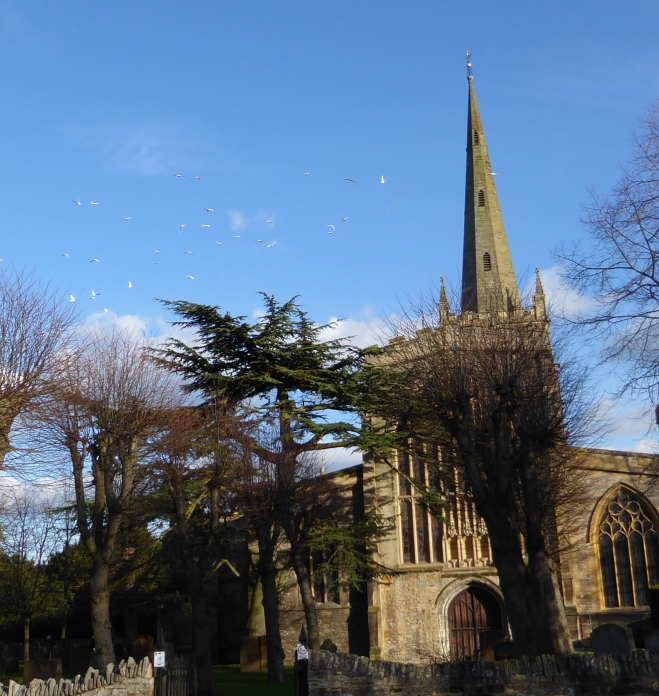
There were white doves circling the spire of Holy Trinity Church where Shakespeare is buried.  They sparkled in the winter sunshine reflecting the snowdrops below.

White Doves around steeple.JPG

At the entrance to the church I photographed the small Sanctuary Door and knocker.  This door is set into the massive 15th century doors.  I have passed through it countless times not realising its importance.  But I learned that anyone who held on to the ring in the knocker of the sanctuary door, would be let in and given protection for 37 days.  This was a custom started in Saxon times to protect poor people from the harsh penalties for crime, and even from lynch mobs.  It was upheld across the land and continued well through Shakespeare’s time until 1623.

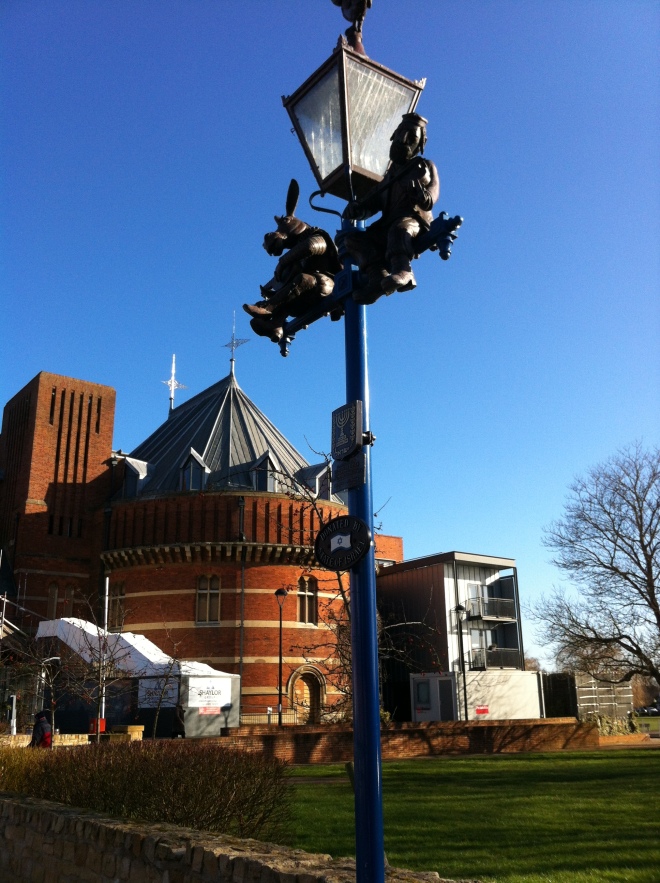
There was also a striking streetlamp outside our hotel, which I had not noticed before.  It was donated to the town by the Government of Israel.  There are wonderful decorative statues and lamps all around the town, mostly donated by ambassadors from countries where Shakespeare is revered.

Lamp donated by Israely Govt

 We stayed in the Arden Hotel, which is right opposite the Shakespeare Theatre.  In fact the building was previously owned by the theatre along with many buildings along the Waterside.  Naturally many famous people have passed through its doors over the years and inside there are some wonderful photographic portraits of famous actors in role. Put your cursor over the pictures to find the names and roles.

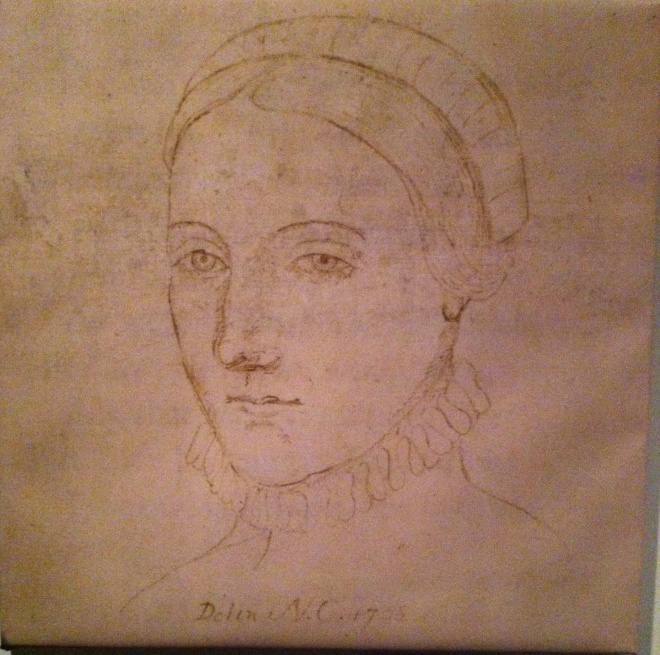
So my Valentine weekend was a great success, perfect weather in a beautiful season in my heart’s true home.  In the Shakespeare Centre I came across a sketch of Anne Hathaway, Shakespeare’s wife and mother of his children.  It is the only known likeness of Anne and she was very beautiful.  But she looks so sad.  I suddenly saw her as a real person whom Shakespeare must have loved and missed very much.

Sketch of Ann Hathaway from her lifetime.  The only one in existence

Enjoy some more of my photographs below.


The Art of Love

The Art of Love


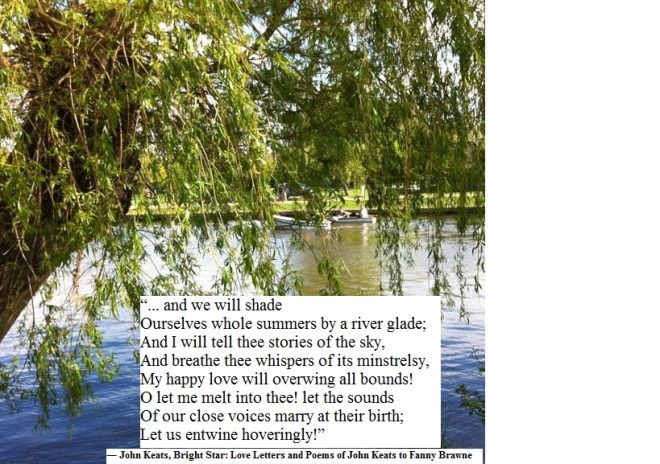
Keats quote on River Avon

As we will be celebrating Valentine’s Day this weekend, I thought I would post about my favourite Romantic poet.  Bless him, Keats died when he was only 25 years old but, in a truly inspired period of just three and a half years, he produced some 150 poems.  He said that love was his religion.  It is said that his best poetry was written in the last nine months of his life, when he was madly in love with Fanny Brawne, his neighbour in Hampstead where he had lived.

To follow the WPC theme for this week, which is “Life Imitates Art”, I have added an extract from one of his poems to a photo I took of the River Avon in Stratford, where I often took shade for whole summers on school holidays.

Keats (1795-1821) died in Rome when he was just twenty-five years old.  He had left his home in London’s Hampstead to seek a better climate, hoping this might cure him.  But he left behind some of the most exquisite and moving poetry ever written.

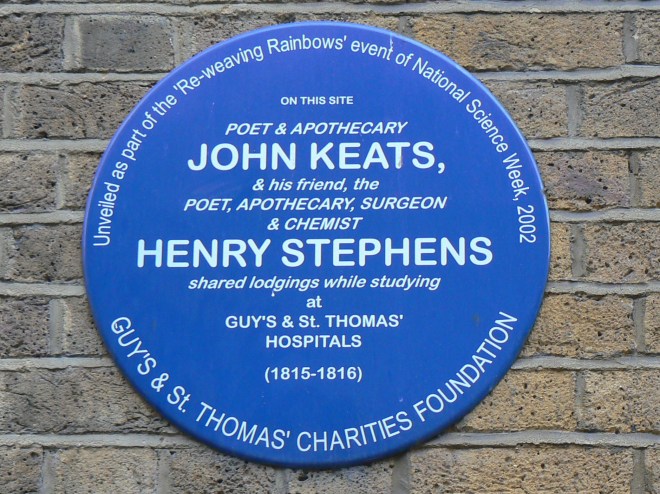
00000948Before he gave his life to poetry, he had qualified as a surgeon-apothecary at Guy’s Hospital in London.  But he had to give that up as his health was fading.  There is a beautiful bronze statue of him in the garden of the hospital, which was unveiled in 2007 by another wonderful poet, Andrew Motion.  I went to visit it with two of my dearest friends.

Keats famously said, “Poetry should be great and unobtrusive, a thing which enters into one’s soul, and does not startle it or amaze it with itself, but with its subject”.

He remains to this day one of the greatest of British poets.  Who knows what he could have achieved had he not died so young of TB. But what he left us, his beautiful poetry, will survive.  And, contrary to what he thought, he will never be forgotten.  In one of his later letters to Fanny he was obviously feeling despondent, as he wrote,

“If I should die,” said I to myself, “I have left no immortal work behind me-nothing to make my friends proud of my memory-that I have loved the principle of beauty in all things, and if I had had time I would have made myself remembered”

But of course he is remembered and he was truly loved by Fanny although her family disapproved.  She wore the ring he gave her until the day she died.

He knew that whatever sorrows, difficulties or even tragedies we face in this world, there will always be beauty in nature and art.  He wrote about this in his exquisite heroic poem, Endymion

A thing of beauty is a joy for ever: 
Its lovliness increases; it will never 
Pass into nothingness; but still will keep 
A bower quiet for us, and a sleep 
Full of sweet dreams, and health, and quiet breathing. 
Therefore, on every morrow, are we wreathing 
A flowery band to bind us to the earth, 
Spite of despondence, of the inhuman dearth 
Of noble natures, of the gloomy days, 
Of all the unhealthy and o’er-darkn’d ways 
Made for our searching: yes, in spite of all, 
Some shape of beauty moves away the pall 
From our dark spirits. Such the sun, the moon, 
Trees old and young, sprouting a shady boon 
For simple sheep; and such are daffodils 
With the green world they live in; and clear rills 
That for themselves a cooling covert make 
‘Gainst the hot season; the mid-forest brake, 
Rich with a sprinkling of fair musk-rose blooms: …

There was a film called “Bright Star”, starring Abbie Cornish as Fanny, and Ben Whishaw as John Keats, released in 2009.  I haven’t seen it so I can’t say whether it does him justice.  But if you would like to see a clip the link is here.

Below are some photos I took in London while visiting Keats’ statue, Enjoy x

Have a wonderful Valentine’s Day everyone x x x

P1080460

Henry Stephens invented Stephens Ink and Wood Stain which was used at the buildings of the Great Exhibition of 1851


Age of Kings

Age of Kings

Age of Kings Tibor Reich Red

Age of Kings Red

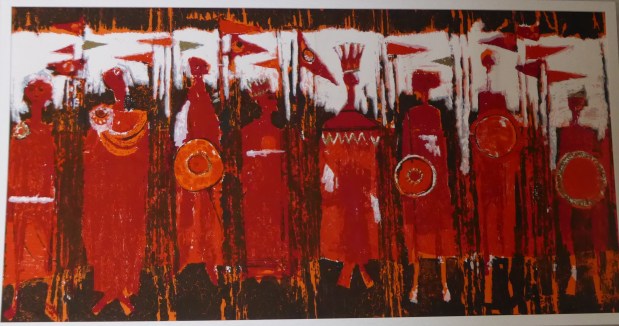
This is one of the most vibrant pieces of printed cotton I have ever seen.  It was made by Tibor Reich and I have one of the original panels, which were made for the opening of the Shakespeare Centre at Stratford on Avon in 1964.  The Centre was opened to commemorate the 400th anniversary of William Shakespeare’s birth.

Tibor Reich was born in Budapest, Hungary in 1916.  His father was a wealthy businessman who had a factory making decorative braids, ribbons and haberdashery for military ceremonial uniforms and folk costumes.  Here, the young Tibor learnt about textiles and colour.   As a child he visited the factory and was spellbound.  He once said, “Here I noticed cerise, kingfisher, very bright emeralds, flame reds and deep oranges…”

Following his parents’ divorce, Tibor went to live with his grandmother and immersed himself in drawing, painting and photography.  Until, in 1933 at the age of 17, Tibor went to Vienna to continue his studies.   Already artistic, his talents blossomed in the creative atmosphere of pre-war Vienna.  He studied textile design and technology as well as architecture and poster design.  But as Nazism spread, Tibor left Vienna for England, where he went to Leeds University to continue his studies in textile technology and woven design.

Tibor brought the vibrancy and colour of his homeland, of Hungarian folk music and peasant costumes, as well as the beauty of nature, to the UK in his work.  And, not long after leaving Leeds, he moved to Warwickshire and set up his own woven textile design business in Cliffords Mill using old hand looms that he repaired and renovated.

Being totally original, he quickly established a good reputation, and worked on the highest profile contracts.  In fact it is true to say he revolutionised textiles in post war Britain with his use of colour, pattern and texture.  By the 1950s Tibor’s textile weaving business was well established and he expanded into printed designs.  His projects included the Royal Yacht Britannia, Concorde, The Festival of Britain and the Shakespeare Memorial Theatre as it was then called.  Here he designed and created curtains, wall hangings and carpets each named after a Shakespearean character.

He also produced his own range of pottery called Tigo ware and designed a most unusual house for his family which was very innovative and modern.  I visited him here in the 60s as a teenager, with my mum who was in Stratford art circle and seemed to know everybody!   I was amazed by the huge onion shaped open fire which stood in the centre of the room and went right up through the house to the roof.  I had certainly never seen anything like it.  I visited again last week and took some photos.  I believe the house has been renovated and I didn’t see inside, but the garden with its earthen embankment is established now and the fir trees are huge, providing a very useful privacy screen.  Tibor did not like the idea of fences and walls, preferring natural boundaries.

In 1964 he helped to furnish the brand new Shakespeare Centre, which is in Henley Street adjoining Shakespeare’s birthplace, for its opening to mark the 400th anniversary of William Shakespeare’s birth.  And this is where our paths crossed.

I have written before about the 1964 celebrations, which were undoubtedly one of the highlights of my life.  I worked at the Shakespeare Centre and the sights and sounds produced there I will never forget.  Shakespeare’s plays on a loop, pomanders and dried petals creating the perfumes of the Tudor age, all brought Shakespeare to life.  Added to that was the music of the age and Tibor Reich’s exquisite carpets, curtains, textile panels and wall hangings, some of which are still there today.

The tapestries and wall hangings evoked so brilliantly the scenes from the plays I loved, especially the Age of Kings panel.  This material, showing the kings from Shakespeare’s plays, was produced as stage curtains.  Panels of it were created in several vibrant colours, red, gold, orange, blue etc.  I am lucky enough to have the original red version as a wall hanging.  It was designed by Pamela Kay and made by Tibor Reich in 1964.  I also have a detail from A Tournament and an original of “garrick Jubilee”.

Recently, a new gold curtain was put up in the historic Becket chapel at Holy Trinity Church.  The chapel is dedicated to the martyred Archbishop of Canterbury, Thomas Becket, who was assassinated in Canterbury Cathedral in 1170.

I went to see it last week.  The golden fabric was commissioned for the chapel by The Friends of Holy Trinity Church and comes from the Tibor archive of 20th century design stored in Stratford and in the Victoria and Albert Museum in London.

If you would like to see Tibor’s textile and pottery work for yourself there is a retrospective exhibition on from 29 January – August at the Whitworth Art Gallery, University of Manchester, Oxford Road, Manchester, M15 6ER.  www.whitworth.manchester.ac.uk

And you can even see a clip of Tibor Reich and see him at work here.

More of his work is on display at the Gordon Russell Design Museum in Broadway until 12 October, and at the V&A Museum in London.  The Tibor Reich family, son Alex and Grandson, Sam hold an archive too which they are currently using to relaunch the Tibor Ltd brand.  They are lucky enough to still live at Tibor House in Avenue Road, Stratford on Avon.  It is a beautiful tree lined road near the open countryside on the way to Warwick.

This year, 2016, marks the 400th anniversary of Shakespeare’s death.  I know that the whole town of Stratford on Avon is busy preparing for the massive celebrations in April.  I can’t wait to be there to join in the festivities and see what Stratford can do to match or better the celebrations of 1964.


Catching up

Reunited Arthur Beadle, Hugh Bradley and Me, 2015

I have never been to a reunion before but this gathering was one I could not miss.  It was to celebrate the 40 years that St Thomas More Primary School has been open.

Having worked there for 16 happy years, I was keen to meet up with old colleagues and past pupils.  I left in 2001 so I was also interested to see how much the building had changed to accommodate all the educational innovations that have taken place.

And change it had!  The entrance hall which used to be a small library, is now like a hotel lobby with a rather swish curved desk where the secretary works in an open plan office.  The hall and kitchen have not changed at all, but the classrooms were very different.  There seemed to be fewer desks and chairs for pupils and no large desk for the teacher.  But the biggest change for me was NO BLACKBOARD!  On the walls were white screens/boards, which presumable are linked to the bank of keyboards below.  No huge computers now either, just small tablets (of the electronic kind) for every child.  What a transition!

I was flooded with nostalgia at the memories of chalkdust, board rubbers and metre long board rulers, protractors etc.

In the corridor, there used to be a small special needs area for individuals or group who were struggling to keep up, or needed to be stretched.  Now, that area is used by language specialists to help the many children for whom English is not their first language.

Of course most of the old team who worked at the school still get together now and again for coffee mornings, walks and meals out.  But we don’t often get to see past pupils.  It was a revelation and a joy to see so many of them there.   Most of those who attended are now in their 30’s with careers and children of their own.  Without exception they all had many happy memories.

The highlight of the evening for me was being back together with the A team ~ The first Headteacher, Arthur Beadle, his deputy, Hugh Bradley, and myself, who made a great trio even if I say so myself. I followed Arthur to become the second Headteacher in the school.  Other highlights included seeing old photos on display, and being hugged by a tall handsome 36 year old man carrying his child.  He, who shall be nameless, apologized for being such a naughty boy when he was a pupil.  He remembered spending a lot of time outside the Head’s office door!  He now has his own business and is very successful so he must have learned something!


Happy with History and Heritage

In previous blogposts I’ve described my love of water and written about days at the seaside, by rivers, or admiring springs and waterfalls  and lakes that are special to me.  I could be happy near any of them.  Beside water I can relax and be at peace.  I am often inspired to write by the sheer beauty and elemental power of water.  But today I would like to bring canals and docks into the mix.

Being born near the great River Tyne, I have been fascinated from the earliest age by ships, bridges, and the industrial buildings that line the banks around docks, ports and quaysides.  Of course many have now been lost to us through disrepair.  Others have been restored as wonderful museums, like the Gloucester Waterways Museum, or art galleries like the Baltic Mill in Gateshead.  Many have been converted into luxury homes and offices like Butler’s Wharf on the River Thames in London.  But some have just aged gracefully, and stand majestically observing the changing world around them.

One such building, close to where I live, is the old ‘Llanthony Provender Mill’ or ‘Foster Brothers’ Oil and Cake Mill’ on Baker’s Quay.  It faces the Gloucester and Sharpness canal, which is served by Gloucester Docks.

Opening in 1862, the 6 storey warehouse played an important role in the industrial development at the docks in the late 19th century.  In fact it is listed by English Heritage because of its important place in Gloucester’s history.  Originally, the mill crushed linseed and cottonseed, extracting the oil from the seeds and then forming the remainder into seed cakes for cattle feed.  According to the civic society, the business remained in the hands of the Foster family for 4 generations, until 1945, when it was sold to West Midland Farmers as a storage and distribution depot.  In the last two decades much of the area has been bought up by developers and some areas have been dramatically changed by the building of the shopping centre and the College on opposite sides of the canal.  However, so much is unchanged, that the area has become a magnet for film makers who use Baker’s Quay as a film set.

Last year Tim Burton’s film, ‘Through the Looking Glass’, was filmed there.  It starred Johnny Depp, Anne Hathaway and Helena Bonham-Carter.  It was an amazing sight with Tall Ships in the misty docks ~ very atmospheric.  Sadly I was not invited to be an extra on this occasion, disappointing as they filmed on my birthday!

The warehouses at the docks are all built of red brick several storeys high.  Inside there are wooden beams and cast iron pillars.  Outside they look very impressive with lots of small windows covered with metal bars.  Many of the warehouses still have faint painted signs showing their original dates, names and uses.  They were mainly for storing grain or salt and had wooden loading bays facing the quay.  Some have very impressive covered areas supported by pillars jutting out to the canal or quayside.

The docks area, the bridges, and the warehouses are utterly fascinating to me.  I have delighted in taking my grandchildren over there by car, bus or train over the years, then going on boat trips down the canal to Sharpness.  Thankfully I have taken lots of photos too as last weekend (3rd October) there was a dreadful fire which partially destroyed this wonderful historic building.   The local people are devastated by the loss of this much loved building, and local photographers and artists have been sharing their thoughts and feelings.

One local artist, Claudia Araceli was drawn to go over to the docks and paint that very building on the day that it was destroyed.  She was there until early evening completing a beautiful painting before leaving at 6.45pm.  The fire caught hold at 9pm and took fire crews all night to extinguish.

The photos at the top of this post show before and after the fire.  One was taken a couple of years ago when I took my grandchildren on a boat trip along the canal.  The other was taken this week after the fire.  Here is Claudia’s stupendous and serendipitous  painting IMG_8623

The gallery below is a general view of the Gloucester Docks area and some of the boats and buildings there.

Rhyme first published in 1844

Doctor Foster went to Gloucester,

In a shower of rain;

He stepped in a puddle,

Right up to his middle,

And never went there again.

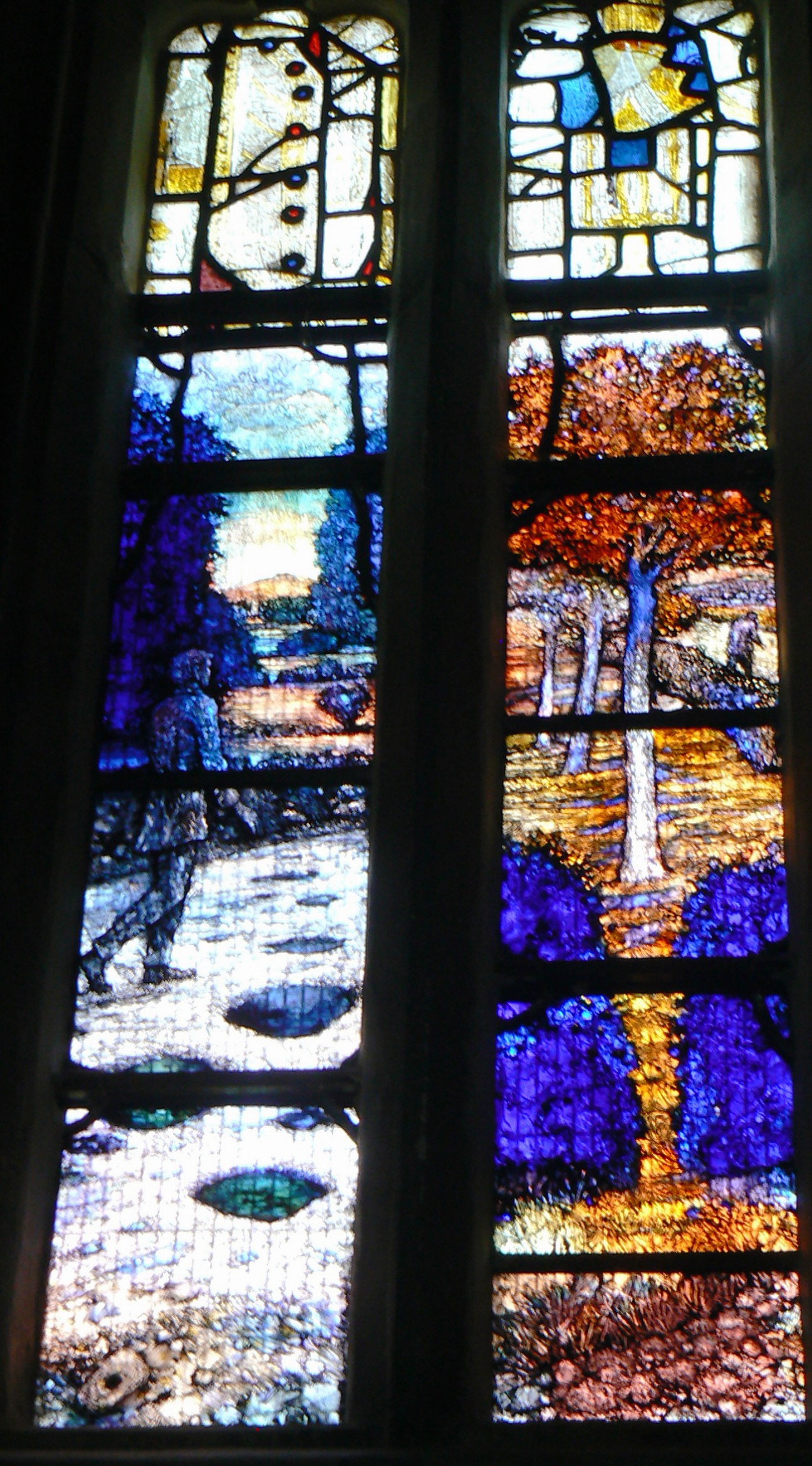
Stained Glass Window in memory of Ivor Gurney, WW1 Composer and Poet of Gloucestershire

Stained Glass Window in memory of Ivor Gurney, WW1 Composer and Poet of Gloucestershire


Ivor Gurney Window by Denny 3Ivor Gurney Window by Denny 10

In Gloucester Cathedral there is a new stained glass window created by Tom Denny, which is a memorial to the Gloucestershire poet, Ivor Gurney.  Like Will Harvey, whom I have written about before, he was a pupil and chorister at the Cathedral school before joining the Gloucestershire Regiment to serve in the First World War.  Indeed, they were great friends.  Gurney was a talented musician firstly, but in the thick of war, poetry became his creative outlet.   Like Will Harvey  he survived the war but was drastically changed by it.  So much so that his fragile mental health was totally destroyed, and he spent many years in a mental asylum where he eventually died before he was 50.  Gurney is buried at Twigworth, where his gravestone commemorates him as ‘poet composer of the Severn and Somme’.

Gurney’s poetry is beautiful and reflects his love for the Cotswolds, the countryside and the beauty of nature.  I’d like to share 2 of them with you that touch me deeply for different reasons.

Firstly, To His Love which is a poem thought to be written by Ivor Gurney when he thought his friend Will Harvey had been killed.

To His Love’

He’s gone, and all our plans
Are useless indeed.
We’ll walk no more on Cotswolds
Where the sheep feed
Quietly and take no heed.

His body that was so quick
Is not as you
Knew it, on Severn River
Under the blue
Driving our small boat through.

You would not know him now…
But still he died
Nobly, so cover him over
With violets of pride
Purple from Severn side.

Cover him, cover him soon!
And with thick-set
Masses of memoried flowers-
Hide that red wet
Thing I must somehow forget.

The second is The Bugle, written after Gurney returned from the war, a sadder and wiser man.  I include it as my grandfather was a bugler in WW1, and also because it speaks to me loudly of how ordinary life and commerce still goes on while soldiers suffer and die ‘out of sight, and out of mind.’ 

The Bugle

High over London
Victory floats
And high, high, high,
Harsh bugle notes
Rend and embronze the air.
Triumph is there
With sombre sunbeams mixed of Autumn rare.
Over and over the loud brass makes its cry,
Summons to exultancy
Of past in Victory.
Yet in the grey street women void of grace
Chatter of trifles,
Hurry to barter, wander aimlessly
The heedless town,
Men lose their souls in care of business,
As men had not been mown
Like corn swathes East of Ypres or the Somme
Never again home
Or beauty most beloved to see, for that
London Town might still be busy at
Its sordid cares
Traffic of wares.
O Town, O Town
In soldiers’ faces one might see the fear
That once again they should be called to bear
Arms, and to save England from her own.

There are many learned websites with information about Ivor Gurney, but my wish today is simply to share the beauty and poignancy of the new window and explain a little of its background.

Ivor Gurney Window by Denny 2

There are 8 lights or panes overall and each reflects something from the life and writing of Ivor Gurney.  The notes are a precis of those that appear in the Cathedral by the window.

Light 1 ~ Glimmering Dusk ~ a figure walks at dusk in a Vale landscape.  there are dark pools of rain on the white road and May Hill can be seen in the distance.

Windows 1 & 2

Light 2 ~ The Stone Breaker ~ In Flanders a chance encounter with some road menders reminds Gurney of a much earlier meeting (“Oh years ago and near forgot”), in the fresh beauty of a summer’s early morning, in a landscape of Vale orchards.

Light 3 ~ Brimscombe ~ Gurney remembers a night-time walk through the fir trees of the steep-sided Brimscombe valley near Stroud.  The “pure clemency” of the moment enables him to forget the “blackness and pain” of France.

Windows 3 & 4

Light 4 ~ Severn Meadows ~This was written in March 1917 at Caulaincourt.  As the sun sets over Severn meadows, a figure, in the shadow of a willow, looks back at the river and the willows.

Light 5 ~ Pain ~ Gurney recalls the grey-white Somme battlefield.

“Pain, pain continual; pain unending;….

Grey monotony lending

Weight to the grey skies, grey mud where goes

An army of grey bedraggled scarecrows in rows

Careless at last of cruellest Fate-sending.

Seeing pitiful eyes of men foredone,

Or horses shot, too tired to merely stir,

Dying in shell-holes both, slain by the mud.

…………………………………….

The amazed heart cries out to God.

Windows 5 & 6

Light 6 ~ To His Love ~ Probably drafted on the Somme battlefield, Gurney reacts to the news (false as it turns out) that his great friend, the poet Will Harvey, is presumed killed.  A couple walk on the Cotswold hills as their dead friend lies among the violets.

Light 7 ~ To God ~ In the intense suffering from mental illness, surely aggravated by his experiences on the battlefields, Gurney cries out for death, “I am praying for death, death, death”.

Windows 7 & 8

Light 8 ~ Song and Pain ~ A more optimistic end to the window as a figure emerges from an understanding of pain to enter “The House of Joy”.

As I stood and gazed at these incredibly beautiful but harrowing windows, there were people around me moved to tears by what Gurney had seen and suffered.  Tom Denny is a wonderful artist. He has captured and honoured Gurney’s genius, his love of Gloucestershire, and his suffering in that dreadful war and in his mental distress.

Meditating on a window

https://wordpress.com/post/heavenhappens.me/4977

http://www.ivorgurney.org.uk/biography.htm

http://movehimintothesun.wordpress.com/2011/04/22/to-his-love-ivor-gurney/