My Literary DNA


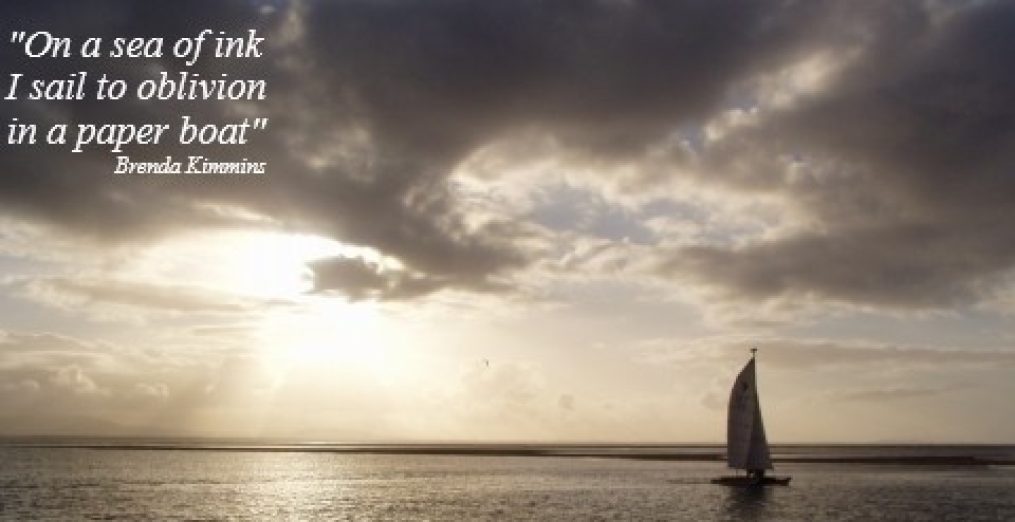
On a sea of ink

I sail to oblivion

On a paper boat

My haiku says it all really!  So many ‘writers’ feel like this.  They create something they feel inspired to write, but no-one gets to read it.

I have been thinking and reading a lot about this recently and trying to gather all the hints, tips and advice I have gleaned.   One of the bloggers I follow, Jamie Lee Wallace says:

A writer’s voice is that often intangible yet unmistakable something that defines the author’s work. Like literary DNA, it is as unique and complex as a fingerprint. Syntax, diction, dialog, and punctuation are combined with characterization techniques, scene delivery, and other stylistic elements and then distilled into an elixir that lets us see the world through the writer’s eyes.

But I think there is more to it than that.

The words a writer uses are like the lava flowing from a volcano.  The story may have been churning and burning deep inside for many years; changing, developing and demanding to be written.  The overflow of words is edited away like so much waste gas and ash, until the lava cools and sets into a final draft.  Once published, the writing is set like stone and the crust that protects the writer’s vulnerability and privacy has been split open irrevocably.  For make no mistake, the heart and soul of the writer is laid bare by the writing process.  It takes courage to put your thoughts, feelings, experiences and imagination into print for all to read.

The need to write is an itch that won’t go away; a fire inside that won’t be quenched except by expressing your own inner life in prose or poetry.  It is an incredibly personal thing that sets each writer apart from every other writer.  What you need to write comes from deep inside.  It was probably always inside you and was determined by the journey you have travelled during your life.  Every story you consumed, every experience you enjoyed or endured, every trauma, doubt, dream and question became part of your writer’s voice.

So it was with me.  Firstly, I wrote my own life story.  I needed to deal with a traumatic event in childhood, a disastrous first marriage, family things, work things, ill health and major depression.  I wrote it all out ~ then I shredded it and burnt it before I moved house!  This was so therapeutic, I not only put it all behind me, I wiped it off the face of the earth. Because that was not me!  All of that was what other people, situations or events had done to me.  And, I made a conscious decision to try and live the rest of my life as who I wanted to be.  And to…Get a life worth writing about.

Whatever kind of writing you would like to pursue, here are my tips for you:-

  • Take a course ~ Artists Way, Creative Writing, Futurelearn, anything that will stimulate and unblock you
  • Read some self-help/motivational books such as Change for the Better by Elizabeth Wilde McCormick or Life’s Companion, Journal Writing as Spiritual Practice by Christina Baldwin, if you are blocked by any of life’s unresolved issues
  • Buy Writing Down the Bones, Freeing the Writer Within by Natalie Goldberg
  • Start a Journal or more than one
  • Save poems, ideas for stories, photos, cuttings, inspiring phrases in spiral bound notebooks
  • Buy pens that feel good to hold and flow nicely. Many writers use fountain pens but I prefer gel pens
  • Find a colourful box big enough to store all your magazines, books, pens and journals together
  • Start a blog on WordPress, Blogger or Google Medium.  It’s easy to set up and you can safely practice and develop your creative skills,
  • Subscribe to, or borrow and read Writing Magazine (www.writers-online.co.uk) ~ hard copy or online ~ endless supply of ideas, advice, competitions, courses and opportunities
  • Get involved in something that involves meeting other people ~ I was WI secretary, on the Campaigns and Public Affairs Committee, an Extra for BBC and supporting artist in many  tv programmes.  I also I did charity work and joined a Choir and local theatre group
  • Observe the world, daydream, imagine, embellish, invent ~ all the things that got me into trouble when I was a child will enhance my stories!
  • Carry a notebook and pen with you always, or a fancy phone that takes notes and photographs! Jot down and capture anything that strikes you as interesting, unusual, meaningful or beautiful.  You will be surprised at how often a phrase or snatch of a song or poem touches you.
  • If so inclined, take photos whenever you see anything that inspires you

Maeve Binchy said her greatest tip was to, “Write as if you are talking to someone”.  I have always written about day trips, places I’ve been and things I’ve done.  And, I used to write a monthly article for a charity magazine, but I didn’t think I was a ‘writer’.

When I had grandchildren that changed.

Initially my role models were Beatrix Potter and Kenneth Grahame who were unashamed of creating an escapist world with the animals.  So I started off by writing stories for my grandchildren.  I wrote about Humphrey the pheasant who hangs out at the fishing lake, and Bart the cocker spaniel who emigrated to Vermont and had lots of adventures.  Humphrey and Bart are real but their adventures come out of my head or were embellished.  My plan was to write just for the grandchildren, and about the grandchildren, in order to help them develop their reading and writing skills.  Success was achieved when Rosie told me to stop making up a particular story about a tortoise because she wanted to finish it herself!  I was over 50 before I realised that ordinary people could be writers, she was 5!

Then I had to find something else to write about, so I started my blog at http://heavenhappens.me

I wrote the blog posts to rationalise and record positive aspects of my life’s journey.

Teaching; Twinning in Kenya, Russia and Poland; Trips to Lourdes; Travelling in USA and Europe; Becoming a carer; Joining Amateur Dramatics and a Choir; Working as a BBC Extra; Performing in Cathedrals, studios and theatre; WI committees; Charity volunteering: All of these experiences informed and enriched my writing.

My inner critic was silenced because I didn’t think anyone else would read it.  But gradually a community built up with whom my writing strikes a chord.  There are over 830 readers now who follow my blog.  I feel I have found “my place in the family of things”.

Wild Geese by Mary Oliver

You do not have to be good.
You do not have to walk on your knees
for a hundred miles through the desert repenting.
You only have to let the soft animal of your body
love what it loves.
Tell me about despair, yours, and I will tell you mine.
Meanwhile the world goes on.
Meanwhile the sun and the clear pebbles of the rain
are moving across the landscapes,
over the prairies and the deep trees,
the mountains and the rivers.
Meanwhile the wild geese, high in the clean blue air,
are heading home again.
Whoever you are, no matter how lonely,
the world offers itself to your imagination,
calls to you like the wild geese, harsh and exciting-
over and over announcing your place
In the family of things.

Story time

Just give me the grandchildren and I’ll make up the stories

Now that I have 7 grandchildren, I have reached a point where I want to publish some of the stories I write for them.  Every thing they say or do, and everywhere we go to play, inspires me to write more.  And, at 78 I am getting closer to oblivion so I can’t afford to waste time!

Check out Stanley’s Day out!
These are the days of our lives


snowdrops-and-heelebores (2)

I went to the funeral of a dear man this week who was my next-door neighbour for many years, and, as these occasions are wont to do, it made me rethink the value and purpose of our lives and what we leave behind.

Listening to the heartfelt words of his children and grandchildren I was reminded of the saying, “people may not remember what you did or said, but they will always remember how you made them feel.”

Not one of them mentioned a gift he had bought them or how much pocket money they had received if any.  They didn’t mention his house or his décor, his car or his clothes.  They didn’t mention his looks or his job.  What they all mentioned was that he was kind; always there for them, would do anything for them, and that they had fun with him.

He was an ‘ordinary’ man, one of 9 children in the 1940s, when large families were more common.  He was a happy rascal as a little boy, playing truant from school to hunt for rabbits in the countryside.  He met his wife to be when he was 15 and she was 14.  They married at 19 and have been happy together ever since.

He grew up at a time when it was possible to get a job for life in a large, local company.  He worked hard, enjoyed the job, was on friendly terms with all his fellow workers, and stayed there for 40 years.

Apart from his family, the love of his life was his garden.  We always used to look after and water each other’s gardens whenever either of us was away.   His garden was a delight but his passion was such that he eventually took on 2 allotments as well.  There he grew all the fruit and vegetables you can imagine, for eating, and to brew his home-made beer, wine and cordial.

Gardening was so important to him that this lovely poem was recited at his funeral.

The Glory of the Garden by Rudyard Kipling

Our England is a garden that is full of stately views,
Of borders, beds and shrubberies and lawns and avenues,
With statues on the terraces and peacocks strutting by;
But the Glory of the Garden lies in more than meets the eye.

For where the old thick laurels grow, along the thin red wall,
You will find the tool- and potting-sheds which are the heart of all ;
The cold-frames and the hot-houses, the dungpits and the tanks:
The rollers, carts and drain-pipes, with the barrows and the planks.

And there you’ll see the gardeners, the men and ‘prentice boys
Told off to do as they are bid and do it without noise;
For, except when seeds are planted and we shout to scare the birds,
The Glory of the Garden it abideth not in words.

And some can pot begonias and some can bud a rose,
And some are hardly fit to trust with anything that grows;
But they can roll and trim the lawns and sift the sand and loam,
For the Glory of the Garden occupieth all who come.

Our England is a garden, and such gardens are not made
By singing: – “Oh, how beautiful!” and sitting in the shade,
While better men than we go out and start their working lives
At grubbing weeds from gravel-paths with broken dinner-knives

There’s not a pair of legs so thin, there’s not a head so thick,
There’s not a hand so weak and white, nor yet a heart so sick.
But it can find some needful job that’s crying to be done,
For the Glory of the Garden glorifieth every one.

Then seek your job with thankfulness and work till further orders,
If it’s only netting strawberries or killing slugs on borders;
And when your back stops aching and your hands begin to harden,
You will find yourself a partner in the Glory of the Garden.

Oh, Adam was a gardener, and God who made him sees
That half a proper gardener’s work is done upon his knees,
So when your work is finished, you can wash your hand and pray
For the Glory of the Garden, that it may not pass away!
And the Glory of the Garden it shall never pass away!

And it reaffirmed in me the knowledge that wealth, position and possessions, ultimately mean nothing to the people who truly love you.  They remember your smile, your kindness, and how you made them feel.

Although the funeral made me sad and thoughtful, this poem comforted me.  For, like the glory of the garden, this dear man’s goodness will live on, in his widow, his children and grandchildren.  His life had inestimable value to them and to all who knew him.

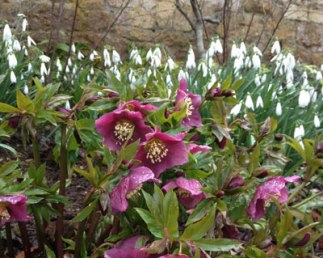
In memory of my neighbour I will give you a photographic guided tour of the Rococo Gardens in Painswick which at the moment is aglow with snowdrops and hellebores.


Transformation

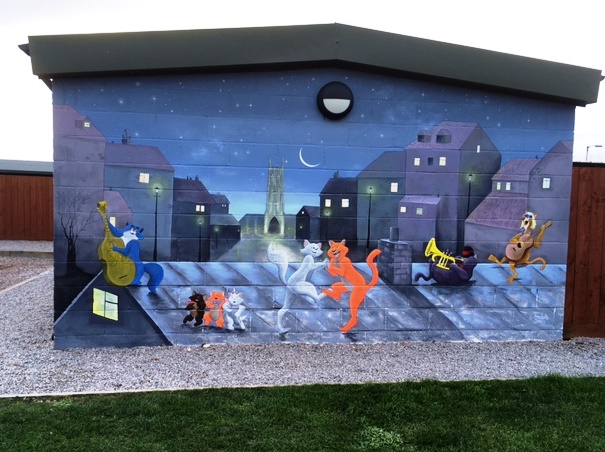
It is truly amazing what a transformation takes place when a mural is added to a boring wall.

BJ Kennels2

On the rare occasions when I travel, I put my little dog, Toffee, into kennels.  The facilities for the dogs are great and no expense was spared when they were built.  The owner of the kennel used to be a RSPCA inspector so his standards were always high.  The kennels were sited near our small local airport.   As the airport got busier and the planes got bigger, it became necessary to extend the runway.  As the kennels were right in the way the owner was made a very generous offer to move.

This was a once in a lifetime opportunity for him to build a state of the art facility.  He travelled the country researching the best kennels and what they offered.  he then had his new kennels built to the highest standards.  Each kennel has its own  little exercise area.  There is underfloor heating.  The walls and floors are finished in hospital quality anti bacterial finishes that can be easily washed down.  There are open fields behind with country walks, and enclosed exercise areas for play.  There is even an agility course and grooming salon!

Altogether, this makes for a beautiful environment for the lucky pets who spend any time there.  The staff are also first rate.  They treat every visiting dog as if it were their own and give lots of love, care and attention as well as exercise.

However, the outside walls, which faced the carpark, were a bit boring to say the least.  But on a recent visit, I was delighted to see murals by a local artist had been painted on the outside walls.

One was based on the film 101 Dalmations.  The other reminds me of the stage musical, Cats.

BJ Kennels

I absolutely love them.  I took my puppy-loving granddaughter along to see them and she loved them too.  They have even continued the theme along the fences with puppies here and there.  It is adorable.  Enjoy my photos of this very special place.


Walk this Way

Walk this Way

P1020105

Almost the end of the summer here in the UK and Autumn is definitely in the air.  So, I went with the grandchildren to Westonbirt Arboretum.  The arboretum is so popular that the car park was overflowing, but once inside the woodland is so vast that it didn’t seem crowded at all.   The aim of the visit was to go on the Gruffalo trail but we found that a bit disappointing.

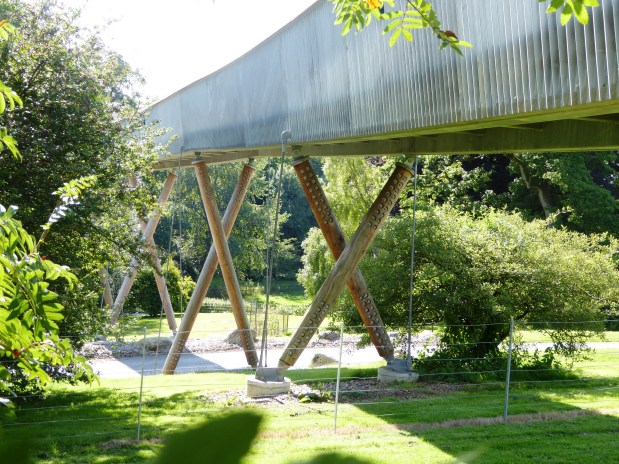
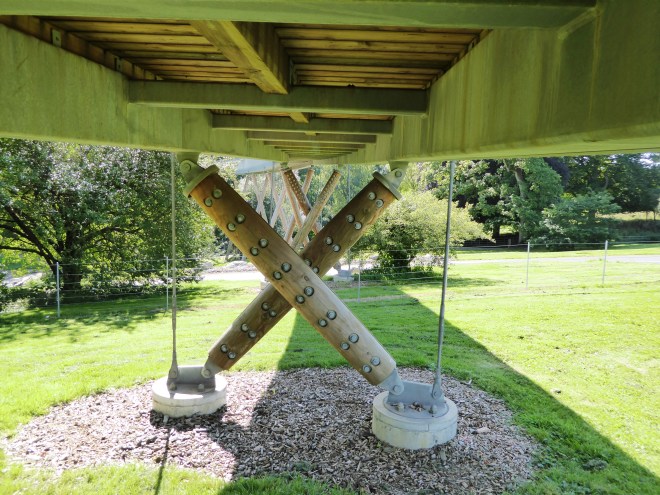
However, a new experience for us was the bridge-like structure which takes visitors right up into the canopy of the trees.  The bridge is very cleverly built with angled slats on the sides so that even the smallest children or wheelchair users can see the trees every step of the way.  At intervals, there are viewpoints like ‘crow’s nests’ with information and pictures of the wildlife you can find.  Some of the wildlife was a bit too realistic as there were swarms of bees building hives in some trees!

Up there on the walkway you get a totally different view of, and perspective on the 15,000 trees from all around the world which thrive there.

All around the arboretum there are woodcarvings and buildings created from the trees in the woods.  They are magnificent.  But the grandchildren’s favourite was in the adventure play area.  There was a sea theme with a huge pirate ship, small canoes, sharks and fish, all carved from the wood.   The grandchildren loved it and I can’t wait to go back in Autumn when the trees have turned golden and red.

Wooden Walkway and other structures at Westonbirt

Trees are structures just made for climbing up and over, or jumping off!

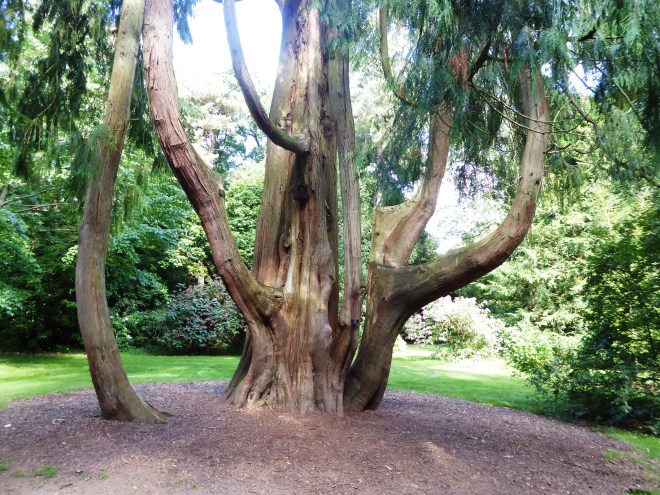
The Western Red cedar is a spectacular structure

P1020080

And lastly,  a woodcarving

A Lego Doughnut

lego_finished_model-3707x2471px


I have made a rather obscure link to this week’s photo challenge theme, which is ‘security’.  But, as regular readers of my blog know, I will use any excuse to write about my grandchildren!

One of the many advantages of spending lots of time with the grandchildren is that I can have fun playing with their toys.

Currently I am enjoying Lego Duplo with Stanley who is 4 and Thea who is 2.  The sets are a far cry from the uninspiring little pieces I remember from when my children were young.  They are so colourful and child friendly now, with animals and themed sets.   Yet they still stimulate the imagination and encourage a world of creative play.

Fortunately I don’t have a tablet, or an ipad, or a kindle, or any of the gadgets they seem to get addicted to as soon as they can hold them these days.  And, horror of horrors, I only have terrestrial TV channels, not games on demand!  So at grandma’s house creative play still rules.

Thea is particularly enjoying the Forest Park and Family Pets sets because she loves animals while Stanley loves the vehicles and characters.  But, however many sets they get, their first desire is still to build the tallest tower!

My older grandson, who has reached the ripe old age of 13, is also into Lego.  He has a bedroom full of it and is very expert.  I don’t even attempt to meddle with his models though, as they are very technical and way beyond my skills.

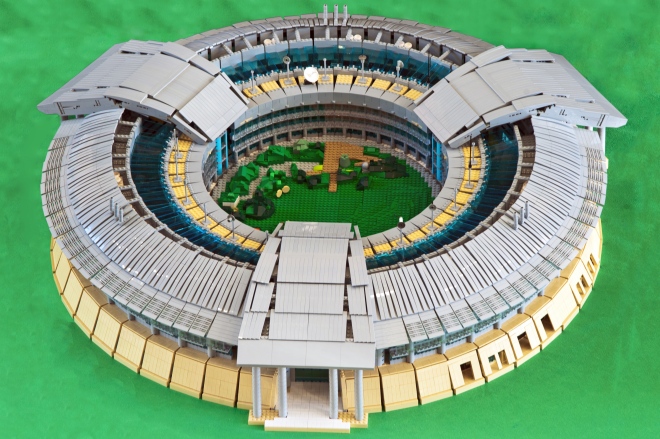
So, you can imagine how impressed I was to hear recently that part of our national security agency, the Government Communications Headquarters (GCHQ), which is based near my home, had set it’s employees the challenge of modelling the building out of Lego. This is not just any regular building,  it is shaped like a doughnut, which must be really difficult to model.  But they did it and the result is impressive as it would be with all their skills brought to bear.

I can’t take credit for the photo as it was on the official GCHQ website, but I do have permission to use it.  I think it is brilliant, especially as it was created in order to raise funds for a local charity, Elisabeth’s Footprint, which is very dear to my heart.

Do click on the links to see more blogs on the theme of ‘security’ and if you want to know more about the Doughnut Lego model, or the inspiring story of the marvellous woman behind Elisabeth’s Footprint.

What else can you do with grandchildren in the absence of gadgets? Well, We build dens, paint, play with sand and water,  picnic in the woods, take the dog for walks, or go to farms, parks and forests.  If it is cold or wet we make up stories, poems and fantastical adventures…

What did you do today?

Did you go to the airport with an alligator,

Or go to the beach with a bear?

Did you eat in a café with a camel

And frighten the people there?


Did you build a den for a dinosaur,

Or run through the grass with emu?

Did you go to the fairground with a fox?

Did he win a goldfish for you?


Did you play houses with a hedgehog,

Or go ice-skating with an impala?

Did you drive a jeep with a jellyfish,

Or fly a kite with a koala?


Did you eat lunch by the lake with a lamb,

Or play marbles with a monkey?

Did you go on a nature trail with a newt?

Now that would be quite funky.


Did you eat an orange with an octopus,

Or splash in a puddle with a pig?

Did you quiver and quake at a queen bee,

Then go out and dig?


Did you ride the rails with a reindeer,

Or go to the seaside with a snake?

Did you climb a tree with a tiger?

Now that would be a mistake.


Did you race upstairs with a unicorn,

Or drive a van with a vole?

Did you make a wish with a wallaby,

Or did you do nothing at all?


Did you swim with an x-ray tetra,

Or sail on a yacht with a yak?

Did you go to the zoo with a zebra?

Tomorrow ~ are you coming back?

 Poem by Brenda Kimmins.

Time to play

Time to play


Toffee aged nearly 7 months

Each week I spend lots of time with my pre-school grandchildren and I love every minute of it.  I have so much fun joining in their fantasy worlds where dinosaurs roar, toy trains hurtle through tunnels, sparkly unicorns upstage colourful ponies, and teddy bear families have picnics under blanket-covered playpens.

There is not a bit of my tiny house that hasn’t been given over to play, and that includes the garage, shed and garden.

I realised this week that although I may be getting close to my second childhood, I am actually reliving the one I missed and wished I had enjoyed.

I was born just after the  second world war in a northern city which had been in dire straits with poverty and unemployment even before the shipyards, mines, factories and chemical works were bombed.  The after effects of the war meant more joblessness, more shortages, and rationing of even  essentials like food.  Toys were a luxury that very few children in my area had, unless they were home made.   Thankfully I had a clever mum who knitted dolls and soft toys, and a wonderful dad who wittled away at wood to make tops and whips and covered them with shiny paper for decoration.

Add to the mix the fact that in the 1940s children tended to be tolerated in the family rather than central to it as they are now.  And, as well as all that, or maybe because it, I was a very sickly child who spent a lot of time in hospital, or a horrendous children’s convalescent home where the idea of play therapy was light-years away.

The result as I remember it, was a rather unhappy childhood, thankfully worlds away from the one that my grandchildren are enjoying.

However, the advantage of my early experience is that I developed a vivid imagination and have a buried need for creative play, which is at last being given free rein.

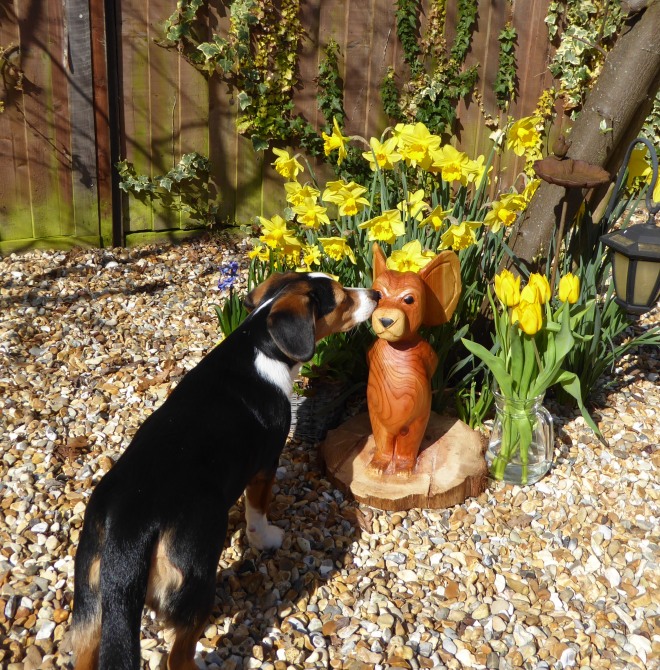
The trigger for this line of thought is in the photo.  No, not my puppy, but the mouse!  I have been collecting the characters from The Gruffalo story for the grandchildren and the mouse is rather special.  It was created by a local woodcarver from a bit of fallen tree in the Forest of Dean.  There is a marvellous museum there called the Dean Heritage Museum celebrating the mining and forest crafts that used to go on in the area.  One of the attractions is a magnificent Gruffalo trail where each of the characters is carved from wood.   I just had to have the mouse for my garden.  I thought it would enjoy living among my daffodils  for a while.   As I stood atop them I wondered if I could find a home in my garden for a 6 foot Gruffalo?  The grandchildren would love it!

Grandma’s house is very small
Just 2 bedrooms off the hall
A tiny kitchen, shiny-floored
A larder where my treats are stored
A shower with a seat inside
Wardrobes where doggy and I can hide
An archway leads into the lounge
Where furniture gets moved around
To make a station for my trains
Or an airport for ‘copters and planes
Sometimes it’s a racetrack for my cars
Or a farmyard with tractors, paddocks and barns
Grandma puts blankets over the table
To make a den, a forest or a stable
In the garden there’s gravel that scrunches when I walk
And a patio where I can draw pictures with chalk
In granddad’s shed there are drawers full of tools,
Boxes of nails, tubes of glue, jars of screws
A little mouse is nesting inside the wood store
While outside live birds, bees, hedgehogs and more
Grandma says her shed is a magical place
It’s furnished and carpeted and curtained with lace
Lavender hangs drying from the painted ceiling
While pine shelves are covered in things that have meaning
Like Icons from Finland, and medals from Lourdes
Calabash from Africa made out of gourds
Matrushkas from Moscow, maracas from Spain
I can’t wait for summer to play there again
Grandma loves it when I come to play
She makes indoor picnics we eat off a tray
She has lots of photos all over her wall
The best one is my mummy when she was small.


Dayna


dayna-in-porch-2

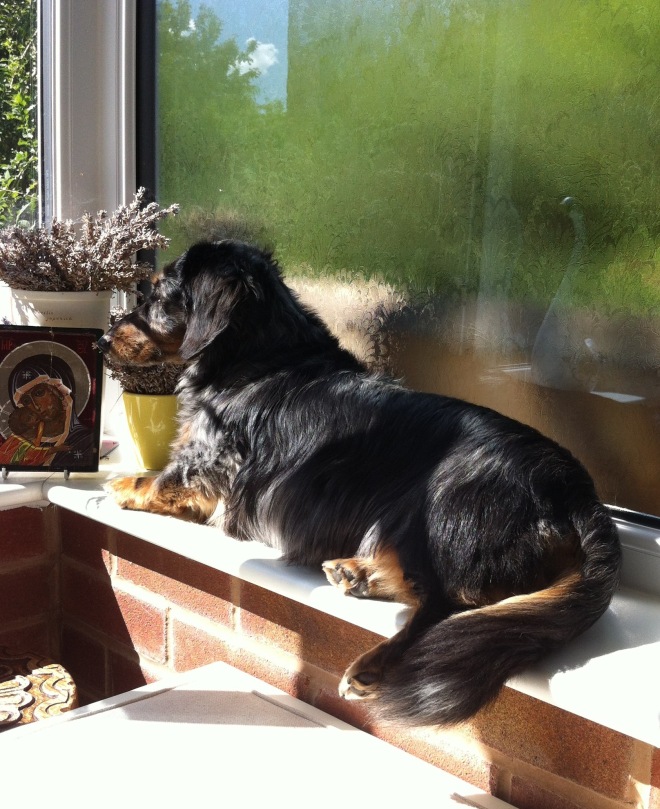
I’m posting a photo of my much-loved dog Dayna today sitting in our porch.  This is where I like to sit and write, colour or do puzzles in my very rare free moments.  I am proud to say that until Sunday 16th October, wherever I was you would find Dayna very close by.  In the porch, her favourite spot was the windowsill.  She would sit there guarding me from the world and watching the people go by.  Being south facing our porch is warm and cosy and a great suntrap.  Dayna’s beautiful silver dapple coat of fur would shine in the sunlight as she sat, so proud of herself in her little domain.

Just four momentous years ago I wrote about the little Dachsund, Dayna, that I rehomed.  She settled in quite well after a few minor hiccups!  As soon as I picked her up from her previous home, I popped into the Pets at Home Store.  There I rashly bought 3 very large bags of a good quality dog food, one chicken, one beef and one vegetable variety, which she flatly refused to eat.  I also bought a canvas cage for her to sleep in ~ which she absolutely refused to get into.  I bought a lovely red extending lead to match her very sparkly red collar, which she chewed through during her first walk.

Feeling desperate I appealed to my wonderful dog-loving daughter in Vermont who sent me 3 books packed full of guidance on training your dog:

How to Raise the Perfect Dog by Cesar Millan

How to be your dogs Best Friend by The Monks of New Skete

Dog Stories ~ Everyman Pocket Classics.

I found these books insightful and very helpful, but obviously Dayna has previously read one called How to Get your Owner to Do Whatever You Want, so she wins hands down.  One week and three leads later we got the measure of each other and Dayna had got me trained.

Dayna would eat fresh meat or fish, any kind of cheese, pouches of lamb and rice with vegetables, or tins of expensive dog food.  On no account would she eat dry food however expensive ~ 3 large bags of which were donated to the local animal rescue centre.

Dayna would walk for miles very happily with a short chain metal lead.  She had no interest in being on a long extension, preferring to be within a couple of inches of my feet, preferably between them so I am in danger of tripping.

Dayna had no intention of ever sleeping in a cage, however softly padded or comfortably den-like whatever the Monks of New Skete say!  She prefers to sleep within licking distance of my foot in a soft bed with a fluffy cushion.

We had some great days out. In Pershore for the Plum Festival we sat outside a cafe in the sun where every passer-by fell in love with her.  At the seaside she gloried in the freedom of the beach.  In Wick at the Confetti Fields, she climbed on a trailer and surveyed the scene.  She had such a big personality for such a small dog.

When my two adorable grandchildren came on the scene she was gentleness personified.  As babies they soon realised she was a real-live fluffy toy who loved to play with them.  As Thea grew into a toddler she would dress Dayna up in hats and cover her in jewellery.  Stanley would include her in all his games too. For him she was a dinosaur or an obstacle in the way of his bike or on his train track.

How could something so small have so much control?  I don’t know but she was everything I could want from a dog:

Loyalty, trust, companionship, healthy walks, fun, and bucket-loads of love.  She was worth her weight in gold.

Then on Sunday, the anniversary of my mum’s death, Dayna was tragically killed on a busy road near our home.  She was being taken for a walk on a new lead which somehow came loose as she excitedly pulled to cross the road in a hurry to get back to where she was happiest ~ in our little bungalow, with her little pack ~ her domain, her world.

My heart is broken by her loss.  She is irreplaceable.  But her memory will shine on in our hearts forever.


Burford Wildlife Park


We are truly spoilt for choice in our local area for interesting places to go.  I am so lucky to have grandchildren who I can use as an excuse for going to all the farm parks, forests, steam railways and adventure playgrounds.

There certainly wasn’t anything like that where I grew up in the North of England.  My playground was the shipyards on the River Tyne, abandoned coal mines, or the sand dunes and castle ruins on the North Sea Coast.

The child in me can never get enough of our local Wildlife Park at Burford.  It is so well run and the animals are the first priority.  It is such a joy to see the beautifully maintained grounds and healthy happy animals living as naturally as it is possible and safe for them to be.  I have a season ticket there and go as often as I can with the grandchildren.


Victory


Oh my goodness I know I should be writing a learned and worthy post on the theme of remembrance for this week’s victory prompt, but I just have to diverge.  I beg your forgiveness for the poor quality of my photos but I was laughing so much as I took them.

This sequence took place on Tuesday morning as I looked after my adorable one year old granddaughter.   The lounge, hall and bedrooms were filled with toys for her to play with, but now that she can walk the kitchen is her favourite place.   For the kitchen is where my little dog hides in her bed when grandchildren appear.

There truly can be nothing more amusing than watching a one year old negotiate with a dachsund.  It was clear the poor dog had no chance of winning and eventually she had to give up her bed, which she did very reluctantly.  Then it was blankets out as soft toys and granddaughter moved in.

If there is such a thing as a saintly dog, my little dachsund truly is one!  She is so good natured and patient under severe provocation.


Thomas the Tank Engine ~ Boundaries

IMG_3244

Boundaries

The word Boundaries conjures up all sorts of ideas in my head.  The obvious are fences, hedgerows and walls round private property or land, to define ownership and maintain privacy.  Then there are those railings around parks and public buildings to regulate or restrict access.  Some boundaries are essential for security such as round airports, government or military buildings.  Then there are the barriers around areas of danger, like deep water, rock falls or steep cliffs.  These would all provide super subjects for this week’s photo challenge.

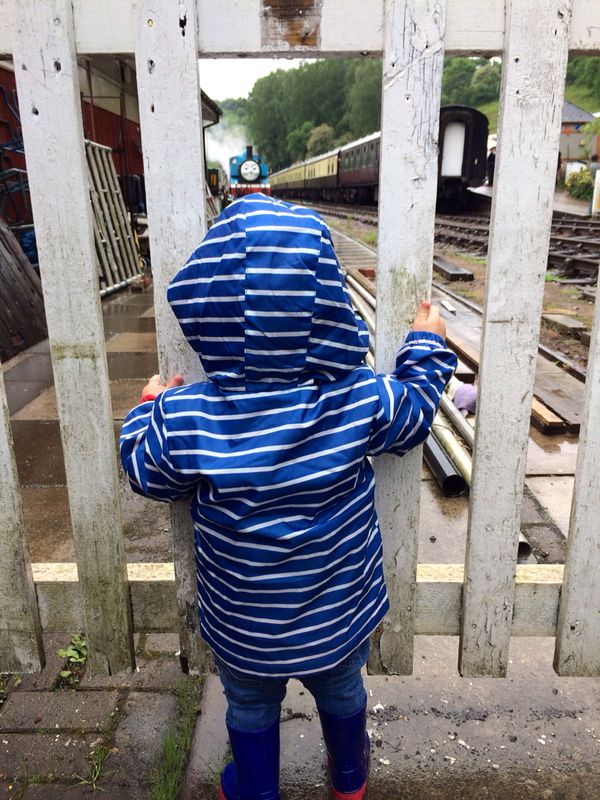
But, having looked through my photos I selected an emotive photo of my little grandson standing by the boundary fence at a recent steam railway event.  He could easily squeeze through the gap provided by the missing paling, but of course he doesn’t, because, at the age of 2, he already setting himself personal boundaries.

The object of his interest is Thomas the tank Engine, which, although it is incredibly old fashioned, seems to appeal to most children, and especially little boys or children on the autistic spectrum.

The stories of Thomas and his friends were actually published 70 years ago in 1945 under the title of The Three Railway Engines, and Thomas wasn’t even in the first book.    It was about Edward, Henry and Gordon.  Thomas didn’t come in until the end of book two.  If you are really interested in  the history of Thomas I recommend this site, pegnsean

I spend a great deal of time with my grandchildren and I have been through the Thomas phase a couple of times.  Personally, as an adult, I prefer Chuggington with its exciting storylines and more contemporary language.  But I can see the appeal of Thomas for very young children.  The island of Sodor, where Thomas lives and works, is an idyllic setting, safe and stable, where nothing much changes.  Whenever problems arise the little engines sort everything out slowly and surely with hard work and co-operation.  This is reassuring for children making them feel safe and comfortable.

There is something about Thomas as a character too that is deeply comfortable.  It could be the chubby cheeks or the big eyes.  He just looks like the archetypical train engine.

Children when asked to draw a house will draw a rather square box with a chimney, windows and a door, whether they live in a semi or a flat.  I read that a recent survey found when children were asked to draw a train, 95 per cent of them drew a steam train!  This is surprising when trains these days are so different.  Virgin Trains are running a competition at the moment to design a Christmas Train.  I do wonder how many of the entries will feature a steam chimney or funnel!

Empuriabrava on the grid

Well September, always my favourite month, has been particularly exciting this year.  I was lucky enough to take a trip to Empuriabrava in Spain with some of my family, to celebrate my daughter’s 40th birthday.  My photos come from there.   Thanks to WPC, I became obsessed with grids and spotted them everywhere in the old town!

Empuriabrava is a wonderful place, especially in Autumn, when the vast majority of foreign tourists have gone home.  It is built around national parks ~ lush and green thanks to the fresh water springs, and there are magnificent views of the Pyrenees in the distance.  The beautiful beaches are deserted except for fearless young windsurfers.  The parks are left to local children and older folk who make good use of the play and exercise equipment freely provided.  The seemingly endless footpaths are given over to dog walkers, runners and cyclists.   While walking along the footpath, I was surprised and delighted by a herd of extremely well-behaved goats following a farmer.  They stopped occasionally to feed or explore the hedgerow, but were easily coaxed onward by the goat at the rear with a bell round his neck.  They seemed happy and even managed what looked like a smile for the camera.   The wide river Muga flows along one side of the footpath on its journey from the Alberes mountains of the eastern Pyrenees to the Mediterranean Sea at the beautifully named Gulf of Roses.  The bamboo, rushes and trees beside it were filled with birds and butterflies while the steps leading up to the path were dotted  with sunbathing lizards.   Nearer the town, the fig trees were filled with the sound of squabbling parakeets.  There seemed to be masses of these bright green birds with grey breasts nesting in every palm tree, which delighted my little grandson.   They are feral monk parakeets apparently and they are quite common.

The new part of Empuriabrava is often referred to as the Venice of Spain.  However, it reminded me strongly of St Petersburg.  There is no Hermitage, and no Palace or fort, but the whole town is criss-crossed by canals, just like St Petersburg.  Many of the luxurious white houses, villas and apartments back onto the canal and have their own moorings.  Sleek boats of all shapes and sizes can be seen everywhere and they can be hired quite cheaply.  It is such a leisurely way to get around.

The old town of Castello d’Empuries is only about 4km from the new town and is connected to it by the footpath that we walked each day.  It is so quaint that if it were possible to remove the occasional car and delivery lorry, it would be easy to imagine yourself back in the Middle Ages.  There are unspoilt historical monuments, including roman baths, and a fascinating Jewish Quarter.  But the most exciting place for me was the restaurant in the Gothic Portal de la Gallarda.   It is sited over the Gallard gate, which was the fortified entrance to the old town.  There is an ancient moat around the wonderfully conserved walls, which extend to the Basilica of Santa Maria.  We had a superb meal there, contrary to negative TripAdvisors’ reviews ~ and lots of lovely Cava!

My trip was the perfect restorative holiday, and it was rounded off at the airport in Girona when the Spanish ‘Red Arrows’, known as the Patrulla Aguila (Eagle Patrol), flew in.  They had been performing a display in Mataro near Barcelona at the Festa al Cel.  The display team is normally based at San Javier in the Murcia region so we were very lucky to see them. This was a week earlier than usual to avoid the regional elections for the government of Catalunya which take place this Sunday.  These elections are hotly contested and there were flags on many of the houses displaying their allegiances.

Below you can see some of my photos.  They are all connected with my trip and some are in monochrome.

Summer surrenders

Fruit falls from burdened branches

September sweeps by

http://www.castelloempuriabrava.com/en/natural-park.html

“Today was a good day” or  “I wouldn’t start from here!”

In the woods with hubby and dog

There’s a well-known joke, which has been around since at least 1924 about a tourist in Ireland who asks one of the locals for directions. The Irishman replies: ‘Well, if I were you, I wouldn’t start from here’.

That’s the way I feel about today’s weekly photo prompt!

The prompt is “Today was a good day”.  But recently every day seems to present a challenge of almost unmanageable proportions so I am just going to imagine what ‘a good day’ would be for me.

I think my good day would start with a breakfast of fresh fruit with muesli and natural yoghurt.  I would eat this sitting in a Cotswold garden, by a stream with fish swimming lazily by.  To drink I would have fresh orange juice followed by the perfect cup of coffee.  I imagine it to be an autumn day, early September, when the trees are still laden with fruit, the harvest from field and hedgerow is in, and the birds are well-fed and singing happily.

I would be content for a while sitting with my husband and little dog reading a good book; I can recommend ‘The Snow Child’ by Eowyn Ivey; or doing the puzzles in my favourite daily newspaper.  But pretty soon I would want to meet up with my grandchildren for an adventure.

I would take them anywhere with trees and animals, a playground and a picnic area.  We are spoilt for choice in the Cotswolds with natural woods and ancient forests on our doorstep, as well as Burford Wildlife Park, Bourton on the Water Birdland, and Prinknash Bird Park, which are among my favourites.   Westonbirt Arboretum and Cotswold Wildlife Park are close behind.  There we would run free, or explore on cycles, skates and scooters with the youngest in her pushchair.  We would climb trees, collect berries, nuts and seeds, cross wobbly rope bridges, build dens, swing, slide, feed the animals, sing songs, take photos and make up stories.  Then we would have an enormous feast of a picnic washed down with ice cold spring water and followed by a soft whippy ice cream.

The children would have a nap on the journey back and wake refreshed to capture their memories of the day in collage, painting and drawing, or stories and poems illustrated with their photos.  Later we would bake yummy pies and crumbles with the fruits and berries they collected.  We would enjoy them with their parents before sending them home to sleep well and dream of their good day.

I would return to my seat in a Cotswold garden, by a stream with fish swimming lazily by.   My hubby would be there with our sisters and some special friends.  Someone would barbecue a perfect steak for me and serve it with a fresh salad from the garden.  I would have a large glass of beautiful red wine and watch the hot air balloons float overhead as the sun set.  No doubt one of them will be pig shaped!

ROY-G-BIV ~ Rambles and rainbows

Indigo denim jeans on  Jungle playmat

Jungle playmat

The differences between being a child in postwar Britain, a parent in the 1970’s, and a grandparent today are amazing to me.  When I was a child there were still shortages of food which meant essential supplies were rationed while luxuries were just none existent for the ordinary family.  This made for a simpler diet with few choices and little chance of overindulging.  However, undernourishment was such a big issue for children at the time that the government provided orange juice, cod liver oil, malt extract and often a tonic like Minadex for every school age child.  Babies and schoolchildren were given free milk.

Food was basic, grown, fished or farmed, and home cooked.  There was very little processed food and no such thing as ready meals!  Packaging was practical and simple too.  Butter and cheese was cut off a large block and wrapped in greaseproof paper then put in a brown paper bag.  Sugar, flour and dry goods were scooped out from large sacks, weighed and poured into paper bags.  Fresh fish was bought straight from the quayside or from a man who brought it round the houses in a horse and cart.  Bread and pastries were usually baked at home or bought from the local baker, while meat was from the local butcher and chickens were often still alive!  Every town had a High Street which had a selection of specialist shops and there were ‘corner shops’ in most residential areas.  In fact when my grandfather left the army in 1952, he bought a corner shop right next to the hospital off the West Road in Newcastle.  Some shops, like Woolworth’s, were quite large, but nothing like the huge supermarkets of today.

Women, and it was almost always women, had large sensible shopping bags, which were used over and over again.  Plastic bags had not been invented.   Often the shopping was delivered to the housewife in a cardboard box by a lad on a bicycle or a man in a van.  This was essential as working class women, or indeed men, would not have had a car.  We have gone full circle here as so many supermarkets deliver shopping now, but not for the same reason!

But to get back to childhood, babies as far as I remember were dressed and treated as babies until they were about 3 years old. They would be put in a big pram and stuck outside in the garden or yard, or often, on the street outside the front door.  Here the child would sleep or watch the world go by for hours between feeds with a few toys.  My soft toys would have been knitted by my mum while my dad would occasionally make wooden toys.  Toys, being few,  were treasured.  I still have the doll I had when I was 1 and the golly (sorry) my mum knitted when I was 4.  Boys would often have tin cars or lead soldiers, both of which would be considered dangerous now.

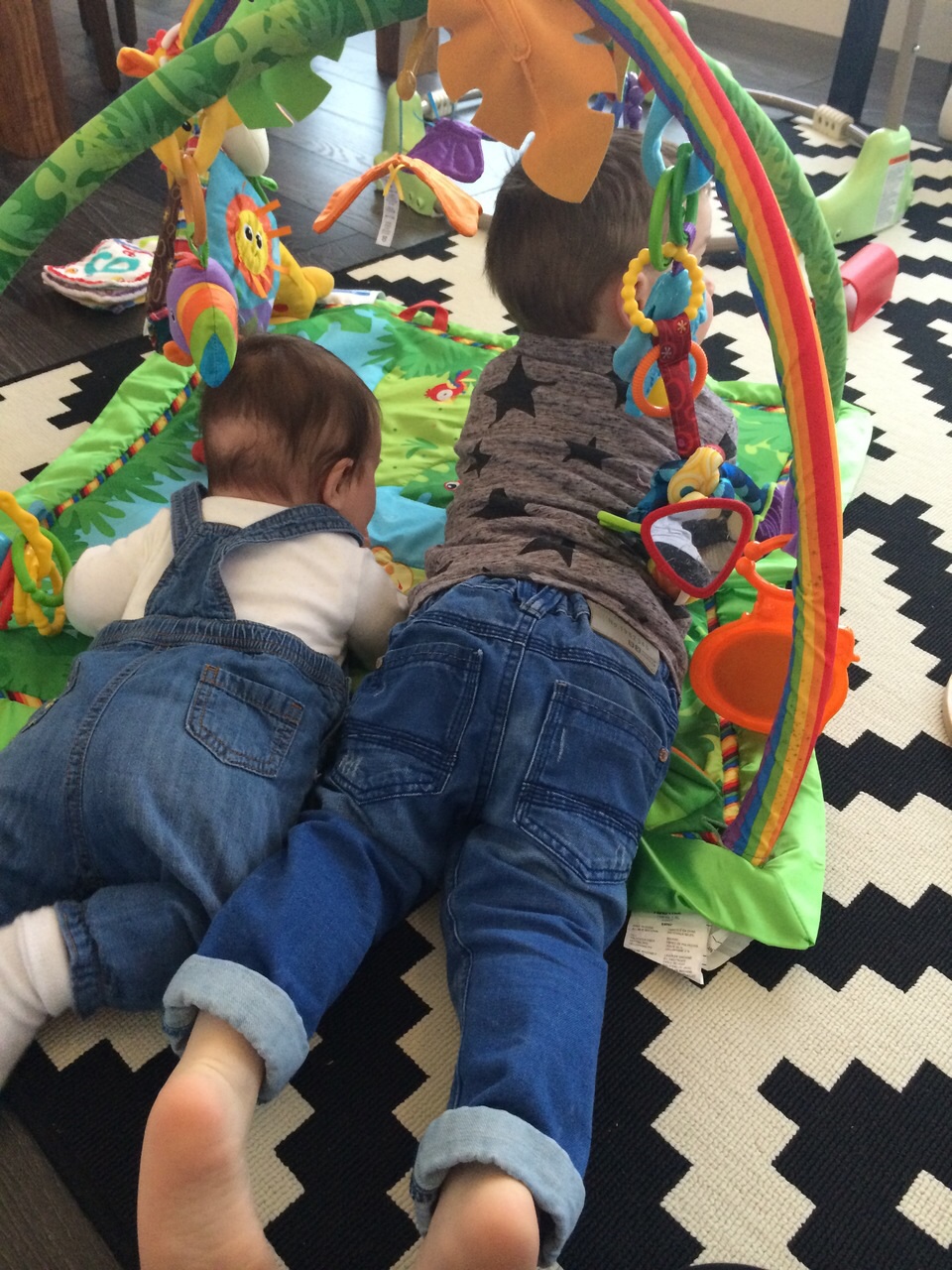
Today things are so different.  Babies are socialised and stimulated from the earliest age.  My grandchildren are taken to ‘bounce and rhyme’,  baby gym, play barns, swimming classes, baby massage  etc. etc.  It amazes me to see the speed of their development.  And at home the range of toys is breathtaking.  Everything seems to have movement, music, colour and lights built in.  Even books have appropriate sounds alongside the story.  And, before babies can even crawl they have play mats like the one in my photo.  This 3D mat has all the colours of the rainbow in it.  It is based on a jungle theme so there are animals adorning it.  It is soft, safe, supportive and stimulating.  It plays a variety of music, animal noises, and even waterfall sounds.  It has given my grandchildren hours of pleasure.  I chose this photo for a couple of reasons.  It shows  my two and a half year old grandson teaching his 8 month old sister how to roll over.  It is so cute and the clothes just tickle me.  Denim jeans on a baby I find hilarious and absolutely adorable.

So this week’s photo challenge was to illustrate the colours of the rainbow and I think this photo does that.  The denim jeans qualify as Indigo while all the other colours of the rainbow are in the playmat.  but just in case you want more I have added a little group of colourful shots below.


Afloat

my grandchild afloat in her mother's womb my grandchild afloat in her mother’s womb

Goodness I have been down memory lane again with this weekly photo challenge  In fact I went through various stages ~  philosophical ~ historical ~ scientific ~ photojournalistic ~ spiritual and ended up just reminiscing.  I have included a 3D photo of my youngest granddaughter afloat in her mother’s womb and a beautiful photo of a good friend afloat on Taung Tha Man Lake in Myanmar (Burma), which I did not take but have permission to use. So here are my offerings for the theme Afloat!

Fresh Lead

As always I found this week’s photo challenge fascinating in where it leads me.  If you manage to read to the end I think you will be as amazed as I was!

The word ‘Fresh’ immediately led me to photographs I had taken of my adorable granddaughter picking fresh fruit and vegetable from my garden.  I love to do this in season and then cook with the children, soups, pies and crumbles.

But then yesterday was rather special in many ways, not least for a solar eclipse!

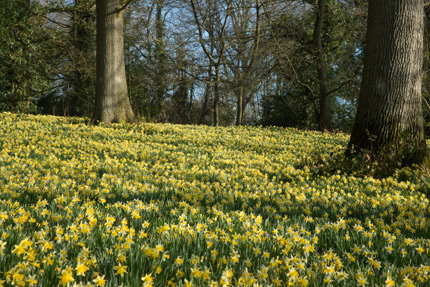
It was also officially the first day of Spring yesterday here in the UK; a fresh season with fresh delights.  This is when I switch from sauntering through the Gloucestershire countryside seeking out snowdrops, to heading for the Herefordshire borders hunting out wild daffodils.  The best place to see these beautiful fresh flowers is in what is known locally as the ‘Golden Triangle’, namely the villages of Dymock, Kempley and Oxenhall.

wild daffodils native to the golden triangle

I have mentioned before that snowdrops were picked commercially by the local women and children of Sherborne to be whisked off by train to London and sold for 6d a bunch in flower markets like Covent Garden.  Similarly, daffodils were picked commercially in the golden triangle.  You can read about the daffodils and see some beautiful photographs on the Glos Oracle website if you would like to know more.

And enjoy this poem by A. A. (Alan Alexander) Milne (1882-1956), famous for his stories about Winnie the Pooh and Christopher Robin, Tigger, Piglet and the rest, who wrote that, ‘winter is dead’ in his poem Daffodowndilly

Daffodils in my garden

She wore her yellow sun-bonnet,

She wore her greenest gown;

She turned to the south wind
And curtsied up and down.

She turned to the sunlight
And shook her yellow head,
And whispered to her neighbour:
“Winter is dead.”

As is often the way on my days out I got totally sidetracked and ended up in a fascinating little place called Upleadon.  Named after the river Leadon, this is a small village with a fascinating history and some superb buildings.  But what struck me as I drove over the hill in glorious sunshine was what looked like snow covered fields in the distance.  As I got closer I realised it was actually a vast expanse of farmland covered in polytunnels.

Having explored, investigated then googled I discovered that Upleadon has been a fruit growing area for hundreds of years.

Cider orchards were cultivated next to many of the farmsteads including Middletown before 1700. In 1627 a garden was known as the cherry hay and in 1678 an arable close was called perry grove field.In 1739 it was reported that Thomas Hammond’s estate included several thousand fruit trees from which one tenant had made 100 hogshead of cider in a year and in the late 1770s it was said that the fruit from orchards in Upleadon made excellent cider. Among orchards planted in the corn fields by the early 19th century were several of squash pears and in leasing Lower House farm in 1817 the landowner James de Visme reserved pear but not apple windfalls. Both apple and pear trees were also cultivated at Middletown which was one of the farmsteads with its own cider mill.

(Victoria History of Gloucestershire XIII, draft text by John Juřica: © University of London 2011)

I was really struck by the juxtaposition of the ancient church of St Mary the Virgin which has a thousand years of history, and the really modern cultivation methods.  It appears that polytunnels have caused some controversy as they can be rather unsightly when they cover large areas of farmland.  However, as a consumer I have to say I am delighted that I can buy (or pick) fresh local strawberries, raspberries, gooseberries, Victoria plums and blackcurrants from mid-June to August and different varieties of apples and pears from September to Christmas.  An added bonus is that growers use much less herbicides and insecticides on fruit grown in polytunnels as they are not as prone to rot or disease.

Church of St Mary the Virgin, Upleadon

Now here is the bit that just took my breath away literally and gave me a fresh lead in my family history search.

As I was searching online for the history of Upleadon I came across a fascinating document held by the Gloucestershire Archives.  It was the file of documents re: Thackwell Roche estate.  The former Roche estate at Aghada (in county Cork, Ireland) came into the possessionof the Thackwell family in the second half of the 19th century.  The Thackwells were related to the Roche family of Trabolgan.  Another document describes how the Thackwell Roche estate comprised Norman’s Land estate near Old Rock, Dymock, (here on the Gloucestershire/Herefordshire border in the Golden Triangle) as well as lands in Ireland.  Believe it or not my great grandfather William Roche was the son of James Roche and he comes from that very area.  I have searched for years for information on his family.  I know his mother died when he was young so his father remarried and took his new wife and the other children to America in the second half of the 19th century.  William, being 15 was old enough to join the Royal Navy as a boy sailor so he was left behind.  he joined a training ship, HMS Conwy in 1855 and spent the next few years rising through the ranks.  By 1861 he was sailing on the Victor Emmanuel, and thereafter he sailed the China seas on tea clippers as First Mate.  He never saw any of his family again and I have searched for clues as to their home and their destination.

Who would have thought that a trip to take photographs of daffodils in Gloucestershire would throw up a fresh lead for me to follow in the archives.  It is just amazing and I am thrilled.  You can see Normanstown just near Kempley on the map of the Poets’ Walks by clicking on this link Poets Paths

Reward ~ Weekly Photo Challenge

I enjoyed this Weekly Photo Challenge!

Fry's Five Boys

Fry’s Five Boys

I was what was known as a sickly child in the 1940s and 50s.  It turned out that I had Rheumatic Fever which left me with a variety of problems and no appetite (how times have changed!).  Because of this I was often unwell and my mum would get me Lucozade and a bar of Fry’s Five Boys Chocolate with Five Centres.  I guess it could be called a reward because 60 years later I remember every sensory detail!

Five Centres was produced from 1934 to 1992.  It was similar to today’s Fry’s Chocolate Cream in that it had a dark chocolate coating, with fondant inside.  But instead of peppermint cream there were five different flavoured fondant centres. In the early days they were strawberry, orange, raspberry, lemon and pineapple, all of which I loved.  In later years coffee, lime, and blackcurrant replaced strawberry, lemon and pineapple but I don’t remember ever having those.

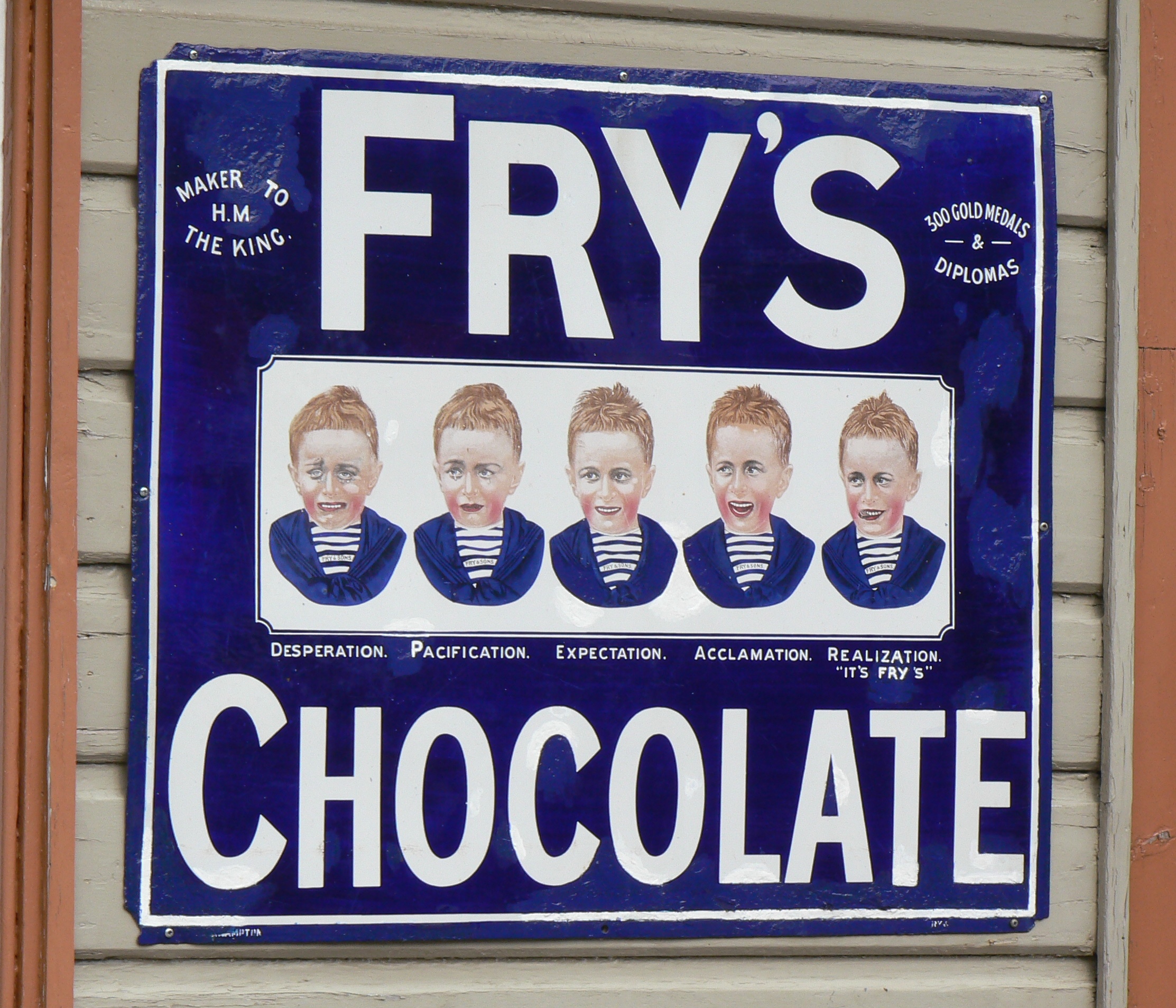
The wrapper was deep blue and it had what looked like 5 boys’ photos on it.  But really they were just one boy in a sailor suit who was photographed with five different facial expressions.  The photo was taken in 1885 and the boy was called Lindsey Poulton.  He was, appropriately, 5 years old.  His father and grandfather took the photos and Fry’s chocolate company in Bristol paid them the considerable sum of £200 for exclusive use of the set.  The photos appeared in adverts and in shop windows for years.  As my grandfather had a little general store in Newcastle on Tyne in the 1950s the enamelled metal sign on the outside wall was very familiar to me.

I’m very grateful to pocketbookuk for explaining the facial expressions and I would urge you to take a look at their fascinating blog.

The five faces of Fry’s Five Boys chocolate on an enamelled metal sign. Desperation – no chocolate, Pacification – the promise of chocolate, Expectation – the prospect of chocolate, Acclamation – happiness at receiving chocolate, and Realization – eating the chocolate, and discovering that it is a Fry’s milk chocolate bar!


I can’t really leave out a couple of photos of my grandson and his rewards.  He is such an active lad, 11 now and always busy so he is used to getting rewards for his labours.  He is a boy scout and his uniform is covered in the badges he has earned.  He also plays football for his school team and a local team.  He sometimes plays in goal and is often man of the match, receiving cups and plaques as his reward.

Being a nature lover I have to include a few photos of rewards in the natural world.  Firstly there is Jock, the silver backed gorilla who lives in a family of 6 at Bristol Zoo and is a very popular animal.  He is so magnificent and such a good role model for his youngsters that he deserves lots of fruit as his reward.

The robin created a grand residence in a large plant tub in my garden.  He and his made laid one egg then disappeared.  I was really worried that they had abandoned their nest with this egg in it.  But weeks later they returned and more eggs appeared.  Apparently this is quite normal and the first egg hatched out with the others which surprised me.  I was so pleased to see the robins back that I overcame my squeamishness and rewarded them with a daily quota of live mealworms.

The beautiful carp was the first fish I ever caught ~ reward for my hours of patient fishing

Lastly the basket of apples were a reward for finding a beautiful open orchard in a church yard.  No-one seemed to be collecting these gorgeous fruits so i helped myself to as many as I could carry after checking with the vicar!

I have to say one of my favourite rewards after a day out is a whippy ice cream.  I share this passion with my husband and grandchildren!

Reward for walking all day in the heat at Bristol Zoo

Reward for walking all day in the heat at Bristol Zoo


Am I the ‘lunatic fringe’?

Alex Polizzi says I belong to the “Lunatic Fringe”.  Little old me?  Really?

I’ve been called many things in my time, drama queen and nervous wreck spring to mind and I hold my hands up to both.  But this week I fell into a whole new category ~ the Lunatic Fringe!

Now if you know me, or think you do from reading my blog, this may come as a bit of a surprise, so let me explain.

I watch very little television as a rule, although I have to say currently I am spoilt for choice.  I could not miss Wolf Hall, Broadchurch or Mr Selfridge!  I am also tempted to watch anything with George Clarke, the restoration man in, as his beautiful Sunderland accent reminds me of my Geordie roots.  Another presenter I admire is Alex Polizzi.  She is the sort of feisty, intelligent, successful, call a spade a spade businesswoman/celebrity, I enjoy watching.  On her programme she goes into failing businesses, be they hotels, cafés, shops, or entertainment venues, and gives practical help and advice on how to turn them around.  It makes for fascinating TV.

This week Alex visited a children’s play barn.  These are the sort of places I frequent with my grandchildren when it is too wet for the park! Of course these businesses are not so popular in the summer when children can play for free out of doors.  I have to say Alex did not suggest the improvements which to me were blindingly obvious.  I would install air conditioning to make it inviting on hot summer days and dedicate an area to sand and water play with a whippy ice cream maker nearby!  It would be like going to the seaside but without the sunburn and crowded motorways.

Alex’s suggestions of course were practical, doable and great ~ new space-themed murals and paintwork, a much needed deep clean, and more nutritious, appealing and varied menu options.  I did think that with the owner’s love of baking he could have been a bit more adventurous.  My daughter makes wonderful little cupcakes for her son with grated vegetables or fruit in as well as mini tortillas packed with goodness.  They are so cheap to make yet much healthier than the sugary cakes and biscuits the owner was lovingly preparing.

It was then that Alex explained that ‘normal’ customers who are dissatisfied don’t complain, they just never return!  She said only the ‘lunatic fringe’ bothers to complain.  What?  Is this true? If so I am definitely a paid up member of the ‘Lunatic Fringe’.  Who knew?  Well just maybe Pets at Home, Greene King Inns, Gloucester Royal Hospital, the County Council and our local MP did.  These have all been the recipients of complaints from me over the last few years.  And, I have to say my complaints all achieved positive outcomes.

I could tell you about the explicit posters that were displayed outside our local pub advertising a ‘ladies night’ with male striptease.  My complaint was that children on their way to school would see these posters, which I think is inappropriate.  I also felt that a local pub was not the place for male strippers!  My complaint succeeded because the landlords did not have a license for this type of entertainment so the posters were removed and the event cancelled.

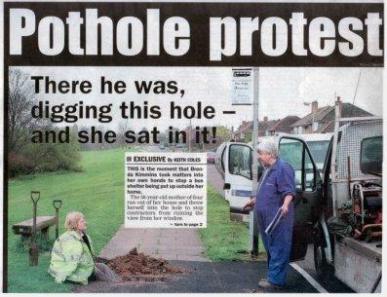
I could tell you about my rather embarrassing but successful run in with the council over their attempt to site a hideous green bus shelter right outside my front window. (Does that make me a NIMFY?)  I won’t go into detail about all of my complaints but if you read my blogpost Bus Stop Brenda you will get my drift.

If something is wrong in my opinion, I will usually write a letter of complaint in the hope that the person, company or service will put it right.  I am polite, I use nice cards or paper, and I often search the internet for the name of the person at the top who makes the decisions.  Is that lunatic?

My current grumble is with Sainsbury’s.  I dread to think how much of my hard earned cash has passed through their tills over the years.  I don’t have time to shop around, I never did, and so Sainsbury’s has fed my family and kept my household going for as long as I can remember.  But they are risking all this loyalty for points worth pennies, and vouchers which drive me insane.

I have a Nectar card with Sainsbury’s and for every pound you spend you get points ~ so far so simple.  You save up the points which equate to cash off your shopping.  But recently the value of the points has been halved.   You now need to jump through all sorts of hoops to get ‘bonus’ points or double points.  This just takes you back to where you would have been originally but they pretend it’s a great deal for the customer.  Next there are the confounded vouchers which come through the post or pour out of the till.  They are not just simple money off vouchers, they are date restricted, product linked or just for fuel.

I also get vouchers from Pets at Home, Waitrose and M&S, sometimes for food, or clothing, pet stuff, or for household goods.   It’s a nightmare trying to use them.

Nowadays, no-one calls me a domestic goddess, organised I am not.  I used to be.  When I was younger and working full time, a parent of 4 children with a dog and a cat to consider, I could manage to work efficiently for 60 hours a week, ferry my children to their various activities, attend to most of the domestic chores and provide nutritious food on a regular basis as well as keeping the animals happy, fed and exercised.  But since I retired my organisational skills have dwindled to the point where cutting out and collecting the relevant vouchers and actually taking them in my purse to the right shop for the specified items between the appropriate dates is totally beyond me.

Bemoaning this to a couple of friends who still qualify as domestic goddesses they advised me to:

  1. a) sort out vouchers into date order
  2. b) buy a plastic zippy pouch to keep vouchers in
  3. c) keep the zippy pouch with your purse in the reusable shopping bags
  4. d) take the bags, purse and pouch to the shops
  5. e) go through the vouchers at the checkout and present the relevant vouchers

So I tried this last week and failed miserably.  Going shopping with a 2 teenagers, a small child and a baby in a pushchair may have been difficult but it was a doddle compared to going shopping with a 6 foot hubby currently in a wheelchair, which goes something like this:~

  1. Convince hubby that shopping needs to be done
  2. Explain to hubby that he needs to get out of the house
  3. Find his shoes, coat, scarf, hat, wallet, hanky, drinks bottle in case he gets thirsty, sweets in case he gets dry throat
  4. prise hubby out of comfy rise and recline chair
  5. help him on with previously mentioned items
  6. use indoor, 4 wheeled mobility aid to get to front door
  7. use outdoor, 3 wheeled, foldable mobility aid to get to car
  8. help hubby into car
  9. put outdoor walker in garage
  10. get wheelchair out of garage
  11. fold up wheelchair and lift into boot
  12. drive to Sainsbury’s
  13. dodge the car washers who want to charge me £8 to put wax on my driver’s window with a dirty rag so that I can’t see out of it
  14. get wheelchair out of boot
  15. help hubby into wheelchair
  16. ask staff to unlock store’s mobility scooter
  17. help hubby into mobility scooter
  18. take wheelchair back to car, fold and lift into boot
  19. do the shopping, carefully adding a bit extra because we have vouchers
  20. find a checkout wide enough for mobility scooter
  21. unload all shopping onto conveyor belt
  22. look for reusable bags, purse and zippy pouch bursting with vouchers worth £12 and hundreds of nectar points
  23. Realise they are still at home on the indoor mobility aid
  24. Ask hubby for his wallet
  25. Pay for shopping
  26. Replay 1 to 18 in reverse order
  27. Go home and have a little cry

Now the end to this tale of woe is that I kept my receipt and went in the next day with the voucher for £12 off having fulfilled all the criteria, but the computerised till would not accept the voucher because it ran out at close of business the night before.  My complaint is that my shopping was done within the specified time so the voucher should be honoured.  What would Alex Polizzi say?  Would the shareholders of Sainsbury’s rather I acted like a ‘normal’ customer and just voted with my feet or would they prefer to get a letter giving them the opportunity to honour my voucher and keep my custom?

Answers on a postcard please …

pothole-protestjpeg

Frozen in Norway

Sculpture by Gustav Vigeland in Oslo park

Sculpture by Gustav Vigeland in Oslo park

One of the many joys associated with having grandchildren is that you get to watch the most beautiful films at the Cinema, or enjoy Disney videos at home, without feeling silly.
Recently I have been captivated by Frozen which I watched with Ben and Rosie. In the film Elsa the Snow Queen sings ‘Let it Go’, which is one of the songs our choir sings. It really is a most beautiful song, but when the children and their parents sing along together it is truly moving. This weekend we are performing it in a concert at the Tuckwell Open Air Theatre.

The film, Frozen, is based on Hans Christian Anderson’s tale of the Snow Queen.  When my daughter, Anna,  was young she played a part in a local production of the fairytale so it has a special place in my heart.  Also, the dramatic landscape of Norway was the inspiration for the setting apparently and I had a wonderful holiday in Norway some years ago.

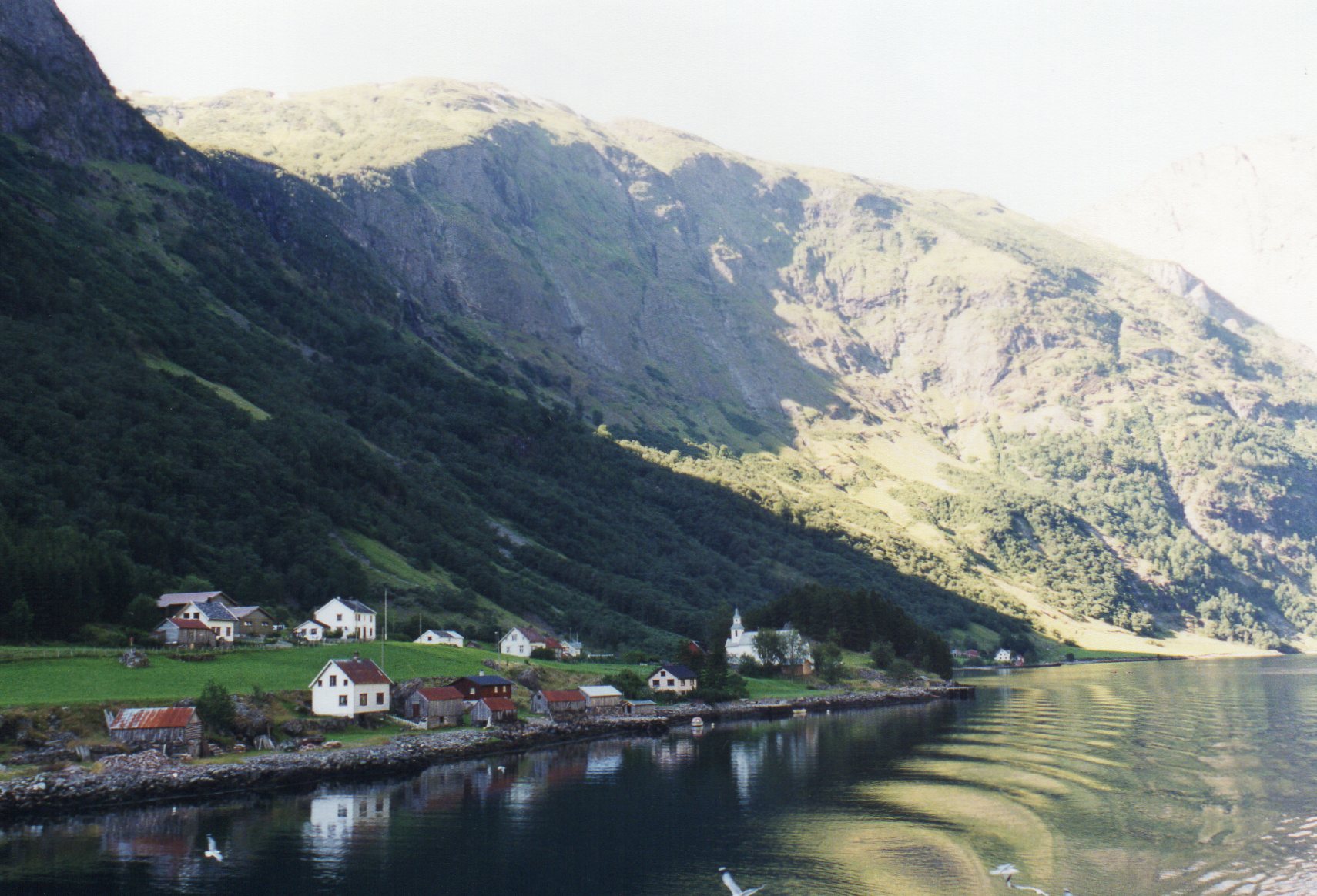
If you have never been to Norway, I hope this film will inspire you to go. In July 1999 I flew to Oslo then travelled by train across Norway. Trains and boats are really the best way to travel for seeing scenery I find, and in Norway there is so much to see. The countryside was truly spectacular and very rugged with snow-covered mountains, icy glaciers, breathtakingly beautiful fjords and waterfalls, wildflower covered meadows and lakes so still that it was hard to tell what was real and what was a reflection.

Reflections in a still lake

Reflections in a still lake

There is a real port called Arendal in the South of Norway which becomes Arendelle in the film, Frozen. But it is in Bergen that you find the exquisitely preserved old buildings of Bryggen which feature in the film. There is a fish market in Bergen just opposite these ancient timber buildings. I was a bit shocked to find whale meat for sale alongside fabulous salmon.

Shopping for Salmon in Bergen Market

Shopping for Salmon in Bergen Market

Also in the film you will see Stave churches. There are many of these beautifully preserved churches in Norway. They were built mostly of wood during the middle ages. The largest is Heddal near Notodde. It is a beautiful fairytale church which dates back to the 12th century. There are several of these Stave churches around Bergen and we decided to visit the Fantoft Stavkirk on St Olav’s day. I caught a bus with my husband from Bergen and we had a very pleasant journey to the church. As we went to enter the church my husband realised he had left his wallet with all our money, tickets and passports on the bus! Fortunately I had a mobile phone with me and I managed to find the telephone number of the bus company. I rang them and sadly explained our situation. Imagine my delight when they said the driver had found the wallet and was finishing work for the day soon. He offered to drive back to where he had dropped us on his way home and return the wallet to us! He would not take any tip and seemed surprised that we were so overwhelmed with gratitude. Call me an old cynic but I just can’t imagine this happening in the UK.

Stavkirk

Stavkirk

My husband and I intended visiting the church on the way to the house at Troldhaugen where Edvard Grieg lived. I say the house but actually it was like an estate with a very impressive villa which is now a living museum. There was an island where visitors can enjoy free lunchtime concerts of Grieg’s music in the summer months. There is also the cabin where he worked. By the time we got there we had missed the concert and only had time for a rushed visit.

There are several fjords which could be the setting for Arendelle but it is claimed that it is Nærøyfjord, an arm of the Unesco-listed Sognefjord. I can believe that as it is so spectacularly beautiful. We travelled on the famous Flam railway passing huge waterfalls to reach the fjord. Along the way we could hear beautiful operatic singing and we could not work out where it was coming from. The train stopped under a waterfall and from there we could see a woman standing on the very top of the mountain. She was producing that magnificent sound which echoed around the fjord. From there we travelled by boat to one of many little villages dotted around the fjord.

Village along the fjord

Village along the fjord

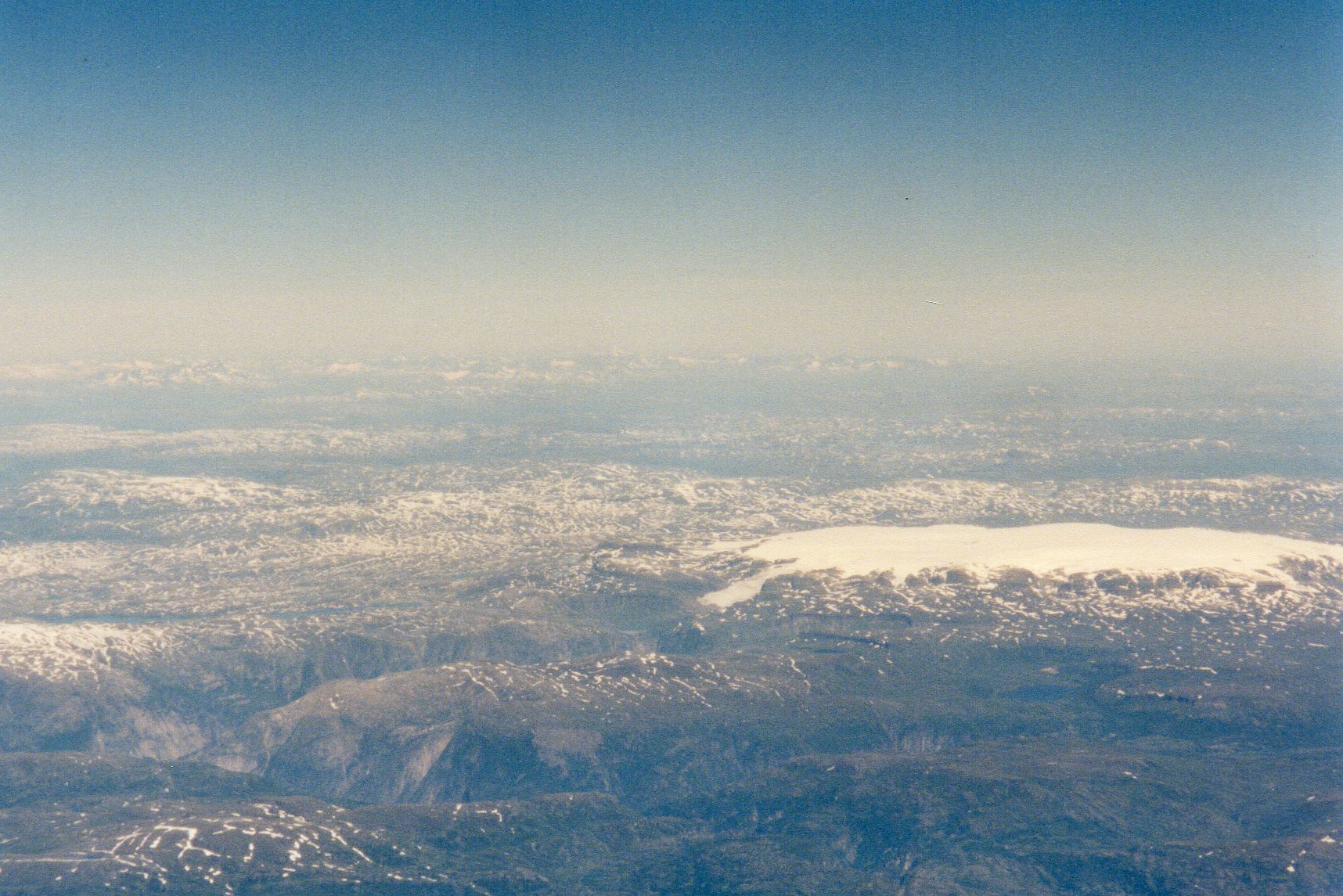
Also in the film, Frozen, Elsa flees across a glacial landscape which resembles the Folgefonna glacier. It could equally have been the Hardanger Glacier, which we saw, and flew over. It certainly is a bleak and barren place when viewed from the air.

Frozen Norway Norway from the air Hardanger glacier seen from plane

Watching Frozen brought all this back to me so I fished out my photos. Enjoy!


The Joys of Cornwall

Derelict mine building at Wheal Coates3

Old tin mines stand tall

Telling stories of the past

On Cornish coastline

I recently spent another lovely week in Cornwall. I wanted to be near the sea while still being near Truro for my hubby’s regular dialysis sessions, so I opted for a cottage in St Agnes. St Agnes is a beautiful, unspoilt little town on the North Cornwall coast. It is full of fascinating relics from the days when tin and copper mining was the main industry. It seemed strange to me to see derelict tin mines visible from behind houses and forming the boundary walls of gardens. In fact tin is still produced in St Agnes at the Blue Hills Mine, the only place in the UK that still produces it. St Agnes is an area of outstanding natural beauty and it has been designated a World Heritage Site. I can certainly see why. I just loved the rugged land and seascapes. Even in our state of unfitness we were able to walk some of the coastal path. This leads to sights that can never be appreciated from the road. One of these is Wheal Coates Mine. It is truly amazing when seen from a distance with its three shafts and its spectacular position on the side of the cliffs. In fact the mine goes all the way down to the sea and at high tide you can hear the waves crashing against rocks through a grid in the ruins. It was possible to get into this mine via a large cave at a nearby beach. There is a local legend that says Wheal Coates is haunted by the spirits of the miners who died there. I expect the eerie sounds of the sea account for the legends.
I’ve always been interested in industrial buildings. I guess this is mainly due to my father’s influence as he was a steel man from the age of 13 and he developed in me a passion for ships, bridges and buildings. The other reason could be because of where I grew up. I lived in the Felling, a shipbuilding and mining area in the North of England. I skipped past the railway station and shipyard every day on my way to school and there was a derelict engine house complete with winding gear at the end of our street of 2 up and 2 down back to back miners’ cottages. These were our adventure playgrounds. Children were never allowed to play on the grass or ride bikes in the municipal parks in those days! Parks were for floral displays and grown-ups to walk in and the park warden was fierce.
Being a traditional and romantic sort of person I regret that industrialisation almost destroyed the crafts of blacksmiths, weavers, spinners, millers and grinders. But I find there is great beauty to be found in the derelict buildings, in the machinery that drove the mines and the mills, and in the engines that turned their wheels and moved their goods

Around St Agnes there are beaches, bays and coves with caves where wreckers and smugglers, no doubt, once hid their treasures. We visited a pub reminiscent of Jamaica Inn. The pub is called the Driftwood and it has a fascinating history. It is a 17th century building which in its time has been a warehouse for the tin mines, a ships’ chandlery, and a sail maker’s loft, before becoming a characterful old pub. It is built of Cornish stone and slate and ship’s timbers and spares. Behind one of the fireplaces in the pub there is a tunnel which was uncovered during restoration. It is said that this was the secret escape route for the wreckers and smugglers of the area as it leads all the way to the beach.

The cottage we stayed in was perfect and my joy was complete when my daughter came to stay for a couple of days with my adorable grandson. He just loved the sea and sand, the horses in the paddock and the trampoline in the garden. We took him to Lappa Valley Railway, which is kiddie heaven in my book. Built on the site of yet another ruined mine, there are castles and treehouses and adventure equipment to satisfy any age. There are also 12 steam engines giving rides on trains which Stanley really loved. There is also a boating lake, café, shop and everything you could want for a fun day out. I loved it.

Home


Sadly it will be another year before I can go away again due to the shortage of holiday dialysis spaces around the country. But until then I have my photos to remind me of the fun we had and the beauty of Cornwall. Enjoy!