Close up and personal

Close up and personal

In 1994 we took the trip of a lifetime to the North West of America and into Canada.  It was a self-drive trip lasting 3 weeks and covering up to 350 miles a day of the most spectacular scenery I have ever seen.  I have rather craftily used my memories of this trip to illustrate both the Half and Half prompt, and the Close Up prompt for the Weekly Photo Challenge.

Here I am standing at the North American Continental Divide in Yellowstone national Park which is part of the Rocky Mountain range.   The Continental Divide is the separation between the Atlantic and the Pacific Ocean drainage systems.  In Spring, rain water and melting snows flow into the Isa Lake which sits astride the divide and it overflows.  Oddly, the water that drains to the East eventually flows into the Pacific Ocean through Shoshone Lake and the Lewis, Snake and Columbia rivers.  The water that flows West, eventually reaches the Gulf of Mexico and the Atlantic Ocean via the Firehole, Madison, Missouri and Mississippi Rivers.  So I think that qualifies as half and half!

Our round trip started off with an exciting few nights in Seattle, Washington, followed by a flight to Vancouver in Canada and a ferry trip to the gorgeous Vancouver Island.  From there we drove to Jasper National Park in Alberta and on to Banff.  The drive between Jasper and Banff taking in Lake Louise has got to be the most beautiful stretch of scenery in the whole world.  It just took my breath away. From there we drove back into the USA to Glacier National Park via the ‘Big Sky Country’ of Montana.  I absolutely loved everything about Montana, the wide open spaces and the Rocky Mountains, but especially Yellowstone National Park.  There are no adjectives extravagant enough to describe the Natural Wonders of Yellowstone.  It has to be seen to be appreciated.  It is simply other-worldly.  The bubbling geysers and hissing hot springs remind visitors that they are walking on an active supervolcano!   The pastel colours of the thin crust over the volatile earth are tempting to walk on but treacherous. The lakes, rivers and waterfalls are spectacular, while the fireholes and popping mudpots are what I imagine hell to be like!  Everything about the wildlife in Yellowstone is remarkable.  We watched soaring ospreys carried by the thermal currents in deep canyons.  We saw petrified trees, herds of bison, families of elk, prowling black bears and yellow bellied marmots, all reasonably close up!

http://www.yellowstonepark.com/natural-wonders/volcanos/

Victor and Vanquished ~ Symbol of The Battle of Tewkesbury

Victor Victor

This weekend there is a Medieval Festival taking place in the nearby market town of Tewkesbury.  It is an annual event which commemorates the Battle of Tewkesbury which took place here on 4th May 1471.  The main event is a very realistic re-enactment of the battle on the actual site.

The Battle of Tewkesbury brought to an end the Wars of the Roses between the house of York whose symbol was the white rose, and the house of Lancaster, whose symbol was the red rose.  The Yorkist King Edward 1V, was victorious while Edward, Prince of Wales, son of Henry V1 and last Lancastrian heir to the throne, was killed.  His burial place lies in Tewkesbury Abbey with an inscription which reads,

“Here lies Edward, Prince of Wales, cruelly slain whilst but a youth, Anno Domine 1471, May fourth. Alas the savagery of men. Thou art the soul light of thy Mother, and the last hope of thy race.”

Also in Tewkesbury Abbey high up on the ceiling there is a magnificent Red Rose carved, which shows the badge of Edward 1V, the ‘sun in splendour’.

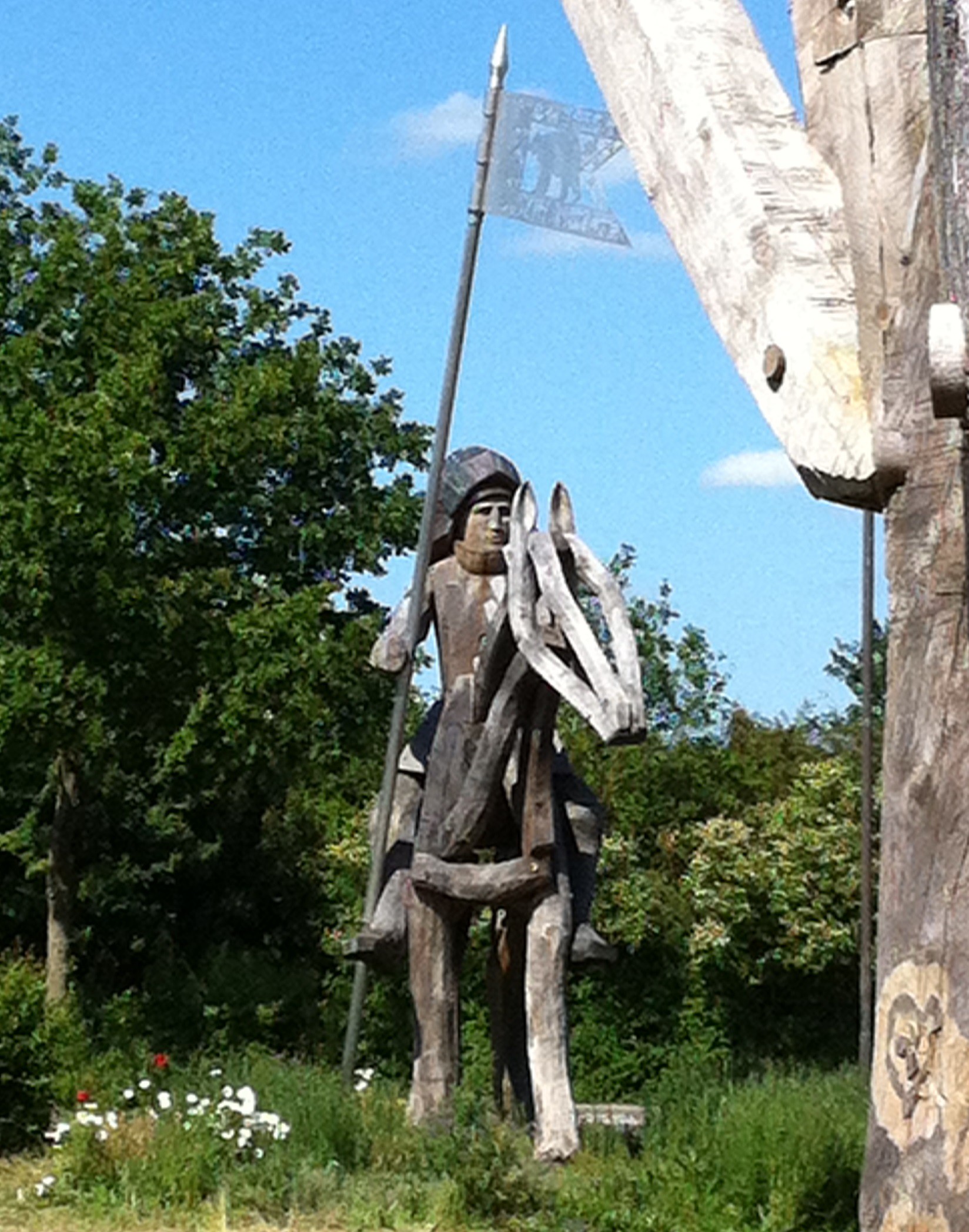
Fittingly, both the victor and the vanquished are remembered in the Abbey.  They are also remembered by an impressive sculpture, which was installed on the Stonehills Roundabout at the Tewkesbury end of the A38 road to Gloucester last year.  The sculpture is called ‘Arrivall’ and consists of two timber framed horses 5m (16ft) tall.   One is a mounted knight, known as Victor, which is a symbol of the victorious Yorkist forces of King Edward IV.  On the opposite side of the roundabout stands the other sculpture, the riderless horse Vanquished, which is a symbol of the beaten Lancastrian forces.  His head is bowed in defeat and exhaustion from the battle.  The sculptures, made by Phil Bews from the Forest of Dean are of green oak, and the work took 2 years to complete.  Local schoolchildren and members of the community were invited to carve poppies on the horses’ legs in remembrance of the centenary of WW1 in 2014.

Both of the horses have lances with pennants which swing in the breeze.  These were made by a local company and donated free.  In fact the local people and business community raised almost all the £65,000 needed for this magnificent sculpture, which rather eerily faces the original battle site.

I took my life in my hands on this busy roundabout to get some photos.  I am looking forward to going back and getting more photos at different times of the year and in different weather conditions, at sunset and in moonlight.  But even in daylight I found the sculptures very impressive and strangely moving.

Doors Painted by Fr Stephen Horton OSB of Prinknash Abbey

Today I took my grandson to Prinknash Abbey for a snack in the wonderful café, and to play in the beautiful grounds of the Monastery of Our Lady and St Peter. I have written about the abbey several times before as it is a very special place for me.  I was thrilled to meet Fr Stephen Horton again, who painted all the beautiful doors above.

The Abbey is set high in the Cotswold Hills near Cranham and Painswick so the views are spectacular.  There is ancient woodland behind, and to the front, a clear view towards Gloucester with its magnificent Cathedral.  On a clear day you can see May Hill with its crown-shaped clump of trees on the summit.  They were planted in celebration of Queen Victoria’s Diamond Jubilee in 1897, and are visible for miles around.  Beyond that there are the Brecon Beacons and the Black Mountains.  Having observed that view on a daily basis, the monks are very good at forecasting the weather merely by looking at May Hill.  If the hill looks a misty blue they know there will be rain at Prinknash later.  If the crown of trees is lost in cloud, there will be a storm.

I discovered while working in the old ‘St Peter’s Grange’, which is now home to the monks again, that it was built in this position, sheltered by the hills and trees, as protection from the plague!  There is documentary evidence, as well as evidence inside, that some parts of the Grange were built in the 14th century.  In 1339 the Bishop of Worcester granted a licence “For the Abbot of Gloucester and his fellow monks to celebrate Mass or to have it celebrated by a suitable chaplain in an oratory within their manor of Princkenasch.”  So we know that there was a chapel on the site then.  By the time the Grange was built the Black Death had already swept through England and people thought it was carried on the wind.  Wealthy people therefore built their homes on the side of a hill sheltered from the wind in the hope that this would protect them.

One of my jobs at the Abbey was to polish the Parker room.  This room was named after William Parker who was Master of the Works in the Abbey before he was elected Abbot in 1515.  He was responsible for many improvements to the building.  In July 1535 Abbot Parker entertained King Henry V111 and Anne Boleyn for a week.  They used St Peter’s Grange as a hunting Lodge because there were many deer around – as there are today nearby.  One fascinating snippet that appeals to me is that Abbot Parker had windows put into positions from which he could watch the monks about their work.  He used to spy on them.  I believe, contrary to what Wikipedia states, that this is where the phrase “Nosey Parker” comes from.

At Prinknash the monks have long been known for their art and craft work.  Vestments and stained glass were early specialities. They also made beautiful pottery for many years from the local clay.  The monks still make Incense that is exported all over the world.  One of the monks. who sadly passed away. created a huge wonderful painting for the millennium which was displayed in the Abbey Church.  He also painted and created stained glass.  Many of his pictures were made into lovely cards which were sold in the Abbey Shop.  The abbey’s walled garden is still growing a variety of fruits.  Today there were ripe raspberries to pick.

As I said, we met Fr Stephen Horton OSB who is the Prior and Novice Master.  He is a prolific and very talented painter.   I was fortunate enough to buy some of his original water colour paintings while I worked at the Grange.  They are my pride and joy.  The one I love especially is a watercolour of the Vale of Gloucester as seen from the roof of the Abbey.   When inspiration struck him for this painting he had no suitably sized paper on which to paint the panorama.  Being a monk and used to making use of whatever is available, he used two pieces of A4 paper side by side.  This painting speaks to me of so much more than the view.  It is creativity at its most basic, I feel.  The painting had to be painted there and then using whatever was to hand.  The muse could not wait for a trip to the art suppliers!  It also speaks to me of the way of life of the monks.  They waste nothing and ask for nothing.  They live such a simple life yet produce beauty all around them from whatever is there to be used.

Apart from being a brilliant painter, Fr Stephen is also a great thinker who gives wonderful sermons.  He says that “the one journey that really matters is the journey inwards”.  On occasion I have asked him for copies of his notes as I want to study his words deeply.  He says monastic silence is, “an inner stillness like at the bottom of the ocean, where the force eight gale might be going on, but deep down you do come to a stability, an inner anchoring”.

One of the saddest things that happened at Prinknash was the theft of a statue of Our Lady of Prinknash in 2002.  There are many statues at Prinknash but this one was extremely beautiful and so special.  It was about 20 inches tall, carved of Flemish Oak, and had belonged to St Thomas More. After the Reformation, it was taken abroad but returned in 1925 when the Benedictine monks founded their new abbey at Prinknash.  Of course this means it was hundreds of years old and priceless in the truest sense.   The Abbey Church was always open for visitors and those who wished to pray, and the statue used to stand on a shelf to the left side of the church.  One day it just disappeared while the monks were at tea, stolen to order presumably as nothing else was taken.  It devastated the community in the abbey and the wider community, including myself, who attended Mass there.  I almost believe it took the heart out of some of the monks and the community itself.  I have a picture of that statue and I often think that one day it will return to its rightful home.  Maybe when the current ‘owner’ dies he will leave it in his will to be returned to Prinknash ~ after all he can’t take it with him!

This coming Saturday, 11th July is the Feast Day of St Benedict who lived in the 6th Century.  I have no doubt that the monks at Prinknash, who follow the rule of St Benedict, will be celebrating with a special meal and maybe a glass of wine.

Below I have added some of my photos of doors for the weekly photo challenge

Musings in silence

Red Poppy field in Cotswolds

Red Poppy field in Cotswolds

This Weekly Photo Challenge. is the word Muse and it has given me a lot to think about.  On reflection I believe my muse is the natural world.  It provides memorable, magnificent moments when my spirit soars with the spectacle before me.  This is usually when I am on my own, in silence, in the countryside.  Wide open pastures, woodland filled with wildflowers and birdsong, snow-capped mountains, cool crashing waterfalls, tumbling streams and majestic rivers.  These are what excite me.  Acres of colourful, cultivated flowers, or a single poppy bursting into life uplifts me and carries me away from the mundane.  These are the moments that matter.  this is when heaven happens and I just have to capture it with my camera or with a blogpost.

These days I don’t do much travelling, but I am blessed to live in a beautiful part of the world.  Whatever the season there is always something sublime to see within a short journey.  And, if I can’t get out, I can always enjoy nature’s efforts in my garden.

In January there are snowdrops, crocuses and hellebores, and often snow on the Cotswold Hills. Then I take myself off to Painswick or Sherborne to enjoy them.

In February the first primroses and wild daffodils appear.  There is frost on the ground and skeletal trees when the first lambs and goat kids are born.  That’s when I go to the Golden Triangle.

In March the magnolias burst into flower and blackthorn gleams white in the hedgerow.  Hyacinths smells fragrant and frogspawn appears in the pond.

In April there are cowslips on the Common and blossom on the fruit trees and in hedgerows.  This is the prefect time to go on the Blossom Trail around Evesham.  By the time Easter arrives the new lambs and baby rabbits are out in the fields and the lilac trees are in full flower.

In May fields of yellow rapeseed sweep far into the distance, and yellow and orange poppies brighten up the roadside.  Self-seeded Lily of the Valley fill the border under my fruit trees.

In June it’s off to the woods to see the Bluebells and wild garlic which grows by the roadside.  Bright red poppies appear in the fields and roses fill the gardens

In July I go to Wick near Pershore to see acres of delphiniums, which are grown to be dried and sold as natural confetti.  On the way back I stop to admire the blue Linseed fields outside Elmley Castle.  Now is the time to pick cherries from the trees and strawberries from the fields.

By August I am picking apples, pears and blackberries daily and storing or freezing them for winter.  In Pershore the plum festival is held and there are sunflowers to see and lavender fields to visit!

But September is my favourite time. There are conkers and cob nuts to collect.  The Cotswold countryside is a giant nature table with a cloth of autumnal colours.

October means pumpkins, root vegetables, toffee apples and fudge.   It’s time to go to Westonbirt Arboretum for the best display of Maples turning red outside of Japan.

November means baked potatoes, nourishing soups and bonfires, foggy mornings and falling leaves.  Time to head to the park to watch them dance in the wind!

Things quieten down in December but there are fir trees and holly bushes to admire.  Christmas lights glisten in the houses, shops and streets. I head off to Stratford on Avon to see them at their best.

One of my favourite quotes is

Let thy soul walk softly in thee

As a saint in heaven unshod

For to be alone with silence

Is to be alone with God