
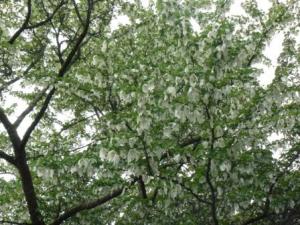
A Handkerchief tree at Minterne Gardens in Dorset
I am fascinated by trees, not only for their beauty, but for the stories they could tell. Some trees have lived through amazing times and been part of the lives of such interesting people. If only they could talk!
This week I went to the city with a couple of friends. We visited two wonderful museums and wandered along the streets of London where the trees are at their glorious Autumn best. We strolled along the Embankment beside the River Thames and marvelled at the changing skyline. I was struck by the juxtaposition of old buildings and new, especially the magnificent Shard which is so close to the old St Thomas’s. It is a breathtaking sight and a brilliant feat of engineering. Yet even in front of this awesome glass building my eyes were drawn to a row of trees nearby.
Consumed by the clouds
Engineered to perfection
A giant in glass

The Shard with trees in the foreground

The enormous Shard disappearing into the clouds
Sheer face of the Shard
Glass monument to mammon
Shatters the skyline
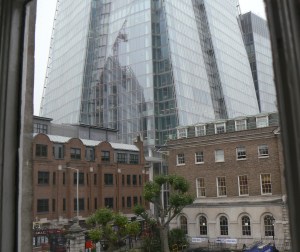
View of the Shard from St Thomas’s
One amazing tree I have seen is an ancient olive tree at the site of St Francis of Assissi’s remote hermitage, the Eremo delle Carceri on Mount Subasio. Olive trees are the longest living trees. Indeed in good conditions some live to a thousand years old. This tree is one of them. It is protected and propped up by poles. I find it breathtaking to think that St Francis actually touched this tree, walked by the stream and slept in the cave, all of which can still be seen. I found it very moving when I visited in 2000 and I have to admit to picking some leaves from the tree. I have pressed them and kept them in my travel journal from Rome and Assissi. St Francis lived a simple life and slept in the cave on a bed of stone and a pillow of wood. Some of his followers lived there as hermits too in prayer and meditation. The warren of caves still exists in a clearing with a stream and lots of trees.

The ancient Olive Tree that St Francis would have seen
Birds stopped to listen
As the humble hermit preached
At one with the trees.

Leaves from the Olive Tree on Mount Subasio

An early picture of St Francis of Assissi

St Francis’s cell in the cave at Mount Subasio
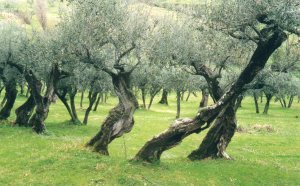
Olive Trees in Italy
Another tree that inspires me is the Mulberry tree which was in the garden of St Thomas More’s home when he was Lord Chancellor in the time of King Henry V111. Sir Thomas More, as he was then, bought some land in Chelsea and Kensington in 1524 in order to build his Great House. Sadly his house is long gone, but the Mulberry tree he planted is still there. On the site today is Allen Hall, the Seminary of the Roman Catholic Archdiocese of Westminster. Visitors can visit the seminary by appointment and walk to the secluded walled garden where Thomas More’s Mulberry Tree still stands. Outside and nearby is a beautiful statue of St Thomas More in a garden facing the river Thames. In the grounds of Tewkesbury Abbey near where I live there is a Mulberry tree grown from a seed from St Thomas More’s tree. I often visit this tree and sometimes pick the delicious fruit.
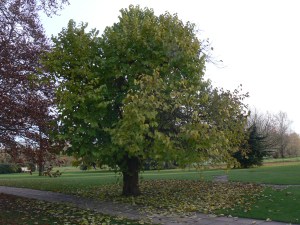
Mulberry Tree at Tewkesbury Abbey
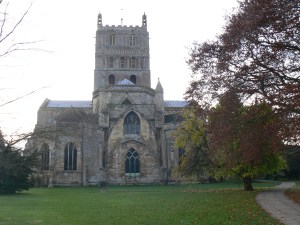 Tewkesbury Abbey and Trees

Portrait of St Thomas More
He planted his tree
And dreamed of Utopia
In turbulent times
The Yew trees in the beautiful village of Painswick in the Cotswolds are also very interesting. There are 99 of them in the grounds of St Mary’s Church and many of them are hundreds of years old. They lived through the English Civil War (1642-1645). There is evidence of Royalist cannonballs high up on the walls of the church to this day. At times people have tried to establish more Yew Trees in the churchyard but a hundredth will never grow. It seems as if 99 is the maximum for some reason. There is an old story that if a hundredth tree ever grows, the devil would pull it out. It is one of our old Cotswold mysteries!
Last but by no means least, is a historic small-leaved Lime tree at Westonbirt which is unbelievably ancient. It is reputedly 2000 years old! It is so big that it seems as if it is many trees. However, it is actually a clump of around 60 trees all growing from one original. This was the result of coppicing which was a way of managing woodland for fuel established in Anglo-Saxon times. Over hundreds of years of repeated cutting, the stump gradually spreads outwards in a ring until it reaches enormous proportions. My photo does not do it justice!

Ancient Lime tree at Westonbirt
 Heavenhappens