Dayna


dayna-in-porch-2

I’m posting a photo of my much-loved dog Dayna today sitting in our porch.  This is where I like to sit and write, colour or do puzzles in my very rare free moments.  I am proud to say that until Sunday 16th October, wherever I was you would find Dayna very close by.  In the porch, her favourite spot was the windowsill.  She would sit there guarding me from the world and watching the people go by.  Being south facing our porch is warm and cosy and a great suntrap.  Dayna’s beautiful silver dapple coat of fur would shine in the sunlight as she sat, so proud of herself in her little domain.

Just four momentous years ago I wrote about the little Dachsund, Dayna, that I rehomed.  She settled in quite well after a few minor hiccups!  As soon as I picked her up from her previous home, I popped into the Pets at Home Store.  There I rashly bought 3 very large bags of a good quality dog food, one chicken, one beef and one vegetable variety, which she flatly refused to eat.  I also bought a canvas cage for her to sleep in ~ which she absolutely refused to get into.  I bought a lovely red extending lead to match her very sparkly red collar, which she chewed through during her first walk.

Feeling desperate I appealed to my wonderful dog-loving daughter in Vermont who sent me 3 books packed full of guidance on training your dog:

How to Raise the Perfect Dog by Cesar Millan

How to be your dogs Best Friend by The Monks of New Skete

Dog Stories ~ Everyman Pocket Classics.

I found these books insightful and very helpful, but obviously Dayna has previously read one called How to Get your Owner to Do Whatever You Want, so she wins hands down.  One week and three leads later we got the measure of each other and Dayna had got me trained.

Dayna would eat fresh meat or fish, any kind of cheese, pouches of lamb and rice with vegetables, or tins of expensive dog food.  On no account would she eat dry food however expensive ~ 3 large bags of which were donated to the local animal rescue centre.

Dayna would walk for miles very happily with a short chain metal lead.  She had no interest in being on a long extension, preferring to be within a couple of inches of my feet, preferably between them so I am in danger of tripping.

Dayna had no intention of ever sleeping in a cage, however softly padded or comfortably den-like whatever the Monks of New Skete say!  She prefers to sleep within licking distance of my foot in a soft bed with a fluffy cushion.

We had some great days out. In Pershore for the Plum Festival we sat outside a cafe in the sun where every passer-by fell in love with her.  At the seaside she gloried in the freedom of the beach.  In Wick at the Confetti Fields, she climbed on a trailer and surveyed the scene.  She had such a big personality for such a small dog.

When my two adorable grandchildren came on the scene she was gentleness personified.  As babies they soon realised she was a real-live fluffy toy who loved to play with them.  As Thea grew into a toddler she would dress Dayna up in hats and cover her in jewellery.  Stanley would include her in all his games too. For him she was a dinosaur or an obstacle in the way of his bike or on his train track.

How could something so small have so much control?  I don’t know but she was everything I could want from a dog:

Loyalty, trust, companionship, healthy walks, fun, and bucket-loads of love.  She was worth her weight in gold.

Then on Sunday, the anniversary of my mum’s death, Dayna was tragically killed on a busy road near our home.  She was being taken for a walk on a new lead which somehow came loose as she excitedly pulled to cross the road in a hurry to get back to where she was happiest ~ in our little bungalow, with her little pack ~ her domain, her world.

My heart is broken by her loss.  She is irreplaceable.  But her memory will shine on in our hearts forever.


Burford Wildlife Park


We are truly spoilt for choice in our local area for interesting places to go.  I am so lucky to have grandchildren who I can use as an excuse for going to all the farm parks, forests, steam railways and adventure playgrounds.

There certainly wasn’t anything like that where I grew up in the North of England.  My playground was the shipyards on the River Tyne, abandoned coal mines, or the sand dunes and castle ruins on the North Sea Coast.

The child in me can never get enough of our local Wildlife Park at Burford.  It is so well run and the animals are the first priority.  It is such a joy to see the beautifully maintained grounds and healthy happy animals living as naturally as it is possible and safe for them to be.  I have a season ticket there and go as often as I can with the grandchildren.


Cotswold Water Features

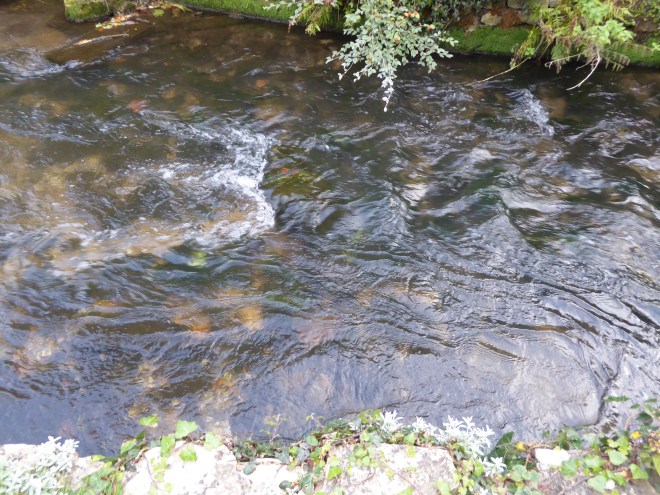
p1010232

Autumn is one of my favourite times to go out and about in the Cotswolds.  When the children are back at school and most of the tourists have gone home, the villages and parks are reasonably quiet.  It is a pleasure then to stroll around them and enjoy the peace and quiet and natural beauty.

I live in a Spa town which was founded on the health giving properties of the natural spring water so water is a common feature around here.  Indeed just off the old Roman Road to Cirencester is an area called Seven Springs.

One of the most unusual Springs is  where the water gushes out of a stone crocodile head. I love the fact that a respected cotswold stone builder from the nearby village of Hazleton built this feature in the 19th Century.  Presumably some local landowner paid for it.  The spring water has been gushing out of the crocodile’s mouth ever since.  Some days, like yesterday, after lots of heavy rain, it is a truly spectacular sight.

Many Cotswold villages have delightful streams or rivers running through them and none is more beautiful than Bourton on the Water.  This delightful town is a favourite of mine when the sun is setting and the only activity is the ducks settling down for the night.


Happy Times Past

Rest not! Life is sweeping by; go and dare before you die. Something mighty and sublime, leave behind to conquer time. — Goethe

tile-spirit-squared-for-abw

The prompt in the Weekly Photo Challenge this week is the word ‘Nostalgia’ and my friends and I are certainly feeling nostalgic today.  We had some truly upsetting news about our old school. The huge tile frieze that we created in 1999 to mark the new millennium, was destroyed in a fire.

It is hard to imagine today just what a big deal it was being on the threshold of a new millennium.  There were all sorts of apocalyptic warnings about power failures, planes falling out of the sky, computer systems not being able to cope etc. No-one really knew what would happen at midnight on 31st December 1999 or what the new millennium would mean for civilisation.  So, as St Thomas More School was such a huge part of my life, I wanted to mark the occasion with something very special and permanent.

In the early 1970’s I watched the new school building rise in the middle of an open field that had once been farmland and an orchard. There was an ancient hedgerow all around the site and just one magnificent old oak tree in what would be the playing field. When it was opened in 1975, I was having my third child so was not available for teaching. But, as I drove past the school every day, I vowed that one day I would work there.

I got my wish in 1984 when my youngest child was ready to start school. I was offered a job and jumped at the chance. The next decade was a time of great blessing as I worked in virtually every class, teaching all age groups, then became deputy Head.

In 1994 the original Headteacher was due to retire and, to my surprise, I was offered his job. He had been such an inspirational Head that the school was a joy to work in. Taking on his role, I tried to emulate him while making my own mark and bringing my own vision for the school into being.

Due mainly to the quality of the staff and their outstanding teamwork, the school became a strong and successful community, ‘an oasis of excellence’, appreciated by staff, pupils and parents alike.

In 1999, as the new millennium approached, the staff wanted to mark the year 2000 with a special feature. We wanted the whole school community to be involved in creating something totally unique and meaningful. We came up with the idea of making a large tile frieze. Each year group was asked to brainstorm their favourite lessons, subjects, or topics, and represent their ideas on paper.

Reception class, the youngest children were just 4 or 5 years old and had only just started school. They had their photographs taken in their shiny new uniforms, so that was their contribution.

The Year 1 class had helped to build a pond and were raising ducklings which they had hatched from eggs in an incubator, so they drew pictures of that. I have a wonderful memory of the day the ducklings hatched out ~ the local policeman had called up to the school on a social visit and he watched as the first duckling struggled to crack open the shell. When it finally succeeded and out popped this beautiful and perfect little bundle of yellow feathers, he was overwhelmed by emotion and had tears in his eyes.

In Year 2 the 7 year olds made their first Holy Communion as it was a Catholic school so they drew a chalice and host. Being the most significant event in the year ~ yes honestly, not SATs! That was their contribution.

Year 3 was the first year of juniors and the children enjoyed learning about Vikings and the Human Body, so they drew lovely longboats and skeletons.

In Year 4 things got much more subject focused so Maths was represented by a calculator and mathematical symbols.

In Year 5, Creative Arts such as Music, Dance, Drama and painting were the main features, so a pot of paint and a brush was drawn. Science too was represented by the planets.

By Year 6 the children were getting ready to move on to secondary school. In order to give them a taste of independence and adventure, it was our tradition to take the class away to Shropshire for a week to stay in a Youth Hostel. Here, in the Ironbridge Gorge, birthplace of the Industrial Revolution, we had a wonderful time. We visited the Iron Museum, The Jackfield Tile Museum, Blist’s Hill Reconstructed Village, River Severn Museum and of course the first Iron Bridge ever built. We also had amazing night hikes, midnight feasts and parties. Altogether it was an incredible opportunity for fun and learning. So naturally the Ironbridge at Coalbrookdale was the emblem of Year 6.  Yes, again it wasn’t SATs that featured large in their lives.  How times changed!

For our frieze the staff gathered all these pictures and images together and chose the ones that would be painted on to the tiles. The Year 5 teacher, Anne Bate Williams, a wonderfully creative artist and teacher, took on the challenge of putting all the ideas together and creating a design on tracing paper which could be transferred onto numbered ‘green’ tiles. It was agreed that we would go to Jackfield Tile Museum to create the finished work.

A representative group of staff, parents and children spent a weekend at the Youth Hostel and were each given a small area of the tile frieze to paint. Anne had done a magnificent job scaling all the children’s artwork up or down so that the frieze would truly reflect the life of our school.

It was agreed that the year 2000 would go at the top, as well as the 4 trees, oak, ash, poplar and beech, which were the school emblem.  In the top corners would be tiles depicting the Ironbridge itself.  The children’s artwork would go around the edge, and at the centre would be the Holy Spirit in the form of a dove surrounded by flames.

We painted the tiles in coloured glaze.  I will never forget the atmosphere in that studio at Jackfield as we worked on the frieze.  There was a stillness and peace in the room which was truly sacramental.  While we worked, the Spirit moved in that place and heaven happened.

When we finished, the tiles were left at the Jackfield tile Museum to be fired.  A couple of weeks later they were collected and set into a frame made by Tony O’Shea, the reception class teacher’s husband.

Bishop Mervyn Alexander of Clifton RIP came in the year 2000 to celebrate the school’s 25th anniversary and he blessed the tile frieze.

Although most of the staff who worked at the school have retired or moved on now, the frieze stayed proudly in the school hall for the last 16 years and with it, a little piece of all of us who made it.  And now it is no more.

Nostalgia  in my dictionary is defined as ‘a feeling of sadness mixed with pleasure and affection when you think of happy times in the past.’  I think this sums up our feelings today perfectly.

So here I go down Memory Lane…

Partners

Partners

I just have to post photos of my grandchildren to illustrate this week’s photo challenge.  The theme is Partners and these two are definitely partners when it comes to getting up to mischief.  But they adore each other!

Following on from the surprising result of our referendum on membership of the European Union this week, I feel sad that our partnership with the other European countries is coming to an end.  So many people gave so much to bring peace and partnership to Europe during the wars, not least the combined services of army, airforce and navy.  In their honour I am posting some photos I took on Remembrance Day at Westminster Abbey in London.

I can’t resist putting in some of my favourite photos.  Of course my little Dachsund, Dayna, is a wonderful companion for me, but her hero is my husband.  When he is at the hospital for dialysis she often sits beside (or on) his slippers waiting for his return. The pair of ponies share a field near me so I guess they qualify as partners.  And of course the garden birds are my constant delight and we have a partnership.  I feed them regularly and they reward me by coming into my garden and sometimes even into the house like this little one!

And last but not least, partners for life ….literally!

My mum and Dad lived in parallel streets as children and went to the same school.  They were friends from the age of 8 and eventually married in 1945.  They were inseparable until my father died in 1993 and she followed him some years later.

terry & stella wedding

My mum and Dad on their wedding day in 1945


Curve

This week I am just posting some photos that I love for WPC on the theme of curve

The first batch are from Stratford on Avon taken this April at Anne Hathaway’s Cottage and along the curve of the River Avon looking towardfs Holy Trinity Church where Shakespeare and Anne are buried.

Next are some exquisite photos of Calla Lilies taken by a friend, Anne Bate-Wiliams, in her garden.  The curves are delicate and totally unmatched in the manufactured world for beauty I feel.


Lastly, some beautiful curves both natural and man-made that I spotted in Dorset.  The Ammonite-like decorative lampposts are in Lyme Regis and reflect the fact that many fossils are found on the Jurassic Coast.

The other photos are from Abbotsbury and Bennets Water garden

http://abbotsbury-tourism.co.uk/gardens/http://www.bennettswatergardens.com/


Stepping out

Stepping out

The Cotswold countryside, parks and gardens are a almost swamped by luscious green foliage this year.  The early spring and wet May seem to have benefited the trees and lawns.  It is a joy to walk amongst them.

There are lambs, foals, baby rabbits and ducklings to be seen all around and my garden birds are working overtime to feed their young.  They beaver away all day long in choreographed movements almost like a dance.

I went to a local park with my little granddaughter at the weekend and she was delighted to see six cygnets that have hatched out recently.  The swans nest on an island in the lake but they come over to the grass to feed and walk their little ones.  It is amazing and heart-warming to see how many adults and children turn up in their spare time to see and photograph the new arrivals.

Swans are very protective parents so it is best not to get too close!  As Shakespeare says…

So doth the swan her downy cygnet save,

Keeping them prisoner underneath her wings.

Eloquent Barcelona

Eloquent Barcelona

Anna in Barcelona

I’m feeling very jubilant today as my middle daughter, Anna, has started her own business in the wonderful arty quarter of Gracia in Barcelona, Eloquent Barcelona  Anna has lived and worked in Barcelona for many years, having travelled the world as a dancer and fallen in love with the Mediterranean climate.

Spain, like everywhere in the world these days, is a hard place to build a successful business.  It would give Anna so much encouragement if all my blog’s followers logged onto her website and sent her good wishes and positive vibes.  And, if you are on Facebook, could you like and share her Eloquent page please.  This would give her just the boost she needs.

I know I am her mother, BUT, she really is a multi – lingual, very talented, highly skilled and experienced, hard-working and beautiful young lady.  Not only does she provide English language lessons and tutoring for adults & teenagers (age 16-19) in Spain, but she also offers bespoke language services for businesses, including translations, editing and copywriting. She is also able to provide language & logistical support for International businesses setting up or working in Barcelona.

Anna local in Gracia Eloquent Barcelona

 Thank you


A Tribute

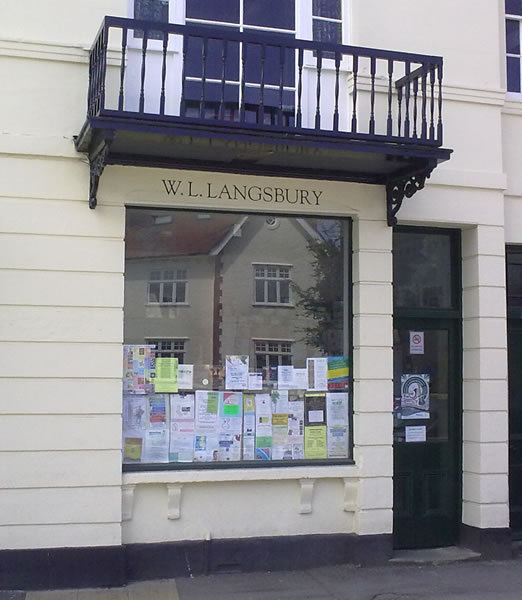
W L Langsbury Printers front

It is quite normal these days to see small shops close down in High Streets up and down the land.  And, after a few weeks or maybe months, the passing shoppers don’t even notice they have gone or forget what was there before.  But just occasionally, a shop is so well loved by its regular customers that its closure is a genuine shock.

This was the case for me recently when I popped to W L Langsbury, the local printers in Suffolk Road.

I arrived to find a simple notice on the door saying, ‘closed due to bereavement’.  My heart missed a beat on reading this.  I hoped that it was not the lovely old printer who was known to me, and all of his regular customers, as Bill Langsbury and to his family as Lionel.

I used to pop in to Bill if I wanted anything special printed for school in my teaching days, before we had computers and photocopiers in the school office.  Then after retirement, when I became the secretary of our WI.  Many of our older members did not have email but they all needed monthly minutes and agendas as well as occasional newsletters.  I produced a master copy on my computer and then Bill printed out enough for everyone.  He did the job to perfection ~ quickly, efficiently and cheaply.  He took great delight in telling me that there is no VAT on newsletters.

It was always a joy to step inside the door of his shop.  The smell of metal, ink, wood and paper is a heady mixture, like a steam train in a timber yard.  It was for all the world like the living museums at Blist’s Hill or Beamish and yet the jobs got done if not immediately, always by the end of the day!  The machinery looked ancient, in fact one of the printing presses was a 1938 Heidelberg and it still worked perfectly.  On the walls there were pictures of Cheltenham in days gone by and posters from the 1940’s warning that ‘careless talk costs lives’! Almost every inch of wall and floor space in the front shop was used to store boxes of paper of all sizes and colours.  There was also a wonderful selection of notepads which Bill made himself from the paper offcuts.  These he sold for pennies and they were great for shopping lists or jotters.  Some were so old they still had the price in pre-decimal currency.

In the back room of the shop where the serious work was done there was a treasure trove of vintage wooden shelves and drawers full of cast metal numbers and lettering of different sizes and fonts.

High up on the walls was the ‘filing system’, which I am sure only Bill or his brother and workmate Ken could understand.  Beyond, there was a narrow hallway with a staircase leading to where Bill lived, above the shop.

I suppose I find all this a delight because my grandad had a general store in the 1950s after he left the army.  He and my grandma lived above the shop and I loved staying there.

But of course the shop would be nothing without the character of the printer himself.  I was full of admiration for him and the life he had lived over 83 years.  It is the living history that fascinates me.

Bill was born in Shepherd’s Bush, London, in December 1932 when King George V was on the throne. He moved to Ealing with his parents where his brother Ken was born in 1938.  There they lived through the short reign of King Edward V111 who abdicated in 1936 to marry Wallis Simpson, a divorcee.    He was a young lad of 7 when the bombs started dropping on London during the Blitz of WW2 in the reign of King George V1.  When a neighbouring house was destroyed by the bombs his parents, Harry and Queenie Langsbury moved the family to Cheltenham for safety.

After a brief stay with in-laws they lived in a cottage behind the King’s Head Pub in the Lower High Street where Queenie worked.  The boys went to church 3 times on a Sundays and went to local schools.  Bill was a keen student and talented artist enjoying cartoon drawing.  So he went on to the art college which is where he learned his printing skills.  By this time our Queen Elizabeth 11 was on the throne.

Leaving college he got a printing job in a pharmaceutical company but he had an entrepreneurial streak.  He managed to save his money, and, with the help of his brother’s paper round money, he bought his own second hand printing press by the time he was 16 and set up business in the family home.

Bill did his National Service in the catering corps with the RAF in the early 1950’s and returned to Cheltenham where his mum had bought the terraced house in what was Andover Road and is now Suffolk Road.

At first Bill, aged just 24, was printing in the front room while the family lived in the rest.  However, Bill got so many orders that he took over the back room too and the family were relegated to upstairs.

Bill’s brother Ken married and moved on to have his own family.  Bill, staying single, lived with his mum until she died aged 93.

Eventually Bill had so much work that his brother Ken came to work with him.  It is wonderful to think that these two brothers got on so well that they worked together for over 40 years.  But you couldn’t not get on with Bill.  He was an eccentric, sweet, kind gentleman.  He loved his work, his shop and his machinery.  He lived a simple life with few mod cons and no visible luxuries, but he was always cheerful.  Printing was his passion.

In 2016 W L Langsbury Printer’s celebrates 60 years in business.  To commemorate this Bill produced a special edition of his letterpress Gloucester bold calendar, containing a selection of proverbs from a collection first published in 1640.

Bill worked a normal day in his printer’s shop on 14th January 2016.  He had a problem with his leg but didn’t bother anyone about it.  This was typical, as according to his brother, Bill had not visited a doctor between 1948 and 2015 and he only went in 1948 because the National Health Service had just started and his father took the boys for a free health check!  He ran a bath and sitting on the edge his kind heart finally and peacefully took its rest.  His brother found him there next morning.

The shop is now closed and the fittings will no doubt go to letterpress collectors or to auction.  I feel sad that this delightful, Dickensian shop with its vintage machinery, which is a feast for the senses, will be open no more.

But mostly I feel sad that Cheltenham has lost a truly irreplaceable character.  I, and many other customers I’m sure will miss him greatly.

Abstract

Abstract

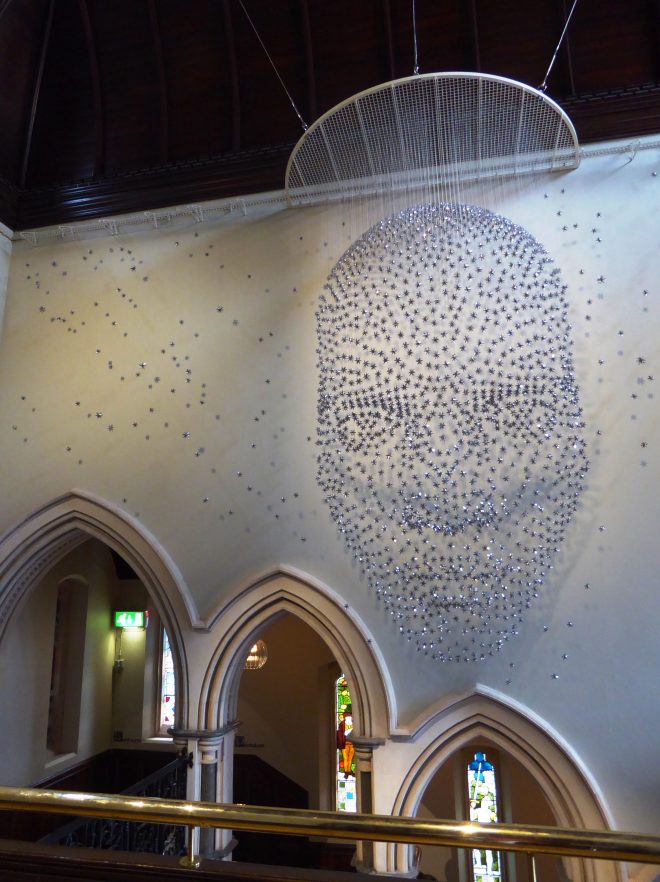
400 celebration face of stars4

For All Time

“When he shall die,
Take him and cut him out in little stars,
And he will make the face of heaven so fine
That all the world will be in love with night
And pay no worship to the garish sun.”

from Romeo and Juliet by William Shakespeare

What an enjoyable weekend I just spent in Stratford on Avon.  I was there to join in the celebration of Shakespeare’s birthday and to commemorate his death 400 years ago on 23 April 1616.

The town, where I lived during my teens, was festooned with flags and shields from almost every nation in the world.  There were banners with Shakespeare’s likeness waving high across the streets or pinned to railings.  There was blue and yellow bunting in side streets and blue and yellow market stalls along the waterside leading to the Royal Shakespeare Theatre.  Shakespeare’s colours of blue and yellow amuse me as in theatre superstition wearing blue and yellow means you will forget your lines! My school uniform at Shottery Manor in Stratford was mainly purple but with blue shirts and blue and yellow striped ties. We wore straw boaters in the summer months with a purple blue and yellow band round them.  In the winter we wore purple felt hats with the same coloured band round them. Wearing the hats at the wrong angle on the head was considered a very serious misdemeanour and a detention would surely follow if spotted.

The RSC put on a special celebration, Shakespeare Live!, in honour of the occasion.  It included Opera, Comedy, Ballet, Hip-hop, Poetry, and of course extracts from the plays.  I thought the whole evening was a resounding success.  It appealed to almost everyone whatever their age or tastes in entertainment.

The well-known, justifiably renowned and much-loved, stars who took part included Judi Dench who took the part of Titania falling in love with Bottom played by comedian Al Murray.  The costumes were brilliant, the set was great, and the acting was superb.  The overall effect was slick, professional and absolutely hilarious.  I loved it.  There is a wicker sculpture of Titania and Bottom outside the theatre in the new Stratford Garden.  The flowers in it are all mentioned in the plays and the effect should be quite impressive when they grow.

Among lots of memorable performances in Shakespeare Live!, the most moving I thought was Sir Ian McKellan’s rendition of a speech handwritten by Shakespeare for the character of Sir Thomas More.  I, like most people listening I imagine, had visions of the horrific ‘Jungle’ at Calais and the wretched scenes of migrants behind the barriers and fences, which have been erected along European borders to keep them out.  Sir Ian McKellen brought tears to my eyes with this speech.  You can hear an earlier rendition of it here

The whole speech is written at the end of this post and here is a link to the very relevant and learned Shakespeare Blog.

On Sunday and Monday I indulged myself by taking a walk along the river Avon and revisiting many of the houses and museums connected with Shakespeare.  The weather was changeable but I managed to get some reasonable photos, especially at Anne Hathaway’s Cottage where the garden is a riot of spring colour with flowers including daffodils, bluebells and tulips.  I also spent some time in the newly restored Swan Theatre with its amazing abstract sculpture, ‘For All Time’ created by Steven Follen.  This representation of a head, shown in photo at the top, is made of 2000 stainless steel stars suspended from the ceiling by fine wires to make the shape of a 3 metre tall human face.  It is surrounded by other stars which closely represent the position of the constellations on the day of Shakespeare’s birth.

There are two additional places to visit in Stratford now, which in previous years were not open to the public.  One is King Edward the Sixth School for Boys, which Shakespeare attended.  His actual schoolroom is open to the public with professional actors dressed in costume teaching Latin and chatting to visitors in character.  It was a surreal experience being inside the actual classroom.  I have been to the school before in the days when Mr Pratt was Headmaster, but it was a joy to visit the most ancient parts of the building, which have been beautifully restored.

The second is Harvard House where John Harvard was born in 1607.  This is a three story Elizabethan house almost opposite New Place, the house which Shakespeare bought in 1607.  It is remarkably authentic in its preservation and restoration, with lots of oak beams and areas of ancient wall paintings.  John Harvard eventually married and emigrated to Massachusetts in America where he was a preacher and teaching elder.  When he died of TB he left 230 books and a very generous legacy to a fund for the founding of a new college.  This was to become Harvard College, the oldest institution of higher education in America.  The house is owned by the American University but looked after by the Shakespeare Birthplace Trust.  It is worth a visit just to see the Bible Box.  This is a beautifully carved oak box for storing the treasured Bible.  After Henry V111 declared that all bibles should be written in English (not Latin) so that they were accessible to ordinary folk who could read, it became fashionable for families to keep a Bible at home.  Wealthier families would store their bible in such a box.

Of course I visited Holy Trinity Church where Shakespeare, his wife Anne, and other members of his family are buried.  It is traditional for all the dignitaries and important visitors who attend the bard’s birthday celebrations, to bring flowers to the grave.  At this time of year, when daffodils are still abundant, the sight and smell in the church is quite literally breathtaking.  There was a rather unusual floral tribute with Shakespeare’s dates on it.  It was standing on trestles with a huge candle at each corner.  It had been processed through the town earlier in the day looking rather coffin-like.

I have celebrated Shakespeare’s birthday in Stratford many times, most notably the 400th anniversary  one in 1964, but I have never before attended a commemoration of his death. It was odd as both events occurred on the same date.  But I have to say it was all very tasteful ~ well except for the countless people wearing Shakespeare masks?!

Do enjoy some of my photos below.

The Royal Shakespeare Theatre

The Seven Ages of Man on Stained Glass in the Swan Theatre

Holy Trinity Church

King Edward Sixth School

Around The Town

Anne Hathaway’s Cottage in Shottery ~ very close to my old school!

http://theshakespeareblog.com/2015/09/shakespeare-sir-thomas-more-and-the-immigrants/

Grant them removed, and grant that this your noise
Hath chid down all the majesty of England;
Imagine that you see the wretched strangers,
Their babies at their backs and their poor luggage,
Plodding to the ports and coasts for transportation,
And that you sit as kings in your desires,
Authority quite silent by your brawl,
And you in ruff of your opinions clothed;
What had you got? I’ll tell you: you had taught
How insolence and strong hand should prevail,
How order should be quelled; and by this pattern
Not one of you should live an aged man,
For other ruffians, as their fancies wrought,
With self same hand, self reasons, and self right,
Would shark on you, and men like ravenous fishes
Would feed on one another….
Say now the king
Should so much come too short of your great trespass
As but to banish you, whether would you go?
What country, by the nature of your error,
Should give you harbour? go you to France or Flanders,
To any German province, to Spain or Portugal,
Nay, any where that not adheres to England,
Why, you must needs be strangers: would you be pleased
To find a nation of such barbarous temper,
That, breaking out in hideous violence,
Would not afford you an abode on earth,
Whet their detested knives against your throats,
Spurn you like dogs, and like as if that God
Owed not nor made not you, nor that the claimants
Were not all appropriate to your comforts,
But chartered unto them, what would you think
To be thus used? this is the strangers case;
And this your mountainish inhumanity. 

“O this learning, what a thing it is!”

In honour of Shakespeare I found appropriate quotes for my grandchildren.  They are my treasures, full of life, fun, personality and potential.  But what are their prospects?

Thankfully, they are too young for school yet.  They are busy enjoying whatever experiences their family can offer.  They are soaking up knowledge, developing skills, growing in understanding, and learning a rich vocabulary, as they play.  They don’t have a target in sight except to have as much fun as they can with people they love and trust.

“O this learning, what a thing it is!”

With all the furore in UK over proposals to turn all schools into academies over the next few years, I do worry for their future.

I am so concerned that I wrote to my MP and we continue to have a very rational debate about the issue.  But it is always on my mind.  That and the educational methods employed these days.

While wallowing in the peace of Kew gardens, I observed the various stages of development of the different trees and wished that one day we could have a Minister for Education who truly understands child development.

As the bard said~

“No profit grows where no pleasure is taken In brief, sir, study what you most affect”

But sadly we often seem to be saddled with pompous people who, as in the present case, have never studied either education or child development.  And, as the bard knew~

“A fool thinks himself to be wise, but a wise man knows himself to be a fool”

As Shakespeare knew, it is so much easier to tell teachers what to do, than to train, gain experience, develop your skills, complete further study and work night and day for the good of your pupils~

It is a good divine that follows his own instructions I can easier teach twenty what were good to be done, than be one of the twenty to follow mine own teaching.”

I believe that each and every person, of whatever age and ability, has the right to an education which equips them with the knowledge, skills and understanding they need, to discover and learn from the past, to experience, explore and enjoy the present fully, and to enrich the future.

For this they need stimulating experiences and active learning to trigger their interest;. They need a variety of ways to express themselves (poetry, art, music, drama). And they need enthusiastic, knowledgeable facilitators/teachers/mentors/carers to work alongside them, enabling their learning.

They do not need arbitrary targets to aim for, endless tick sheets and multiple choice questions to answer, and pointless tests at the end of every learning opportunity.  Having watched my older grandchildren doing homework I can say that these methods kill any potential excitement in learning and discovering.

What was, What is, and What will be!  3 Trees on the same day, all beautiful, all allowed to develop at their own pace.  Would that children were!  Shakespeare knew it, even Solomon knew it!  Pete Seeger, the influential folk singer and activist of the 60s paraphrased Solomon’s words from Ecclesiastes 3:1-8 in his song released by the Byrds in 1965 ~ Turn, Turn, Turn.  You can hear the song by clicking on ‘when they are ready’ at the end of this post!

“To everything there is a season, and a time to every purpose under heaven”


I believe children need to learn about the past, enjoy the present, and enrich the future and they will ~ given the opportunities ~ when they are ready!

Kew dinnertime

Kew dinnertime

My photos for the weekly photo challenge come from my visit to Kew Gardens.  The weather was so glorious that visitors and school groups chose to eat outside in the beautiful surroundings.

Kew Gardens are in Richmond, London and we went there yesterday for a Spring time coach trip with Carers Gloucestershire.  This is a wonderful charity that can be a real lifeline for both carers and the cared-for.  For myself it provided a very rare opportunity to go somewhere beautiful with my husband and enjoy a stress free day.  The volunteers and staff of Carer’s Gloucestershire did everything they could to make the day as relaxing as possible.  I am deeply grateful to them for their organisation, their practical support and the funding that subsidised the trip.

The weather was glorious with blue skies and warm sunshine ~ just perfect for seeing the abundant cherry blossom, exotic magnolia and camellia, fabulous fritillaries, drifts of daffodils in the gardens, and woodlands blanketed in bluebells in this glorious and historic park.

Apart from the beautiful plants and impressive landscapes at Kew, we saw some lovely lakes with swans nesting, ducks flying or ambling about, and grumpy geese arguing with each other.  We also saw Jays, peacocks, and lots of noisy green parakeets, which have taken up residence in the trees and are the cause of lots of damage to fruits and buds we were told.

We loved the historic buildings and mock roman ruins situated near the gateways, which also sport beautiful sculptures.  My favourite was the Unicorn near the Victoria Gate.

There are some truly enormous glass buildings, including the world’s largest Victorian greenhouse, which was closed for restoration while we were there.  I can’t wait to see it when it opens.  But the Palm House, Orangery, and various conservatories were open to view.

Sadly, it was impossible to see everything in just one afternoon.  I walked miles as it was and only managed to see about a quarter of the gardens.  There is a road train which does a tour taking an hour and a half which would have been a good idea, but there is nothing better than just walking around soaking up the sights, sounds and smells of this beautiful park.

I really hope to be going back!

I have posted just some of my photos below, but if you want to read the fascinating history of Kew Gardens and how Henry V111 was involved in it click on

http://www.telegraph.co.uk/gardening/8301243/A-history-of-Kew-Gardens.html

or http://www.kew.org/visit-kew-gardens

Landscape ~ For ever, for everyone

Landscape ~ For ever, for everyone


Tailor of Gloucester Shop on left

The Tailor of Gloucester’s Shop recreated inside and out as illustrated by Beatrix Potter

Landscape is the theme for the Weekly Photo Challenge and it inspired me to get out and about on a literary trail with my little Panasonic camera.

So many of our great writers were, and still are, inspired by the landscape.  I know I have previously blogged about Thomas Hardy’s Dorset, and I have probably exhausted my readers with photos of Shakespeare’s Stratford on Avon, so just for a change, I set off for Gloucester, and The Tailor of Gloucester’s house in particular.

I chose this because 2016 marks the 150th birthday of Beatrix Potter who wrote a delightful story about the Tailor of Gloucester following her success with The Tale of Peter Rabbit and the Tale of Squirrel Nutkin. I am auditioning this month to be part of a community choir that will perform in the Everyman Theatre’s professional production of The Tailor of Gloucester and I could not be more excited.  The theatre, in my home town, is putting on the play to celebrate the 150th anniversary, and to celebrate the fact that a new Beatrix Potter story has been discovered. The new book, called The Tale of Kitty-in-Boots, is to be published on 1 September 2016.

Beatrix Potter was passionately interested in conserving and protecting the landscape to be enjoyed by everyone.  She was a great supporter of, and benefactor to, what is now the National Trust, whose Motto is the title of this blog~ “For ever, for everyone”.  She was so generous to the trust in fact that when they moved their headquarters to the site of the Steam Museum in Swindon, they named it Heelis, which was Beatrix’s married name.  Altogether Beatrix bequeathed to the nation the 15 farms she had bought in the Lake District comprising over 4000 acres of land, farm buildings, cattle and flocks of rare Herdwick sheep.

The building which now represents the Tailor of Gloucester’s house and shop can be traced back to 1535.  It is in a historic cobbled street which leads through an ancient archway into the cathedral grounds.  Having been through many changes, the building was eventually bought by Beatrix Potter’s publisher, Frederick Warne and Co Ltd in 1978.  Using the illustrations which Beatrix did for the story, they replicated her vision of the inside and front of the building.  

While in the shop I read an account of the remarkable background to the story:

“The inspiration for this story came in May 1894 when Beatrix Potter was staying with her cousin, Caroline Hutton.  Whilst at the Hutton’s home, Harescombe Grange, which lies 5 miles South of Gloucester, Caroline told Beatrix the curious tale of a local tailor.  Closing the shop at Saturday lunchtime with a waistcoat cut out but not sewn together, he was surprised to discover when, on Monday morning he opened the shop again, that apart from one button hole, the waistcoat had been sewn together.  A tiny note was pinned to the button hole which read, ‘no more twist’.  Beatrix requested that they visit Gloucester the next day when she saw the tailor’s shop and sketched some of the city’s buildings.”

Spoiler Alert!

The actual event did of course have a much more logical prosaic explanation than the wonderfully magical one imagined by Miss Beatrix Potter.

There was an actual tailor in Gloucester called Mr Pritchard who worked in a building at the end of the lane leading to the Cathedral.  He was young and very keen to succeed.  He did have an order for a very important client which he had not managed to complete.  He left the garment all cut out when he closed up his shop on Saturday lunchtime ready to be finished on Monday.  However, his two assistants, knowing how worried he was about the garment, came back over the weekend and finished it beautifully for him.

Poor Mr Pritchard, who had obviously been worrying all weekend was amazed when he found the garment completed so beautifully.  In fact he was so surprised that he put a sign in the shop window saying he believed fairies had sewn the garment.

It was some time later that his assistants admitted their part in the mystery and his wife eventually broke the story.

But of course Beatrix had elaborated on the event as only she could, making it Christmas and the poor tailor ill.  It is believed that she actually used her Gloucester friend’s coachman, Percy Parton, as the model for her illustrations of the tailor.  Her other illustrations were drawings that she had done in and around Gloucester and Harescombe Grange.  The most identifiable picture is of College Court, the lovely old lane leading from Westgate Street to St Michael’s Gate, an ancient entrance to old Abbey, now the Cathedral precincts.

Beatrix chose number 9 College Court as the setting for her tailor’s shop and this is the building which Frederick Warne and Co Ltd purchased and restored just as Beatrix had imagined it in her illustrations.

Below are some of my photos from the actual shop.


Do enjoy some landscape photos from around the Cathedral Grounds and the Gloucester Docks close by the Tailor of Gloucester’s shop.

Getting Romantic in Stratford on Avon

To celebrate Valentine’s Day we treated ourselves to a weekend in Stratford on Avon.  The weather was perfect; crisp and cold with a hint of frost in the mornings, and glorious sunshine in the afternoons.  Spring is such a beautiful season in the UK and it has definitely started early this year.

I could never tire of going to Stratford.  I always learn something new about the life and times of William Shakespeare, and new details about the town catch my eye, which are worth a photograph. I find Stratford such a stimulating, yet relaxing place, whatever my state of mind.

During Valentine’s weekend there were smatterings of snowdrops under the trees in the churchyard and along the banks of the River Avon. It seems appropriate that snowdrops were brought to England in the early 16th century, so maybe Shakespeare would have seen some of the first ones.

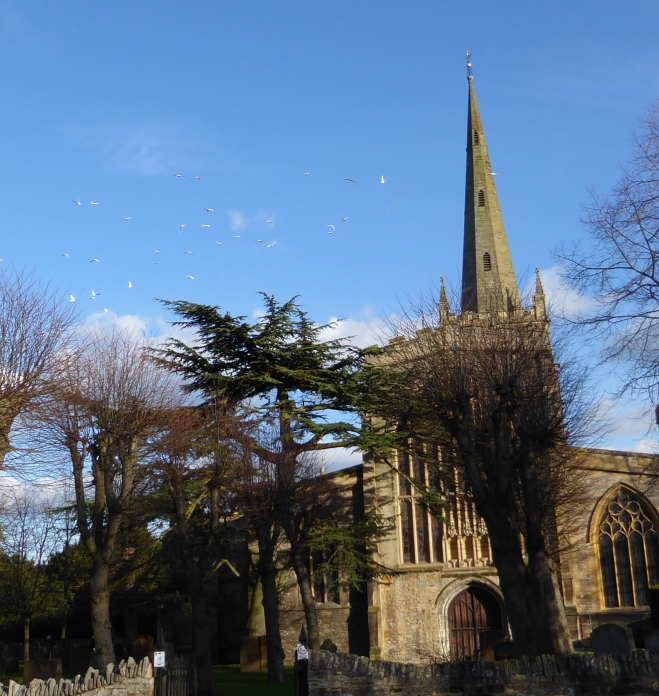
There were white doves circling the spire of Holy Trinity Church where Shakespeare is buried.  They sparkled in the winter sunshine reflecting the snowdrops below.

White Doves around steeple.JPG

At the entrance to the church I photographed the small Sanctuary Door and knocker.  This door is set into the massive 15th century doors.  I have passed through it countless times not realising its importance.  But I learned that anyone who held on to the ring in the knocker of the sanctuary door, would be let in and given protection for 37 days.  This was a custom started in Saxon times to protect poor people from the harsh penalties for crime, and even from lynch mobs.  It was upheld across the land and continued well through Shakespeare’s time until 1623.

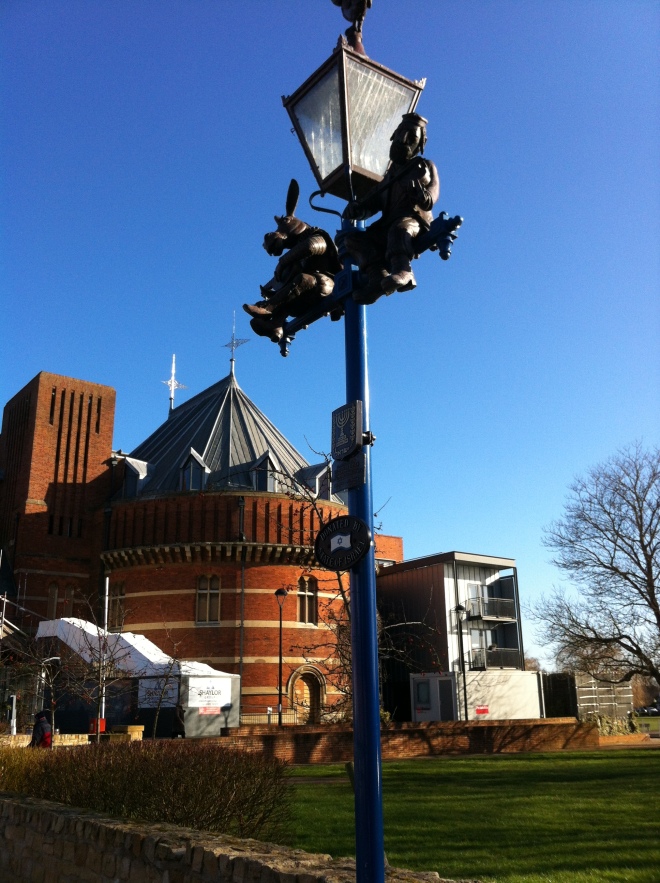
There was also a striking streetlamp outside our hotel, which I had not noticed before.  It was donated to the town by the Government of Israel.  There are wonderful decorative statues and lamps all around the town, mostly donated by ambassadors from countries where Shakespeare is revered.

Lamp donated by Israely Govt

 We stayed in the Arden Hotel, which is right opposite the Shakespeare Theatre.  In fact the building was previously owned by the theatre along with many buildings along the Waterside.  Naturally many famous people have passed through its doors over the years and inside there are some wonderful photographic portraits of famous actors in role. Put your cursor over the pictures to find the names and roles.

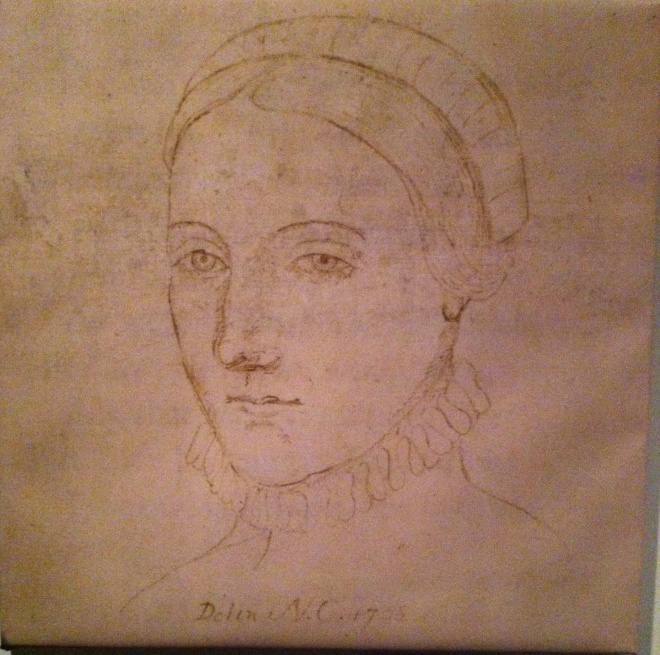
So my Valentine weekend was a great success, perfect weather in a beautiful season in my heart’s true home.  In the Shakespeare Centre I came across a sketch of Anne Hathaway, Shakespeare’s wife and mother of his children.  It is the only known likeness of Anne and she was very beautiful.  But she looks so sad.  I suddenly saw her as a real person whom Shakespeare must have loved and missed very much.

Sketch of Ann Hathaway from her lifetime.  The only one in existence

Enjoy some more of my photographs below.


The Art of Love

The Art of Love


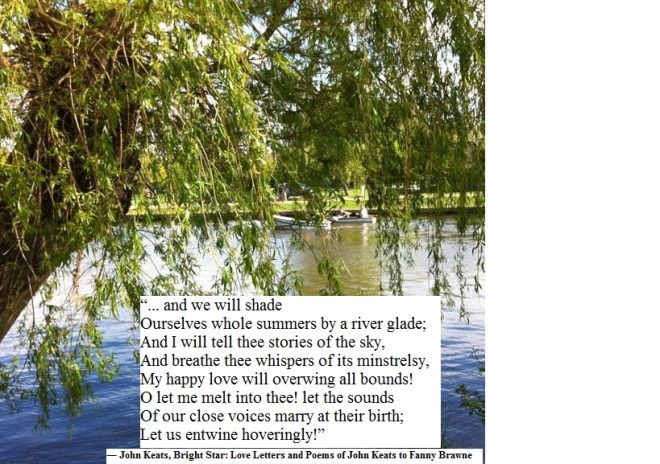
Keats quote on River Avon

As we will be celebrating Valentine’s Day this weekend, I thought I would post about my favourite Romantic poet.  Bless him, Keats died when he was only 25 years old but, in a truly inspired period of just three and a half years, he produced some 150 poems.  He said that love was his religion.  It is said that his best poetry was written in the last nine months of his life, when he was madly in love with Fanny Brawne, his neighbour in Hampstead where he had lived.

To follow the WPC theme for this week, which is “Life Imitates Art”, I have added an extract from one of his poems to a photo I took of the River Avon in Stratford, where I often took shade for whole summers on school holidays.

Keats (1795-1821) died in Rome when he was just twenty-five years old.  He had left his home in London’s Hampstead to seek a better climate, hoping this might cure him.  But he left behind some of the most exquisite and moving poetry ever written.

00000948Before he gave his life to poetry, he had qualified as a surgeon-apothecary at Guy’s Hospital in London.  But he had to give that up as his health was fading.  There is a beautiful bronze statue of him in the garden of the hospital, which was unveiled in 2007 by another wonderful poet, Andrew Motion.  I went to visit it with two of my dearest friends.
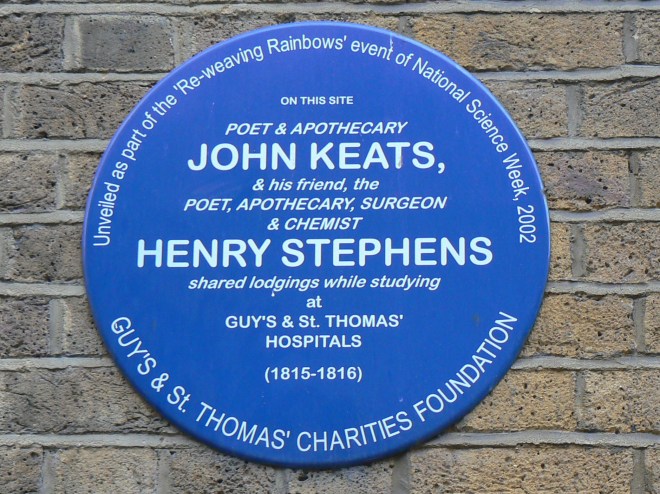
Keats famously said, “Poetry should be great and unobtrusive, a thing which enters into one’s soul, and does not startle it or amaze it with itself, but with its subject”.

He remains to this day one of the greatest of British poets.  Who knows what he could have achieved had he not died so young of TB. But what he left us, his beautiful poetry, will survive.  And, contrary to what he thought, he will never be forgotten.  In one of his later letters to Fanny he was obviously feeling despondent, as he wrote,

“If I should die,” said I to myself, “I have left no immortal work behind me-nothing to make my friends proud of my memory-that I have loved the principle of beauty in all things, and if I had had time I would have made myself remembered”

But of course he is remembered and he was truly loved by Fanny although her family disapproved.  She wore the ring he gave her until the day she died.

He knew that whatever sorrows, difficulties or even tragedies we face in this world, there will always be beauty in nature and art.  He wrote about this in his exquisite heroic poem, Endymion

A thing of beauty is a joy for ever: 
Its lovliness increases; it will never 
Pass into nothingness; but still will keep 
A bower quiet for us, and a sleep 
Full of sweet dreams, and health, and quiet breathing. 
Therefore, on every morrow, are we wreathing 
A flowery band to bind us to the earth, 
Spite of despondence, of the inhuman dearth 
Of noble natures, of the gloomy days, 
Of all the unhealthy and o’er-darkn’d ways 
Made for our searching: yes, in spite of all, 
Some shape of beauty moves away the pall 
From our dark spirits. Such the sun, the moon, 
Trees old and young, sprouting a shady boon 
For simple sheep; and such are daffodils 
With the green world they live in; and clear rills 
That for themselves a cooling covert make 
‘Gainst the hot season; the mid-forest brake, 
Rich with a sprinkling of fair musk-rose blooms: …

There was a film called “Bright Star”, starring Abbie Cornish as Fanny, and Ben Whishaw as John Keats, released in 2009.  I haven’t seen it so I can’t say whether it does him justice.  But if you would like to see a clip the link is here.

Below are some photos I took in London while visiting Keats’ statue, Enjoy x

Have a wonderful Valentine’s Day everyone x x x

P1080460

Henry Stephens invented Stephens Ink and Wood Stain which was used at the buildings of the Great Exhibition of 1851


Age of Kings

Age of Kings

Age of Kings Tibor Reich Red

Age of Kings Red

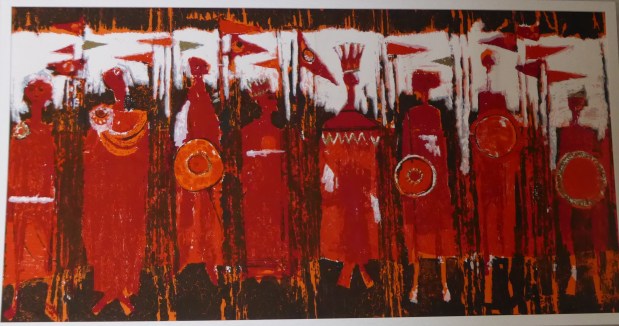
This is one of the most vibrant pieces of printed cotton I have ever seen.  It was made by Tibor Reich and I have one of the original panels, which were made for the opening of the Shakespeare Centre at Stratford on Avon in 1964.  The Centre was opened to commemorate the 400th anniversary of William Shakespeare’s birth.

Tibor Reich was born in Budapest, Hungary in 1916.  His father was a wealthy businessman who had a factory making decorative braids, ribbons and haberdashery for military ceremonial uniforms and folk costumes.  Here, the young Tibor learnt about textiles and colour.   As a child he visited the factory and was spellbound.  He once said, “Here I noticed cerise, kingfisher, very bright emeralds, flame reds and deep oranges…”

Following his parents’ divorce, Tibor went to live with his grandmother and immersed himself in drawing, painting and photography.  Until, in 1933 at the age of 17, Tibor went to Vienna to continue his studies.   Already artistic, his talents blossomed in the creative atmosphere of pre-war Vienna.  He studied textile design and technology as well as architecture and poster design.  But as Nazism spread, Tibor left Vienna for England, where he went to Leeds University to continue his studies in textile technology and woven design.

Tibor brought the vibrancy and colour of his homeland, of Hungarian folk music and peasant costumes, as well as the beauty of nature, to the UK in his work.  And, not long after leaving Leeds, he moved to Warwickshire and set up his own woven textile design business in Cliffords Mill using old hand looms that he repaired and renovated.

Being totally original, he quickly established a good reputation, and worked on the highest profile contracts.  In fact it is true to say he revolutionised textiles in post war Britain with his use of colour, pattern and texture.  By the 1950s Tibor’s textile weaving business was well established and he expanded into printed designs.  His projects included the Royal Yacht Britannia, Concorde, The Festival of Britain and the Shakespeare Memorial Theatre as it was then called.  Here he designed and created curtains, wall hangings and carpets each named after a Shakespearean character.

He also produced his own range of pottery called Tigo ware and designed a most unusual house for his family which was very innovative and modern.  I visited him here in the 60s as a teenager, with my mum who was in Stratford art circle and seemed to know everybody!   I was amazed by the huge onion shaped open fire which stood in the centre of the room and went right up through the house to the roof.  I had certainly never seen anything like it.  I visited again last week and took some photos.  I believe the house has been renovated and I didn’t see inside, but the garden with its earthen embankment is established now and the fir trees are huge, providing a very useful privacy screen.  Tibor did not like the idea of fences and walls, preferring natural boundaries.

In 1964 he helped to furnish the brand new Shakespeare Centre, which is in Henley Street adjoining Shakespeare’s birthplace, for its opening to mark the 400th anniversary of William Shakespeare’s birth.  And this is where our paths crossed.

I have written before about the 1964 celebrations, which were undoubtedly one of the highlights of my life.  I worked at the Shakespeare Centre and the sights and sounds produced there I will never forget.  Shakespeare’s plays on a loop, pomanders and dried petals creating the perfumes of the Tudor age, all brought Shakespeare to life.  Added to that was the music of the age and Tibor Reich’s exquisite carpets, curtains, textile panels and wall hangings, some of which are still there today.

The tapestries and wall hangings evoked so brilliantly the scenes from the plays I loved, especially the Age of Kings panel.  This material, showing the kings from Shakespeare’s plays, was produced as stage curtains.  Panels of it were created in several vibrant colours, red, gold, orange, blue etc.  I am lucky enough to have the original red version as a wall hanging.  It was designed by Pamela Kay and made by Tibor Reich in 1964.  I also have a detail from A Tournament and an original of “garrick Jubilee”.

Recently, a new gold curtain was put up in the historic Becket chapel at Holy Trinity Church.  The chapel is dedicated to the martyred Archbishop of Canterbury, Thomas Becket, who was assassinated in Canterbury Cathedral in 1170.

I went to see it last week.  The golden fabric was commissioned for the chapel by The Friends of Holy Trinity Church and comes from the Tibor archive of 20th century design stored in Stratford and in the Victoria and Albert Museum in London.

If you would like to see Tibor’s textile and pottery work for yourself there is a retrospective exhibition on from 29 January – August at the Whitworth Art Gallery, University of Manchester, Oxford Road, Manchester, M15 6ER.  www.whitworth.manchester.ac.uk

And you can even see a clip of Tibor Reich and see him at work here.

More of his work is on display at the Gordon Russell Design Museum in Broadway until 12 October, and at the V&A Museum in London.  The Tibor Reich family, son Alex and Grandson, Sam hold an archive too which they are currently using to relaunch the Tibor Ltd brand.  They are lucky enough to still live at Tibor House in Avenue Road, Stratford on Avon.  It is a beautiful tree lined road near the open countryside on the way to Warwick.

This year, 2016, marks the 400th anniversary of Shakespeare’s death.  I know that the whole town of Stratford on Avon is busy preparing for the massive celebrations in April.  I can’t wait to be there to join in the festivities and see what Stratford can do to match or better the celebrations of 1964.


Catching up

Reunited Arthur Beadle, Hugh Bradley and Me, 2015

I have never been to a reunion before but this gathering was one I could not miss.  It was to celebrate the 40 years that St Thomas More Primary School has been open.

Having worked there for 16 happy years, I was keen to meet up with old colleagues and past pupils.  I left in 2001 so I was also interested to see how much the building had changed to accommodate all the educational innovations that have taken place.

And change it had!  The entrance hall which used to be a small library, is now like a hotel lobby with a rather swish curved desk where the secretary works in an open plan office.  The hall and kitchen have not changed at all, but the classrooms were very different.  There seemed to be fewer desks and chairs for pupils and no large desk for the teacher.  But the biggest change for me was NO BLACKBOARD!  On the walls were white screens/boards, which presumable are linked to the bank of keyboards below.  No huge computers now either, just small tablets (of the electronic kind) for every child.  What a transition!

I was flooded with nostalgia at the memories of chalkdust, board rubbers and metre long board rulers, protractors etc.

In the corridor, there used to be a small special needs area for individuals or group who were struggling to keep up, or needed to be stretched.  Now, that area is used by language specialists to help the many children for whom English is not their first language.

Of course most of the old team who worked at the school still get together now and again for coffee mornings, walks and meals out.  But we don’t often get to see past pupils.  It was a revelation and a joy to see so many of them there.   Most of those who attended are now in their 30’s with careers and children of their own.  Without exception they all had many happy memories.

The highlight of the evening for me was being back together with the A team ~ The first Headteacher, Arthur Beadle, his deputy, Hugh Bradley, and myself, who made a great trio even if I say so myself. I followed Arthur to become the second Headteacher in the school.  Other highlights included seeing old photos on display, and being hugged by a tall handsome 36 year old man carrying his child.  He, who shall be nameless, apologized for being such a naughty boy when he was a pupil.  He remembered spending a lot of time outside the Head’s office door!  He now has his own business and is very successful so he must have learned something!


Victory


Oh my goodness I know I should be writing a learned and worthy post on the theme of remembrance for this week’s victory prompt, but I just have to diverge.  I beg your forgiveness for the poor quality of my photos but I was laughing so much as I took them.

This sequence took place on Tuesday morning as I looked after my adorable one year old granddaughter.   The lounge, hall and bedrooms were filled with toys for her to play with, but now that she can walk the kitchen is her favourite place.   For the kitchen is where my little dog hides in her bed when grandchildren appear.

There truly can be nothing more amusing than watching a one year old negotiate with a dachsund.  It was clear the poor dog had no chance of winning and eventually she had to give up her bed, which she did very reluctantly.  Then it was blankets out as soft toys and granddaughter moved in.

If there is such a thing as a saintly dog, my little dachsund truly is one!  She is so good natured and patient under severe provocation.


A fruitful season

A fruitful season

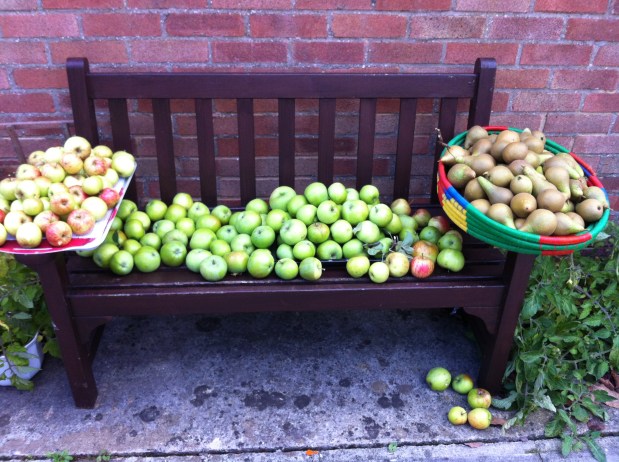
My apple and pear harvest 2015

My apple and pear harvest 2015

In the UK Autumn is well underway.  The trees have been turning all shades of gold, orange, amber and red for some time.  But now that the rain and wind has come, the leaves are blowing horizontally off their branches to cover the pavements, fields and gardens.

My precious Japanese maple tree, sheltered from the weather between the wall and the fence outside my window, is absolutely aflame with red leaves. While those at Westonbirt Arboretum are sensational as always.

But my fruit trees are now just skeletons of their former selves.  The apple trees look so ordinary and drab there is no hint that 2015 was the best apple season for 20 years or more!  We had perfect conditions for them due to the mild winter and warm spring.  Spring was followed by gentle rains then a gorgeous hot early summer.  This weather combination produced masses of blossom very early and with plenty of bees around to pollinate the seeds, an abundance of fruits developed.

In my garden the apple trees are trained in the ancient way, horizontally along wires beside a fence.  It’s called Espalier and makes picking the fruit very easy.  It also helps with pruning which I do quite drastically each year because the best fruit grows on the older branches.

I think these apple trees must be over 40 years old.  The thick trunks are gnarled and misshapen, but the fruit is fabulous.  One of the trees is a local early eating variety called Worcester Pearmain.  The apples are small, crisp and wonderfully juicy.   They taste sweet but not cloying, almost with a strawberry flavour.   I haven’t managed to store them well so I use them all up in desserts, cakes and picnic boxes.  The grandchildren love them and eat them straight from the tree.  When I have a glut of apples, like this year, I put a big basket outside on the garden wall with a sign saying ‘help yourself’.   It would grieve me if any were truly wasted, but of course there are always damaged windfalls.  The birds and squirrels love those and feast on them.

My other tree is a Bramley apple tree.  This is by far the best cooking apple around.  It has been grown commercially in the UK for over 200 years but probably a lot longer in orchards and country gardens.  The fruits grow really big, firm and juicy.  They are tart to taste but when cooked they have a sensational flavour.  I make lots of Dorset Apple Cakes, Blackberry and Apple Crumbles and Apple Charlotte.  For my Charlotte I just slice up the apples then drizzle them with lemon and lay them in a deep ovenproof dish.  I then melt some butter, and whizz up some breadcrumbs in my grinder.  I mix brown sugar into the breadcrumbs and maybe a bit of cinnamon or nutmeg.  Then I just sprinkle the breadcrumbs and sugar over the lemony apples, and drizzle them with melted butter (quite generously!)  I repeat these layers a couple of times and finish by sprinkling lemon rind and brown sugar on top of the last layer of breadcrumbs.   Pop this in the oven until it looks golden brown and the smell is mouth-watering.   Then eat it with loads of cream or custard or icecream.  That’s a real treat!

The apples that are left over, I cook down and freeze for apple pies or apple sauce, which will keep us healthy over the winter.  Enjoy the life cycle of my apple trees through my photos ~