Argentine Tango at the WI!

It was such an exciting evening at the last WI meeting.  There was passionate, fiery and exotic music, rare footage of filmed tango, a fascinating talk and beautiful dancing demonstrations.  Janet Earl and Adrian Barsby, who teach together but are not regular partners, did a double act chatting in a relaxed fashion and inviting members to ask questions or interrupt whenever they wished, rather than wait until the end.  The talk was so informative, explaining the background and history of the dance as well as describing the different types of tango.

They explained that Tango is a social partner dance which originated in South America.  In spite of its name, ‘Argentinian Tango’, Uruguay and Chile also lay claim to originating it. Argentine Tango should not be confused with ballroom tango which is a sanitised version of the dance developed in Europe in the 1920s and 1930s because the Argentine brand was considered a little too steamy.

Salon tango (the most social version) is a fully improvised dance, though it clearly follows rules which give it its appearance. The leader, who is usually the man, expresses himself by interpreting the music in his own steps and those which he invites the follower, usually the woman, to make. Historically, there is an element of “showing off” the woman by making her dance well. Their classes are generally based around this style of tango.  There is often a tragic story being danced out!

Another style of tango is called Canyengue, which has a slightly higher stepping characteristic (possibly due to its having been dance in the sawdust and blood on slaughterhouse floors).

Tango Fantasia is a show version of the dance which is more likely to be choreographed and includes aspects of jazz and ballet dancing.

Socially, dancers also dance Milonga, which is more uplifting and happy, and Vals (Waltz) which is more graceful. Tango is danced in bars of two beats each but phrased in two lots of two bars, giving a phrase of 8 beats. Milonga is also in bars of two beats each, but phrased two bars at a time. Vals is in bars of 3 beats (though usually fast enough to be in 1), where the first beat of each bar “corresponds to a whole beat in tango”.

Janet and Adrian explained the instrument used in tango traditionally is the Bandoneon which is rather like an accordion.   They played beautiful recordings of Tango music on the instrument.  They delighted us by showing a clip of Rudolph Valentino and Alice Terry dancing in “the Four Horsemen of the Apocalypse” in 1921.

They explained how Tango spread to USA and came to Europe in the 1920s, mentioning lots of very famous singers, dancers and musicians whose names I cannot spell ~ Carlos di Sarli, Asto Piazzolla among them!

Janet showed us her beautiful dance outfits and her exquisite shoes, which she buys in Argentina.  They finished by recommending several performances of Tango that members may wish to see locally:-

Tango at the Music Festival on 11th July, Tango, Tango at the Roses Theatre in October, Midnight Tango in Oxford and Bristol in July etc.

A fabulous night out!

Journaling my Journey number 2

Journaling my Journey

Some years ago when I was feeling very low, my daughter sent me a copy of The Artist’s Way by Julia Cameron.  I started writing ‘morning pages’ as Julia suggested.  It was just 3 pages of stream of consciousness words, whatever came into my head.  Sometimes, if words just would not come, I drew sketches.

I used to get up very early in the morning anyway as I was finding it difficult to sleep.  So before I listened to the radio, read the paper, did Sudoku, filled in a crossword, switched on my computer, or had any distraction or outside input I would write my morning pages.  I did this religiously (interesting word) every day for the weeks and months that followed.  I did not read the pages back and I did not show them to anyone.  In fact if I was really down I would wrap the pages round with Sellotape and hide them in a cupboard, figuratively locking away the pain that was revealing itself on the pages.

The Artist’s Way is of course a 12 week programme for creative discovery and/or recovery.  However, apart from the urge to draw little sketches alongside my pages I did not discover any hidden artistic talent during those 12 weeks!  Nevertheless, I continued writing my morning pages and taking myself off on ‘artist’s dates’ for another couple of years, and my depression lifted.

In Autumn 2011 I saw an advert for a course at the Isbourne Foundation on “The Artists’s Way”.  Knowing how much I had enjoyed following the book, I was intrigued and inspired to sign up, which I did.  There I met tutor Dr Lesley O’Neill and joined a small group of women whom I immediately felt connected to.  So I read the book again and inspired and encouraged by Lesley and the group, I discovered to my joy that I did have some creative talents.  Poetry popped up, Haiku hurtled out. I dabbled in drawing, played with Plasticene, discovered Zentangles, started writing stories, and carried my camera everywhere I went.  Now, I wrap my pages in pretty ribbon, not Sellotape, and I save them in a beautiful turquoise box with doves all over it.  I now live the Artist’s Way.  I am part of a small local community of creative and inspiring women and my life is transformed.  With them I am free to be myself and express myself, with no pretensions, no explanations and no alibis required.  There are never enough hours in the day for all I want to do.  I have several writing projects on the go including newsletters, travelogues, competition entries, children’s stories, my blog, and of course my morning pages.  But now I realise that they too are transformed into Journal entries.  I realised this after seeing a recommendation for the book “Life’s Companion, Journal Writing as Spiritual Practice” by Christina Baldwin on the New Hampshire Writer’s Group blog www.nhwn.wordpress.com that I follow .  I bought the book and look forward to continuing my journey of discovery ~ discovering myself!

Rapeseed field ripening in the Cotswolds

April 23rd 1964 ~ 400th Anniversary of the birth of William Shakespeare

William Shakespeare was born on April 23rd 1564 and died on 23rd April 1616.  1964 was the 400th anniversary of his birth and I was living in Stratford on Avon, which was certainly the most exciting place to be at that time for a theatre mad teenager.

The highlight of my acting career had been the part of Mole in Toad of Toad Hall at St Gabriel’s Convent in Carlisle.  Cardinal Heenan was the honoured guest in the audience.  My part was memorable as it involved a tea party at Toad Hall.  We had real cakes and biscuits.   I had never seen those pink and white marshmallows with a biscuit base and coconut all over the top.  I became so engrossed in examining and eating them that I forgot where I was and had to be prompted to continue my lines.  “Oh, you silly ass, Mole”, as rat would say.  But I think I got away with it.  The Cardinal singled me out for praise afterwards, impressed by the realism I portrayed!

I moved to Stratford from the north of England in 1960, the same year that Peter Hall founded the Royal Shakespeare Company (RSC) and became Artistic Director at the theatre.  Sadly the two events were not connected but our paths crossed over the next few years.  At that time he was married to Leslie Caron and they lived on the Warwick Road near St Gregory’s Church.   I was a teenager at the local girls’ grammar school, Shottery Manor, passionate about literature and especially Shakespeare.

In those days you could pay 4 shillings (20p) to stand at the back of the theatre in Stratford and watch the plays.  From 1960 to 64 when I left school I think I saw every production, often going to the matinee and the evening performances.  My all time favourite was King Lear in 1962 which I have never forgotten.  Paul Schofield played Lear and a young and gorgeous Diana Rigg played Cordelia.

In 1964 when I was doing my A Levels I watched the full history cycle; Richard 11, Henry 1V part 1 and 2, Edward 1V and Richard 111.  I became familiar with actors such as Roy Dotrice, Peggy Ashcroft, a very young John Hurt, and my hero David Warner.  All the girls at school had a crush on him as he was so 60’s with his gaunt look and flowing scarf.  We would hang out at the Dirty Duck pub by the river Avon, barefoot and with flowers in our hair, hoping the actors would pop in after the show, which they often did.  I was such a regular at theatre events that I somehow got to know Peter Hall and Leslie Caron.  I was asked to babysit once for the child of actor Tom Bell and his first wife when they were visiting the Halls.  Tom Bell had become very famous for his part in The L Shaped Room in which he played opposite Leslie Caron.  He and his wife were lovely and I was so sad to see that he died some time ago after a long and magnificent career.

1964 also saw the opening of the Shakespeare Centre where visitors could study every aspect of Shakespeare’s work.  I was privileged to work there part time while at school and full time in the summer after I left.  I loved it.  For the centenary year there was a special exhibition with all the sights and sounds and smells of Shakespearean Stratford.  As I remember it the plays were performed on a loop and the visitors could wander in and sit down to listen for as long as they wanted.  To me it was heaven.  I don’t think any exhibition since has bettered that experience for me.

Every year in Stratford there are celebrations for Shakespeare’s birthday but 1964 was spectacular.  There were flagpoles put up in the centre of the streets leading from the theatre to the Holy Trinity Church where the bard is buried.  Representatives from 115 countries of the world came to unfurl their flag at 11am.  This was followed by a procession of dignitaries, townspeople and pupils from the two Grammar Schools, King Edward V1 school for boys, which Shakespeare himself had attended, and Shottery Manor, the school for girls.  I was in that procession and will never forget it.  After the church service and laying of wreaths at the tomb in the presence of Prince Philip, there was a festival on the Bancroft Gardens.  Primary school children danced around maypoles and there was all the fun of the fair.  It was a glorious day.

I still consider King Lear to be the greatest play ever written, and William Shakespeare to be the greatest playwright.   It is almost 449 years  since he was born and the celebrations will  take place this weekend in Stratford.  But they could never match those of 1964.

http://www.britishpathe.com/video/shakespeares-400th-anniversary-1

Shakespeare’s 400th Anniversary

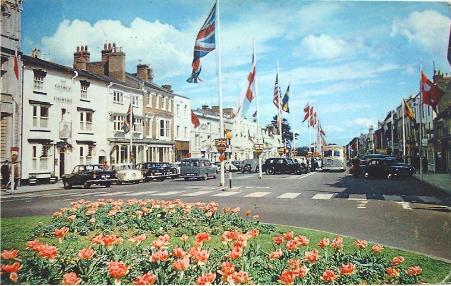
Photos show a portrait of William Shakespeare, A photograph of my old school Shottery Manor, The parade through the town on 23rd April 1964 and a view of Bridge Street from the roundabout at the top.

July 1964 Click this link to show a class photo of our school leaving day,