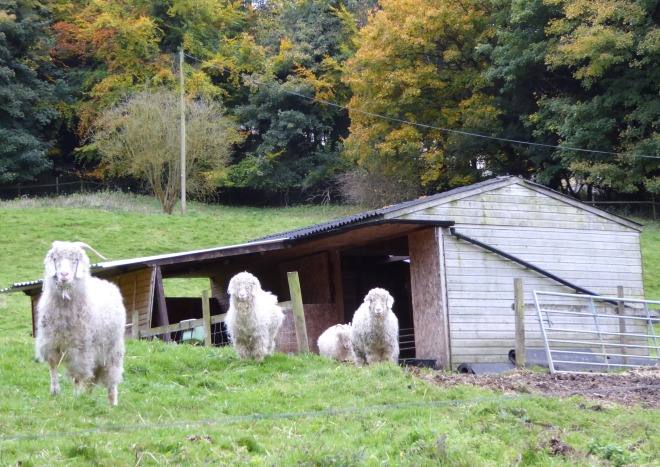
Cotswold Lions at Prinknash Abbey farm
‘In Europe the best wool is English and in England the best wool is Cotswold’
(12th century saying).
This week I am thinking about texture.
There are two types of texture, actual texture which you can feel or touch, and visual texture which uses marks to give the illusion of a textured surface. It fascinates me that the word texture originated from from the Latin textilis ~ woven, from texere ~ to weave and the 17th century word Textile has the same root. A textile is literally ‘that which has been woven’. So this weekend I set out to learn more about it.
There can’t be a more random selection of textures than stone, wool, water, grass and brass; however, there is a link! And it is at the heart of this beautiful area I live in called the Cotswolds.
The Cotswold land is ideal for sheep grazing and in medieval times the Abbeys and Monasteries kept huge flocks of the native breed, which was, and still is, known as the Cotswold Lion, because it has a long shaggy mane over its eyes. These are stocky animals that breed well and grow quickly. Their wool is so long, fine, white and soft that it was known as the ‘golden fleece’ ~ because of the wealth it created, not the colour.
From the earliest times the wool itself was traded, but by the middle ages whole cottage industries grew up to process the wool into cloth. The clothier and his family prepared the raw wool then gave it to his neighbours to be spun by the women and children. It was then woven by men in their homes. The weavers’ cottages had long, low windows in order to give maximum light to the looms. After processing the cloth was extremely dense and almost waterproof due to the nap, which was ideal for the military, huntsmen and landowners.
The merchants who traded in this fine cloth became extremely wealthy. They used their wealth to build wonderful houses out of the local Cotswold stone and to build and furnish exquisite churches in the market towns and villages, with stained glass, stone carvings and brasses.
Yes, the rolling fields, honey coloured stone cottages, ancient mills and beautiful churches that make up our landscape are all here because of sheep. The names of the villages such as Sheepscombe reflect the trade, and even our pubs and inns like the Fleece or the Ram are reminiscent of the wool trade.
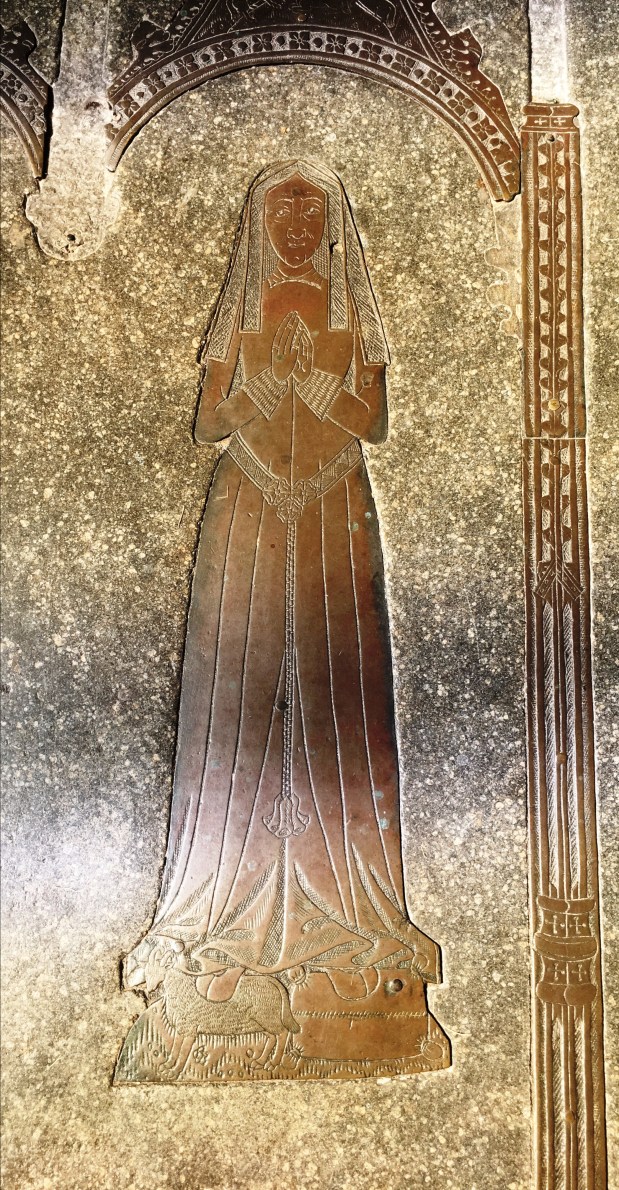
I visited the church of St. Peter and St. Paul at Northleach today. It is one of the largest and finest wool churches in England. There are some fascinating brasses in this church with images of the merchants with sacks of wool or sheep as their footrest. They date back to the 1400s. One or two of the brasses were particularly interesting as they showed that women could be wealthy merchants too. And, one particularly striking couple had their 15 children shown on the brass!
By the 16th century the industry was moving away from the small towns and villages to be nearer to the Stroud valley where the fast-flowing streams supplied the power to drive the fulling mills. In its heyday, there were around 200 mills in the Stroud valley and many of them are still standing today. They are converted for other industrial uses now or renovated into rather swish apartments.
I learned some fascinating facts today. Who knew that subsequent to the ‘Burial in Wool acts of 1667 and 1668’, all bodies had to be buried in wool unless they died of plague. This law was only repealed in 1814. It stated that,
“No corps should be buried in anything other than what is made of sheep’s wool only; or put into any coffin lined or faced with any material but sheep’s wool, on pain of forfeiture of £5.”
The old saying – “You can’t pull the wool over my eyes”, came from being buried in a shroud of wool, and meant that “I am not dead!”
You may know that there is a large wool-stuffed cushion or seat covered in red cloth in the House of Lords. This is called the Woolsack and is where the Lord Speaker sits during Parliamentary proceedings with the Mace on the woolsack behind him. It was introduced by King Edward III (1327-77) and originally stuffed with English wool as a reminder of England’s traditional source of wealth – the wool trade. There is also a larger woolsack where senior Judges sit during the State Opening of Parliament.
Here are some photos from Northleach where wealthy cloth merchant John Fortey paid for the church renovations

Detail from Altar Cloth at Northleach

Detail of John Fortey on stained glass window, gifting the church to God

Church of St Peter and St Paul in Northleach. To the right is the old mill

Mill stream that flows in front of the Northleach church to the mill

Beautifully carved tomb in the cemetery at Northleach

The Good Shepherd in stained glass at Northleach

Brass showing sheep and woolsack at his feet

Beautiful brass of merchant’s wife

Sheep and woolsack on brass plate in Northleach Church denotes a wool merchant

Beautiful couple in brass

Detail of brass showing woolsack and sheep

Northleach town sign showing it was granted an Annual Market Town Charter in 1227

Many street names reflect the importance of sheep to the towns and villages in the Cotswolds

Wool Church in Northleach
Here are some photos from Bibury where wool was treated on Rack isle

Cottages in Bibury opposite Rack Isle. It gets its name from the wooden racks that were used to stretch the cloth made at Arlington Mill. It is surrounded by the River Colne and Arlington Mill stream.

Arlington Row, Bibury where the cloth workers lived and worked
And lastly some photos from Nailsworth where the Fulling Mills refined the texture of the cloth.

Dunkirk Mill in Nailsworth, once the Fulling Mill at the heart of the wool industry in the area, now lovely apartments. Fulling hammers pounded the locally made woollen dampened cloth to shrink and soften it.

Dunkirk Woollen Mill in Nailsworth, now a museum with a working water wheel. The shrunken and softened cloth was stroked with TEAZLES grown in the Severn valley to raise the fibres and create the NAP.

The green wool is still made for top quality Snooker tables. The yellow wool is still made for Slazenger’s tennis balls which are used at Wimbledon.. The red cloth is used for military uniforms and hunting jackets.

Ian Mackintosh from Stroudwater Textile Trust demonstrating the water-powered machinery at Dunkirk Mill

Huge wooden waterwheel driven by the Nailsworth Brook, which provided the power for the machinery

Military Jacket
And lastly, to the pub, The Fleece at Bretforton!

The FLEECE INN at Bretforton. many pubs reflect the importance of the wool trade in their names.

Rear of the FLEECE INN at Bretforton

Rear of The Fleece Inn at Bretforton, once home to wool trade
I could write so much more, but if you are interested I can recommend these very knowledgeable and interesting websites:
http://www.cotswoldjourneys.com/cotswolds-guide/the-cotswolds-wool-trade/
http://stroud-textile.org.uk/history/background-to-the-local-wool-industry/




 Heavenhappens